Unit 5: Poetry II — form, Structure, and Syntax
Introduction to Structural Analysis
In Unit 2 (Poetry I), the focus was on identifying elements like imagery and basic figurative language. Unit 5: Poetry II shifts the focus to Structure—how a poem is built.
In AP English Literature, understanding structure is arguably the most crucial skill for achieving a high score on the Poetry FRQ (Question 1). The arrangement of the parts ensures the meaning of the whole; poets use line breaks, stanza forms, and syntax to control the pacing and evolution of an idea.
The Core Principle
Form $\neq$ Container. Do not think of form as a box the poet pours words into. Think of form as an active force that shapes the argument, emotion, and tension of the poem.
Rhythm, Meter, and Sound Structure
Before analyzing specific forms, you must understand the building blocks of poetic rhythm.
Scansion and Meter
Scansion is the process of analyzing a poem's rhythm by marking the stressed ($/$) and unstressed ($u$) syllables.
- Foot: The basic unit of measurement in a line of poetry.
- Meter: The recurring pattern of sounds.
| Foot Name | Notation | Rhythm Feel | Example |
|---|---|---|---|
| Iamb | $u$ $/$ | Rising (heartbeat) | "to day" |
| Trochee | $/$ $u$ | Falling (pressing) | "dai ly" |
| Spondee | $/$ $/$ | Heavy/Slowing | "true blue" |
| Anapest | $u$ $u$ $/$ | Galloping | "intercept" |
Iambic Pentameter
The most common meter in English traditional poetry (especially Shakespeare/Milton).
- Definition: A line consisting of five iambs (10 syllables total, alternating unstressed/stressed).
- Effect: It mimics natural formal speech and the human heartbeat. When the rhythm breaks (e.g., a Trochaic inversion at the start of a line), it highlights a sudden change in tone or action.
Closed Structure (Fixed Forms)
Closed structure (or fixed form) poetry follows specific, pre-existing rules regarding rhyme, meter, and line count. Understanding why a poet chooses a rigid constraint is key to analysis.
The Sonnet
The sonnet is a 14-line lyric poem, predominantly in iambic pentameter. It is the most frequent closed form appearing on the AP exam. There are two major variations:

1. The English (Shakespearean) Sonnet
- Structure: Three Quatrains (4 lines each) + One Couplet (2 lines).
- Rhyme Scheme:
ABAB CDCD EFEF GG - Logic/Argument:
- Quatrains 1-3: Present a problem, a question, or three variations of a theme.
- The Couplet: Provides a quick resolution, a summary, or a witty twist at the end.
- Tip: Always look at the couplet to find the "thesis" or the final emotional stance of the speaker.
2. The Italian (Petrarchan) Sonnet
- Structure: One Octave (8 lines) + One Sestet (6 lines).
- Rhyme Scheme:
ABBAABBA(Octave) +CDECDEor similar variation (Sestet). - Logic/Argument:
- The Octave: Sets up a difficult situation, poses a philosophical question, or describes a desire.
- The Volta (Turn): Occurs at line 9. The pivotal shift in tone or argument.
- The Sestet: Responds to the octave (answers the question, offers solace, or accepts the reality).
The Villanelle
A highly repetitive, cyclical form often used to express obsession or circular reasoning.
- Structure: 19 lines. Five tercets (3-line stanzas) followed by a quatrain.
- Refrains: Two specific lines are repeated throughout the poem.
- Example: Dylan Thomas's "Do not go gentle into that good night."
The Rhymed Couplet
While often part of a sonnet, rhymed couplets can stand alone or form the basis of a long poem (Heroic Couplets).
- Definition: Two lines of equal length that rhyme.
- Effect: They create a sense of completion, order, and authority. In 18th-century satire (e.g., Alexander Pope), they represent varying degrees of wit and logic.
Impact of Closed Structure
Why use closed forms?
- Tension: The struggle between the wild emotion (content) and the strict cage (form) creates energy.
- Authority: Strict meter implies the speaker is in control of their emotions.
- Convention: Using a sonnet instantly places the poet in conversation with Shakespeare, Petrarch, and Donne, allowing for subversion (e.g., a sonnet about hate rather than love).
Open Structure (Free Verse)
Open structure, or Free Verse, has no set meter or rhyme scheme. However, "Free" does not mean "random." These poets use Syntax (sentence structure) and Lineation to control meaning.
Free Verse Mechanics
Instead of meter, free verse relies on:
- Cadence: The natural rise and fall of speech.
- Visual Arrangement: How the poem looks on the page (e.g., E.E. Cummings).
- Repetition: Utilizing anaphora or parallelism to create rhythm without strict meter.
Prose Poetry
A hybrid form that looks like a paragraph of prose but acts like a poem.
- Characteristics: No line breaks; relies on intense imagery, sound devices, and compact emotional density.
- Effect: It blurs the line between narrative and lyric, often creating a surreal or dreamlike quality distinct from standard poetry.
Syntax and Lineation
In Unit 5, you must analyze how the lines end and how sentences flow across them. This is the "grammar" of poetry.
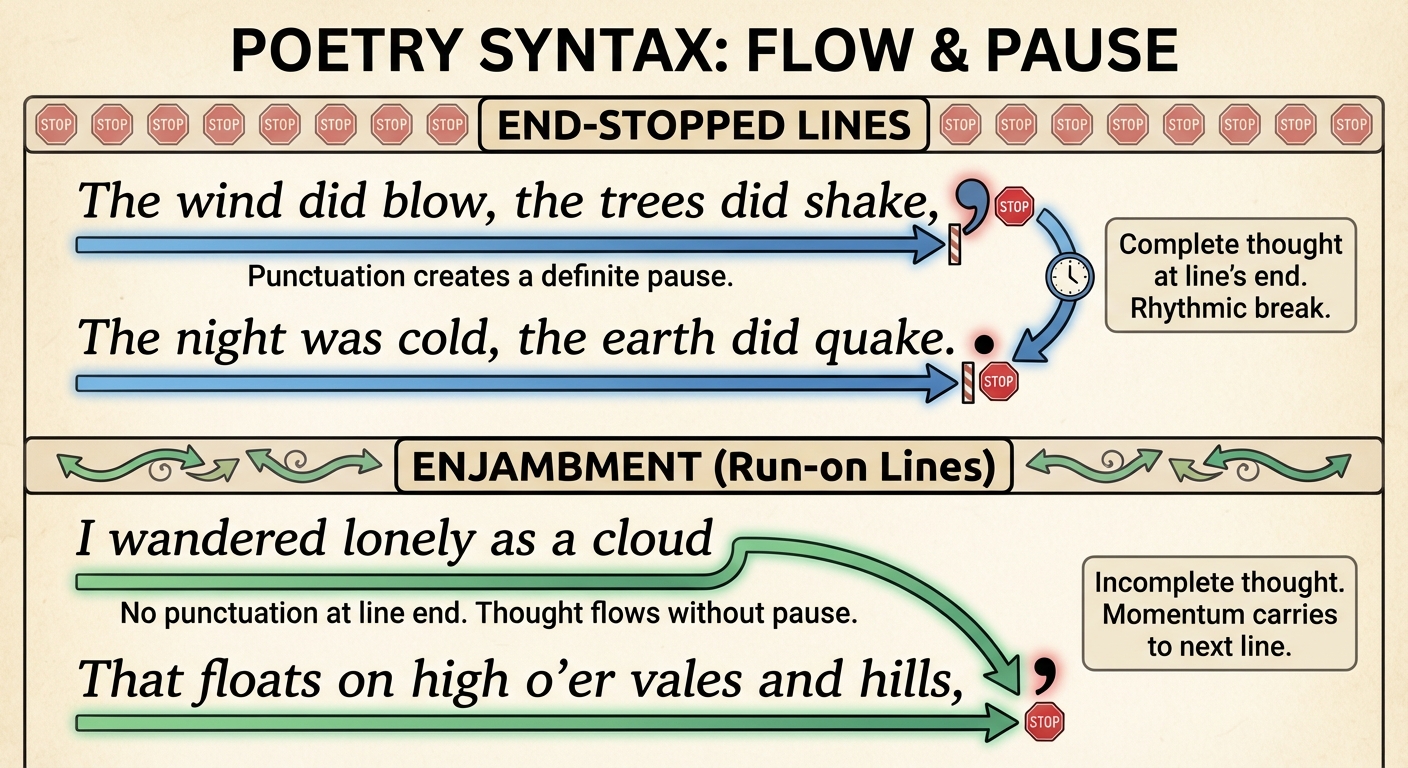
Enjambment vs. End-Stopped Lines
- End-Stopped Line: A line of poetry that ends with a grammatical pause (punctuation like a period, comma, or semi-colon).
- Effect: Creates a sense of stability, order, and distinct, separate thoughts.
- Enjambment (Run-on Line): A sentence continues without a pause beyond the end of a line, couplet, or stanza.
- Effect: Increases speed/pacing; creates ambiguity (double meanings); mimics the flow of rushing thoughts or uncontrollable emotion.
Caesura
- Definition: A strong pause within a line of poetry, usually marked by punctuation ( $||$ ).
- Effect: Breaking the rhythm in the middle of a line can indicate a fractured thought, a shock, or a dual perspective.
The Shift (Volta) and Contrast
STR-1.V: Stanza breaks often mark a shift in tone or thought.
Identifying the shift is the single most useful strategy for analyzing a poem. A poem rarely means the same thing at the end as it does at the beginning.
Identifying Signals of a Shift
- Transitions: Words like But, Yet, However, Although, And then.
- Punctuation: Dashes, colons, or stanza breaks.
- Change in Form: Moving from strict meter to free verse (or vice versa).
- Change in Time/Tense: Moving from "Then" (past) to "Now" (present).
Contrast
Poetry often functions through the arrangement of opposites. Look for contrasts in:
- Scale: Large (cosmic) vs. Small (domestic).
- Tone: Cynical vs. Hopeful.
- Imagery: Light vs. Dark; Natural vs. Mechanical.
Figurative Language in Structure
While Unit 2 introduced these terms, Unit 5 asks how they function structurally to support the poem's argument.
Extended Metaphor (Conceit)
- Definition: A metaphor that spans an entire poem or a significant section of it, rather than just a single line.
- Application: In Metaphysical poetry (e.g., John Donne), poets use a "conceit"—an elaborate, intellectually complex comparison (e.g., comparing two lovers to the legs of a drafting compass).
- Analysis Question: How does the vehicle (the image used) change or evolve as the poem progresses?
Allusion
- Definition: A brief, indirect reference to a person, place, thing, or idea of historical, cultural, literary, or political significance.
- Structural Purpose: It economizes language. By shouting out specific myths (like Icarus) or biblical stories (like the Garden of Eden), the poet imports a massive backstory without having to retell it.
Personification
- Definition: Attributing human characteristics to non-human entities.
- Structural nuance: Watch for apostrophe—a sub-type of personification where the speaker addresses an absent person or an abstract concept (e.g., "Death, be not proud"). This creates an immediate dramatic situation.
Hyperbole and Understatement
- Hyperbole: Exaggeration for emphasis. Crucial for satire and love poetry.
- Understatement (Meiosis/Litotes): Presenting something as less significant than it is.
- Example: Describing a fatal wound as "a scratch."
- Effect: Often creates irony or highlights the stoicism of the speaker.
Common Mistakes to Avoid
1. "Form Shopping"
- Mistake: Identifying the form (e.g., "This is a sonnet") and stopping there.
- Correction: You must explain why it matters. "The rigid constraints of the sonnet mirror the speaker's feeling of being trapped by social expectations."
2. Ignoring the Syntax
- Mistake: Reading a poem line-by-line and stopping at the end of the line regardless of punctuation.
- Correction: Read to the punctuation. Analyze enjambment. Does the line break create a double meaning?
3. Missing the Shift
- Mistake: Analyzing the tone of the first stanza and assuming it applies to the whole poem.
- Correction: Assume the poem is a dynamic argument. Look for the volta. How does the ending complicate the beginning?
4. Confusing "Free Verse" with "No Structure"
- Mistake: Saying a free verse poem has "no structure."
- Correction: Use terms like "open form." Discuss line lengths, stanza groupings, or visual layout.