Comprehensive Guide to Advanced Trigonometry
In AP Precalculus Unit 3, we move beyond basic sine and cosine waves to explore their reciprocals, solve complex equations, and understand the strict rules governing inverse functions. This section connects the algebraic manipulation of identities with the graphical analysis of functions.
The Reciprocal Functions: Secant, Cosecant, and Cotangent
Before diving into equations, we must define the three reciprocal trigonometric functions. These functions are derived by taking the likelihood of the primary functions (, , ).
Definitions and Domains
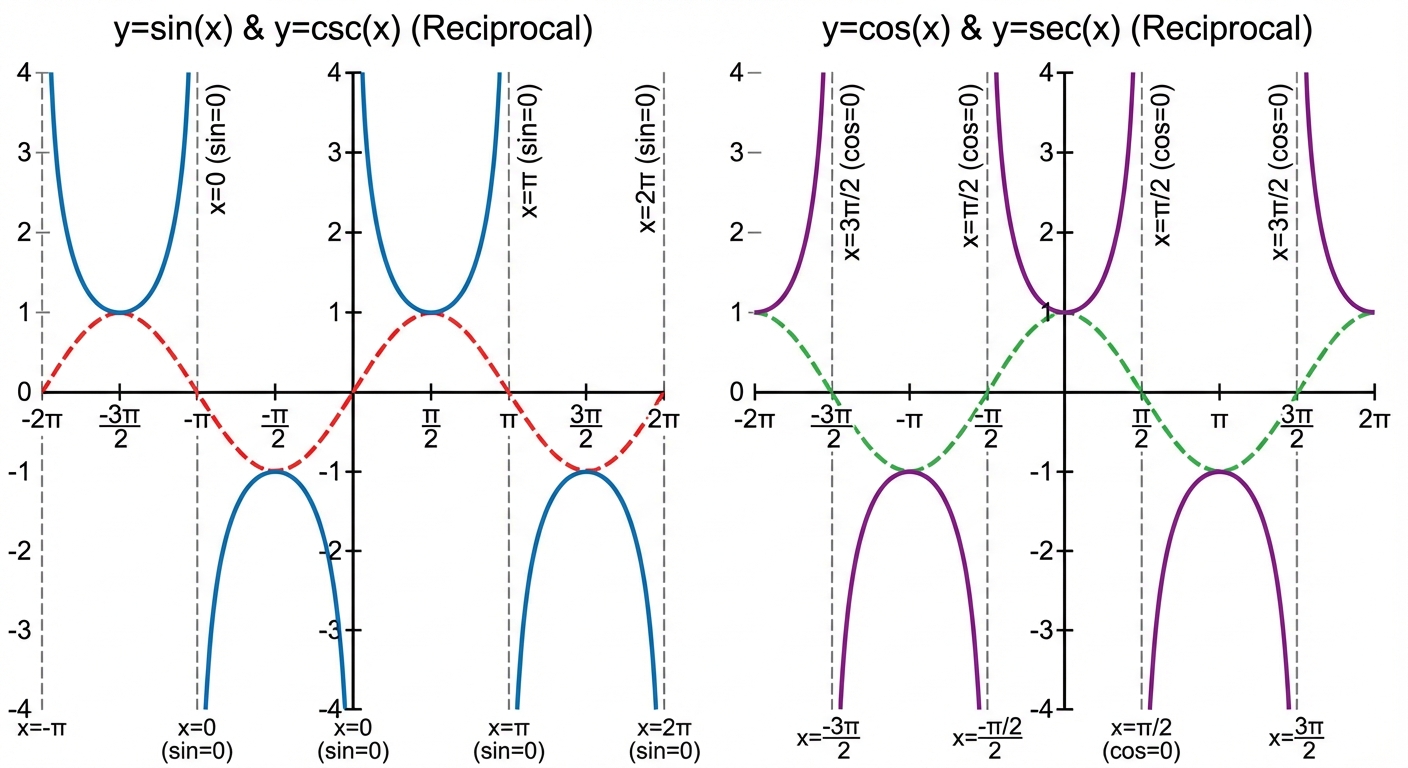
These functions are undefined whenever their denominator is zero. This results in graphical Vertical Asymptotes.
| Function | Definition | Undefined When… | Vertical Asymptotes At | Domain |
|---|---|---|---|---|
| Cosecant | ||||
| Secant | ||||
| Cotangent |
(Note: represents any integer)
Graphical Behavior
The graphs of reciprocal functions are intimately related to their counterparts.
- The "Hill and Valley" Rule: Where has a maximum peak (hill) of 1, has a local minimum (valley) of 1. Where is very small (near zero), explodes toward infinity.
- Asymptotes: The x-intercepts of the original function become the vertical asymptotes of the reciprocal function.
Inverse Trigonometric Functions
While standard trig functions input an angle and output a ratio (coordinate), Inverse Trigonometric Functions do the reverse: they input a ratio and output an angle.
However, trigonometric functions are periodic (they repeat forever), meaning they fail the Horizontal Line Test. To define an inverse function that is actually a function (one input gives exactly one output), we must restrict the domain of the original function.
Principal Values and Range Restrictions
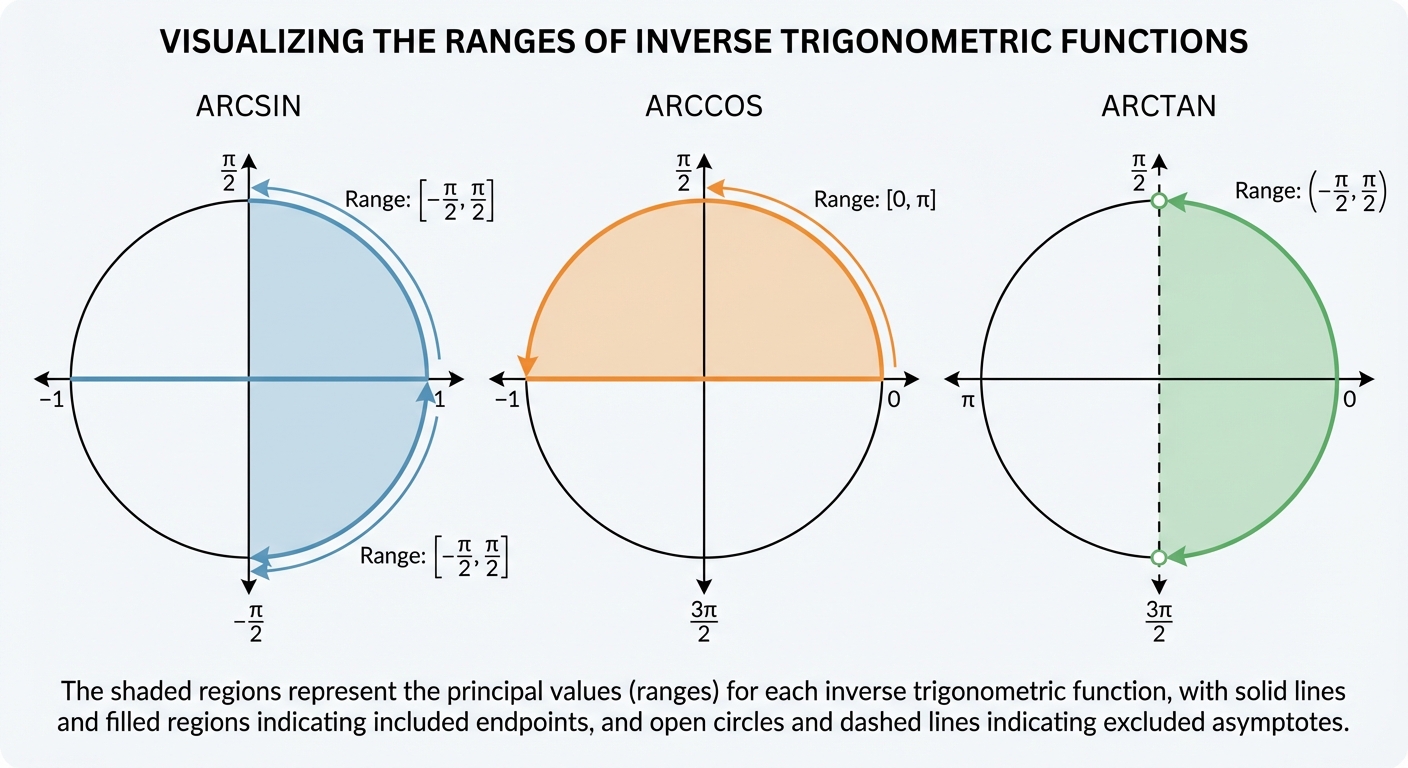
These restricted ranges are known as Principal Values. You must memorize these intervals.
Inverse Sine ( or )
- Input Domain:
- Output Range:
- Where: Quadrants I and IV. (Note: Quadrant IV angles must be negative, e.g., , not ).
Inverse Cosine ( or )
- Input Domain:
- Output Range:
- Where: Quadrants I and II.
Inverse Tangent ( or )
- Input Domain:
- Output Range:
- Where: Quadrants I and IV. (Note the parentheses; asymptotes exist at the endpoints).
Worked Example: Evaluating Inverses
Problem: Evaluate .
Step 1: Identify the question.
We are looking for an angle such that .
Step 2: Check the restrictions.
The range of Arccos is , which covers Quadrants I and II. Since the input value () is negative, our angle must be in Quadrant II.
Step 3: Determine the reference angle.
We know that . The reference angle is .
Step 4: Find the angle in QII.
.
Answer:
Trigonometric Identities and Equivalent Representations
In AP Precalculus, you must be able to recognize when different expressions represent the same function. This often involves using identities to simplify expressions or solve equations.
The Pythagorean Identities
These are derived from the equation of the unit circle . The primary identity is crucial; the other two are derived by dividing the primary identity by or .
Primary:
Tangent/Secant:
Cotangent/Cosecant:
Symmetry and Periodicity Identities
Understanding symmetry helps reduce negative inputs:
- Even Functions (symmetric about y-axis): and
- Odd Functions (symmetric about origin): and
Co-Function and Shift Identities
A sine wave and a cosine wave are identical, just shifted by . This is a major concept in Equivalent Representations.
If you are asked to rewrite a sine function as a cosine function during an exam, determine the horizontal shift using the period and quarter-points definition.
Solving Trigonometric Equations
Solving trig equations combines algebraic techniques (factoring, substitution) with unit circle knowledge.
Strategy for Solutions
- Isolate the Trig Function: Use algebra to get or by itself.
- Use Identities: If the equation mixes functions (e.g., has both squares and singular terms), use Pythagorean identities to convert to a single trig type.
- Find the Reference Angle: Use inverse operations.
- Apply Interval or General Solution:
- Interval (e.g., ): List specific angles.
- General: Add (for sin/cos/sec/csc) or (for tan/cot).
Worked Problem: Quadratic Form
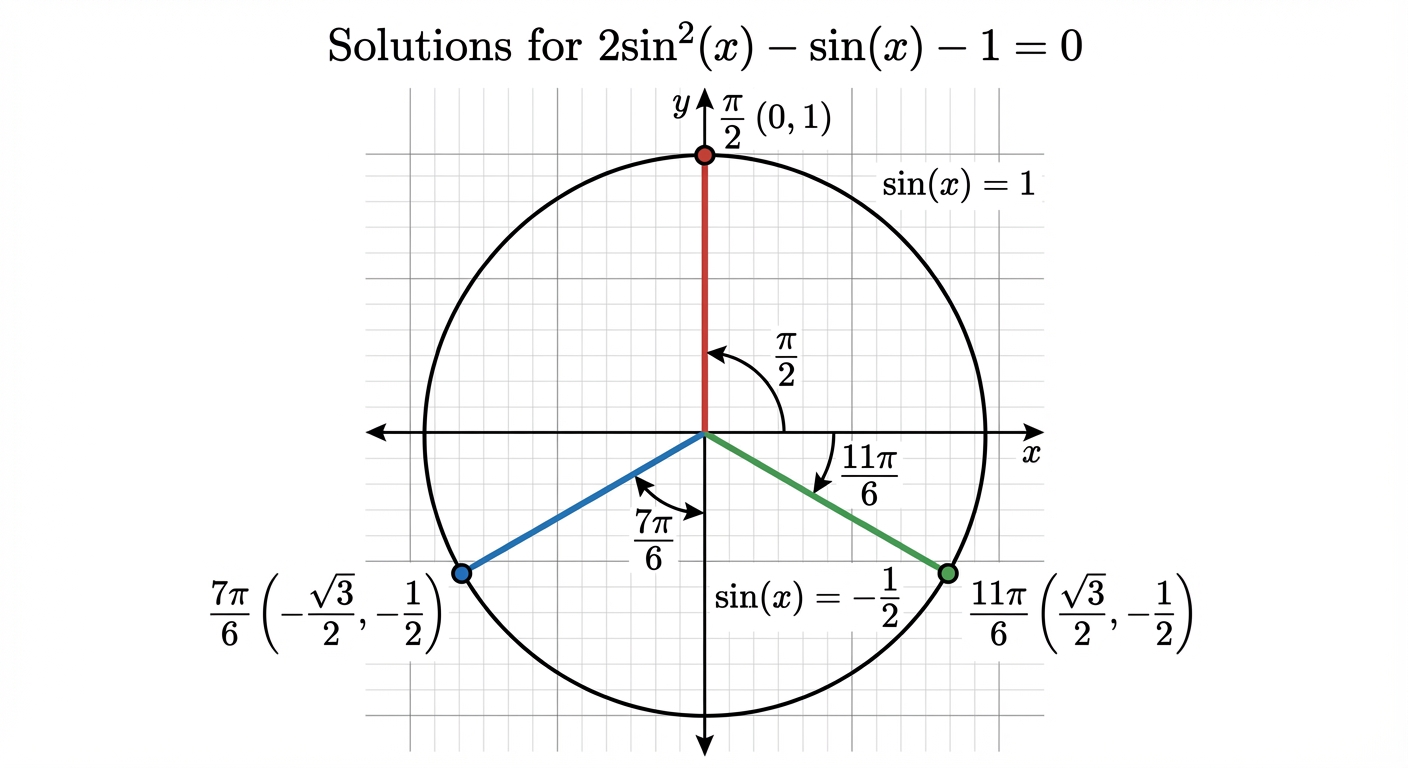
Solve: on the interval .
Factor: Treat this like .
Set each factor to zero:
Find Angles:
- For :
- For : The reference angle is . Sine is negative in QIII and QIV.
- QIII:
- QIV:
Solution Set:
Common Mistakes & Pitfalls
- Confusing Inverse Notation: Remember that means Arcsine, NOT (which is Cosecant). The exponent denotes function inversion, not a reciprocal exponent.
- Inverse Range Errors: Getting the quadrant wrong for inverse functions is the most common error.
- . It is . The range for Arcsine is strictly .
- Dividing by a Function: Never divide both sides of an equation by a trig function (e.g., dividing by ). You will lose solutions where . Always factor instead.
- Ignoring the Period: When applying a general solution, remember that Tangent and Cotangent repeat every , usually resulting in , whereas Sine and Cosine usually require .