ACT Math Strategic Review: Mastering Number & Quantity
Real and Complex Number Systems
Understanding the hierarchy of numbers is fundamental to the ACT. You must be able to classify numbers and manipulate them within the complex number system.
Classifying Real Numbers
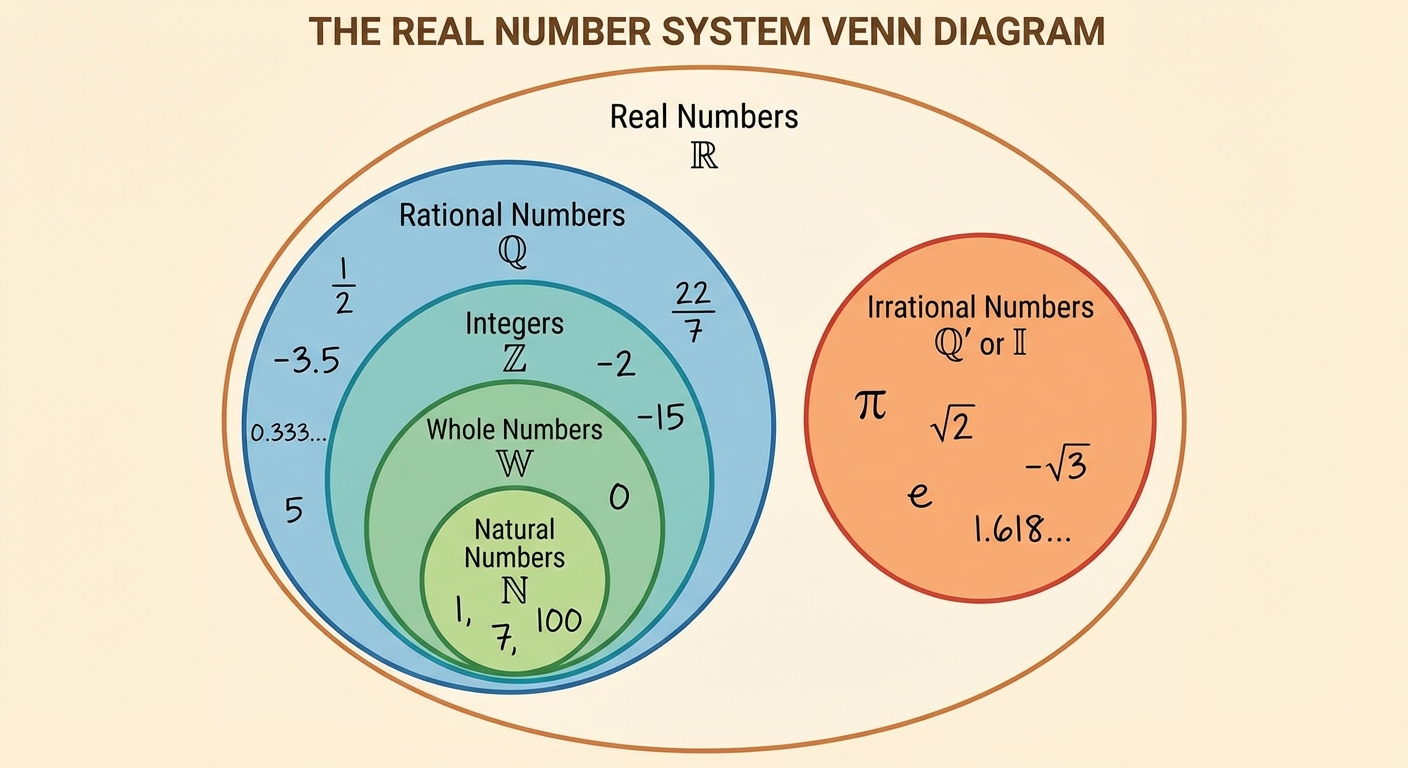
Real numbers constitute the vast majority of numbers you will encounter. They are organized into nested sets:
- Natural Numbers: Counting numbers ${1, 2, 3, \dots}$
- Whole Numbers: Natural numbers plus zero ${0, 1, 2, \dots}$
- Integers: Whole numbers and their negatives ${\dots, -2, -1, 0, 1, 2, \dots}$
- Rational Numbers: Any number that can be expressed as a fraction $\frac{p}{q}$ where $p$ and $q$ are integers and $q \neq 0$. This includes terminating and repeating decimals.
- Irrational Numbers: Numbers that cannot be written as a simple fraction. Their decimal expansions are non-terminating and non-repeating (e.g., $\pi$, $\sqrt{2}$).
The Complex Number System
The sophisticated cousin of the real number system involves the imaginary unit, denoted as $i$.
Definition of $i$:
A Complex Number is written in the standard form $a + bi$, where:
- $a$ is the real part.
- $b$ is the imaginary part.
Powers of $i$
The powers of $i$ follow a repeating cycle of 4. This is a frequent ACT target.
- $i^1 = i$
- $i^2 = -1$
- $i^3 = -i$
- $i^4 = 1$
Tip: To find $i^n$, divide $n$ by 4 and look at the remainder ($R$).
- $R=1 \rightarrow i$
- $R=2 \rightarrow -1$
- $R=3 \rightarrow -i$
- $R=0 \rightarrow 1$
Operations with Complex Numbers
- Addition/Subtraction: Combine real parts with real parts, and imaginary parts with imaginary parts.
- Multiplication: Use FOIL (First, Outer, Inner, Last). Crucial Step: Whenever you see $i^2$, replace it immediately with $-1$.
- Conjugates: The complex conjugate of $a + bi$ is $a - bi$. When you multiply conjugates, the result is always a real number ($a^2 + b^2$).
Integer and Rational Exponents
This section tests your ability to manipulate powers and roots. Fluency here is critical for speed.
Laws of Exponents
| Rule Name | Formula | Example | Condition |
|---|---|---|---|
| Product Rule | $x^a \cdot x^b = x^{a+b}$ | $x^2 \cdot x^3 = x^5$ | Same base needed |
| Quotient Rule | $\frac{x^a}{x^b} = x^{a-b}$ | $\frac{x^5}{x^2} = x^3$ | Same base needed |
| Power Rule | $(x^a)^b = x^{a \cdot b}$ | $(x^2)^3 = x^6$ | |
| Negative Powers | $x^{-a} = \frac{1}{x^a}$ | $2^{-3} = \frac{1}{8}$ | $x \neq 0$ |
| Zero Exponent | $x^0 = 1$ | $195^0 = 1$ | $x \neq 0$ |
Rational Exponents and Radicals
A rational (fractional) exponent represents a root.
The Golden Rule for Rational Exponents:
- The numerator ($m$) is the power.
- The denominator ($n$) is the root.
Worked Example:
Simplify given expression: $16^{-\frac{3}{4}}$
- Handle the negative sign first: $\frac{1}{16^{3/4}}$
- Interpret the fraction $\frac{3}{4}$: Fourth root of 16, cubed.
- Calculate the root: $\sqrt[4]{16} = 2$
- Apply the power: $2^3 = 8$
- Final Answer: $\frac{1}{8}$
Vectors
On the ACT, vectors are quantities describing both magnitude (size) and direction. They are rarely treated with deep university-level physics; instead, focus on geometric interpretation and component arithmetic.
Notation and Component Form
A vector $v$ starting at the origin $(0,0)$ and ending at point $(a,b)$ is written as:
Key Concepts
Magnitude (Norm): The length of the vector. This is simply the distance formula (Pythagorean Theorem).
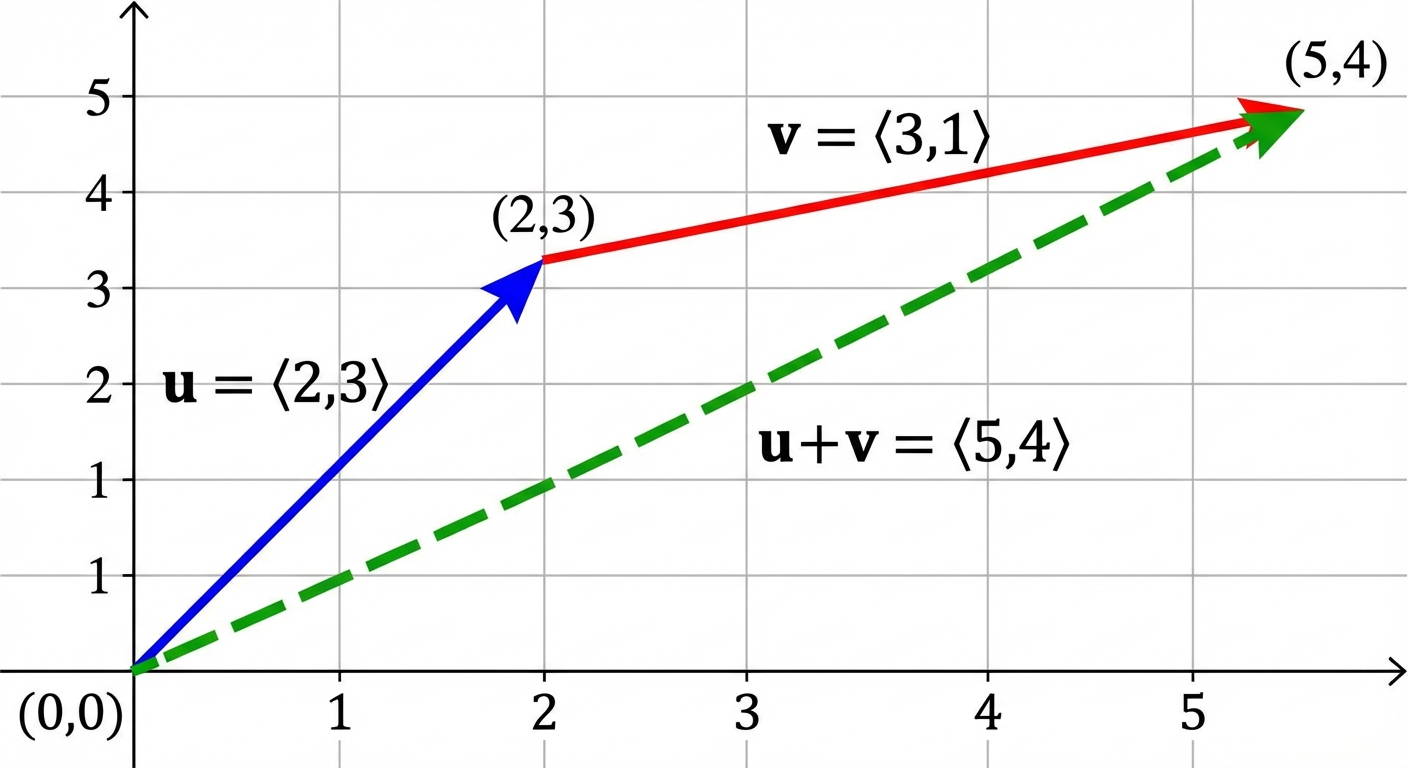
Vector Addition:
- Algebraic: Add corresponding components. If $u = \langle 1, 2 \rangle$ and $v = \langle 3, 4 \rangle$, then $u+v = \langle 4, 6 \rangle$.
- Geometric (Tip-to-Tail): Place the tail of vector $v$ at the tip (arrowhead) of vector $u$. The result is the vector from the start of $u$ to the end of $v$.
- Scalar Multiplication: Multiplying a vector by a real number $k$ scales its length. If $k$ is negative, it reverses the direction.
Matrices and Matrix Operations
A Matrix is a rectangular array of numbers arranged in rows and columns. Dimensions are vital.
Dimensions ($R \times C$)
Always write dimensions as Rows $\times$ Columns.
- Memory Aid: Think RC Cola (Rows first, Columns second).
- A matrix with 2 rows and 3 columns is a $2 \times 3$ matrix.
Basic Operations
Addition/Subtraction:
- You can only add or subtract matrices with identical dimensions.
- Add corresponding elements (top-left adds with top-left, etc.).
Scalar Multiplication:
- Distribute the scalar number to every single element inside the matrix.
Matrix Multiplication
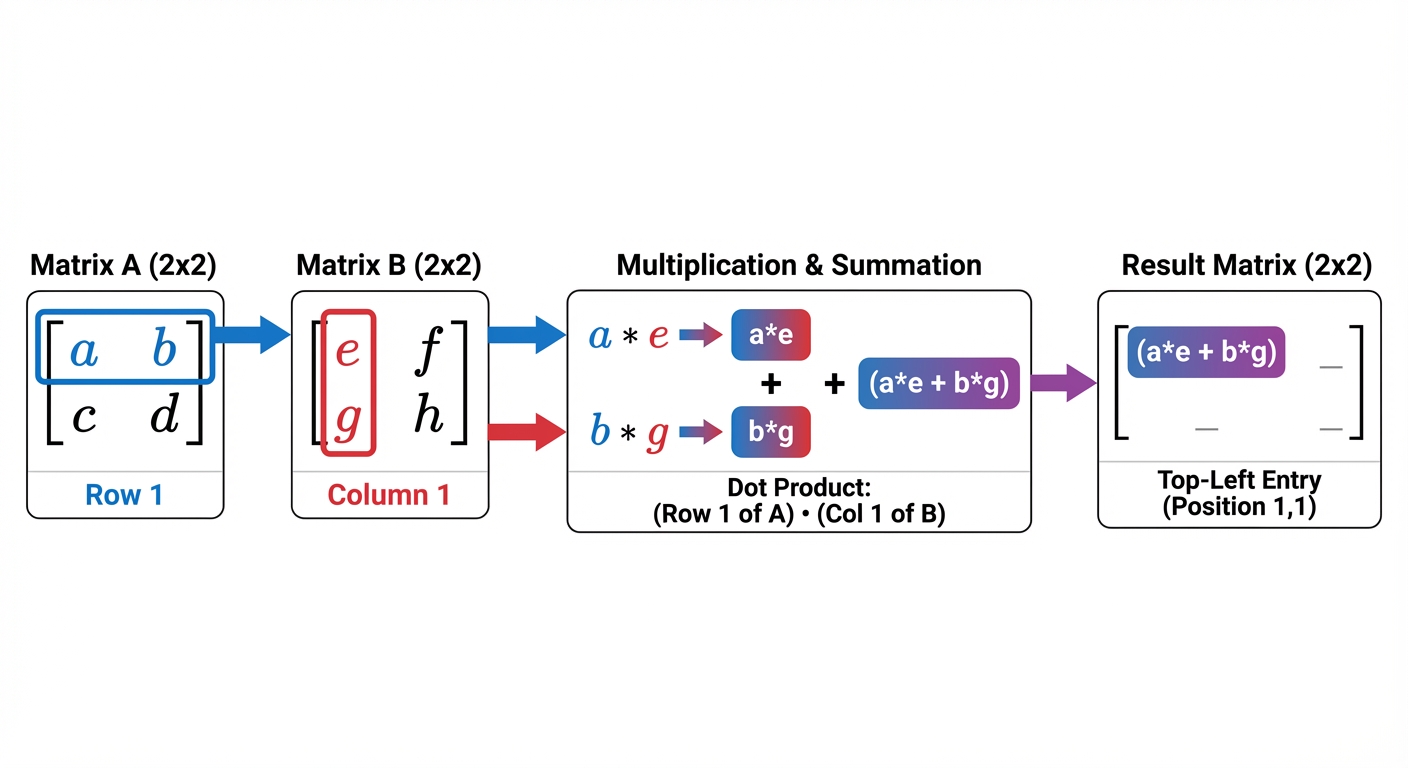
This is the most common pitfall. To multiply Matrix $A$ and Matrix $B$ ($AB$):
The Condition: The number of COLUMNS in A must equal the number of ROWS in B.
- The inner numbers must match.
- The outer numbers determine the dimensions of the result.
The Process: Multiply the Row of the first matrix by the Column of the second matrix, summing the products.
Determinants
Occasionally, the ACT asks for the "determinant" of a $2 \times 2$ matrix. This value tells us about the scaling factor of the matrix transformation.
For matrix $A = \begin{bmatrix} a & b \ c & d \end{bmatrix}$, the determinant is:
Common Mistakes & Pitfalls
Distributing Exponents Incorrectly:
- Wrong: $(a + b)^2 = a^2 + b^2$
- Right: $(a+b)^2 = (a+b)(a+b) = a^2 + 2ab + b^2$
- Why: Exponents do not distribute over addition.
Order of Matrix Multiplication:
- Matrix multiplication is not commutative. $A \times B$ usually does NOT equal $B \times A$. Always check dimensions first.
The Negative vs. Fractional Exponent Confusion:
- Students often flip the number for a fractional exponent instead of taking the root.
- $8^{-2}$ flips the number ($\frac{1}{64}$). $8^{1/3}$ takes the root ($2$). They are distinct operations.
Forgetting $i^2 = -1$:
- When multiplying complex numbers, you will almost always end up with an $i^2$ term. If you leave it as $i^2$, your answer is incomplete. Always simplify it to $-1$.