Comprehensive Guide to Advanced Harmony and Melodic Devices
Unit 6: Harmony and Voice Leading III
Embellishing Tones (Non-Chord Tones)
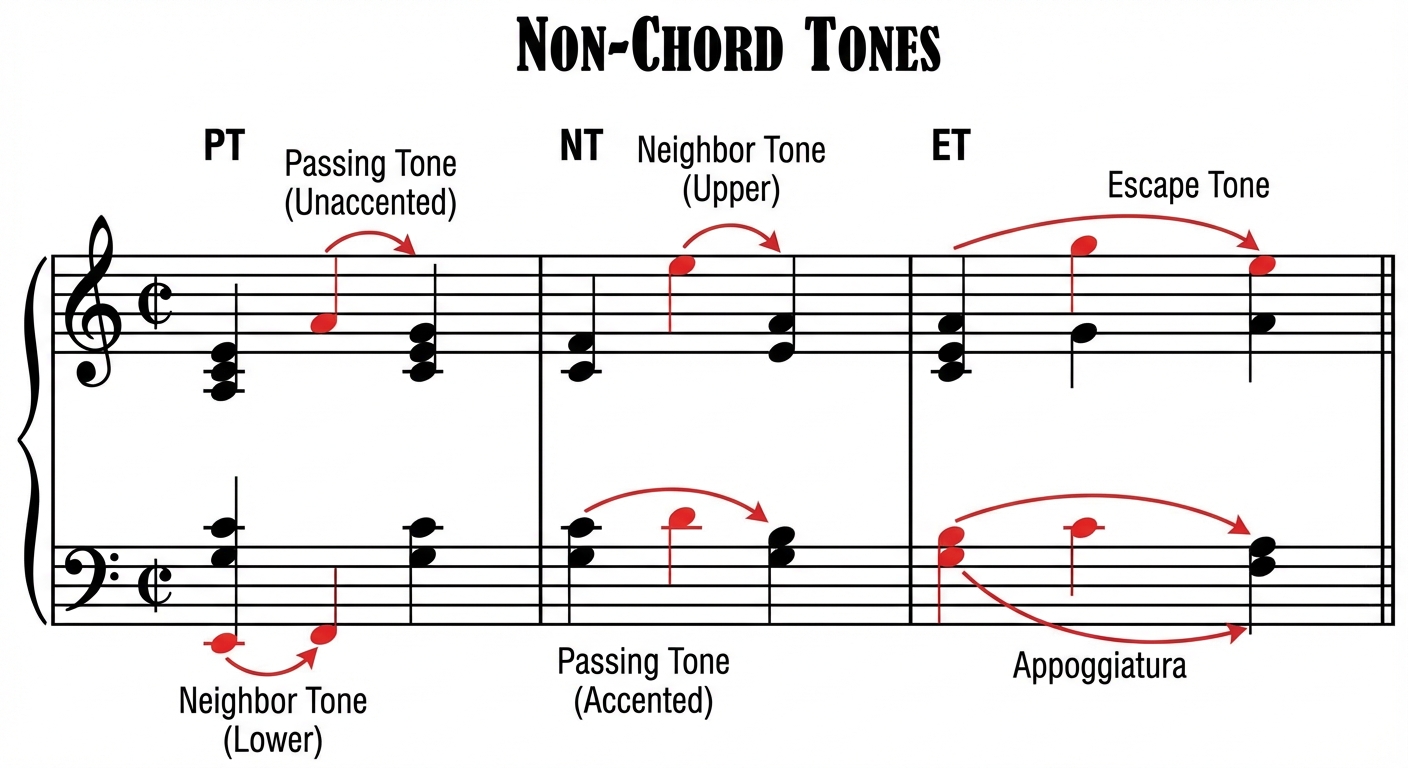
In AP Music Theory, understanding Non-Chord Tones (NCTs)—also called embellishing tones—is crucial for both melodic analysis and part-writing. These are notes that do not belong to the chord sounding at that moment. They are categorized by how they are approached (Preparation) and how they are resolved (Resolution).
Classification by Melodic Motion
We classify NCTs based on three movements:
- Preparation: The note before the NCT.
- The NCT itself: The dissonant/embellishing moment.
- Resolution: The note following the NCT.
| NCT Name | Approach | Resolution | Accent Status |
|---|---|---|---|
| Passing Tone (PT) | Step | Step (Same Direction) | Unaccented (mostly) |
| Neighbor Tone (NT) | Step | Step (Opposite Direction) | Unaccented |
| Suspension (SUS) | Same Tone | Step Down | Accented |
| Retardation (RET) | Same Tone | Step Up | Accented |
| Appoggiatura (APP) | Leap | Step (Opposite Direction) | Accented |
| Escape Tone (ET) | Step | Leap (Opposite Direction) | Unaccented |
| Anticipation (ANT) | Step/Leap | Same Tone | Unaccented |
| Pedal Point (PED) | Common Tone | Common Tone (Harmonies change) | N/A |
Stepwise Embellishments
Passing Tones (PT)
Fills the space between two chord tones a third apart.
- Unaccented PT: Occurs on the weak part of the beat (between chords).
- Accented PT: Occurs on the strong beat (on the chord change), creating a sharper dissonance.
- Chromatic PT: Fills the space of a major second with a half-step motion (e.g., C $\rightarrow$ C# $\rightarrow$ D).
Neighbor Tones (NT)
Moves away from a chord tone and returns to it.
- Upper Neighbor: Moves up a step, then down (e.g., C $\rightarrow$ D $\rightarrow$ C).
- Lower Neighbor: Moves down a step, then up (e.g., C $\rightarrow$ B $\rightarrow$ C).
- Double Neighbor (Neighbor Group): Combines an escape tone and appoggiatura figure (e.g., C $\rightarrow$ D $\rightarrow$ B $\rightarrow$ C) circling the main note.
Leaping Embellishments
Appoggiatura (APP)
A dramatic, expressive embellishment.
- Definition: Approached by leap and resolved by step (usually in the opposite direction).
- Characteristics: Almost always accented (falls on the beat). It leans into the resolution note.
Escape Tone (ET) (Echappée)
The reverse of the appoggiatura.
- Definition: Approached by step and resolved by leap.
- Characteristics: Usually unaccented. It "escapes" the harmony briefly before jumping to a chord tone.
Rhythmic/Suspended Embellishments
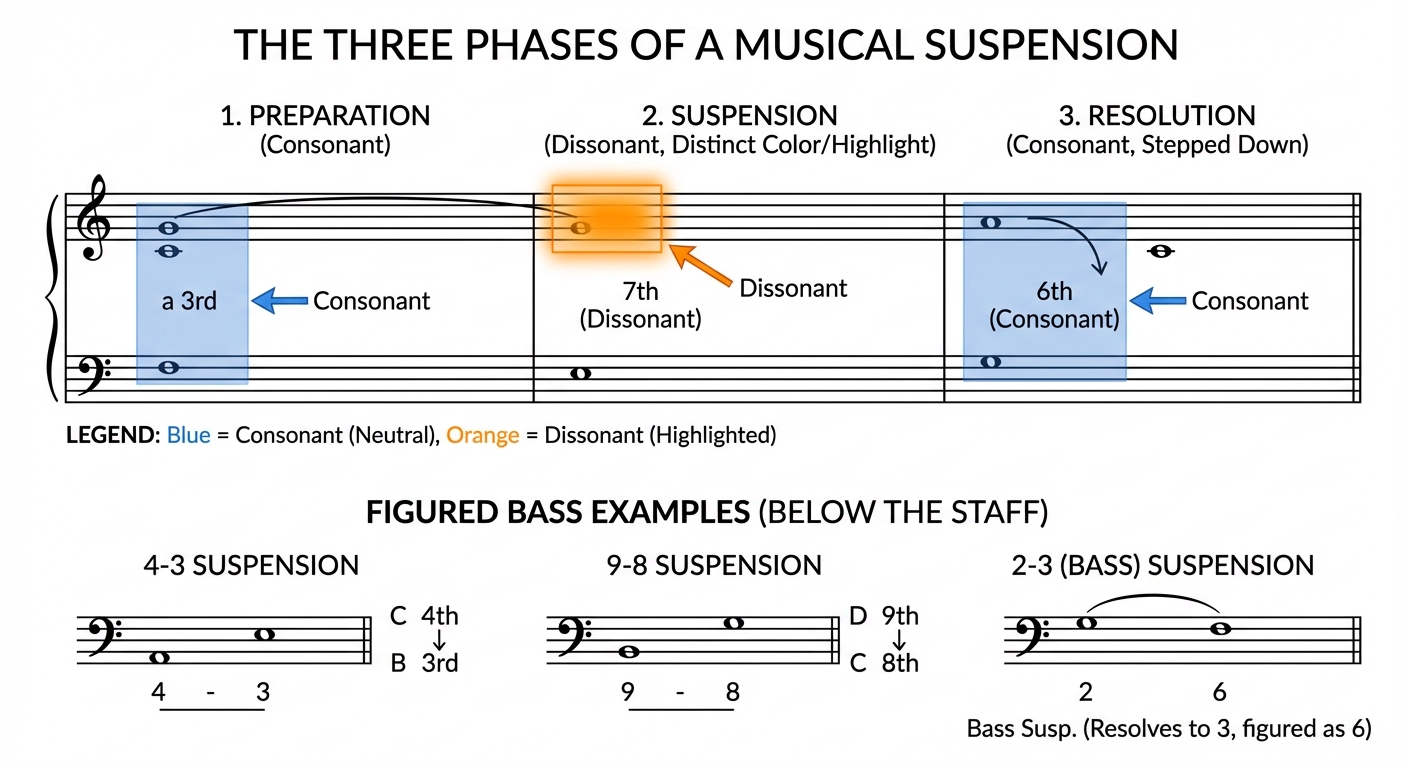
Suspensions (SUS)
A varying of rhythm where a note from the previous chord is held over into a new chord where it obscures the harmony before resolving downward.
The Three Phases of a Suspension:
- Preparation: The tone is a chord tone in the previous beat.
- Suspension: The harmony changes, but the tone is sustained (or rearticulated), creating a dissonance.
- Resolution: The tone resolves down by step to a chord tone.
Numerical Names:
Suspensions are named by the intervals formed between the Bass and the Suspended Voice followed by the Resolution.
- 4-3 Suspension: Common in upper voices. The 4th resolves to the 3rd.
- 9-8 Suspension: Common in upper voices. The 9th (compound 2nd) resolves to the octave.
- 7-6 Suspension: Common in moving lines. The 7th resolves to the 6th.
- 2-3 Suspension: The Bass Suspension. The bass holds a note that forms a 2nd with an upper voice, then resolves down, turning the interval into a 3rd.
Retardation (RET)
Similar to a suspension, but it resolves upward by step.
- Example: In a V-I cadence, the leading tone (7) might be held over into the I chord before resolving up to tonic (1).
Anticipation (ANT)
A note played before the chord to which it belongs arrives.
- It creates a momentary clash with the current chord but matches the immediately following chord.
- Common at cadences (e.g., the soprano sings the final tonic note just before the rest of the band plays the final chord).
Pedal Point
A sustained or repeated note (usually in the bass) that sounds against changing harmonies.
- Even if the pedal note becomes dissonant against a passing chord, it eventually becomes consonant again.
Motives and Motivic Transformation
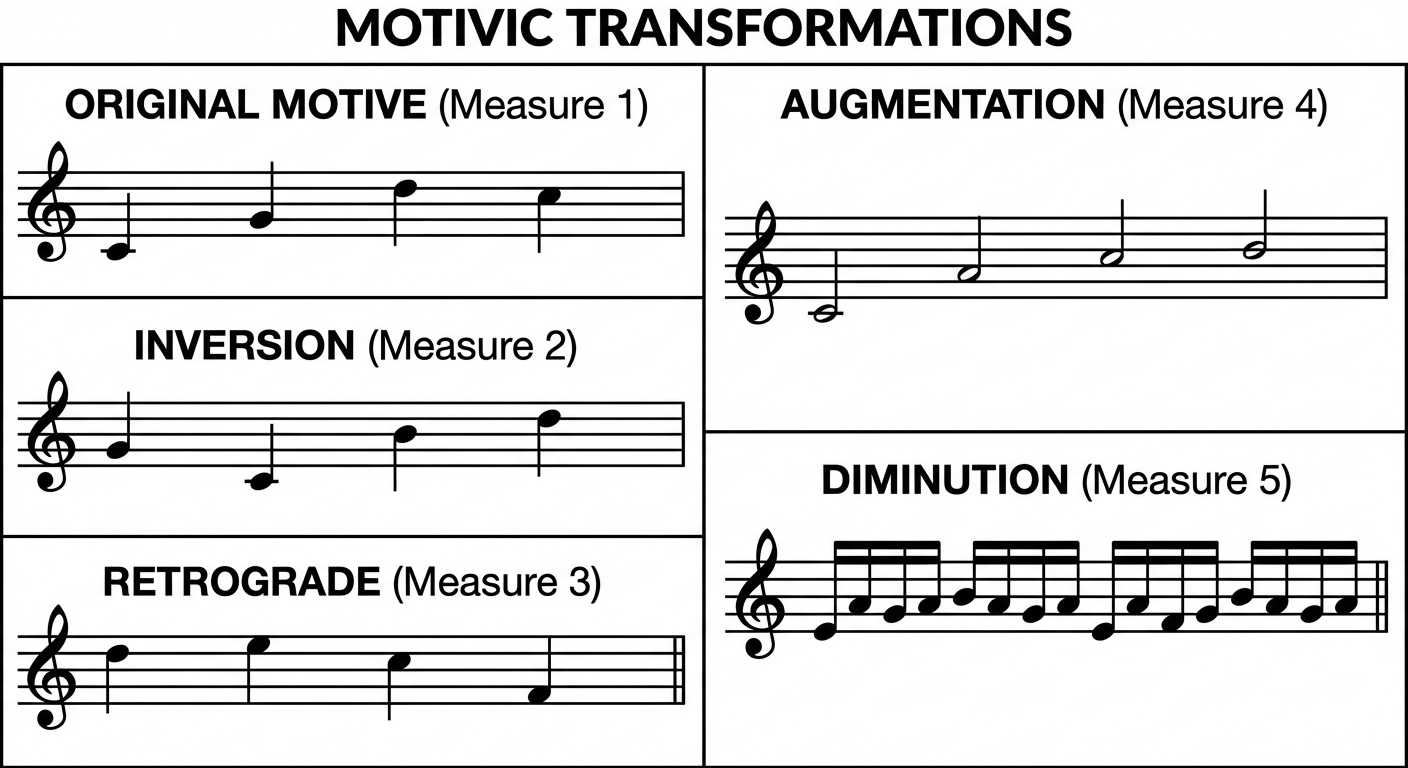
A Motive is a short musical idea (melodic, rhythmic, or harmonic) that serves as a building block for a composition.
Transformation Techniques
Composers develop motives to maintain unity while creating variety. You must be able to identify these transformations visually and aurally.
- Repetition: Repeating the motive exactly at the same pitch level.
- Transposition: Repeating the motive at a different pitch level.
- Inversion: Flipping the melodic contour upside down. (If the original went up a 3rd, the inversion goes down a 3rd).
- Retrograde: Playing the motive backwards (last note to first note).
- Retrograde Inversion: Playing the inverted motive backwards.
- Augmentation: Stretching the rhythmic values (usually doubling the length, e.g., quarter notes become half notes).
- Diminution: Shrinking the rhythmic values (usually halving the length, e.g., quarter notes become eighth notes).
- Extension/Fragmentation: Adding material to the motive or cutting it off early.
Melodic and Harmonic Sequences
A Sequence is the immediate restatement of a melodic or harmonic pattern at a different pitch level (transposed).
Melodic Sequences
- Diatonic Sequence: The pattern is transposed within the key signature. Interval qualities (Major/Minor) may change to stay in key.
- Chromatic Sequence: The pattern is transposed exactly, requiring accidentals outside the key.
Harmonic Sequences
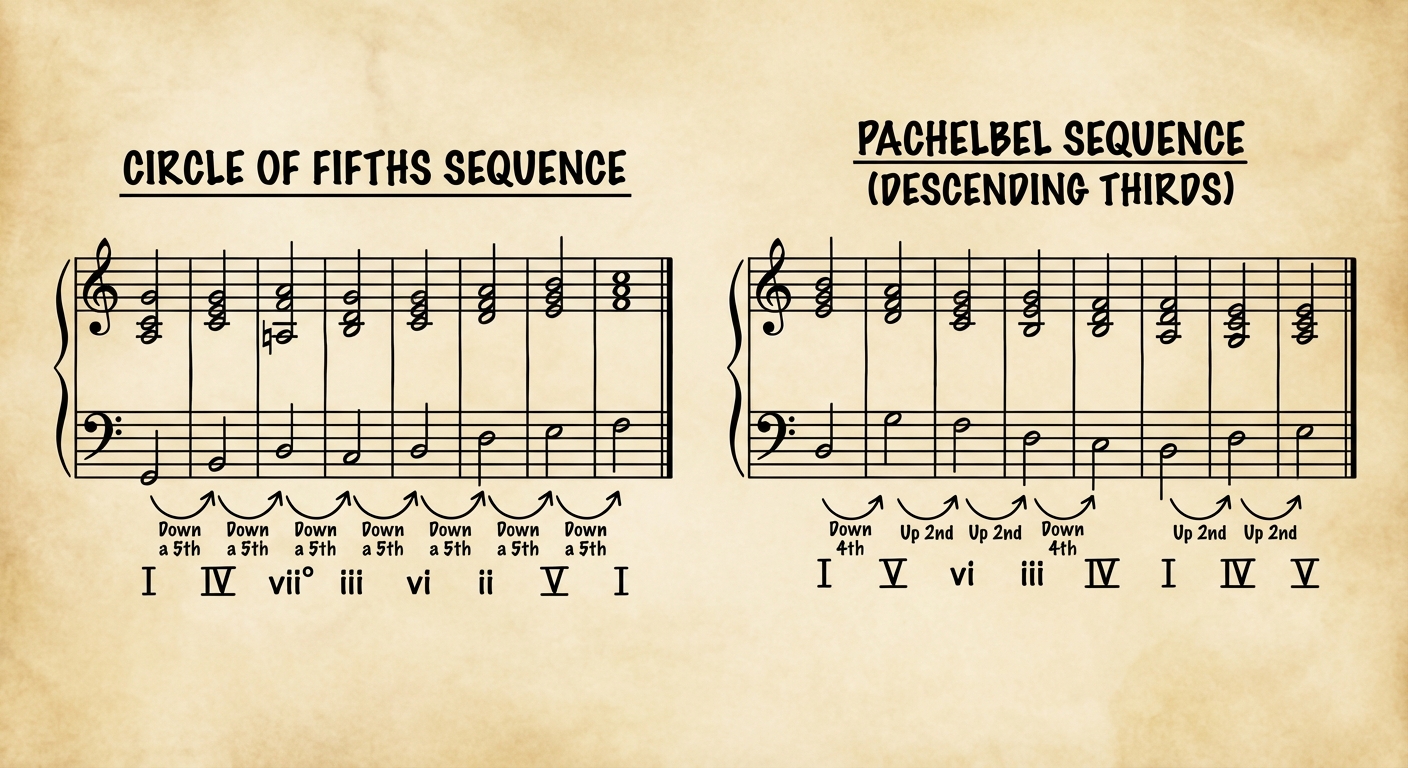
Recognizing harmonic sequences is vital for AP part-writing and analysis. Sequences often follow specific root-motion patterns.
1. Descending Circle of Fifths (Circle of 5ths)
The most common sequence in tonal music.
- Root Motion: Down a Perfect 5th (or Up a Perfect 4th).
- Pattern: $I - IV - vii^o - iii - vi - ii - V - I$
- Voice Leading: To avoid parallel fifths, complete chords usually alternate between complete and incomplete, or alternate between root position and first inversion.
2. Pachelbel Sequence (Descending Thirds)
Famous from Pachelbel's Canon in D.
- Root Motion: Down a 4th, Up a 2nd.
- Pattern: $I - V - vi - iii - IV - I - IV - V$
3. Descending Seconds (Stepwise)
- Root Motion: Down a 2nd (e.g., I - vii - vi).
- The 5-6 Technique: Because moving all voices down by step creates parallel 5ths and 8ves (forbidden), composers use a 5-6 linear intervallic pattern. The root falls a third, the bass moves down a step. Effectively, this alternates root position chords and first inversion chords (e.g., $I - V^6 - vi - iii^6$).
Common Student Mistakes in Unit 6
1. Confusing Appoggiaturas and Escape Tones
- The Mistake: Mixing up the leap/step direction.
- Correction: Remember the definitions are opposites.
- Appoggiatura: Leap then Step (Think: "App-LE-S" $\to$ LEap-Step).
- Escape Tone: Step then Leap (Think: You step out, then leap away to escape).
2. Identifying Suspensions Incorrectly
- The Mistake: Labeling a suspension based on the resolution interval or identifying it as a PT/NT.
- Correction: Always label the suspension by the interval created during the dissonant phase against the bass. If the bass is C and the soprano holds an F, it is a 4-3 suspension (because F is a 4th), not a 3-something suspension.
3. Parallelism in Sequences
- The Mistake: When writing a sequence (e.g., descending seconds), students simply move all notes down by step.
- Correction: This creates parallel 5ths and 8ves. You MUST use alternating inversions (chains of 5-6) or suspensions (chains of 7-6) to break the parallel motion.
- Pedal Point vs. Sustained Chord Tone
- The Mistake: Calling any long note a pedal point.
- Correction: It is only a pedal point if the harmonies change specifically to create dissonance against that note. If a note is held while the underlying chord stays the same, it's simply a sustained note.
Summary Tables
Quick Identifier for Common NCTs
| NCT | Preparation Motion | Resolution Motion | Metric Position |
|---|---|---|---|
| PT | Step | Step (Continue) | Weak (usually) |
| NT | Step | Step (Return) | Weak |
| SUS | Same | Step Down | Strong |
| RET | Same | Step Up | Strong |
| APP | Leap | Step (Opposite by rules) | Strong |
Motivic Cheat Sheet
- Inversion: Mirror upside down.
- Retrograde: Backwards.
- Augmentation: Slower (Fat notes).
- Diminution: Faster (Skinny notes).