Mastering Argument Analysis: Perspectives, Lenses, and Context
Considering Individual and Cultural Perspectives
In AP Seminar, understanding an argument goes far beyond simply reading the text; it involves dissecting who is speaking and why. An argument is rarely a neutral collection of facts—it is a construct influenced by the author's unique background, culture, and vested interests.
Defining Key Terms
Before analyzing sources, you must distinguish between two terms that are often conflated:
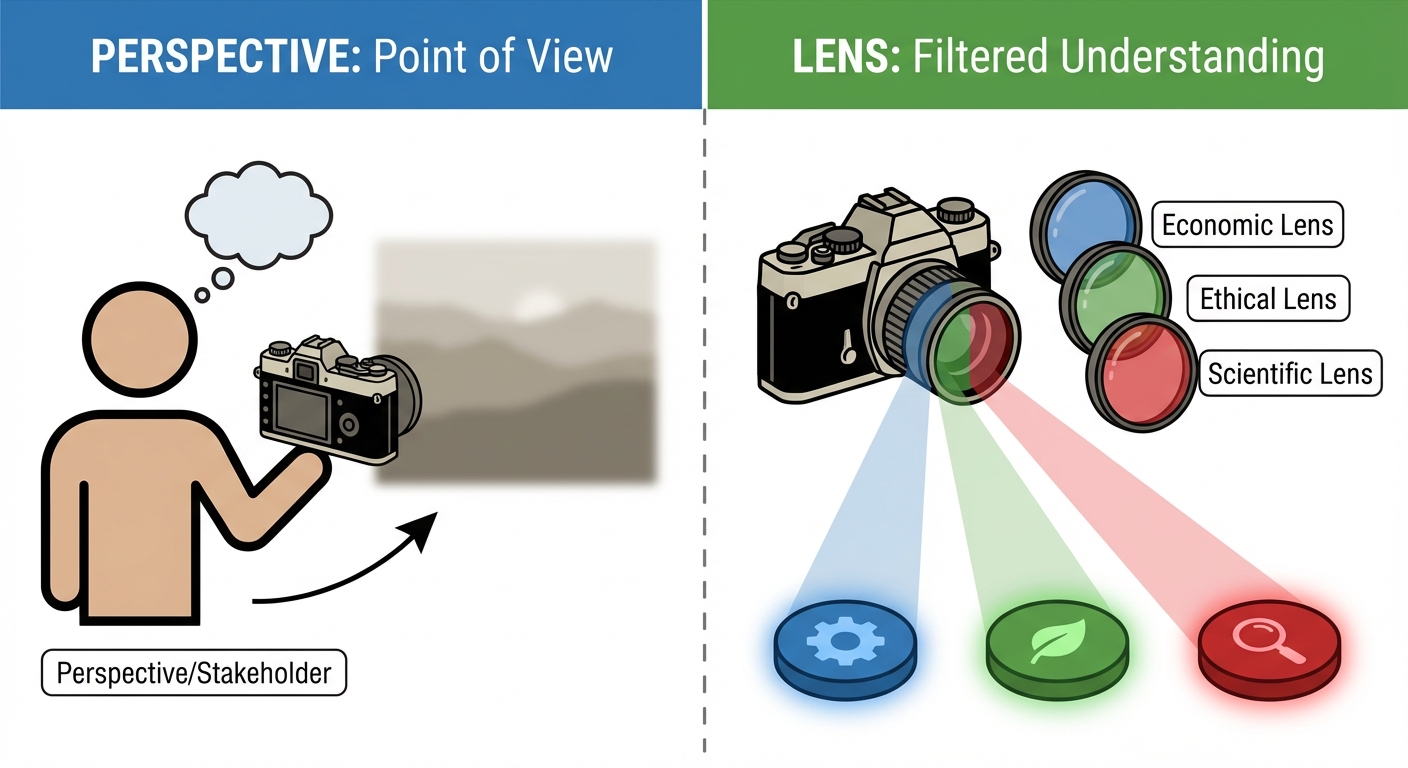
- Perspective: A point of view is conveyed through an argument. It represents who is looking at the issue (e.g., a stakeholder like a parent, a politician, or a scientist).
- Lens: A filter through which an issue is examined. It represents how the issue is categorized (e.g., Environmental, Economic, Ethical, Scientific).
The Role of Individual Perspective
Individual perspective is shaped by personal identity and experience. When analyzing an author or stakeholder, consider:
- Lived Experience: Does the author have personal history with the topic? (e.g., A cancer survivor writing about healthcare reform).
- Professional Expertise: Is the author writing from a position of academic or industry authority?
- Vested Interest: Does the author stand to gain or lose something (money, status, power) based on the outcome?
The Role of Cultural Perspective
Cultural perspectives are broader, stemming from shared group values, norms, and traditions. These often dictate the underlying assumptions of an argument.
- Societal Norms: What is considered "normal" or "polite" in the author's culture?
- Geopolitics: How does the author's national origin influence their view on global rights or economics?
- Religion and Ethics: How do spiritual beliefs shape arguments regarding bioethics or law?
Note: A single text can contain multiple perspectives. For example, a research paper might include the perspective of the researchers (scientific) and the subjects they interviewed (personal/cultural).
Evaluating Strengths and Limitations of Perspectives
Once you have identified a perspective, Big Idea 3 requires you to evaluate its validity. No perspective is perfect; every viewpoint illuminates some aspects of an issue while obscuring others.
Assessing Strengths
A strong perspective usually possesses:
- Authority: Proven expertise or credentials relevant to the specific topic.
- Proximity: Direct access to the event or population being studied.
- Evidence Alignment: The perspective is supported by verifiable data rather than just anecdote.
Assessing Limitations
Limitations are the "blind spots" of an argument. You must ask: What is this author failing to see?
- Narrowness: A purely economic lens might ignore ethical human costs. A purely scientific lens might ignore cultural feasibility.
- Bias: A predisposition or prejudice that prevents neutrality.
- Self-Correction: Bias is not automatically distinct from perspective. Everyone has a perspective. Bias becomes a limitation when it distorts evidence or deliberately omits counterarguments to fake strength.
- Outdated Context: Is the perspective based on social norms or scientific data that has since been disproven?
The RAVEN Mnemonic
Use this mnemonic to quickly evaluate the credibility and limitations of a source's perspective:
| Letter | Concept | Question to Ask |
|---|---|---|
| R | Reputation | Does the author/publisher have a history of reliability? |
| A | Ability to Observe | Was the author actually there? Do they have access to the data? |
| V | Vested Interest | Do they gain financially or professionally from this argument? |
| E | Expertise | Do they have the education or experience to speak on this? |
| N | Neutrality | Is the tone objective, or is it emotionally charged? |
Connecting Perspectives to a Broader Context
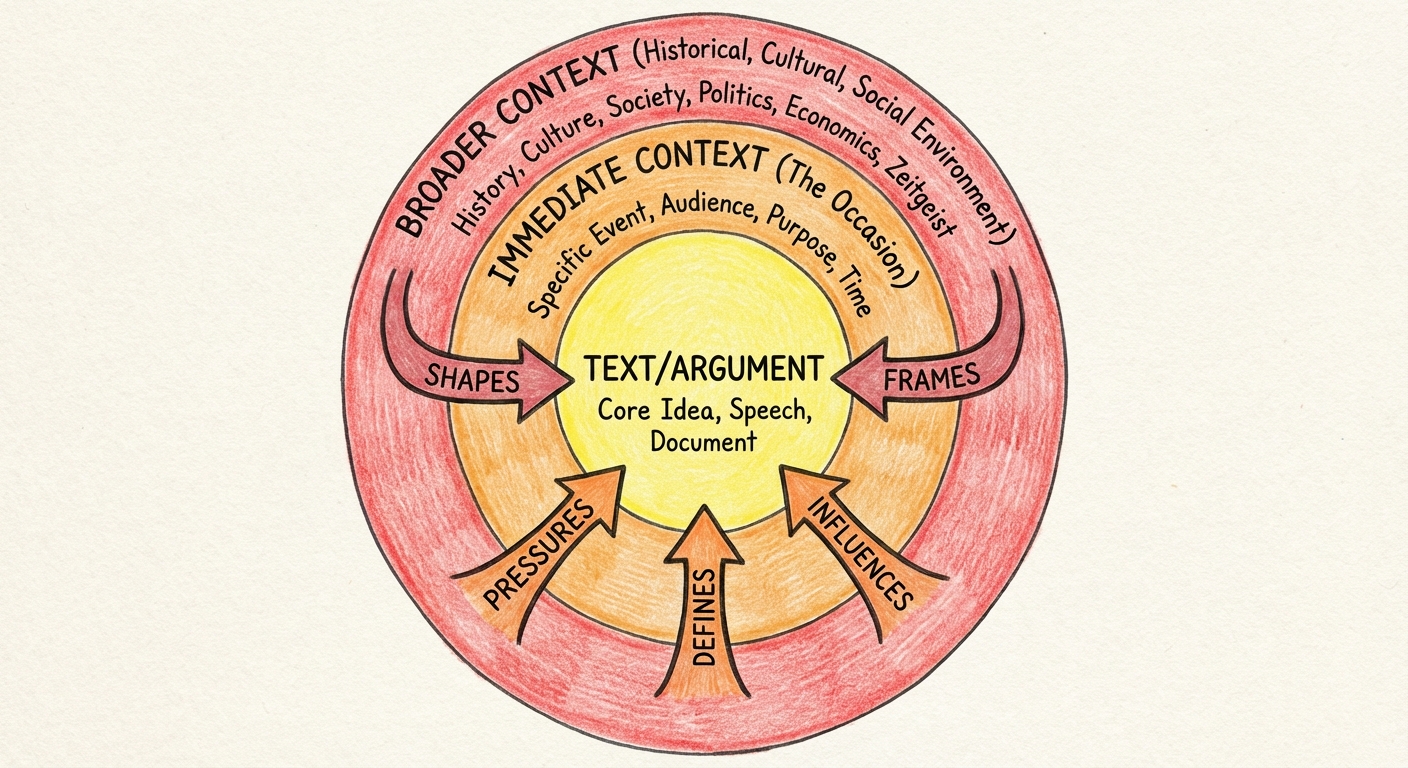
Arguments do not exist in a vacuum. To fully understand a perspective, you must place it within its context—the "time, place, and occasion" of the argument.
Types of Context
- Historical Context: The events leading up to the argument.
- Example: Analyzing a speech about privacy rights written in 2002 requires understanding the immediate aftermath of the 9/11 attacks.
- Situational (Immediate) Context: The specific catalyst for the argument.
- Example: An op-ed about gun control published three days after a major shooting has a different situational context than a theoretical legal paper on the Second Amendment.
- Cultural Context: The atmosphere of beliefs and attitudes surrounding the text.
The "Burkean Parlor" Metaphor
Academics often use the metaphor of entering a parlor (a conversation) that has been going on long before you arrived.
- The Conversation: The ongoing debate about a specific topic.
- The Contribution: How a new specific perspective adds to, contradicts, or nuances that debate.
When you synthesize sources (like in your Individual Research Report), you are mapping this conversation. You are identifying how Perspective A relates to Perspective B within a specific Context.
Example Scenario: The Gig Economy
Imagine analyzing the topic of App-Based Food Delivery services.
- Perspective A (The Worker): Argues for employee benefits. Context: Rising cost of living and lack of healthcare.
- Perspective B (The Corporation): Argues for flexibility and contractor status. Context: Highly competitive market needing low overhead.
- Synthesis: You evaluate how the economic lens of the corporation conflicts with the social/ethical lens of the worker, situated in the context of modern labor laws.
Common Mistakes & Pitfalls
- Confusing Lens with Perspective:
- Mistake: Saying "The author has a scientific perspective."
- Correction: The author is a biologist (Perspective) looking at the issue through a scientific lens.
- Dismissing Biased Sources Entirely:
- Mistake: "This author is a CEO, so they are biased and the source is useless."
- Correction: Acknowledge the bias as a limitation, but recognize that the CEO provides a valuable, unique partial perspective on how the industry functions.
- Ignoring the Counterargument:
- Mistake: Presenting a perspective as absolute truth.
- Correction: Good analysis points out what a perspective fails to address or how other perspectives contradict it.
- Floating Quotes:
- Mistake: Quoting a source without explaining who they are (their credentials/perspective).
- Correction: Always contextualize. Instead of "Smith says…", write "Smith, a cognitive psychologist specializing in teen development, argues…"