Comprehensive Guide to Integration Applications
Average Value of a Function
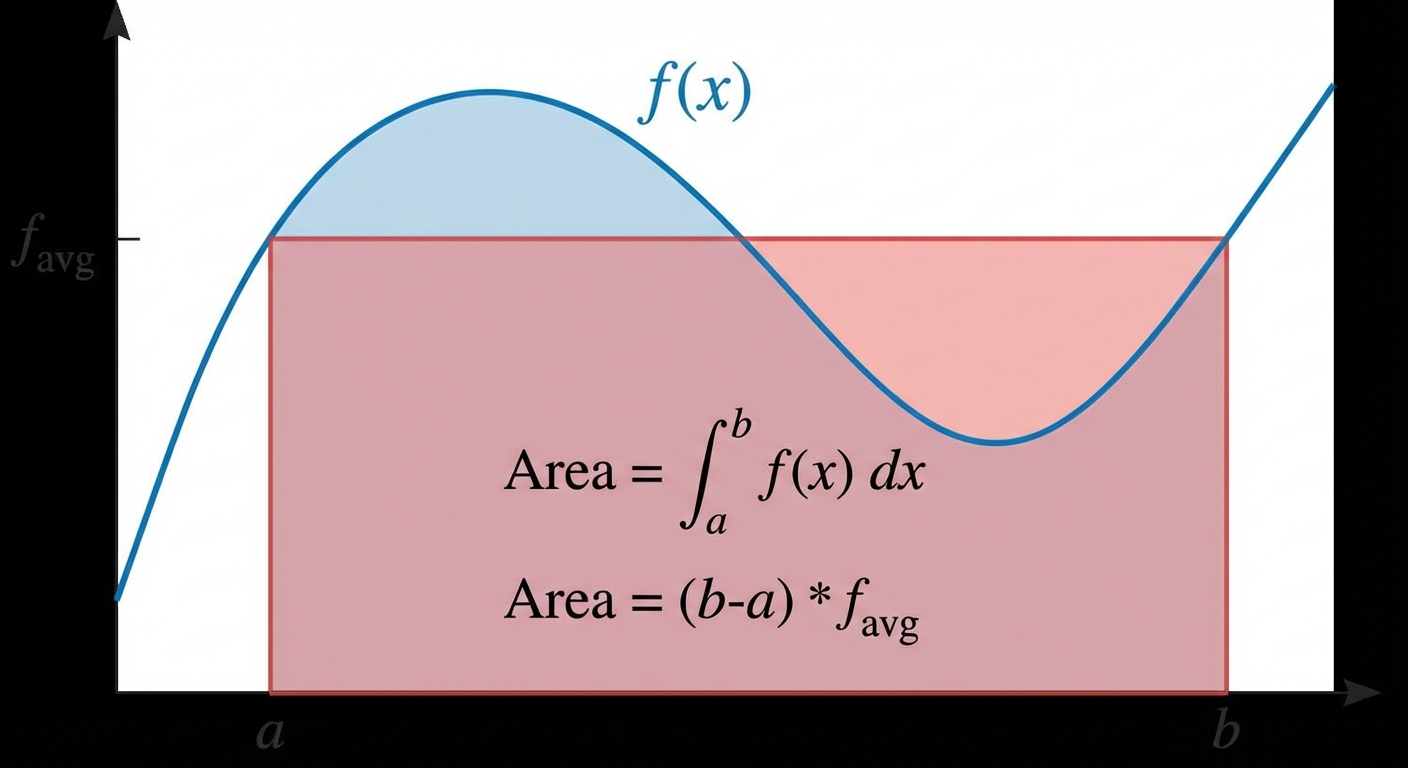
One of the most fundamental applications of the definite integral in AP Calculus AB is finding the average value of a continuous function over a specific interval. While an arithmetic mean sums discrete numbers and divides by the count, calculus allows us to average an infinite set of values along a curve.
Definition and Formula
The average value of a continuous function $f(x)$ on the closed interval $[a, b]$ is defined as:
Key Concept: Geometrically, $f{avg}$ is the height of a rectangle that has the same width $(b-a)$ and the same area as the region under the curve $f(x)$. This is related to the Mean Value Theorem for Integrals, which guarantees that a continuous function assumes its average value at least once in the interval (i.e., there exists a $c$ in $(a, b)$ such that $f(c) = f{avg}$).
Example 1
Find the average value of $f(x) = 3x^2$ on the interval $[0, 2]$.
Solution:
- Identify $a=0$ and $b=2$. The width is $2-0 = 2$.
- Set up the integral:
- Integrate $3x^2$ to get $x^3$.
- Evaluate:
The average value is 4.
Particle Motion (Rectilinear Motion)
In Unit 8, you apply integration to solve kinematic problems involving position, velocity, and acceleration of a particle moving along a line.
Relationships
Recall the derivative ladder: $s(t) \xrightarrow{d/dt} v(t) \xrightarrow{d/dt} a(t)$. Integration allows us to climb back up the ladder.
| Quantity | Notation | Integral Relationship |
|---|---|---|
| Velocity | $v(t)$ | $\int a(t) \, dt$ |
| Position | $s(t)$ or $x(t)$ | $\int v(t) \, dt$ |
Net Change vs. Total Distance
This is the most critical distinction in this unit. Students often confuse displacement with distance traveled.
Displacement: The net change in position. This can be positive, negative, or zero.
Total Distance Traveled: The sum of all movement, regardless of direction. We must integrate the absolute value of velocity (speed).
Current Position: To find the position at a specific time $t$, you generally need an initial condition (start position).
"Current Position = Start Position + Displacement"
Common Pitfall: The Turning Point
When calculating Total Distance manually without a calculator, you must find where the particle turns around.
- Set $v(t) = 0$ to find critical points.
- Split the integral into intervals where $v(t)$ is positive and negative.
- Integrate each piece and sum their absolute values.
Area Between Two Curves
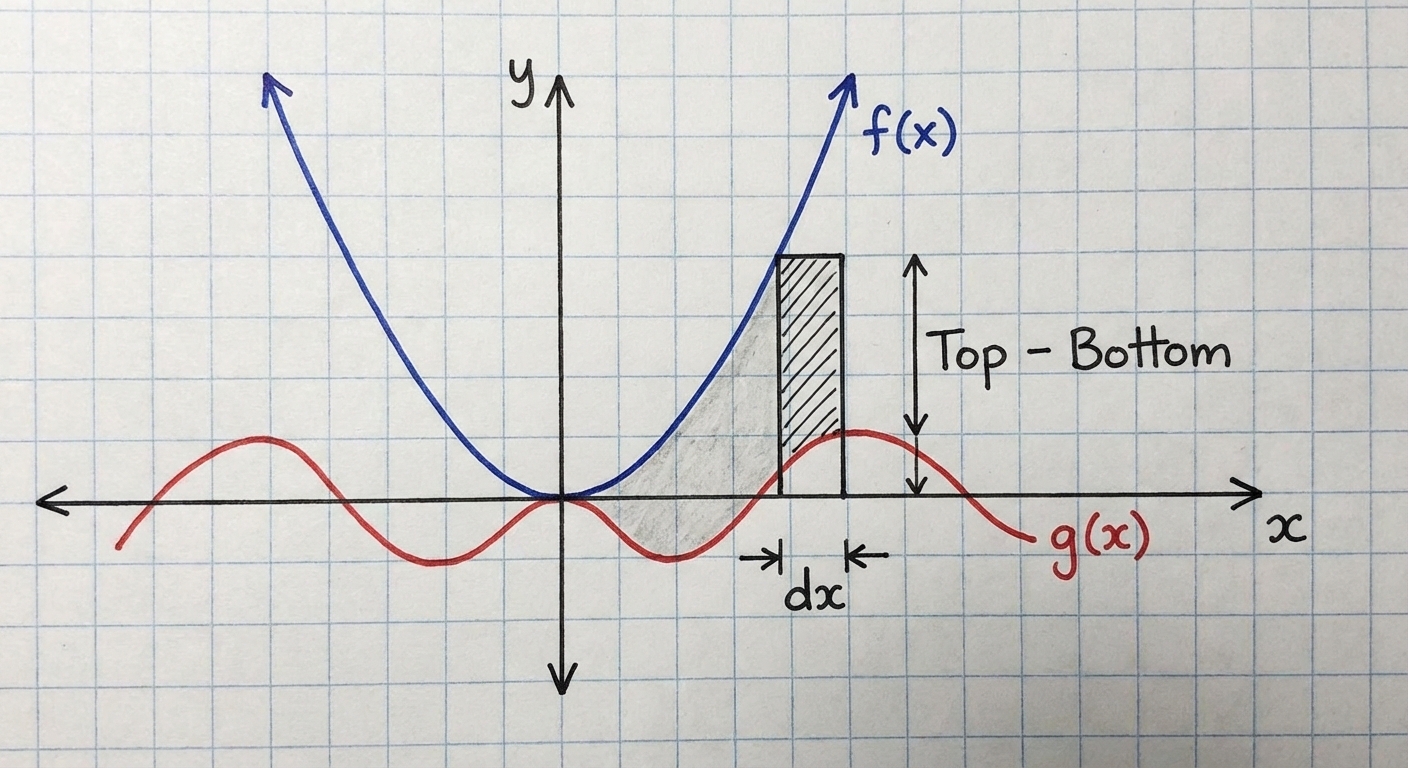
Previously, you found the area between a curve and the x-axis. Now, we calculate the area trapped between two functions, $f(x)$ and $g(x)$.
Vertical Slicing (Normally dx)
If the region is bounded by functions of $x$ (top and bottom), we use vertical representative rectangles.
Steps:
- Graph it (if allowed) to see which function is on top.
- Find Intersections: Set $f(x) = g(x)$ to find the limits of integration $a$ and $b$, unless given.
- Integrate the difference.
Horizontal Slicing (dy)
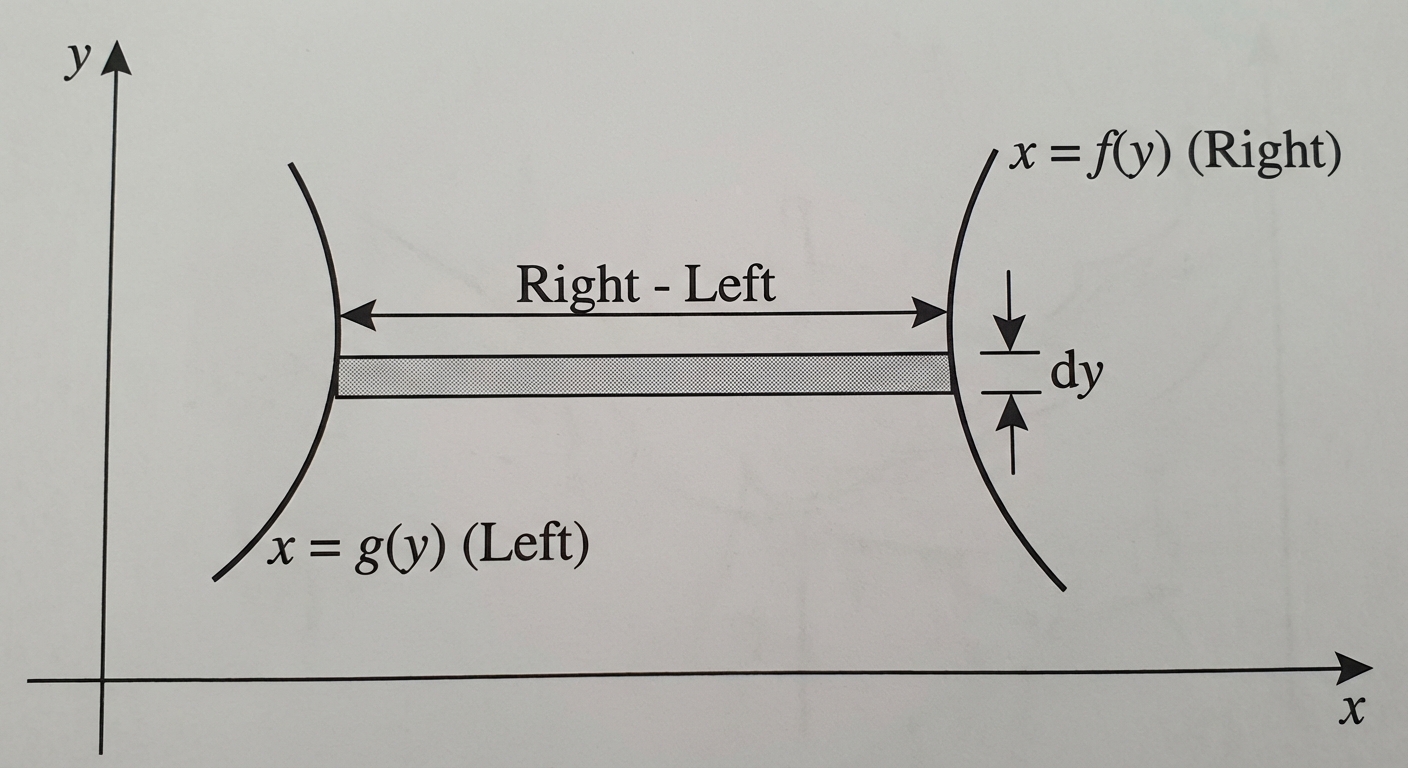
Sometimes curves are better defined as $x = f(y)$ (functions of $y$). In these cases, we slice horizontally.
Note: All equations must be solved for $x$ in terms of $y$. The limits of integration ($c$ and $d$) correspond to y-values.
Example 2: Area Between Curves
Find the area bounded by $y = \sqrt{x}$ and $y = x^2$.
- Intersection: $\sqrt{x} = x^2 \implies x = x^4 \implies x(x^3-1) = 0$. So, $x=0$ and $x=1$.
- Top vs Bottom: On $(0, 1)$, $\sqrt{x}$ is above $x^2$ (e.g., test $x=0.25$, $\sqrt{0.25}=0.5$, $0.25^2=0.0625$).
- Setup: $\int{0}^{1} (\sqrt{x} - x^2) \, dx = \int{0}^{1} (x^{1/2} - x^2) \, dx$.
- Solve: $[\frac{2}{3}x^{3/2} - \frac{1}{3}x^3]_0^1 = (\frac{2}{3} - \frac{1}{3}) - 0 = \frac{1}{3}$.
Volumes with Known Cross-Sections
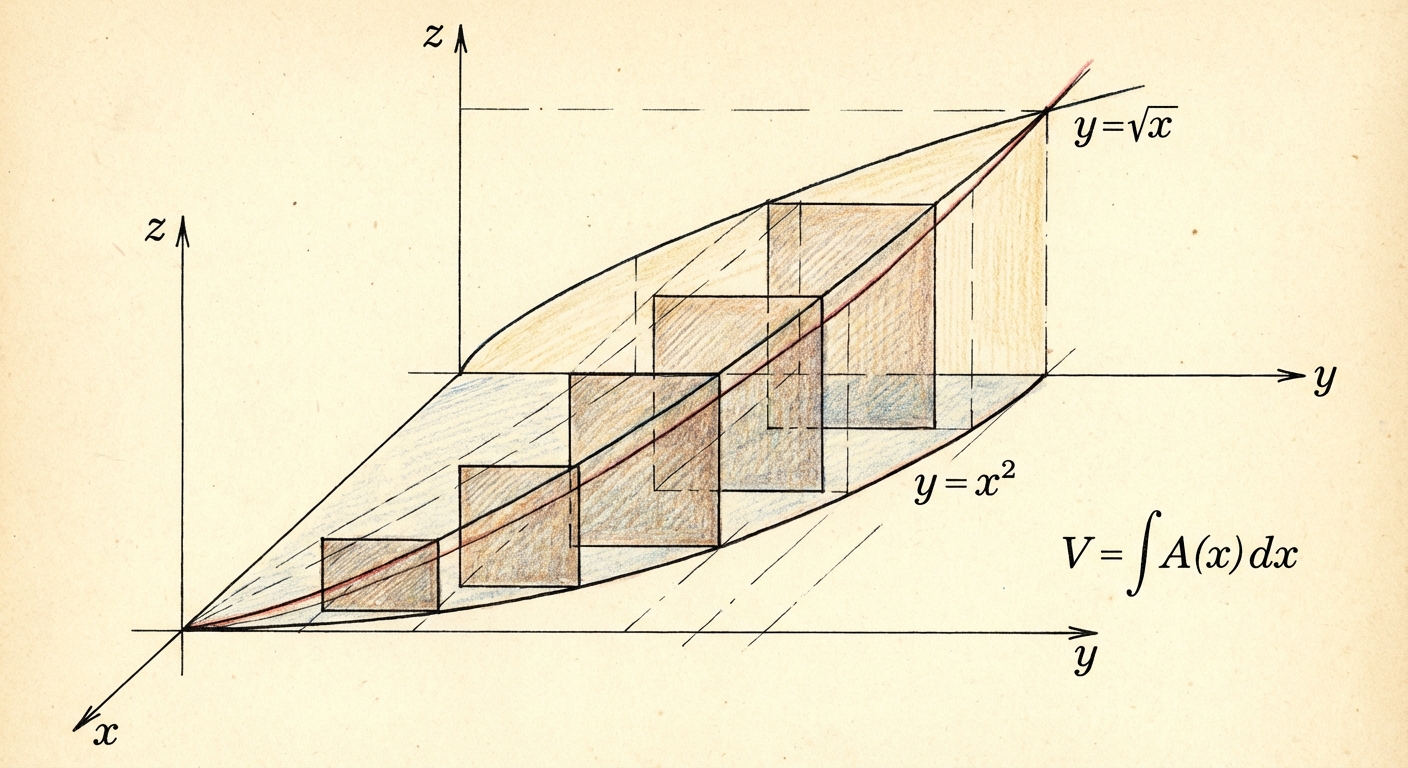
In these problems, a 2D base region is defined by functions in the xy-plane, and 3D shapes pop out of the page perpendicular to this base.
General Concept
Volume is the accumulation of area slices.
where $A(x)$ is the area formula for the specific geometric shape of the cross-section.
Common Cross-Section Formulas
Let $s = \text{Top} - \text{Bottom}$ (the length of the slice in the base).
| Shape of Cross-Section | Area Formula $A(x)$ | Integral Setup |
|---|---|---|
| Square | $s^2$ | $\int (\text{Top}-\text{Bot})^2 \, dx$ |
| Rectangle (height $h$) | $s \cdot h$ | $\int (\text{Top}-\text{Bot})h \, dx$ |
| Equilateral Triangle | $\frac{\sqrt{3}}{4}s^2$ | $\frac{\sqrt{3}}{4} \int (\text{Top}-\text{Bot})^2 \, dx$ |
| Semicircle | $\frac{\pi}{8}s^2$ | $\frac{\pi}{8} \int (\text{Top}-\text{Bot})^2 \, dx$ |
Note on Semicircles: The diameter is $s$, so radius $r = s/2$. Area is $\frac{1}{2}\pi (s/2)^2 = \frac{\pi}{8}s^2$.
Volumes of Revolution
These are 3D solids created by spinning a 2D area around an axis (like the x-axis, y-axis, or another line).
1. The Disk Method (No Holes)
Used when the region being rotated touches the axis of rotation completely (no gaps).
- $R(x)$: The radius, measured from the axis of rotation to the outer edge of the function.
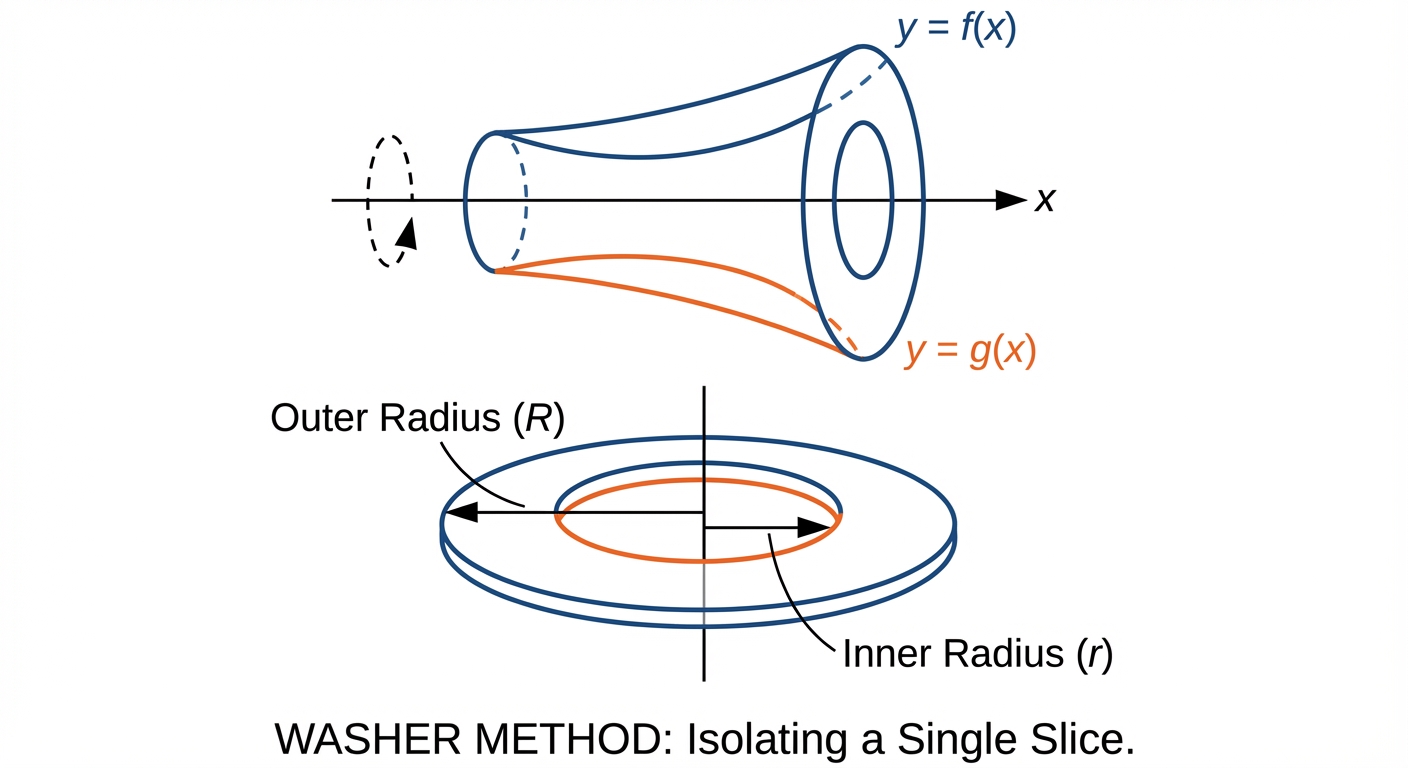
2. The Washer Method (Holes)
Used when there is a gap between the region and the axis of rotation. The resulting 3D cross-section looks like a washer (a donut).
- $R(x)$ (Outer Radius): Distance from axis of rotation to the far curve.
- $r(x)$ (Inner Radius): Distance from axis of rotation to the near curve.
Important Rules for Axes of Rotation
- Revolving around x-axis: Use $dx$. ($y=…$)
- Revolving around y-axis: Use $dy$. ($x=…$)
- Revolving around $y = k$: Radii are vertical distances. $R(x) = |\text{Top} - k|$.
- Revolving around $x = h$: Radii are horizontal distances. $R(y) = |\text{Right} - h|$.
Common Mistakes & Pitfalls
Displacement vs. Distance:
- Mistake: Calculating $\int v(t) dt$ when asked for Total Distance.
- Correction: Always use $\int |v(t)| dt$ for total distance. If you don't have a calculator, split the integral at zeroes.
Square of the Difference vs. Difference of Squares:
- Mistake: In the Washer Method, writing $\pi \int (R - r)^2 dx$.
- Correction: It is mathematically $\text{Volume}{\text{outer}} - \text{Volume}{\text{inner}}$, so it must be $\pi \int (R^2 - r^2) dx$.
Forgetting $\pi$:
- Mistake: Omitting the $\pi$ coefficient in Disk/Washer problems.
- Correction: Remember, you are summing circle areas ($A=\pi r^2$). The $\pi$ is mandatory.
Initial Position:
- Mistake: Thinking $\int_0^t v(t) dt$ is the position.
- Correction: That is only the change in position. You must add the starting position $s(0)$.
Limits of Integration:
- Mistake: Using x-values for limits when integrating with respect to $y$ (dy).
- Correction: If the differential is $dy$, the limits must be $y$-values $(y1$ to $y2)$.