Advanced Thematic Analysis in Longer Fiction and Drama
Constructing Complex Thematic Statements
In AP English Literature, the most significant shift from basic analysis to advanced critique is how you handle theme. In Unit 6, because you are dealing with longer works (novels and full-length plays), themes encompass broad character arcs and sustained conflicts. A theme is never a single word; it is an argument the text makes about the human condition.
Moving from Topic to Statement
Students often confuse a topic (a subject the text portrays) with a thematic statement (what the text says about that subject).
- Topic (Abstract Noun): Love, Revenge, Corruption, Identity.
- Thematic Statement (Complete Sentence): A universal observation about the topic derived from the text.
To construct a specialized thematic statement, use the following logical progression:

The Formula for Complexity
Avoid clichés (e.g., "don't judge a book by its cover"). Instead, acknowledge the nuance and contradictions found in longer works. A strong AP-level thematic statement often acknowledges a tension between two ideas.
The Template:
"While [the text] portrays [Topic A], it ultimately suggests that [Topic B] leads to [Consequence/Insight]."
Example using Hamlet:
- Weak: The theme is revenge.
- Better: Revenge causes tragedy.
- AP Level: While Hamlet explores the filial obligation to seek justice, it ultimately suggests that the psychological toll of revenge paralyzes the individual, leading to the destruction of both the avenger and the corrupt society they seek to cleanse.
Identifying Motifs
A motif is a recurring element (image, phrase, object, or action) that gains symbolic significance through repetition. Motifs are the breadcrumbs that lead to the theme.
- Example: In The Great Gatsby, the motif of weather (rain during awkward reunions, heat during conflicts) reinforces the theme that emotional turbulence is inevitable in the pursuit of the past.
Character Development and Foils
In longer fiction, characters are rarely static. Unit 6 focuses heavily on how character interactions—specifically contrasts—illuminate the meaning of the work as a whole.
The Function of the Foil
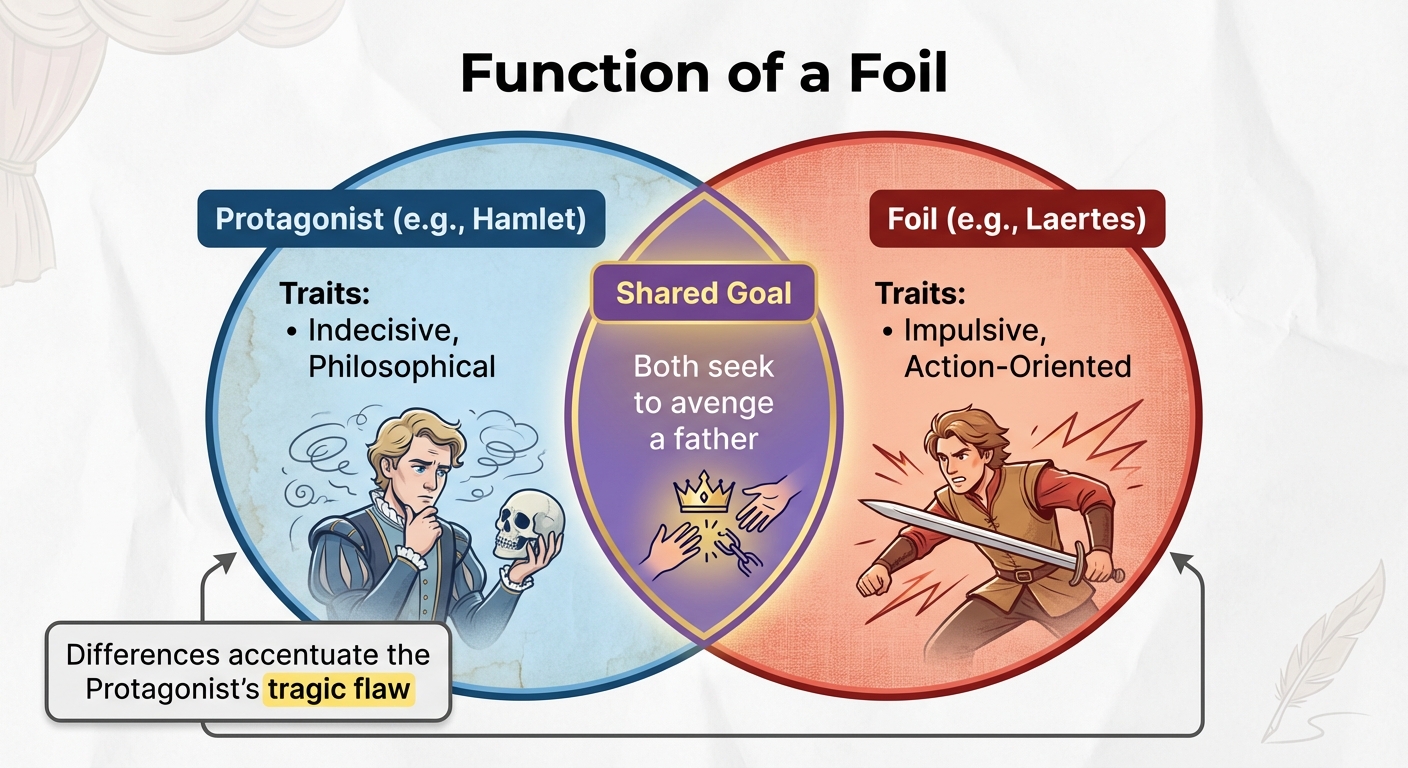
A Foil is a character who contrasts with another character (usually the protagonist) to highlight particular qualities of the other character. A foil is not necessarily an antagonist; they can be a friend or a minor character.
Why use a foil?
- To make the protagonist's specific traits (strength, weakness, hesitation) more obvious by showing distinct alternatives.
- To represent a conflicting worldview or ideology.
| Feature | Protagonist (Example option) | Foil (Example option) | What is Highlighted? |
|---|---|---|---|
| Action | Hesitant, philosophical | Impulsive, action-oriented | The protagonist's paralyzing overthinking. |
| Morality | Rigorous code of ethics | Pragmatic, ends-justify-means | The cost of maintaining moral purity. |
| Fate | Struggles against destiny | Accepts/Embraces social role | The difficulty of nonconformity. |
Worked Example: Frankenstein
In Mary Shelley's Frankenstein, the Creature serves as a foil to Victor Frankenstein.
- Victor: Born into privilege, loved by parents, abandons his "child."
- The Creature: Born into isolation, abandoned, yearns for connection.
- Thematic Result: This contrast highlights Victor's cruelty and irresponsibility. It suggests that "monstrosity" is a product of nurture (or lack thereof), not nature.
Character Inconsistencies
Pay attention when characters act "out of character." In longer fiction, inconsistencies are often intentional. They reveal:
- Internal Conflict: The character is torn between duty and desire.
- Growth: The character is in the process of changing (dynamic character).
- Hypocrisy: The gap between a character's public persona and private actions.
When a character contradicts themselves, ask: What pressure caused this crack in their facade? This pressure point is usually where the theme is located.
Societal and Historical Context
Literature does not exist in a vacuum. To deeply analyze thematic development, you must consider the relationship between the character and the values, mores, and hierarchies of their specific setting (or the author's era).
Setting as a Pressure Cooker
In Unit 6, the setting is often the source of the conflict. The theme emerges from how the character accepts, fights, or is crushed by their environment.
- Historical Context: Refers to the real-world time period the text was written in/set in (e.g., The Victorian Era, The Jim Crow South).
- Societal Context: Refers to the specific cultural expectations within the book (e.g., strict gender roles, class rigidity).
Analysis Strategy:
Do not simply state facts about the era. Connect the context to the theme.
- Bad Connection: "This book is set in the 1800s when women couldn't vote."
- Strong Connection: "The protagonist's struggle for independence acts as a microcosm for the limited agency of women in the 19th century, illustrating the theme that societal repression ultimately forces the individual into madness as the only form of escape."
The Role of "The Other"
Many longer works explore the tension between the "in-group" (society) and the "out-group" (the Other). Themes often center on how a society treats those who do not fit its norms.
- Look for characters who are marginalized due to race, gender, class, or belief.
- The tragic downfall of these characters often serves as a critique of the society that excluded them.
Common Mistakes & Pitfalls
1. The "Moral of the Story" Trap
Mistake: Treating the theme as a piece of advice or a moral instruction (e.g., "You should always tell the truth").
Correction: Literature is observational, not instructional. Frame themes as statements about reality (e.g., "Deception often erodes the foundation of relationships").
2. Confusing Plot with Theme
Mistake: Summarizing what happens (e.g., "The theme is about a boy who goes to war").
Correction: Abstract the plot into ideas. Ask why the plot happened the way it did (e.g., "The narrative illustrates how war strips away youthful innocence").
3. Ignoring Contradictory Evidence
Mistake: Forcing a simple theme onto a complex book and ignoring parts of the text that don't fit.
Correction: If a major plot point contradicts your theme, your thematic statement is likely too simple. Nuance is key—use words like "often," "may," "suggests," or "tension" to allow for complexity.
4. Oversimplifying Foils
Mistake: Thinking a foil is just the "villain" or the "bad guy."
Correction: A foil is a contrast. Dr. Watson is a foil to Sherlock Holmes, not because he is bad, but because his normalcy highlights Holmes's eccentricity.