Mastering SATB Part-Writing: Voice Leading Fundamentals
The Basics of Four-Part Chorale Style
Voice leading (or part-writing) is the art of combining independent melodic lines to create harmonies that adhere to the stylistic norms of the Common Practice Period (approx. 1650–1900). In AP Music Theory, this is realized through the SATB texture (Soprano, Alto, Tenor, Bass).
The primary goal of strict voice leading is to maintain voice independence. Each voice should have its own melodic contour while contributing to the vertical chord structure.
The Grand Staff and Voice Ranges
Voice leading exercises require you to notate four voices on a grand staff. The Soprano and Alto are written in the Treble Clef, while the Tenor and Bass are written in the Bass Clef.
Standard Vocal Ranges
To ensure singability, stick to the following ranges. While professional singers can go higher or lower, staying within these limits prevents penalties.
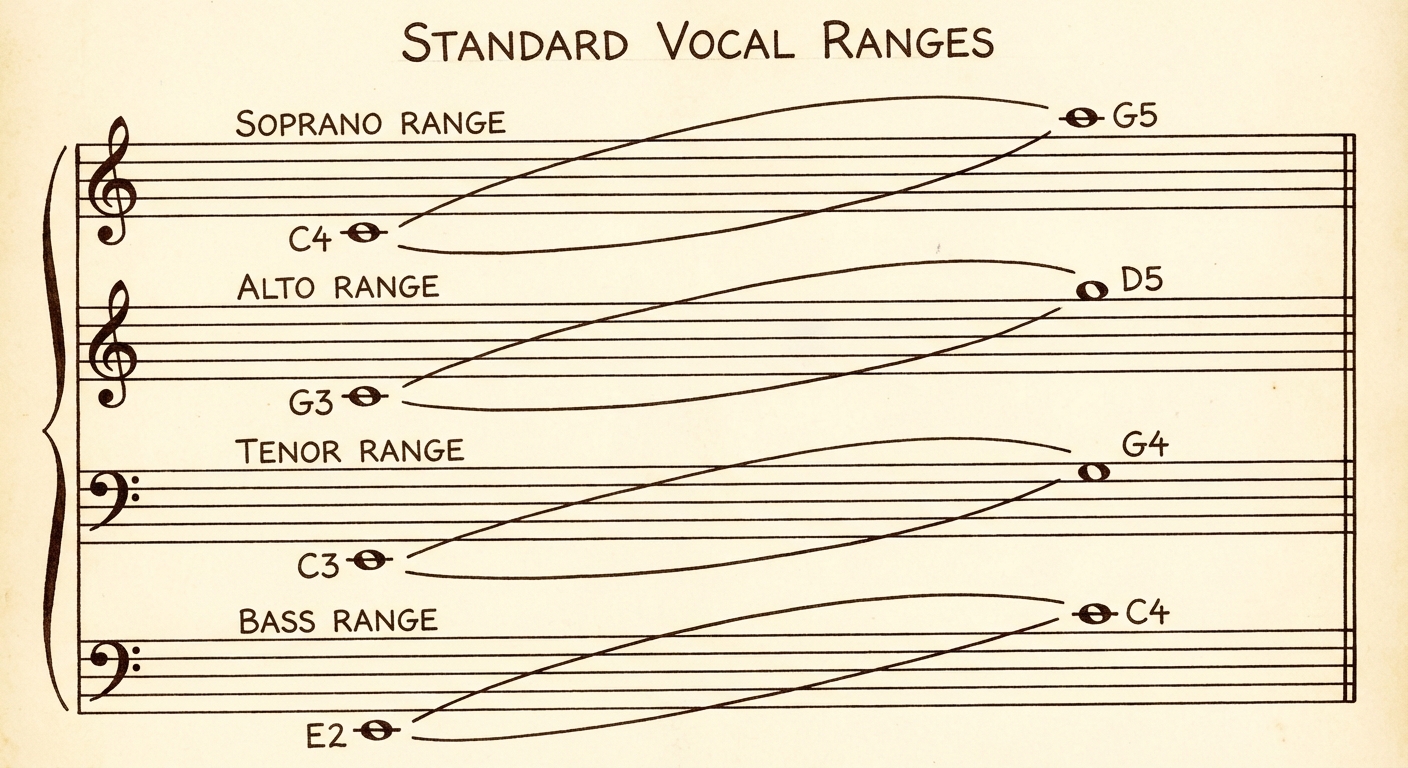
- Soprano (S): $C4$ to $G5$ (Middle C to High G)
- Alto (A): $G3$ to $D5$
- Tenor (T): $C3$ to $G4$
- Bass (B): $E2$ to $C4$
Stem Direction Rule:
- Soprano: Stems always point UP.
- Alto: Stems always point DOWN.
- Tenor: Stems always point UP.
- Bass: Stems always point DOWN.
Types of Contrapuntal Motion
Understanding how two voices move in relation to one another is critical for analyzing voice leading and avoiding errors.
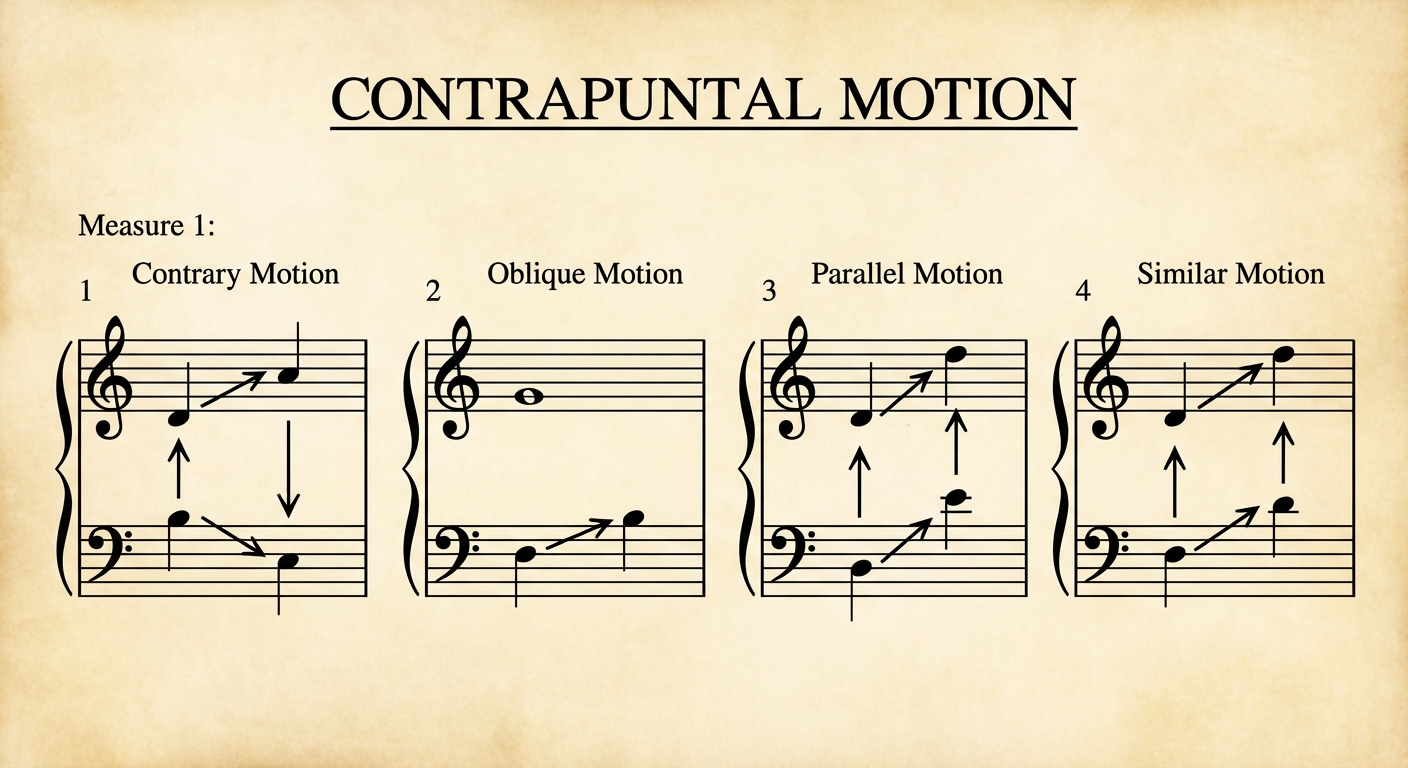
- Static Motion: Neither voice moves; they both repeat the same pitch.
- Oblique Motion: One voice stays on the same pitch while the other moves (up or down).
- Contrary Motion: Both voices move, but in opposite directions (one goes up, the other goes down). This is the most desirable type of motion for preserving independence.
- Similar Motion: Both voices move in the same direction but by different intervals.
- Parallel Motion: Both voices move in the same direction by the same interval.
Essential Voice Leading Rules (The "Don'ts")
The following rules are strict on the AP exam. Violating them usually results in a significant deduction.
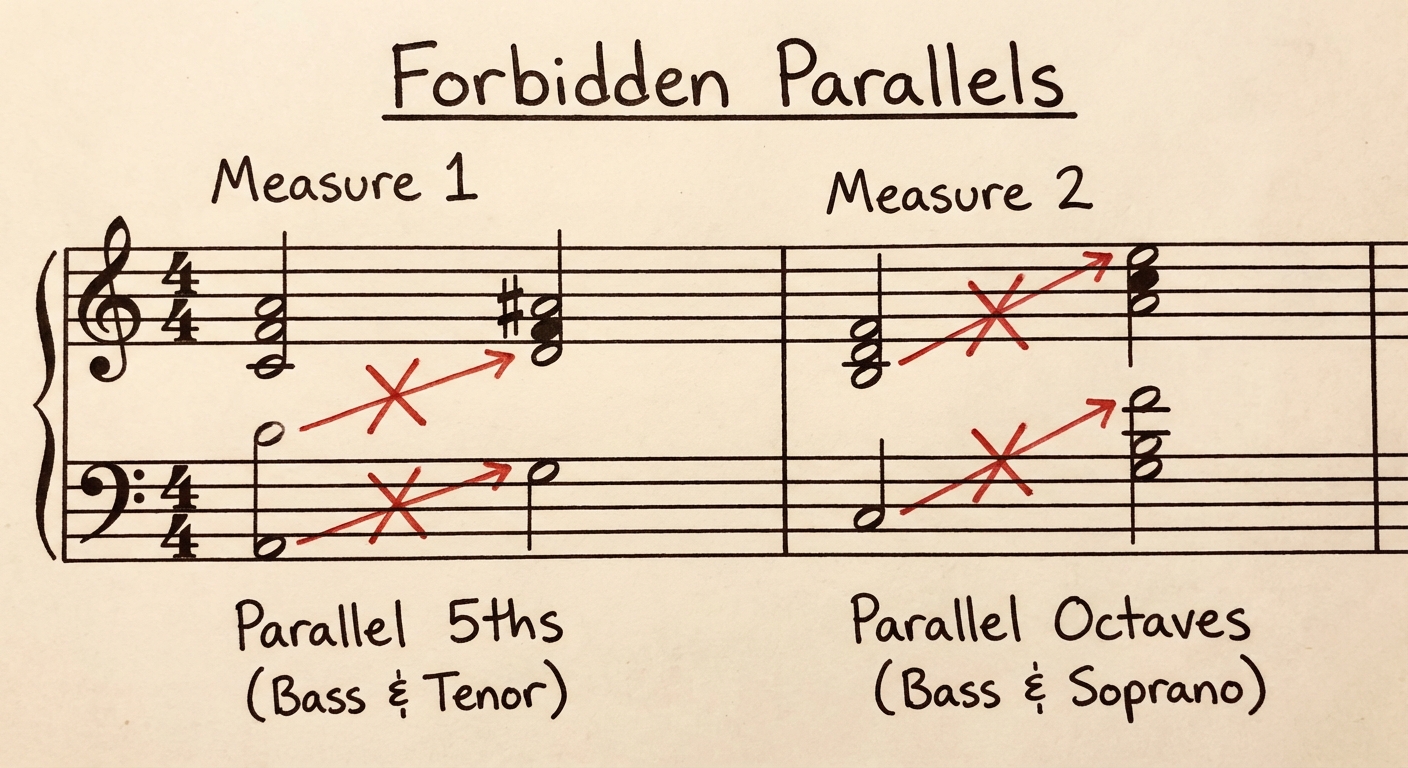
1. Forbidden Parallels
This is the most common and fatal error in part-writing. Parallel perfect intervals destroy the independence of the voices, making two parts sound like one.
- No Parallel 5ths: You cannot move from a harmonic perfect 5th (P5) to another perfect 5th between the same two voices.
- No Parallel Octaves (or Unisons): You cannot move from a harmonic perfect octave (P8) to another perfect octave between the same two voices.
Note: Parallel 3rds and 6ths are perfectly acceptable and encouraged.
2. Direct (Hidden) 5ths and 8ves
This rule applies only to the outer voices (Soprano and Bass).
A Direct 5th or 8ve occurs when:
- The Soprano and Bass move in Similar Motion toward a perfect interval (P5 or P8), AND
- The Soprano moves by a skip (leap).
If the Soprano moves by step, a direct 5th/8ve is usually permitted.
3. Spacing Errors
To maintain a balanced texture, voices must be kept close together in the upper parts.
- Soprano and Alto: Must be within an octave of each other.
- Alto and Tenor: Must be within an octave of each other.
- Tenor and Bass: Can be more than an octave apart (this is common).
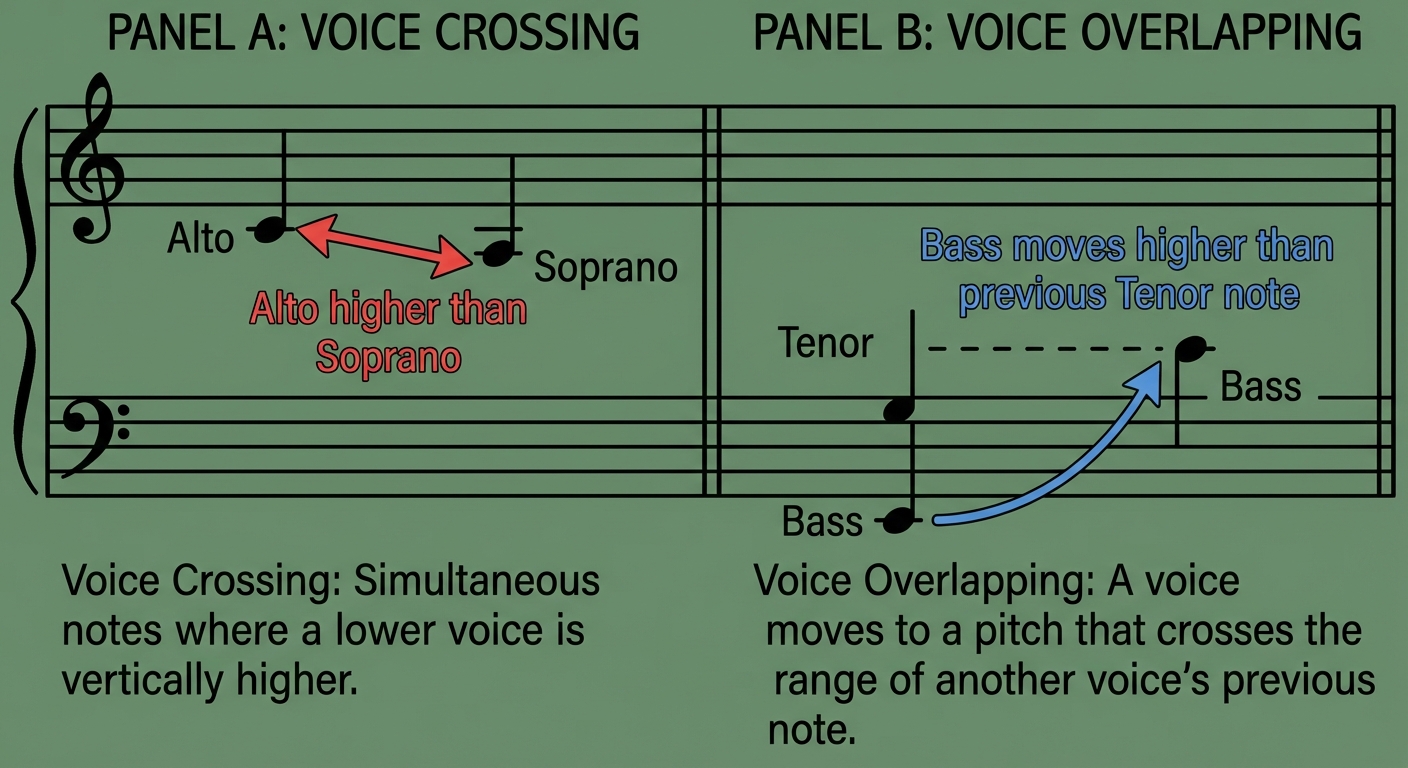
4. Crossing and Overlapping
- Voice Crossing: One voice sings a pitch higher (or lower) than the adjacent voice is currently singing.
- Example: The Alto sings a $G4$ while the Soprano sings an $F4$.
- Voice Overlapping: One voice moves to a pitch that is higher (or lower) than the previous note of an adjacent voice.
- Example: The Bass jumps up to a $G3$, which is higher than the Tenor's previous note ($F3$).
Writing Four-Part Harmony (The "Dos")
When realizing a Roman Numeral progression, follow these guidelines for doubling and smooth connection.
1. Smooth Voice Leading
- Retain Common Tones: If a note exists in both the current chord and the next chord, keep it in the same voice.
- Move by Step: Move strictly by step (2nds) whenever possible. Leaps larger than a 3rd should be rare in inner voices.
2. Doubling Rules
Since a triad has three notes and there are four voices, one note must be doubled.
Root Position Triads:
- Best: Double the Root.
- Allowed: Double the 5th (rarely).
- Avoid: Doubling the 3rd (except in specific cases like $bVI$ in minor).
First Inversion Triads ($^6$):
- Best: Double the Soprano note (whatever is in the melody).
- Alternative: Double the Root or 5th (whichever yields smoother voice leading).
- Exception: In a Diminished triad (vii$^{\circ 6}$ or ii$^{\circ 6}$), always double the Bass (the 3rd of the chord).
Second Inversion Triads ($^{6}_{4}$):
- Strict Rule: Always double the Bass (the 5th of the chord).
3. Tendency Tones
Tendency tones are unstable notes that "want" to resolve to a specific pitch. Failure to resolve them creates frustration in the harmony.
- Leading Tone ($ti$ or $\hat{7}$): Must resolve UP by step to the Tonic ($do$ or $\hat{1}$), especially if it is in the Soprano or Bass (outer voices).
- Chordal 7ths: If you are writing a 7th chord (e.g., $V^7$), the 7th of the chord ($fa$ in a dominant chord) must resolve DOWN by step.
4. Unequal 5ths
Moving from a Diminished 5th (d5) to a Perfect 5th (P5) is generally forbidden in the Bass voice relations (it sounds "clunky"). However, moving from P5 $\to$ d5 is acceptable.
Common Mistakes & Pitfalls
- The "Checkered" Parallel: Students often check for parallels between Soprano/Bass but forget to check inner voices (Alto/Tenor, Tenor/Bass). Tip: Check all 6 voice pairs: S-A, S-T, S-B, A-T, A-B, T-B.
- Leading Tone Frustration: Forgetting to raise the leading tone in Minor keys (using natural minor instead of harmonic minor). This turns a Major dominant ($V$) into a minor dominant ($v$), which is a stylistic error in Common Practice cadence points.
- Spacing Out: Letting the Alto and Tenor drift too far apart ($>8ve$) typically happens when the Tenor moves too low. Keep the upper three voices tight.
- Melodic Augmented 2nds: In harmonic minor, moving from $\hat{6}$ to $\hat{7}$ ($le$ to $ti$) creates an Augmented 2nd interval. This is forbidden melodically. Solution: Raise $\hat{6}$ to create Melodic Minor, or change the voicing.