Unit 2 Guide: Ecosystem Resilience and Biological Succession
Unit 2: The Living World: Biodiversity - Disruptions and Succession
Natural Disruptions to Ecosystems
While human impact is a major focus of Environmental Science, it is crucial to understand that ecosystems change naturally over time. Natural disruptions are environmental consequences that occur without direct human input.
Scales of Natural Change
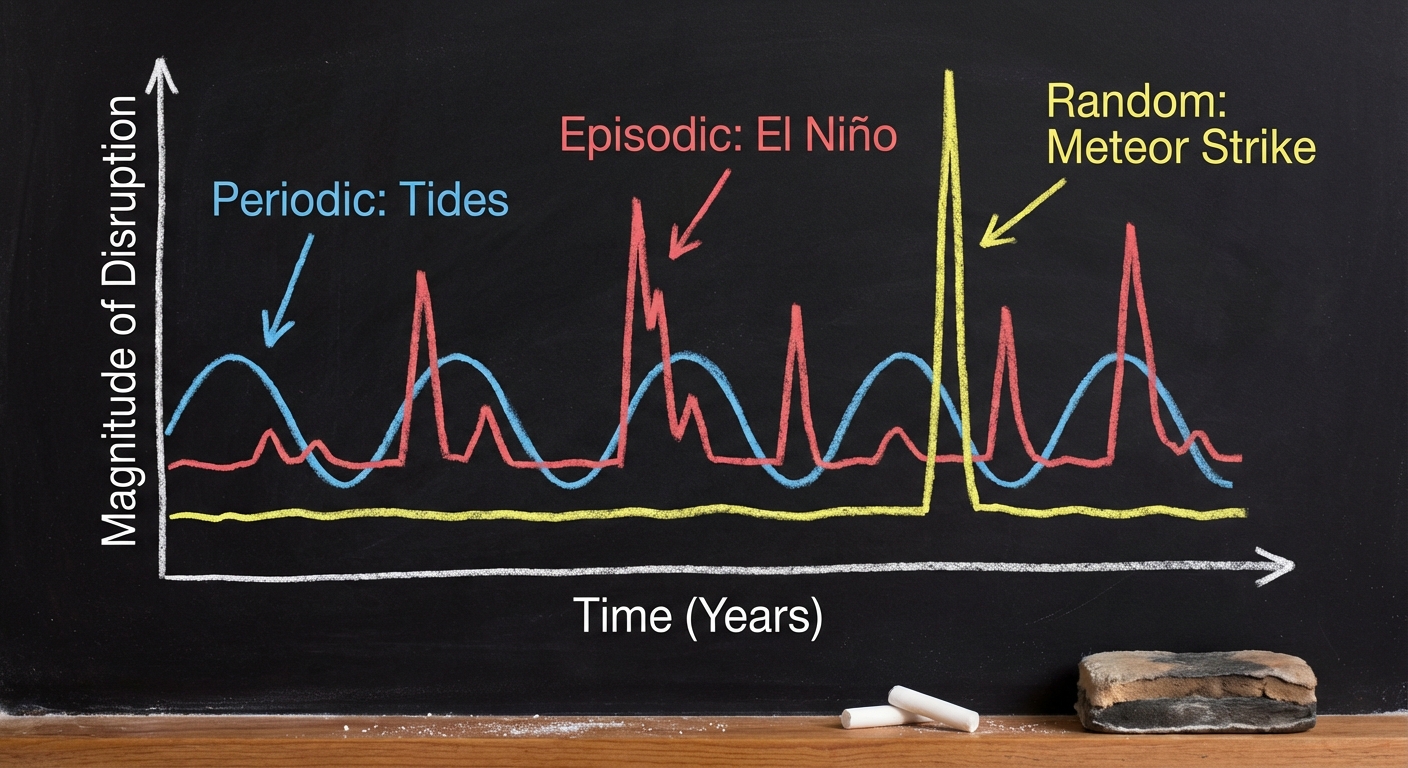
Natural disruptions vary significantly in terms of frequency and predictability. The College Board categorizes these into three distinct time scales:
- Periodic: Occurs at regular, repeated intervals.
- Example: Tides (daily), wet and dry seasons in the tropics (annual).
- Episodic: Occurs somewhat regularly but at irregular intervals.
- Example: El Niño (ENSO) cycles (every 2-7 years), forest fires (in fire-adapted ecosystems).
- Random: No regular pattern; unpredictable.
- Example: Meteor strikes, volcanic eruptions, earthquakes.
Historical Climate and Sea Level Changes
Earth's climate has never been static. By analyzing ice cores and fossil records, scientists have determined:
- Climate fluctuations: Earth has cycled through long periods of warming and cooling (glacial and interglacial periods) over geologic time.
- Sea Level Changes: Sea levels are directly tied to global temperature.
- Glacial Periods: Water is locked in ice sheets $\rightarrow$ Sea levels drop.
- Interglacial (Warmer) Periods: Ice melts $\rightarrow$ Sea levels rise.
- Impact: These changes drastically alter coastal habitats, creating or destroying estuaries and wetlands.
Wildlife Responses to Disruption
When an environment changes, organisms have two main choices: adapt or migrate. Migration is the seasonal or long-term movement of individuals from one area to another.
- Reasons for Migration: Following food sources, breeding grounds, or distinct seasonal temperature changes.
- Disruption Response: As the climate changes (naturally or artificially), biomes shift. Species often migrate toward the poles (latitude) or up mountains (altitude) to stay within their optimal temperature range.
Ecological Succession
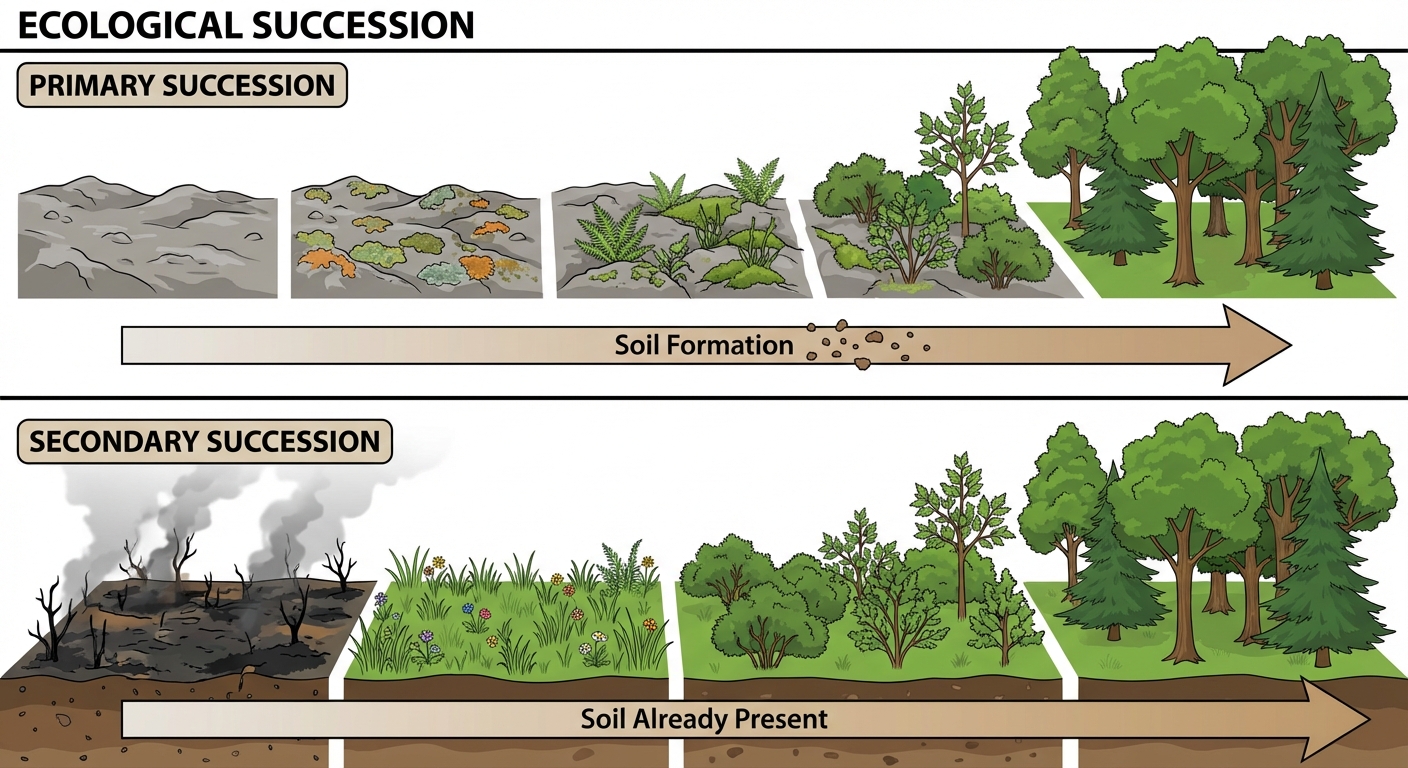
Ecological Succession is the gradual process described by the predictable replacement of one group of species by another group of species over time. This process continues until a stable, distinct community is established.
1. Primary Succession
This type of succession occurs in an area that has no soil and no previous life.
- Starting Condition: Bare rock.
- Causes: Volcanic eruptions (lava flow), retreating glaciers (scraping earth down to bedrock).
- The Process:
- Pioneer Species arrive. In primary succession, these are typically lichens and mosses. They secrete acids that chemically weather the rock, breaking it down.
- Physical weathering (wind/rain) and the decomposition of dead lichens begin to form the first thin layer of soil.
- Once soil is present, small annual plants (weeds/grasses) can take root, adding organic matter to the soil upon death.
- Shrubs and shade-intolerant trees (like pine) grow.
- Large, shade-tolerant trees (like oak or hickory) eventually dominate.
2. Secondary Succession
This occurs in an area that has been disturbed but where soil remains intact.
- Starting Condition: Soil is present.
- Causes: Forest fires, hurricanes, floods, or abandoned agricultural fields.
- The Process:
- Since soil is already present, the process is much faster than primary succession.
- Pioneer Species: Grasses and wildflowers (seeds are often dormant in the soil or blown in by wind).
- The progression moves quickly to shrubs and trees.
3. Key Concepts in Succession
- Pioneer Species: The first members of a community to inhabit a new habitat. They typically have broad ranges of tolerance for harsh conditions.
- Climax Community: Historically defined as the final, stable stage of succession (e.g., an old-growth forest). Note: Modern ecology acknowledges that communities are always shifting due to disturbances, but "Climax Community" is still a tested term.
- Keystone Species: A species on which other species in an ecosystem largely depend; if it were removed, the ecosystem would change drastically (e.g., Beavers, Sea Otters, Wolves).
- Indicator Species: An organism whose presence, absence, or abundance reflects a specific environmental condition (e.g., Amphibians indicate water quality).
Comparison: Primary vs. Secondary Succession
| Feature | Primary Succession | Secondary Succession |
|---|---|---|
| Starting State | Bare Rock | Soil Present |
| Time Scale | Very Slow (Hundreds/Thousands of years) | Relatively Fast (Decades/Centuries) |
| Pioneer Species | Lichens, Moss (must break down rock) | Grasses, Weeds (soil ready for roots) |
| Typical Event | Volcanic Eruption, Glacial Retreat | Wildfire, Hurricane, Deforestation |
Common Mistakes & Pitfalls
Soil Formation Confusion:
- Mistake: Thinking secondary succession creates soil.
- Correction: Soil formation is the defining characteristic of Primary Succession. In Secondary Succession, the soil is already there.
"Disruption" = "Bad":
- Mistake: Assuming all ecosystem disruptions are negative.
- Correction: Many ecosystems require disruption. For example, some pine cones (serotinous cones) only open to release seeds during the heat of a fire. Periodic disturbances can increase biodiversity by creating different habitats.
Timescale Misconceptions:
- Mistake: Thinking climate change is only a modern, human-caused phenomenon.
- Correction: The climate changes naturally (Milankovitch cycles, etc.). However, for the AP exam, distinguish between natural rates of change (slow) vs. anthropogenic rates of change (very fast), which makes adaptation difficult.