Unit 1: The Global Tapestry — Regional Deep Dive (c. 1200–1450)
Topic 1.1: Developments in East Asia
In the period from c. 1200 to c. 1450, East Asia was dominated by the Song Dynasty in China. This era is characterized by political stability through bureaucratic systems, immense technological innovation, and the continuing influence of Confucianism across the region.
Government and Politics: The Song Bureaucracy
The Song Dynasty (960–1279) utilized traditional methods of Confucianism and an imperial bureaucracy to maintain and justify its rule.
The Civil Service Examination
This was the machinery behind the Chinese government. It was a meritocratic system where men took rigorous exams on Confucian texts to enter the bureaucracy.
- Meritocracy: Allowed for upward social mobility (in theory), though the wealthy still had better access to education.
- Scholar-Gentry: This new class of bureaucrats outcome the landed aristocracy as the most influential social group.
Economy: The Proto-Industrial Giant
The Song economy flourished due to increased productive capacity, expanding trade networks, and innovations in agriculture and manufacturing.
Agricultural Innovation
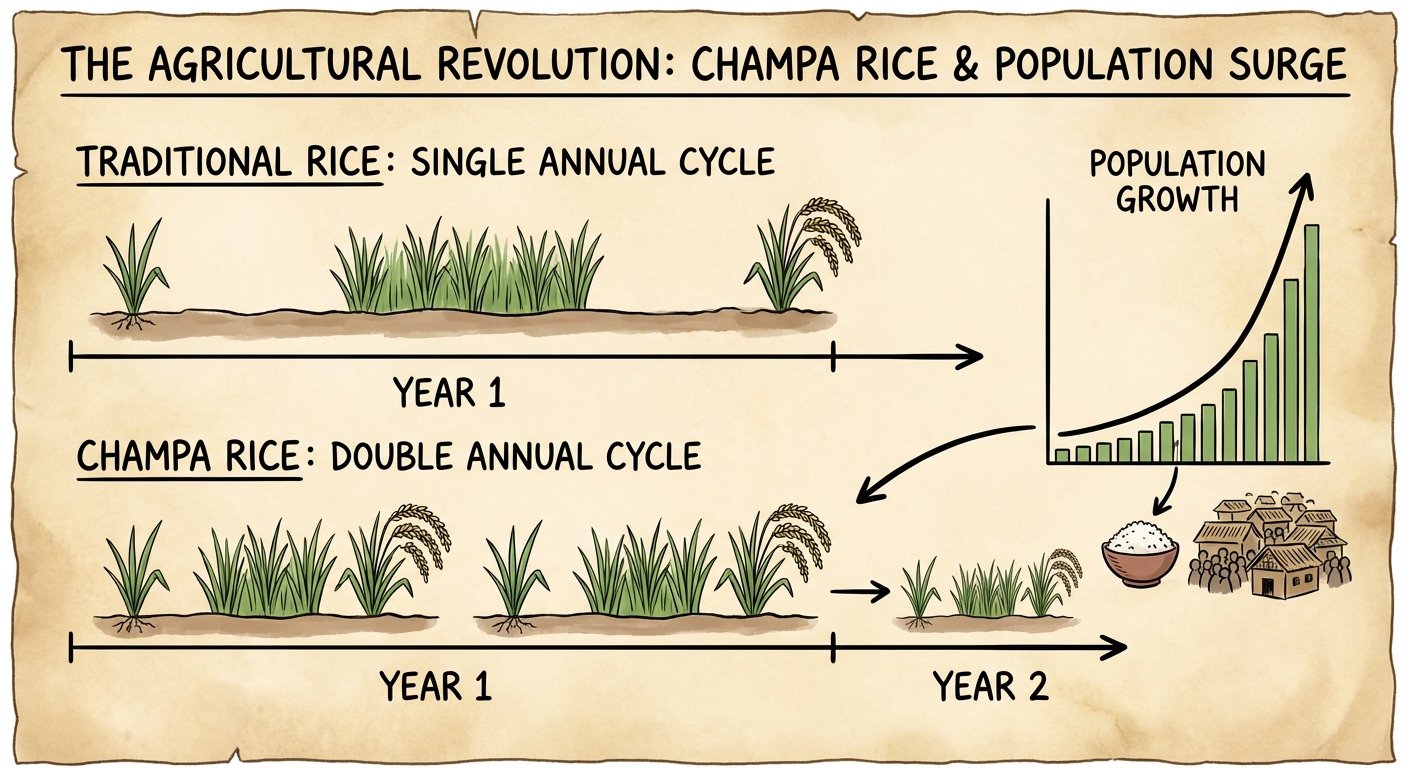
The introduction of Champa Rice from Vietnam was a turning point. It was a fast-ripening, drought-resistant strain that allowed for two harvests per year.
- Result: $Food \uparrow \rightarrow Population \uparrow$. China's population jumped from roughly 25% of the world's population to nearly 40% during this era.
The Grand Canal
The Song expanded the Grand Canal, an internal waterway transportation system that extended over 30,000 miles. It linked the food-rich Yangtze River valley in the south to the populous northern cities, creating a unified national economy.
Key Technologies
- Gunpowder: Initially used for fireworks, then adapted for military use (guns/bombs).
- Woodblock Printing: Lowered the cost of books, increasing literacy and helping the spread of Confucian texts.
- Use of Coal: Allowed for the mass production of iron and steel.
Cultural Traditions: Neo-Confucianism
During this period, Buddhism (which had come from India via the Silk Roads) remained significant, but the government promoted Neo-Confucianism.
- Definition: A syncretic philosophy that combined the rational thought of Confucianism with the metaphysical elements of Taoism and Buddhism.
- Social Impact: It reinforced hierarchy and Filial Piety (duty to family and elders).
- Gender Roles: Patriarchy largely intensified. The practice of foot binding became widespread among aristocratic women, signifying social status but restricting women's movement and participation in the public sphere.
East Asian Sphere of Influence (Sinification)
China's neighbors struggled with its massive influence.
| Region | Relationship with China | Key Difference |
|---|---|---|
| Japan | Voluntarily adopted Chinese culture but retained political distinctiveness. | Decentralized Feudalism (Shoguns/Daimyos) vs. China's Centralized Bureaucracy. |
| Korea | Strong tributary relationship; modeled government on China. | Aristocracy was more powerful; civil service exams were not open to peasants. |
| Vietnam | Adversarial relationship; launched violent rebellions against Chinese influence. | Women had higher status and independence; rejected foot binding and polygyny. |
Topic 1.2: Developments in Dar al-Islam
While the Abbasid Caliphate was politically fragmentation during this period, the Islamic world continued to flourish culturally and intellectually.
Political Fragmentation
The Abbasid Caliphate (centered in Baghdad) was fading. In its place, new Islamic political entities emerged, often dominated by Turkic peoples rather than Arabs.
1. The Mamluk Sultanate (Egypt)
Mamluks were enslaved ethnic Turks purchased by Arabs to serve as soldiers. They eventually seized control of the government in Egypt and established a Sultanate (1250–1517). They prospered by facilitating trade in cotton and sugar between the Islamic world and Europe.
2. The Seljuk Turks
Originating from Central Asia, these Muslims conquered parts of the Middle East, including Baghdad. Their leader took the title Sultan, reducing the Abbasid Caliph to a religious figurehead.
Intellectual Innovations (The Golden Age)
Even as states fractured, the cultural region (Dar al-Islam) remained linked by trade and faith. Scholars preserved and expanded upon knowledge from ancient Greece, India, and Persia.
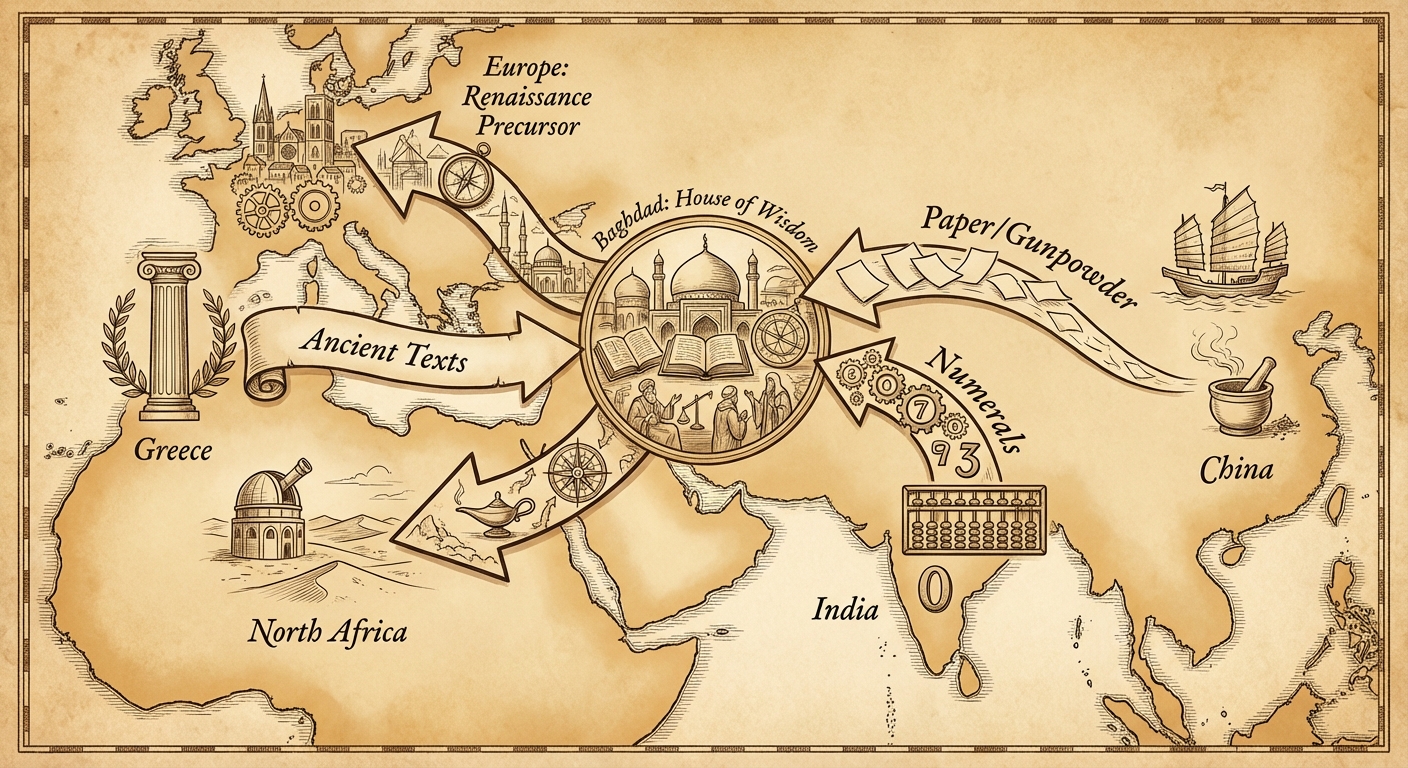
Key Transfers
- House of Wisdom (Baghdad): A major academic center for research and translation until destroyed by the Mongols in 1258.
- Mathematics: Nasir al-Din al-Tusi made significant contributions to astronomy and trigonometry.
- Literature: ‘A’ishah al-Ba’uniyyah was a prolific female Sufi writer and poet, highlighting the active role of women in Sufi orders.
- Medicine: Medical encyclopedias and hospital systems were far advanced compared to Europe at the time.
Religious Developments: Sufism
Sufism is a mystical branch of Islam focusing on introspection and a personal spiritual connection with God (Allah).
- Missionary Work: Because Sufis were adaptable and incorporated local traditions, they were crucial in spreading Islam to India and Southeast Asia.
Topic 1.3: Developments in South and Southeast Asia
This region is defined by the interaction between indigenous Hinduism and Buddhism, and the arrival of Islam via trade and conquest.
South Asia (India)
Culturally, South Asia remained predominantly Hindu, with a rigid Caste System that provided social stability.
Political Structures
- The Delhi Sultanate (North India): An Islamic empire promoting Islam in a Hindu-majority land. They imposed the Jizya (tax on non-Muslims). Most converts to Islam were low-caste Hindus hoping to improve their social status or Buddhists whose temples were corrupted/raided.
- The Vijayanagara Empire (South India): Established by two brothers sent by the Delhi Sultanate who then converted back to Hinduism. It served as a barrier against Islamic invasion from the north.
Religious Reform: The Bhakti Movement
Similar to Sufism, the Bhakti Movement was a Hindu reform movement focusing on a strong personal attachment to a specific deity rather than studying texts or performing rituals. It did not discriminate against women or low social status.
Southeast Asia
Strategically located between China and India, this region controlled critical trade routes (Indian Ocean Trade).
Sea-Based Empires
Power here came from controlling sea lanes (navy and taxes).
- Srivijaya Empire (Sumatra): A Hindu-Buddhist kingdom that grew wealthy by taxing trade passing through the Strait of Malacca.
- Majapahit Kingdom (Java): A Buddhist empire that succeeded Srivijaya; controlled sea routes and focused on tributary systems.
Land-Based Empires
- Khmer Empire (Angkor Kingdom): Located in present-day Cambodia/Thailand. Famous for the Angkor Wat temple complex.
- Significane: The temples show a shift from Hinduism to Buddhism over time, reflecting the region's changing religious landscape.
Common Mistakes & Pitfalls
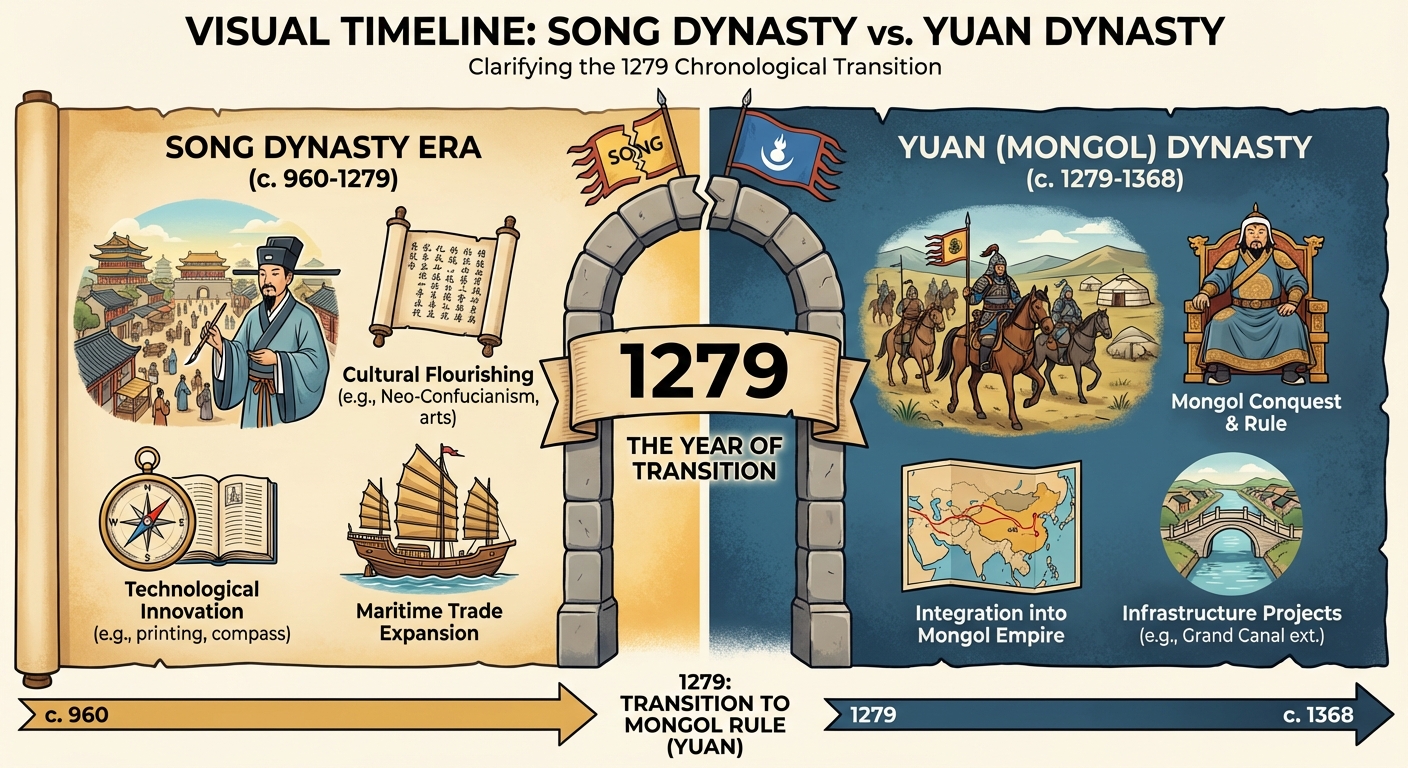
Confusing the Timeline of the Mongols: Students often think the Mongols destroyed the Song Dynasty immediately in 1200.
- Correction: In 1200, the Song are still strong. The Mongols take over China (Yuan Dynasty) near the end of this unit (1279). Don't start your essay with Kublai Khan if the prompt is about the Song economy.
Assuming Islam "Deleted" Hinduism: The Delhi Sultanate ruled N. India, but the vast majority of the population remained Hindu.
- Correction: There was conflict, but also profound syncretism (architecture, Qutub Minar, Urdu language). Islam did NOT replace Hinduism in India like it did Christianity in North Africa.
Neglecting Southeast Asia: Students frequently skip the Srivijaya or Khmer Empires.
- Correction: AP exams love asking about state-building in this region because it demonstrates the synthesis of foreign influence (Indian religions) with local governance.
Misunderstanding "Feudalism":
- Correction: Japan had feudalism (Daimyo/Samurai) similar to Europe. China did NOT have feudalism during this period; it was a centralized bureaucracy.