Unit 7 Study Guide: Evolutionary History and Speciation
Phylogenetic Trees and Cladistics
Phylogeny is the evolutionary history of a species or group of related species. To visualize this history, biologists use phylogenetic trees and cladograms. These are diagrams that represent distinct hypotheses about evolutionary relationships.
Reading the Tree
Understanding the anatomy of these diagrams is crucial for the AP exam. Relationships are defined by common ancestry, not just physical similarity.
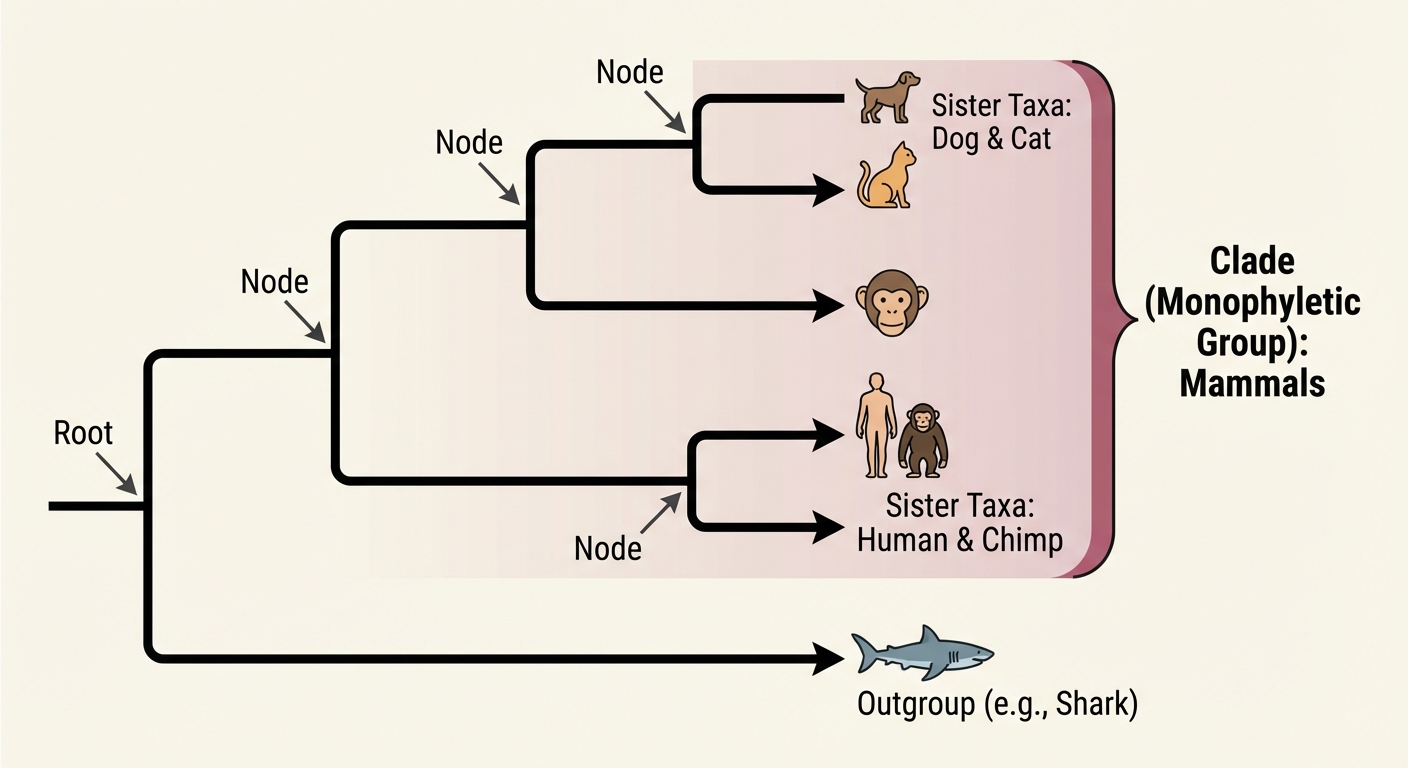
- Node (Branch Point): Represents the most recent common ancestor (MRCA) of all the lineages derived from it. Divergence occurs here.
- Root: The common ancestor of all species included in the diagram.
- Sister Taxa: Groups of organisms that share an immediate common ancestor. They are each other's closest relatives.
- Outgroup: A lineage that diverges early in the history of a group. It is used as a reference point to distinguish derived traits (newly evolved) from ancestral traits (original state).
- Clade: A group of species that includes an ancestral species and all its descendants (also known as a monophyletic group).
Constructing Phylogenies
Scientists construct trees using varying types of data. When data conflicts, the Principle of Parsimony (Occam's Razor) implies that the simplest explanation—the tree requiring the fewest evolutionary events (mutations or physical changes)—is most likely the correct one.
Morphological vs. Molecular Data
- Morphological Homologies: Similarities resulting from common ancestry (e.g., the bone structure of a whale flipper and a bat wing). Be careful not to confuse these with analogous structures caused by convergent evolution (e.g., wings of a bird and wings of a bee).
- Molecular Data: DNA sequences and amino acid sequences. This is currently considered the most reliable evidence.
- Rule of Thumb: The more differences in the DNA/protein sequence between two species, the further back in time their common ancestor existed.
- Molecular Clocks: Some genes mutate at a relatively constant rate, allowing scientists to estimate the absolute time of evolutionary change.
Speciation
Speciation is the process by which one species splits into two or more species. It forms the bridge between microevolution (changes in allele frequencies) and macroevolution (broad patterns of evolutionary change).
The Biological Species Concept
According to this concept, a species is a group of populations whose members have the potential to interbreed in nature and produce viable, fertile offspring but do not produce viable, fertile offspring with members of other such groups.
Note: This concept hinges on Reproductive Isolation. If gene flow stops between two populations, they are independent evolutionary units.
Barriers to Reproduction
Barriers are classified based on whether they prevent fertilization (Prezygotic) or occur after fertilization (Postzygotic).
| Barrier Type | Category | Description | Example |
|---|---|---|---|
| Habitat Isolation | Prezygotic | Species occupy different habitats but same area. | Water snakes vs. land snakes. |
| Temporal Isolation | Prezygotic | Species breed at different times of day/season. | Eastern vs. Western Spotted Skunks. |
| Behavioral Isolation | Prezygotic | Unique rituals/courtships attract mates. | Blue-footed booby mating dance. |
| Mechanical Isolation | Prezygotic | Morphological differences prevent mating. | Snails with shells spiraling opposite ways. |
| Gametic Isolation | Prezygotic | Sperm cannot fertilize the egg. | Sea urchin proteins on sperm/egg don't bind. |
| Reduced Hybrid Viability | Postzygotic | Hybrid development is impaired; frail offspring. | Salamander subspecies hybrids. |
| Reduced Hybrid Fertility | Postzygotic | Hybrid is vigorous but sterile. | Mule (Donkey + Horse). |
| Hybrid Breakdown | Postzygotic | First gen is fertile; second gen is feeble/sterile. | Specialized rice strains. |
Modes of Speciation
Speciation is often categorized by how gene flow is initially interrupted.
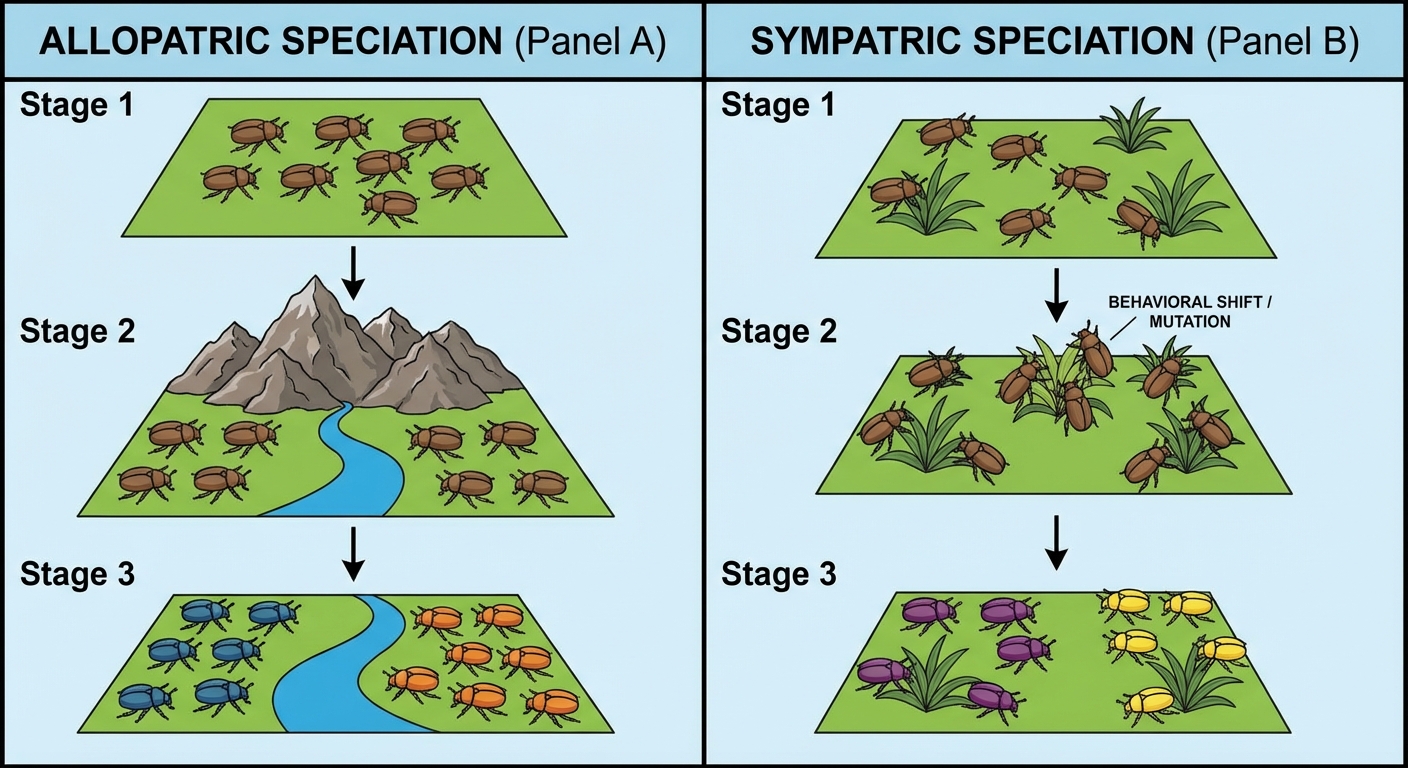
1. Allopatric Speciation ("Other Country")
This occurs when gene flow is interrupted by a geographic barrier (mountains, rivers, islands). Once separated, the gene pools diverge via mutation, natural selection, and genetic drift.
- Example: Ground squirrels separated by the formation of the Grand Canyon developed into two distinct species on opposite rims.
2. Sympatric Speciation ("Same Country")
Speciation occurs in geographically overlapping populations. This is rarer than allopatric speciation and requires specific mechanisms to reduce gene flow:
- Polyploidy: An accident during cell division results in extra sets of chromosomes. This is very common in plants (e.g., wheat, tobacco). Immediate reproductive isolation occurs because the new polyploid cannot breed with the diploid parent population.
- Sexual Selection: Females select males based on specific coloration, creating a reproductive barrier within a single lake (e.g., Cichlids in Lake Victoria).
- Habitat Differentiation: A subpopulation exploits a habitat or resource not used by the parent population.
Rates of Speciation
- Gradualism: Evolution proceeds slowly and at a constant rate over long periods.
- Punctuated Equilibrium: Species exhibit long periods of stasis (no change) punctuated by sudden, rapid change. This is often supported by the fossil record.
Extinction and Biodiversity
Extinction is the termination of a lineage. It is a natural part of evolutionary history, but rates can vary.
Background vs. Mass Extinction
- Background Extinction: The standard rate of extinction in earth's geological history before humans became a primary contributor. It usually occurs due to normal ecological competition.
- Mass Extinction: A widespread and rapid decrease in the biodiversity on Earth. There have been five major mass extinctions (e.g., the Permian, the Cretaceous).
- Cause: Usually typically catastrophic environmental changes (volcanism, meteorites, rapid climate shifts).
Adaptive Radiation
Extinction events are almost always followed by adaptive radiation: periods of evolutionary change in which groups of organisms form many new species whose adaptations allow them to fill different ecological roles (niches) in their communities.
- Mechanism: When a dominant group goes extinct (e.g., Dinosaurs), they leave ecological niches vacant. Surviving organisms (e.g., Mammals) rapidly diversify to fill those spots.
Human Impact
Many scientists argue we are currently in a "Sixth Mass Extinction" driven by human activity (habitat destruction, climate change, introduced species). Species with low genetic diversity are at the highest risk because they lack the genetic variation necessary to adapt to changing environmental conditions.
Common Mistakes & Pitfalls
"Higher" vs. "Lower" Animals:
- Mistake: Thinking that taxa at the top or right of a phylogenetic tree are "more evolved" than those on the left/bottom.
- Correction: All lineages alive today have been evolving for the same amount of time. A tree shows relatedness, not a ladder of progress.
Rotating Nodes:
- Mistake: Assuming that changing the order of tips across the top of the tree changes the relationships.
- Correction: You can swivel the branches around a node without changing the evolutionary information. Always look at the branching pattern (who shares a node), not the horizontal order.
Lamarckian Views on Extinction:
- Mistake: Believing species "try" to adapt to avoid extinction.
- Correction: Adaptation is not a choice. If the population does not possess the alleles for survival when the environment changes, they will go extinct.
Species Concepts:
- Mistake: Applying the Biological Species Concept to fossils or asexual organisms (bacteria).
- Correction: The biological concept requires sexual reproduction. For fossils or bacteria, scientists use morphological or genetic species concepts.