AP Microeconomics Unit 1: Foundations & Systems
Unit 1: Basic Economic Concepts
1.1 Scarcity and Resources
The Fundamental Economic Problem
Scarcity is the central concept of economics. It is the condition that results from society not having enough resources to produce all the things people would like to have.
- Definition: Scarcity exists because human wants are unlimited, but the resources available to satisfy those wants are limited.
- Universal Truth: It applies to everyone—individuals, businesses, and governments—regardless of wealth. Even the richest person on earth has a scarcity of time.
- It is NOT poverty: Scarcity is a permanent condition; shortages are temporary.
Key Principle: Because of scarcity, choices must be made. Every choice involves a cost.
Microeconomics vs. Macroeconomics
- Microeconomics: The study of decision-making by individuals, households, and firms and their interaction in specific markets. (e.g., The price of oranges, the decision of a worker to work overtime).
- Macroeconomics: The study of the economy as a whole. It focuses on broad aggregates such as inflation, unemployment, and economic growth.
Factors of Production
To produce goods and services, an economy needs resources. These are categorized into four distinct groups known as the Factors of Production:
- Land: All natural resources used in production (e.g., water, oil, timber, minerals, the physical ground).
- Labor: All physical and mental effort used by humans in production for which they are paid (e.g., a teacher, a construction worker).
- Capital:
- Physical Capital: Human-made objects used to create other goods and services (e.g., machinery, factories, tools, robots).
- Human Capital: The knowledge and skills a worker gains through education and experience (e.g., a degree in engineering, coding skills).
- Crucial Distinction: Financial Capital (money, stocks, bonds) is NOT a factor of production in economics. Money facilitates trade but produces nothing itself.
- Entrepreneurship: The person who combines the other three factors to create a new good or service. Entrepreneurs take risks to obtain a profit.
Positive vs. Normative Economics
- Positive Economics: Based on facts and cause-and-effect relationships. It avoids value judgments. These statements can be tested or proven.
- Example: "The unemployment rate is 5%."
- Normative Economics: Based on value judgments, opinions, or what "ought" to be. These cannot be proven true or false.
- Example: "The government should lower the unemployment rate because it is too high."
1.2 Opportunity Cost and Economic Systems
Trade-offs and Opportunity Cost
Because of scarcity, every decision involves a trade-off—all the alternatives that we give up whenever we choose one course of action over another.
- Opportunity Cost: The most desirable alternative given up as the result of a decision. It is the "next best thing."
- Formulaic thinking: If you have a choice between studying, sleeping, and gaming, and you choose to study, your opportunity cost is only the one activity you would have done otherwise (e.g., sleeping), not the sum of all other activities.
Economic Systems
Every society occupies an economic system to answer the Three Basic Economic Questions:
- What goods and services should be produced?
- How should these goods and services be produced?
- For whom should these goods and services be produced?
Types of Systems
| System | Characteristics | Pros/Cons |
|---|---|---|
| Centrally Planned (Command) | The Government owns resources and answers the 3 questions. (e.g., North Korea, former USSR). | Pro: Low unemployment, job security. Con: No profit incentive, lack of innovation, frequent shortages/surpluses. |
| Free Market (Laissez-Faire) | Individuals/Firms own resources. The "Invisible Hand" (profit motive and competition) regulates the economy. | Pro: High innovation, variety, efficiency. Con: Market failures, high inequality, potential monopolies. |
| Mixed Economy | A blend of both. Individuals own resources, but the government intervenes to regulate and provide public goods. | Pro: Balances freedom with safety nets. Characteristics: Most modern economies (USA, China, UK) are mixed. |
1.3 The Production Possibilities Curve (PPC)
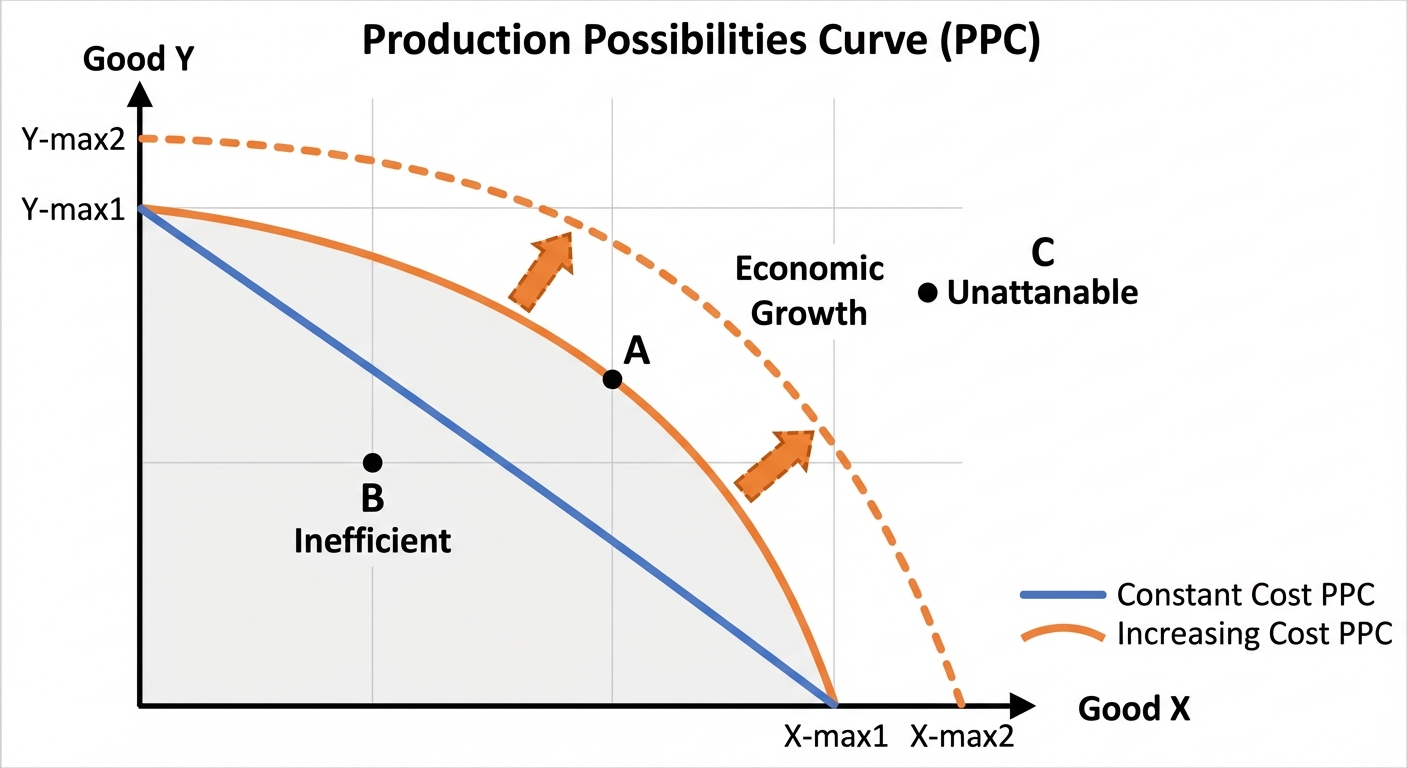
The PPC (or PPF) is a graphical model that shows the alternative ways that an economy can use its scarce resources.
Key Concepts of the PPC
- Assumptions:
- Only two goods can be produced.
- Full employment of resources.
- Fixed resources (ceteris paribus).
- Fixed technology.
Interpreting Points on the Graph
- On the Curve (Points A, B, C): Represents Efficiency. The economy is using all resources to their fullest potential.
- Productive Efficiency: Producing in the least costly way (any point on the line).
- Allocative Efficiency: Producing the specific mix of goods that society desires (a specific point on the line).
- Inside the Curve (Point D): Represents Inefficiency or unemployment. Resources are being underutilized.
- Outside the Curve (Point E): Represents the Impossible/Unattainable with current resources. To reach this, the curve must shift.
Shape of the Curve: Opportunity Cost
- Constant Opportunity Cost: A straight line PPC. This indicates that resources are easily adaptable for producing either good (e.g., Pizza vs. Calzones).
- Increasing Opportunity Cost: A bowed-out (concave) PPC. This indicates that resources are NOT easily adaptable. As you produce more of one good, you must give up increasing amounts of the other (e.g., Cactus vs. Pineapples).
- Law of Increasing Opportunity Cost: As you shift production from one good to another, calculation of the opportunity cost increases because you are using resources that are less and less suitable for the new task.
Shifting the PPC
The PPC shifts outward (economic growth) or inward (recession) due to the 3 Shifters:
- Change in Resource Quantity: More workers, new land discovered.
- Change in Resource Quality: Better education (human capital), healthier soil.
- Change in Technology: New machines, automation.
1.4 Comparative Advantage and Trade
Trade consists of specialization. Countries should produce what they are "best" at and trade for the rest.
Absolute vs. Comparative Advantage
- Absolute Advantage: The ability to produce more of a good or produce it faster (using fewer resources) than another producer.
- Look for: Who has the higher number (for output) or lower number (for time/input)?
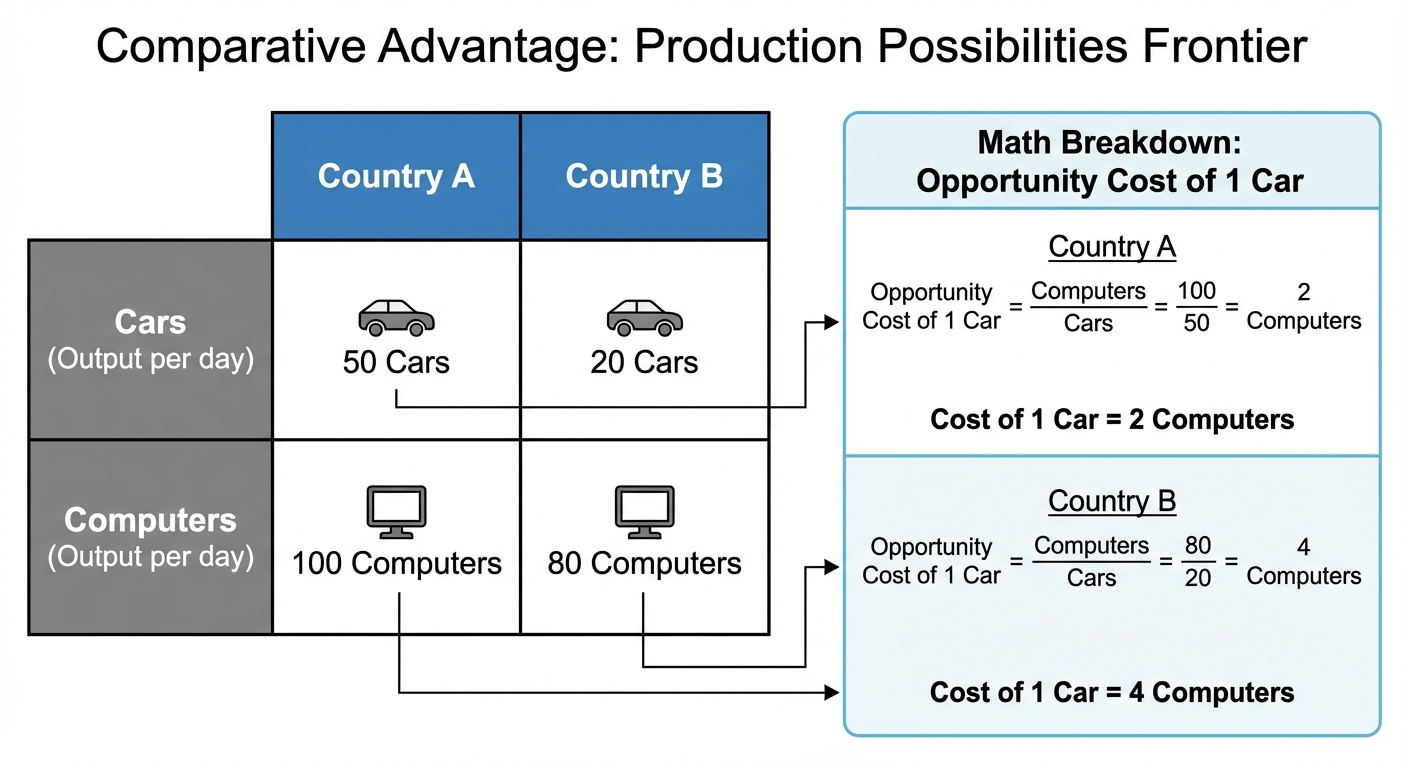
- Comparative Advantage: The ability to produce a good at a lower opportunity cost than another producer.
- Rule: A country should specialize in the good for which it has a comparative advantage.
Calculating Opportunity Cost (The Math)
There are two types of problems: Output and Input. You generally calculate the "Per Unit Opportunity Cost".
1. Output Problems (OOO: Output Other Goes Over)
Data shows how much product is made with a fixed amount of resources.
- Example: US makes 20 Planes or 40 Trucks.
- To find the cost of 1 Plane: Put the "Other" (Trucks) Over the Planes.
2. Input Problems (IOU: Input Other Goes Under)
Data shows how many resources (hours/acres) it takes to make ONE unit.
- Example: It takes US 2 hours to bake bread, 6 hours to bake a cake.
- To find the cost of 1 Bread: Put the "Other" (Cake hours) Under the Bread hours.
Terms of Trade
For trade to be mutually beneficial, the trading price must fall between the two countries' opportunity costs.
- Scenario:
- Country A opportunity cost for 1 Apple = 2 Pears.
- Country B opportunity cost for 1 Apple = 4 Pears.
- Terms of Trade: 1 Apple for 3 Pears is beneficial (Between 2 and 4).
1.5 Cost-Benefit Analysis
Rational agents make decisions by comparing Marginal Benefits to Marginal Costs.
Key Definitions
- Marginal: Additional or extra (concept: "one more").
- Marginal Benefit (MB): The additional satisfaction gained from consuming one more unit.
- Marginal Cost (MC): The additional cost incurred from producing/consuming one more unit.
Decision Rule
Stop doing it when $MB = MC$ (or typically, just before MC exceeds MB).
Types of Costs
- Explicit Costs: Traditional out-of-pocket payments (wages, rent, materials). This is what accountants care about.
- Implicit Costs: The opportunity cost of using resources the firm already owns (forgone salary, forgone rent on land you own). This is what economists care about.
1.6 Marginal Analysis and Consumer Choice
Utility Maximization
- Utility: A measure of satisfaction, measured in "utils".
- Law of Diminishing Marginal Utility: As you consume more units of a specific good, the additional satisfaction (marginal utility) from each subsequent unit eventually decreases.
- Example: The first slice of pizza is amazing (10 utils). The fifth slice makes you feel sick (-2 utils).
The Utility Maximization Rule
When a consumer has a limited budget and wants to maximize total utility with a combination of two goods (X and Y), they follow this rule:
Where:
- $MU_x$ = Marginal Utility of Good X
- $P_x$ = Price of Good X
How to solve:
- Calculate the "Marginal Utility per Dollar" ($MU/P$) for both goods.
- If $\frac{MUx}{Px} > \frac{MUy}{Py}$, buy more of Good X (this lowers its MU) and less of Good Y.
- Continue until the ratios are equal and the budget is exhausted.
Unit 1 Common Mistakes & Pitfalls
- Money is Capital:
- Mistake: Thinking money is a factor of production.
- Correction: Money is NOT capital. Tools and machinery are capital.
- PPC Shift vs. Movement:
- Mistake: Thinking unemployment shifts the PPC curve inward.
- Correction: Unemployment is a point inside the curve. The curve only shifts if the capacity to produce changes (resources/tech).
- Comparative Advantage Calculation:
- Mistake: Using the Output method (Other Over) for an Input problem.
- Correction: Always check the table header. Does it say "Tons produced" (Output) or "Hours required" (Input)? Use IOU for inputs.
- Zero Opportunity Cost:
- Mistake: Assuming "free" goods have no cost.
- Correction: There is always an opportunity cost (time/effort), even if the monetary price is zero.
- Comparative Advantage Limits:
- Mistake: Thinking one country can have a Comparative Advantage in everything.
- Correction: It is mathematically impossible. If Country A has a Comp Adv in Good X, Country B must have it in Good Y.