Eye-Witness to Destruction: Pliny and the Eruption of Vesuvius
Historical and Cultural Context
The Bay of Naples (Campania)
To understand the gravity of Pliny's letters, you must understand the geography. The eruption took place on August 24, 79 AD (though some archaeological evidence suggests late October). The events unfold across the Bay of Naples.
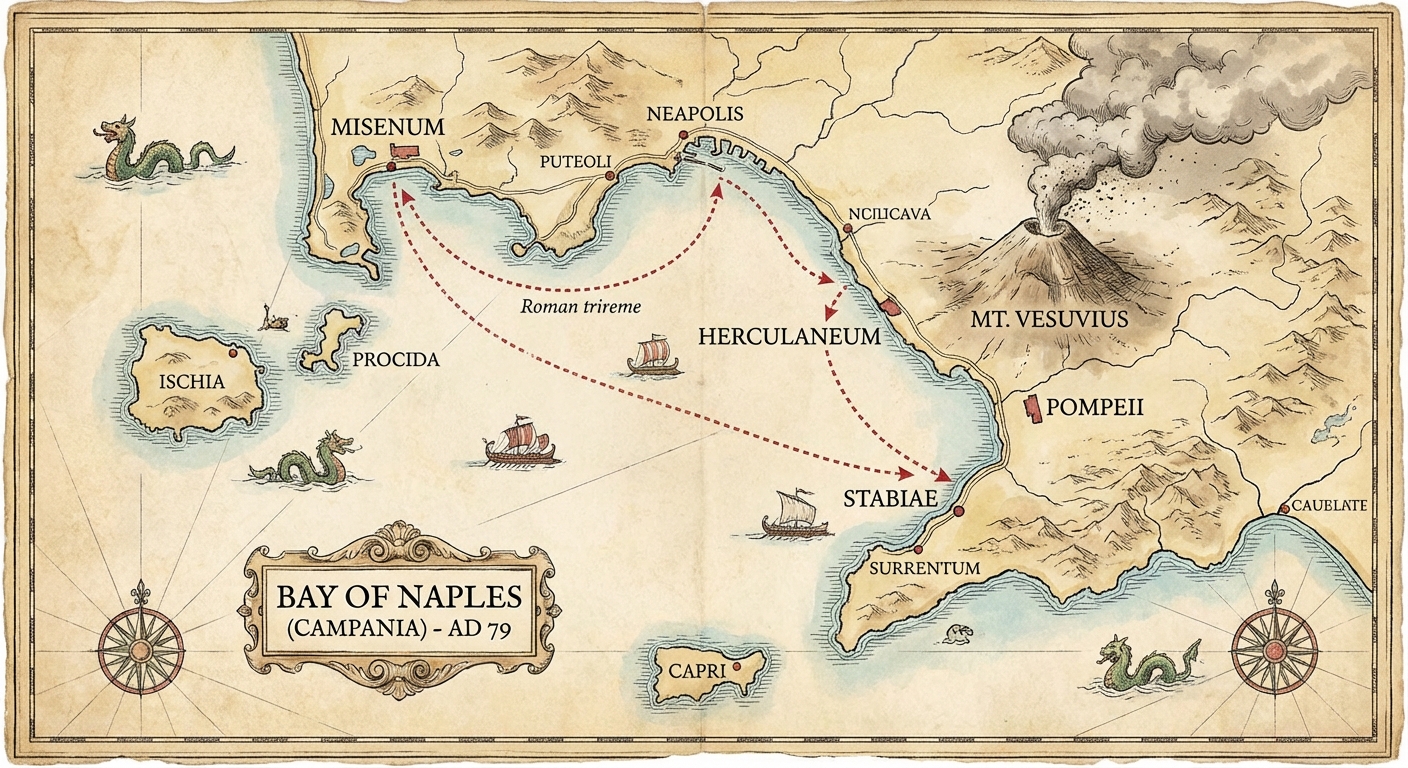
- Misenum: The location of the Roman naval base where Pliny the Elder was the admiral (praefectus classis) and where Pliny the Younger and his mother stayed initially.
- Mt. Vesuvius: The volcano located centrally between Herculaneum and Pompeii.
- Stabiae: The town south of Pompeii where Pliny the Elder eventually died.
- Herculaneum & Pompeii: The two major cities destroyed (though Pliny the Elder was attempting a rescue toward the coast near Herculaneum before diverging to Stabiae).
The Key Figures
- Gaius Plinius Caecilius Secundus (Pliny the Younger): The author of the letters. He was approximately 17 years old during the eruption. He writes these letters later in life (c. 106 AD).
- Gaius Plinius Secundus (Pliny the Elder): The uncle and adoptive father of the author. A thirst for knowledge (naturalis historia) and duty defined him. He died attempting to rescue friends and investigate the phenomenon.
- Cornelius Tacitus: The recipient of the letters. A famous Roman historian. Pliny writes to him so that his uncle's death may be recorded in history, granting him immortality through literature.
Epistula VI.16: The Death of a Hero
This letter focuses entirely on the actions and death of Pliny the Elder. It contrasts his scientific curiosity with his heroic duty.
The Phenomenon: The Umbrella Pine
Pliny famously compares the eruption cloud to a stone pine tree (pinus). This is one of the most famous similes in Latin literature.
"Nubes — incertum procul intuentibus ex quo monte… — similitudinem et formam non alia magis arbor quam pinus expresserit."
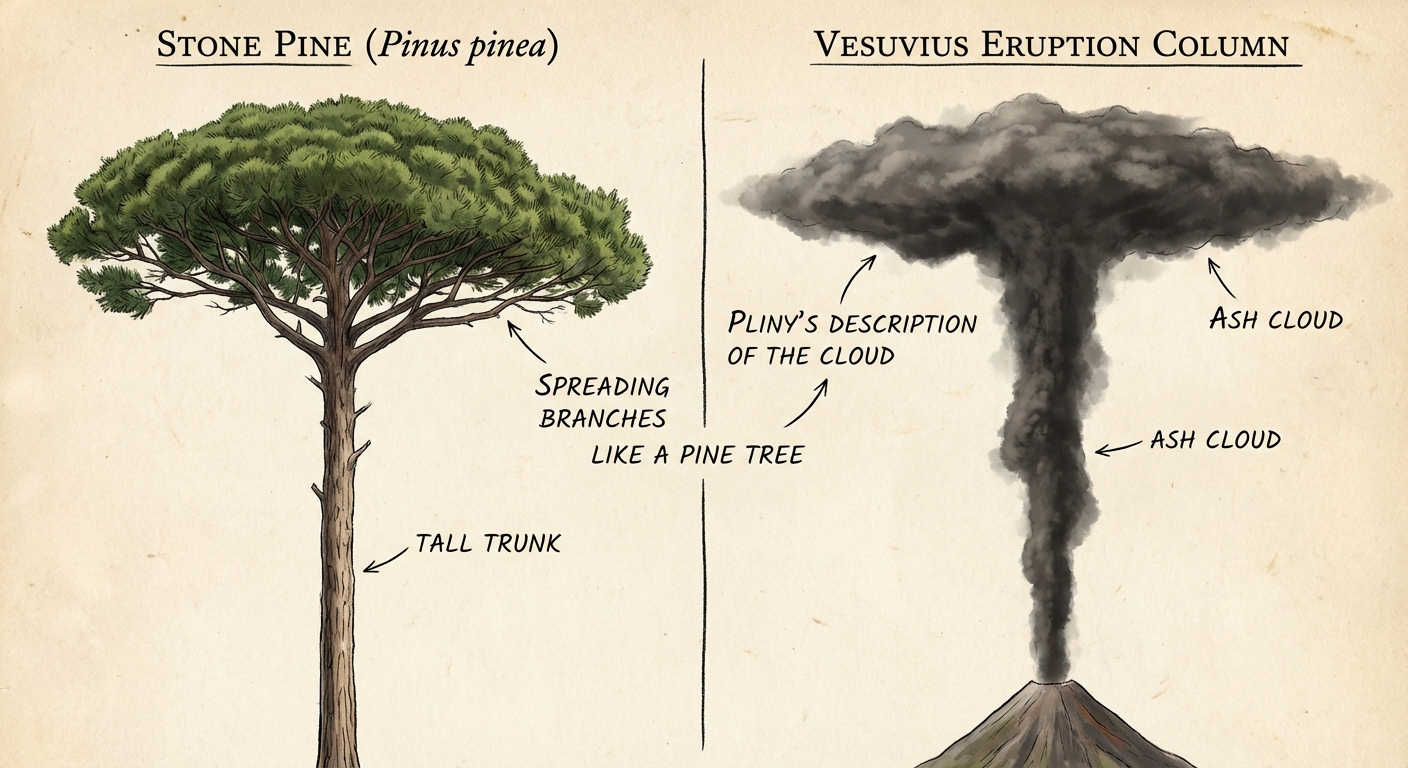
- Visual Logic: The cloud shot up high on a "trunk" (column of smoke) and then spread out into "branches" (debris/ash) as it lost momentum or hit atmospheric layers.
- Scientific Observation: This accurately describes a Plinian eruption (named after him).
The Narrative Arc of VI.16
- Observation: At Misenum, the Elder sees the cloud. He orders a light ship (liburnica) to inspect it (Scientific motivation).
- Call to Duty: He receives a message from Rectina (wife of Tascius), who is trapped at the foot of the volcano. His motivation shifts from science to heroism.
- Into Danger: He heads straight into the danger zone while others are fleeing (rectum cursum, recta gubernacula in periculum tenet).
- Stoicism: As ash falls on the ship, the helmsman advises turning back. Pliny delivers the famous line:
> "Fortes fortuna iuvat: Pomponianum pete."
(Fortune favors the brave: seek Pomponianus.) - Death at Stabiae: They land at Stabiae (at the house of Pomponianus). Steps taken to calm fear:
- He bathes.
- He eats dinner cheerfully.
- He sleeps (actually snoring due to his size).
- The End: The courtyard fills with ash. They decide to flee with pillows tied to their heads for protection against falling rocks (pumice). The air fills with sulfur/fumes. Pliny the Elder collapses (likely a heart attack or asthma exacerbated by gas) and dies.
Epistula VI.20: The Survivor's Tale
This letter is the sequel, requested by Tacitus, focusing on what Pliny the Younger underwent at Misenum.
Themes: Panic vs. Rationality
- The Earthquakes: The ground shook so violently that carriages wouldn't stay still even when wedged with stones.
- The Tsunami: Pliny describes the sea being "sucked back" (mare in se resorberi) leaving sea creatures stranded on the dry sand.
- The Cloud Descends: A black, terrifying cloud (nubes atra et horrenda) descends on the land, described like a torrent or flood, not just smoke.
The Literary Highlight: Reading Livy
To demonstrate his (perhaps exaggerated) Stoic calm or youthful indifference, Pliny claims that amidst the terrifying earthquakes, he sat down and requested a volume of Titus Livius (Livy) to read and take notes.
Rhetorical and Stylistic Devices
Pliny uses sophisticated rhetoric to make the scene vivid (enargeia).
| Device | Definition | Example from Text | Effect |
|---|---|---|---|
| Simile | Comparison using "like" or "as" (ut, similis) | The cloud likened to a pine tree (pinus). | Visual clarity for the reader. |
| Asyndeton | Omission of conjunctions | "Abiit, excessit, evasit, erupit" (Ciceronian style) or rapid lists of actions. | Creates a sense of speed and panic. |
| Chiasmus | ABBA word order | Arrangement of nouns and adjectives. | Highlights contrast or balance. |
| Litotes | Double negative | "Non solum… sed etiam" structures or denying the opposite. | Emphasizes the severity of the situation. |
| Historical Infinitive | Using infinitive verbs as main verbs | "Illi… trepidare… " (They began to tremble). | Used in VI.20 to convey rapid, chaotic action without defining person/time. |
Key Grammatical Construction: The Ablative Absolute
Pliny relies heavily on the Ablative Absolute to set scenes concisely and move the narrative time forward.
- Example: "Cinis incidebat" (Ash was falling) $\to$ Cinis jam densus (The ash now thick…).
- Function: It creates a background circumstance ("With the ash falling…" or "When the ships had been prepared…") allowing the main sentence to focus on the human reaction.
Common Mistakes & Pitfalls
1. Confusing the Plinys
- Mistake: Thinking the author (Pliny the Younger) died in the eruption.
- Correction: Pliny the Elder (the uncle) died. Pliny the Younger survived to write the letters about 25 years later.
2. Misunderstanding the Motivation (VI.16)
- Mistake: Thinking Pliny the Elder went there solely to die or solely to save Rectina.
- Correction: It started as scientific curiosity (liburnica). It became a rescue mission (quadriremes) after he received the message. The shift defines his character.
3. Translation Errors: Fortuna
- Mistake: Translating Fortes fortuna iuvat as "Fortune favors the strong."
- Correction: While fortes can mean strong, in this military/heroic context, it means brave or bold. It is a nod to standard Roman military ethos.
4. Historical Reliability
- Mistake: Treating the letters as a breaking news report.
- Correction: Pliny wrote these letters to Tacitus roughly 25 years after the event. While likely accurate, they are crafted literary works intended to glorify his family, not instantaneous journal entries.