Unit 1: Indigenous Civilizations and Environmental Adaptation (1491)
Native American Societies Before European Contact
Introduction to Pre-Columbian America
Before the arrival of Christopher Columbus in 1492, Northern America was home to diverse, complex societies. The year 1491 is used by historians to represent the state of the Americas prior to significant European interference.
Contrary to older historical narratives that depicted the Americas as a sparsely populated wilderness, modern scholarship confirms that the continent was heavily populated (estimates range from 50 to 100 million people in all Americas) with diverse cultures adapted effectively to their specific environments.
The Defining Role of Maize Cultivation
The spread of maize (corn) cultivation from present-day Mexico northward into the American Southwest and beyond was the single most significant factor in the development of Native societies.
- Economic Shift: The transition from hunting-gathering to agriculture allowed for a stable food supply.
- Social Complexity: Food surpluses led to population growth, permanent villages, and labor specialization (artisans, priests, warriors).
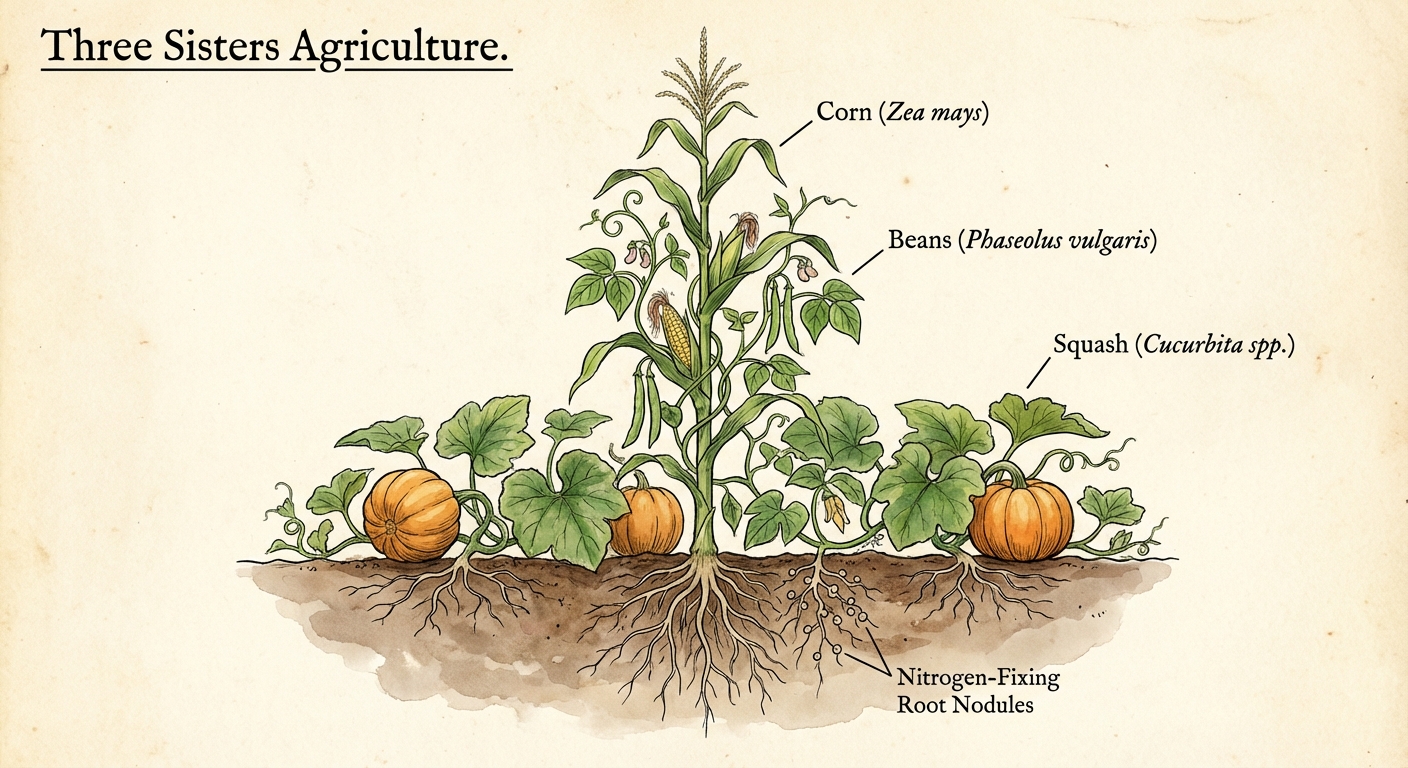
- Three Sisters Farming: In the Northeast and Southeast, maize was often grown with beans and squash. The beans restored nitrogen to the soil, and the squash provided ground cover to retain moisture.
Cultural Diversity Based on Regional Geography
The College Board APUSH curriculum emphasizes environmental determinism in this period—how geography and climate shaped the lifestyle, diet, and social structure of indigenous groups.
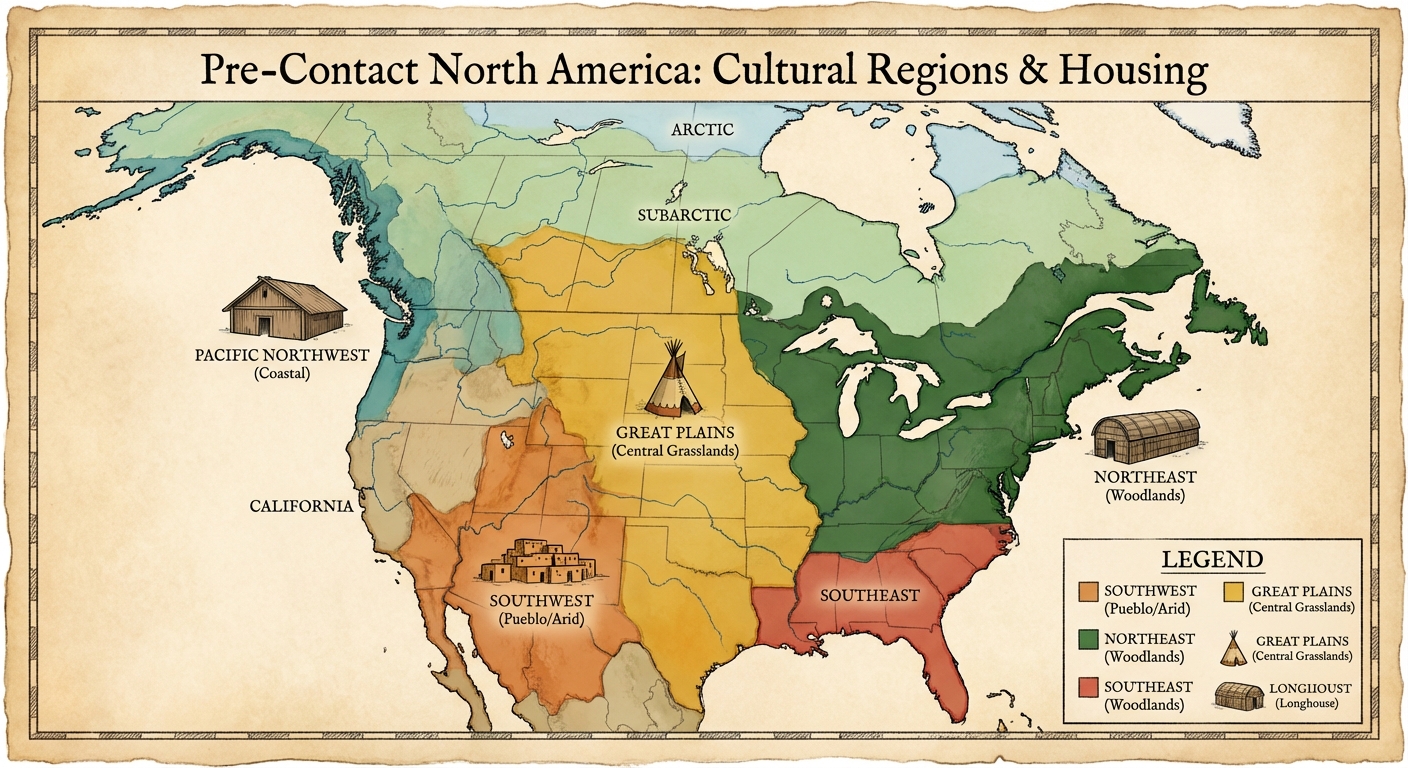
1. The Southwest (Pueblo Cultures)
Geography: Arid, dry desert land (present-day New Mexico and Arizona).
- Adaptation: Societies like the Pueblo (Anasazi) and Hohokam developed complex irrigation systems to cultivate maize.
- Housing: They lived in multi-story buildings made of adobe (sun-dried mud brick) and stone, often built into cliffs for defense and thermal regulation.
- Key Insight: Their sedentary lifestyle was entirely dependent on their engineering ability to manage scarce water resources.
2. The Great Plains and Great Basin
Geography: The Great Basin is a vast, dry, rocky depression between the Rockies and the Sierra Nevada. The Great Plains are vast flat grasslands.
- Adaptation: The aridity made farming difficult or impossible. Societies here were largely mobile (nomadic) lifestyles.
- Diet: relied heavily on hunting bison (buffalo) and gathering nuts/berries.
- Social Structure: Smaller, egalitarian bands that moved with the seasons to follow food sources.
- Important Distinction: Before European contact, these tribes (like the Sioux/Lakota) hunted bison on foot. The horse was not available until the Spanish introduced it later (Columbian Exchange).
3. The Northeast and Mississippi River Valley
Geography: Rich soil, abundant rivers, and forests.
- Adaptation: These societies developed mixed agricultural and hunter-gatherer economies.
- Cahokia: located near present-day St. Louis, this represents the peak of the Mississippian culture. It was a massive city (larger than London in 1250 AD) famous for giant earthen mounds used for religious and ceremonial purposes.
- The Iroquois Confederacy: Located in present-day NY, the Iroquois (Haudenosaunee) formed a sophisticated political alliance of five (later six) tribes to end inter-tribal warfare.
- Society: They lived in Longhouses (structures up to 200ft long housing multiple families).
- Matrilineal Society: Lineage and inheritance were passed through the mother's side; women held significant political power, including the right to select chiefs.
4. The Northwest and California
Geography: The Pacific coast, featuring dense cedar forests and ocean access.
- Adaptation: This region was unique because the abundance of natural resources (fish, whales, acorns, elk) allowed for sedentary societies without agriculture.
- Diet: Heavily distinct on fishing (salmon) and foraging.
- Culture: The Chinook people are a prime example. They built large wooden plan houses and developed distinct social hierarchies (stratification) and artwork (totem poles) because food was so plentiful, they could accumulate wealth.
Summary Comparison Table
| Region | Key Environment | Dominant Lifestyle | Representative Groups | Housing Style |
|---|---|---|---|---|
| Southwest | Arid, Desert | Settled Agriculture (Maize) | Pueblo, Hohokam | Adobe Cliff Dwellings |
| Great Plains | Grasslands | Nomadic Hunting | Sioux (Lakota), Apache | Tepees (mobile skin tents) |
| Northeast | Woodlands | Mixed Ag/Hunting | Iroquois, Algonquin | Longhouses, Timber homes |
| Northwest | Coastal Forests | Hunting/Fishing (Sedentary) | Chinook, Nez Perce | Cedar Plank Houses |
Common Mistakes & Pitfalls
The "Primitive" Myth:
- Mistake: Assuming Native societies were primitive or "uncivilized" before Europeans arrived.
- Correction: Use specific examples like the Cahokia Mounds or Iroquois political confederacy to demonstrate social and political complexity.
The Horse Anachronism:
- Mistake: Writing about Plains Indians riding horses in 1491.
- Correction: Horses are native to the Old World. They did not exist in Period 1 (Pre-Columbian). Plains natives hunted on foot until the Columbian Exchange (Period 2).
The Monolith Fallacy:
- Mistake: Referring to "Native Americans" as a single cultural group.
- Correction: Always distinguish by region. The lifestyle of a Chinook fisherman was vastly different from a Pueblo farmer.
Environmental Passivity:
- Mistake: Thinking Natives lived in perfect harmony with nature without altering it.
- Correction: Indigenous people actively manipulated their environment, particularly through the use of fire to clear underbrush for hunting and farming.