Unit 8: Global Conflict, Cold War, and Decolonization (c. 1900–Present)
Contextualizing the Cold War and Decolonization
8.1 Setting the Stage: The Global Shift in Power
Following World War II, the global balance of power shifted from Western Europe to two emerging superpowers: the United States and the Soviet Union. This shift coincided with the collapse of colonial empires, leading to a wave of decolonization in Asia, Africa, and the Middle East.
Key Concepts
- The Cold War: A state of geopolitical tension between the US (Capitalism/Democracy) and the USSR (Communism/Authoritarianism) that involved propaganda, espionage, and proxy wars, but no direct full-scale military conflict between the two nations.
- Decolonization: The process by which former colonies gained independence from European powers, either through negotiation or armed struggle.
- The Three Worlds:
- First World: US and its allies.
- Second World: USSR and the Soviet Bloc.
- Third World: Non-aligned, newly independent, or developing nations.
The Cold War (1945–1991)
8.2 The Cold War Unfolds
Ideological Confrontation
The conflict was strictly ideological and economic.
| Feature | United States (West) | Soviet Union (East) |
|---|---|---|
| Economy | Capitalism (Free Market) | Communism (Command Economy) |
| Politics | Democratic / Multi-party | Authoritarian / Single-party |
| Goal | Containment of Communism | Spread of World Revolution |
Key Alliances and Policies
- United Nations (UN): Formed in 1945 to replace the League of Nations & promote peace. Unlike the League, it had a military force.
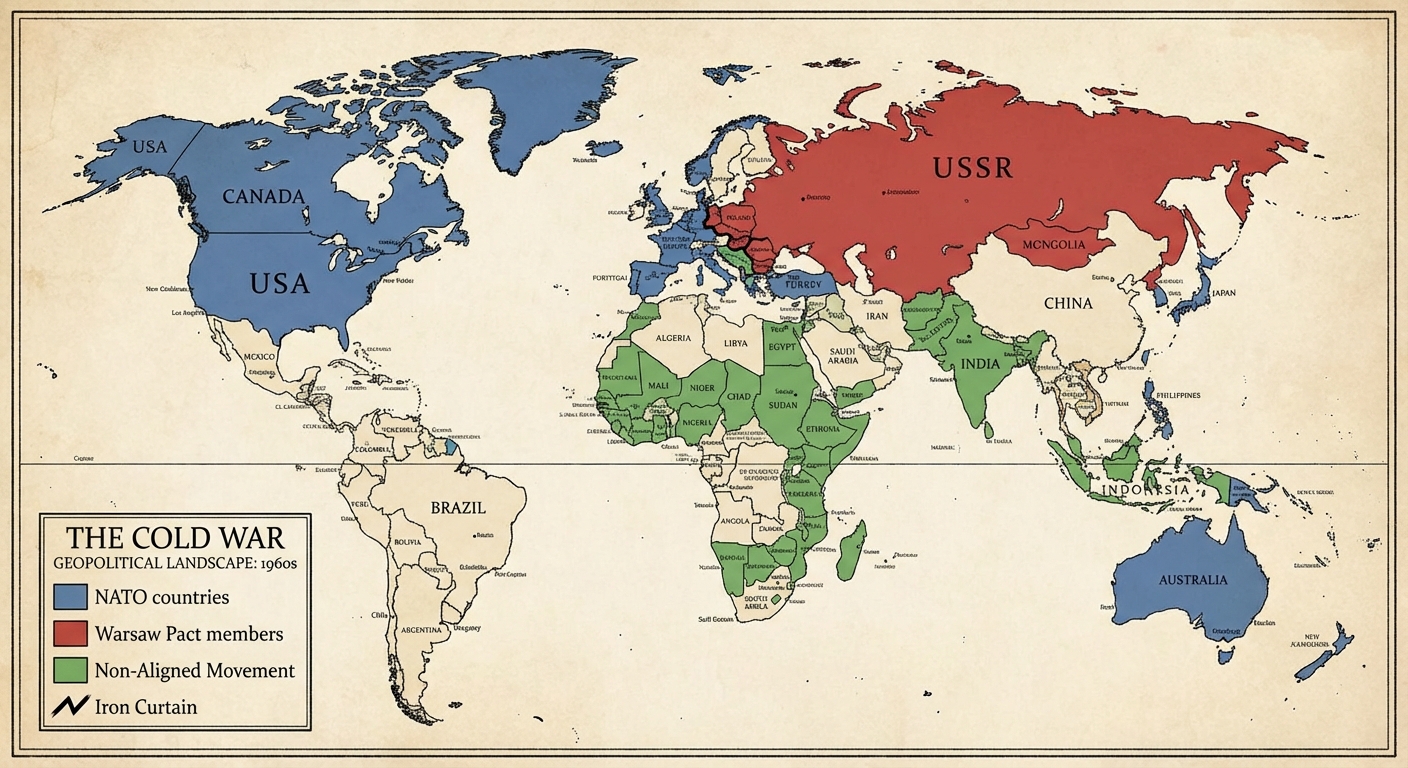
- Iron Curtain: A metaphor coined by Winston Churchill describing the division between Western Europe and the Soviet-controlled Eastern Bloc.
- Containment Policy: US strategy (George Kennan) to stop the spread of communism without actively invading the USSR.
- Truman Doctrine (1947): US promised military aid to countries resisting communism (specifically Greece and Turkey).
- Marshall Plan (1947): US provided $12 billion to rebuild Western Europe, dissuading them from turning to communism.
- Military Alliances:
- NATO (North Atlantic Treaty Organization): Western alliance (US, UK, France, etc.).
- Warsaw Pact: Eastern alliance (USSR, Poland, East Germany, etc.).
The Non-Aligned Movement (NAM)
Many new nations refused to join either bloc. They formed the Non-Aligned Movement to focus on developing their own economies.
- Bandung Conference (1955): The birth of NAM. Key leaders included:
- Sukarno (Indonesia)
- Kwame Nkrumah (Ghana)
- Jawaharlal Nehru (India)
8.3 Effects of the Cold War: Proxy Wars
Because the US and USSR possessed nuclear weapons (Mutually Assured Destruction or MAD), they fought indirectly through Proxy Wars in the Third World.
The Berlin Crisis
- Berlin Blockade (1948): Soviets cut off access to West Berlin. The US responded with the Berlin Airlift, flying in supplies for nearly a year.
- Berlin Wall (1961): Built by East Germany to prevent citizens from fleeing to the democratic West; became the symbol of Cold War repression.
The Korean War (1950–1953)
- Conflict: North Korea (Communist, supported by USSR/China) invaded South Korea (Democratic, supported by UN/US).
- Outcome: Stalemate. An armistice signed in 1953 established a Demilitarized Zone (DMZ) near the 38th Parallel. No peace treaty was ever signed.
The Vietnam War (1955–1975)
- Context: Following French defeat at Dien Bien Phu, Vietnam was divided.
- Conflict: North Vietnam (Communist Ho Chi Minh) vs. South Vietnam (US-backed Ngo Dinh Diem).
- Outcome: US withdrew in 1973 due to anti-war pressure at home. In 1975, North Vietnam captured Saigon. Vietnam reunited under communism.
The Cuban Missile Crisis (1962)
- Background: Fidel Castro overthrew the US-backed dictator Batista in 1959. After the failed US-backed Bay of Pigs Invasion, Castro sought Soviet protection.
- The Crisis: US spy planes discovered Soviet nuclear missiles in Cuba. JFK ordered a naval blockade.
- Resolution: Khrushchev removed missiles from Cuba; US secretly removed missiles from Turkey. Closest the world came to nuclear war.
Latin American Interventions
The US often supported right-wing dictators to prevent communism.
- Nicaragua: The Sandinistas (Socialists) took power. The US backed the Contras (counter-revolutionaries) to overthrow them.
Spread of Communism in China
8.4 Communism in China
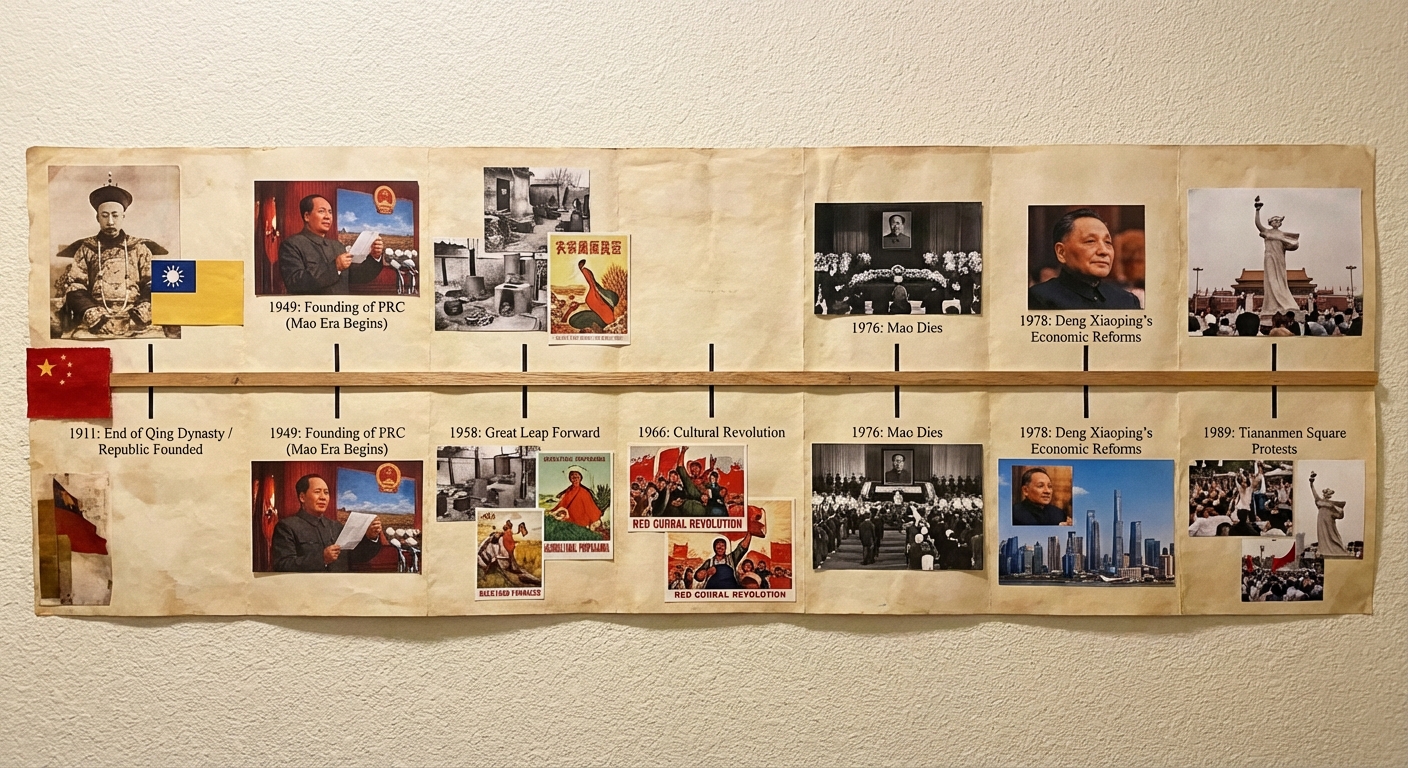
Following the fall of the Qing Dynasty (1911), a power struggle ensued between the Nationalists (Kuomintang/KMT led by Chiang Kai-shek) and the Communists (CCP led by Mao Zedong).
The Chinese Revolution (1949)
- Mao gained the support of peasants (unlike the Soviets who focused on industrial workers).
- The CCP pushed the KMT to Taiwan.
- Mao established the People's Republic of China (PRC).
Mao’s Policies
- Great Leap Forward (1958): Attempt to rapidly industrialize via peasant communes and "backyard furnaces." Resulted in massive famine (20–45 million deaths) and forged production quotas.
- Cultural Revolution (1966–1976): Mao’s attempt to purge "capitalist" and traditional elements. The Red Guards (student paramilitaries) destroyed historical sites and persecuted teachers and intellectuals.
Decolonization
8.5 Processes of Decolonization
In dependence was achieved in two main ways: Negotiation or Armed Struggle.
Negotiated Independence
- India (1947): Led by Mohandas Gandhi and the Indian National Congress. Used non-violent civil disobedience (satyagraha) against the British.
- Gold Coast (Ghana, 1957): Led by Kwame Nkrumah. Modeled on nationalistic organizing; the first Sub-Saharan African colony to gain independence.
- French West Africa: Generally peaceful transition compared to Algeria.
Independence through Armed Struggle
- Algeria (1954–1962): The FLN (National Liberation Front) fought a bloody guerrilla war against France. France considered Algeria a part of France, not a colony, making the separation violent.
- Vietnam: Fought the French (First Indochina War) and then the US.
- Angola: Fought Portugal. After independence, a proxy civil war erupted (MPLA vs. UNITA).
8.6 Newly Independent States
Partition of India (1947)
- Religious tension between Hindus (Indian National Congress) and Muslims (Muslim League led by Muhammad Ali Jinnah) led the British to partition the colony.
- Result: India (Hindu majority) and Pakistan (Muslim majority, East and West). violence erupted during migration; 500k–1M died.
Israel and Palestine
- Zionism: The movement for a Jewish homeland, supported by the British Balfour Declaration (1917).
- Creation of Israel (1948): UN partitioned Palestine. Israel declared independence; Arab neighbors invaded immediately.
- Ongoing Conflict: Six-Day War (1967) and Yom Kippur War (1973) expanded Israeli territory (Gaza, West Bank).
Cambodia
- Following the Vietnam War, the Khmer Rouge (communist guerrillas led by Pol Pot) took power.
- Genocide: Forced urbanization and slaughter of "intellectuals" killed ~2 million people (25% of population). overthrown by Vietnam in 1979.
Global Resistance & The End of the Cold War
8.7 Global Resistance to Established Power
Challenging Imperialism and Apartheid:
- South Africa: The white minority government enforced Apartheid (legalized racial segregation).
- Nelson Mandela and the African National Congress (ANC) initially used non-violence, then sabotage. Mandela was imprisoned (1964–1990).
- Global boycotts and internal unrest ended Apartheid. Mandela was elected President in 1994.
- Martin Luther King Jr.: Used non-violent protest in the US to fight racial segregation (Civil Rights Act of 1964).
1968 Protests: A year of global rebellion (students in France, anti-war in USA, Prague Spring in Czechoslovakia).
8.8 The End of the Cold War
Causes of Soviet Collapse
- Economic Stagnation: The command economy failed to produce consumer goods or innovation.
- Military Spending: Failed invasion of Afghanistan (1979–1989) drained resources. US President Reagan's military buildup forced the USSR to overspend.
- Gorbachev’s Reforms (1980s):
- Perestroika: Restructuring the economy (limited free enterprise).
- Glasnost: Openness (freedom of press/speech).
The Fall (1989–1991)
- 1989: Eastern European satellite states (Poland, etc.) revolted peacefully. The Berlin Wall fell.
- 1991: The Soviet Union effectively dissolved. The Cold War ended.
Common Mistakes & Pitfalls
- Confusing Sun Yat-sen and Chiang Kai-shek: Sun Yat-sen was the "Father of Modern China" (republicanism) who stepped down. Chiang Kai-shek took over the KMT later and fought the Communists.
- The Nature of the Cold War: Students often forget that the US and USSR never fought directly. If they are fighting, it is likely a Proxy War.
- Decolonization nuances: Do not assume all decolonization was violent. Compare Ghana (negotiated) vs. Algeria (violent).
- Israel/Palestine: Be careful with the timeline. The state of Israel was established in 1948, not immediately after WWI.