Mastering Development and Support in the ACT Essay
Strategies for High-Scoring Argumentation
In the ACT Writing section, the Development and Support domain measures your ability to explain your ideas, provide persuasive rationale, and illustrate your arguments with specific examples. It is not enough to simply state an opinion; you must build a robust case for why that opinion is valid.
To score in the top tier (10-12), your essay must demonstrate an "integrated line of reasoning" where claims, explanations, and evidence weave together seamlessly.
Explaining and Deepening Reasoning
Reasoning is the logical glue that holds your essay together. It bridges the gap between your main thesis (claim) and the concrete examples you use to back it up. Weak essays often list claims without explaining the underlying logic.
The "Why" and "How"
To deepen reasoning, you must constantly ask yourself "Why is this true?" and "How does this work?" after making a statement. This moves your writing from surface-level observation to critical analysis.
- Surface Level: "Intelligent machines are bad because they take jobs."
- Deepened Reasoning: "Intelligent machines threaten the workforce not just by automating tasks, but by rendering years of specialized human training obsolete. This rapid shift creates a socio-economic vacuum where displaced workers cannot adapt quickly enough to new industries."
Logical Chains
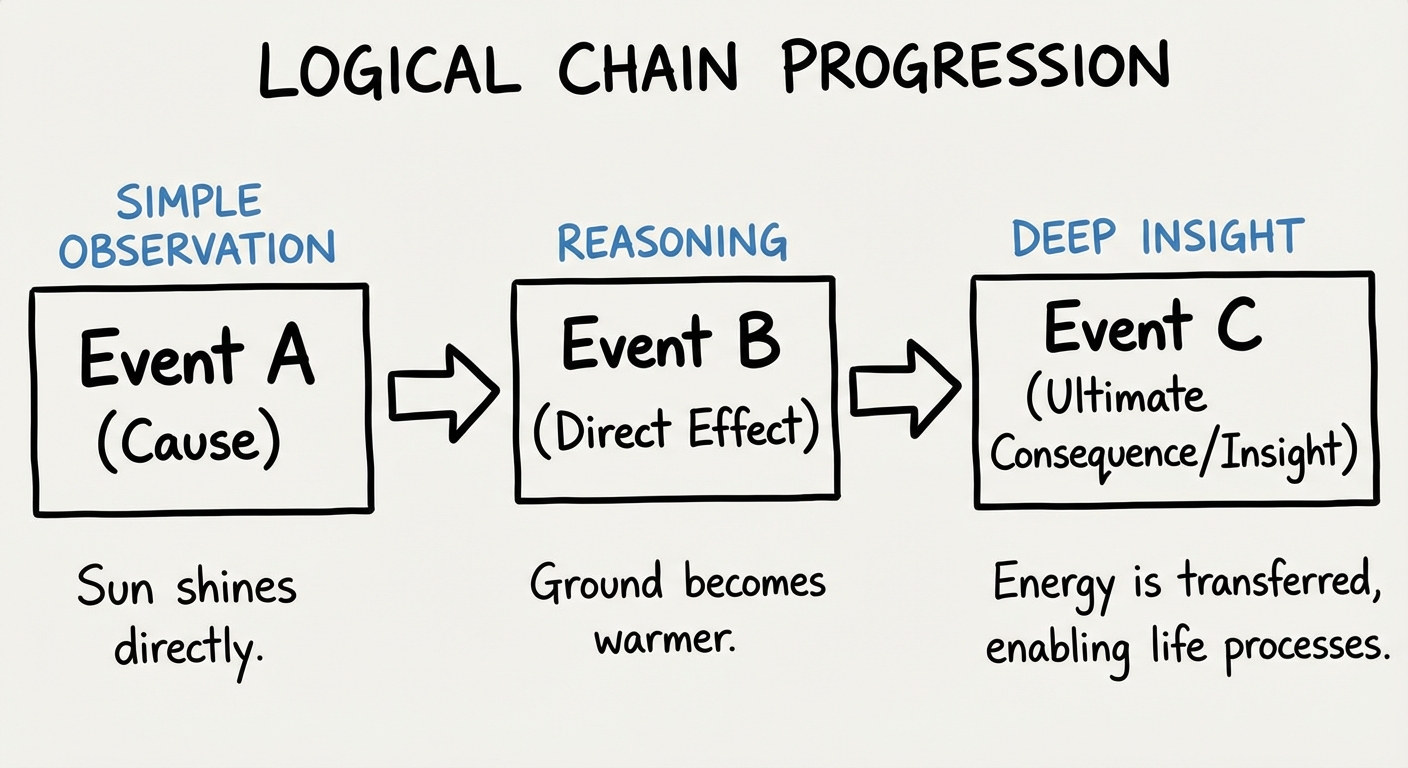
Effective reasoning often follows a Logical Chain—a sequence of cause-and-effect statements that leads the reader inevitably to your conclusion.
Formula: If A
ightarrow B, and B
ightarrow C, then A
ightarrow C.
- Example: If schools rely entirely on automation (A), students lose face-to-face mentorship (B). If students lose mentorship, they lack emotional development (C). Therefore, total automation harms emotional intelligence.
Using Specific Examples and Evidence
The ACT rubric explicitly rewards "specific" examples. A common pitfall is relying on vague generalizations. Since you do not have access to the internet during the test, you must rely on your general knowledge, history, current events, or well-reasoned hypotheticals.
Types of Evidence
- Historical/Current Events: Using real-world situations adds significant weight to an argument.
- Example: Referencing the Industrial Revolution to discuss economic shifts, or citing the rise of social media to discuss communication habits.
- Hypothetical Scenarios: Creating a plausible, logical scenario to illustrate a point. This is perfectly acceptable on the ACT if the logic holds up.
- Usage: "Consider a hospital where AI makes all diagnostic decisions. While efficiency increases, the nuance of patient history usually caught by a human doctor might be missed…"
- Personal Convention: While allowed, personal anecdotes should be used sparingly and only if they apply broadly to the human experience. Avoid overly narrow stories that don't prove the general rule.
The Goldilocks Rule of Specificity
Your examples should be neither too broad nor too obscure. They must be detailed enough to be vivid but general enough to support your universal claim.
| Weak Support (Too Vague) | Strong Support (Specific) |
|---|---|
| "Technology helps people communicate better." | "Video conferencing platforms allow soldiers deployed overseas to witness the birth of their children, maintaining family bonds despite physical distance." |
| "Competition is good for business." | "The rivalry between major tech companies drives the rapid innovation of smartphone batteries, benefiting the consumer with longer-lasting devices." |
Strengthening Arguments with Persuasive Support
Support is not just about having an example; it is about wielding that example to persuade. This concept is often called the Warrant in argumentation—the explanation of how the evidence supports the claim.
The Sandwich Method
Never leave an example "naked" or unexplained. Wrap it in explanation.
- Top Bun (Assertion): State the point.
- Meat (Evidence): Provide the specific example.
- Bottom Bun (Analysis): Explain exactly what this example proves about your thesis.
Bad: "Globalization hurts local culture. For example, McDonald's is everywhere."
Good: "Globalization risks homogenizing unique cultural identities. The ubiquity of Western chains like McDonald's in historic cities like Kyoto or Paris (Evidence) signals a shift where convenience overrides tradition. This visual dominance suggests that meaningful local customs are being displaced by a standardized, corporate monoculture (Analysis)."
Rhetorical Strategies
- Cause and Effect: Focus on long-term consequences.
- Comparison/Analogy: Compare the current issue to a similar situation in the past to predict the outcome.
Addressing Counterarguments
The ACT prompt provides three perspectives. To get a high score in Development and Support, you must engage with perspectives you disagree with. Ignoring them makes your argument look weak and one-sided.
The Concession and Rebuttal
This is the most powerful tool for handling counterarguments. You acknowledge the validity of an opposing point (Concession) but then pivot to explain why your argument is still superior or more important (Rebuttal).
Structure: "While it is true that [Opposing View], it is more important to consider [Your View] because…"
- Example Prompt: Should we automate creative arts?
- Perspective 2 argues: Automation allows for mass production of art, making it accessible.
- Your Rebuttal: "Admittedly, AI-generated art democratizes access to images by lowering costs (Concession). However, this abundance creates a market of hollow imitation rather than genuine expression. Providing everyone with cheap art is less valuable than preserving the human struggle that gives art its meaning (Rebuttal)."
[Diagram: Visualizing the Concession/Rebuttal Balance]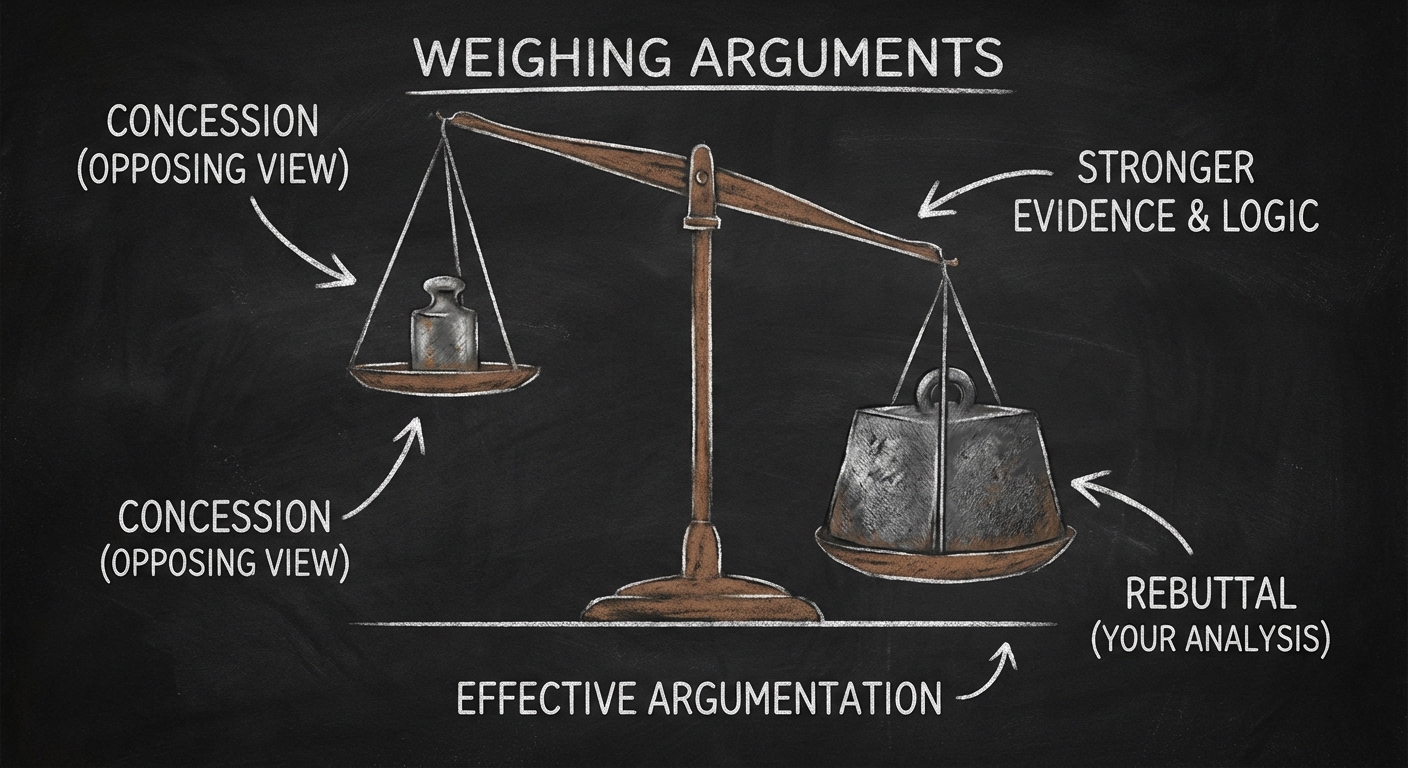
Synthesis of Perspectives
Don't just destroy the other perspectives; show how they relate to yours. You can argue that another perspective is partially correct but incomplete.
Common Mistakes & Pitfalls
- Circular Reasoning: Repeating the claim in different words instead of explaining it. (e.g., "Freedom is important because being free is vital.")
- The "Laundry List" Approach: Listing three different examples without analyzing any of them in depth. Depth > Quantity.
- Ignoring the Prompt's Perspectives: Writing an essay that ignores the three perspectives provided in the prompt creates a disconnected argument.
- Absolute Statements: Using words like "always," "never," or "everyone." These are easy to disprove. Use nuanced language like "often," "tends to," or "many."
Mnemonic for Development: ARE
To ensure every paragraph is fully developed, check for ARE:
- A - Assertion (Topic Sentence/Claim)
- R - Reasoning (The logic/Because)
- E - Evidence (The specific example/Illustration)