Mastering the Fundamental Theorem of Calculus (Unit 6)
The Fundamental Theorem of Calculus Part 1: Accumulation Functions
The Fundamental Theorem of Calculus (FTC) is the bridge that connects the two main branches of calculus: differential calculus (rates of change) and integral calculus (accumulation).
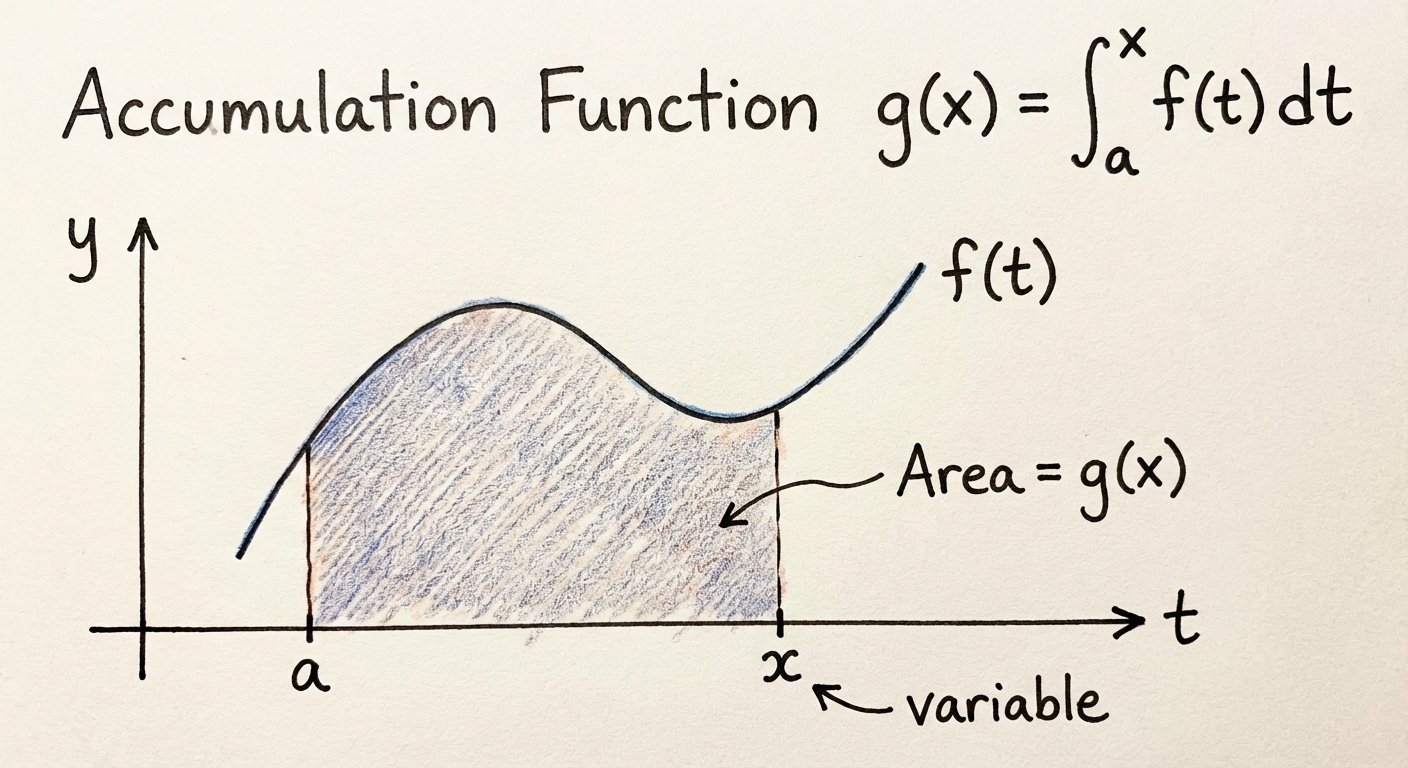
The first part of the theorem deals with Accumulation Functions. These are functions defined by a definite integral where the upper limit of integration is a variable.
The Theorem Defined
If $f$ is continuous on an open interval containing $a$, then for every $x$ in the interval, we define the accumulation function $g(x)$ as:
The theorem states that the derivative of this accumulation function is the integrand itself:
Essentially, differentiating an integral with respect to its upper limit "undoes" the integration.
The Chain Rule Extension
A common AP Exam trap is changing the upper limit from a simple $x$ to a function $u(x)$ (like $x^2$ or $\sin(x)$). When this happens, you must apply the Chain Rule.
Worked Example
Problem: Find $F'(x)$ if $F(x) = \int_2^{x^3} \sin(t^2) \, dt$.
Solution:
- Identify the inside function: $u(x) = x^3$, so $u'(x) = 3x^2$.
- Apply the integrand function to the upper limit: $f(u(x)) = \sin((x^3)^2) = \sin(x^6)$.
- Multiply by the derivative of the upper limit:
Interpreting the Behavior of Accumulation Functions
One of the most frequent Free Response Questions (FRQs) involves analyzing the graph of a function $f$ to determine the behavior of an accumulation function defined by $g(x) = \int_0^x f(t) dt$.
To master this, you must understand the hierarchical relationship between $g$, $g'$, and $g''$.
The Relationship Pyramid
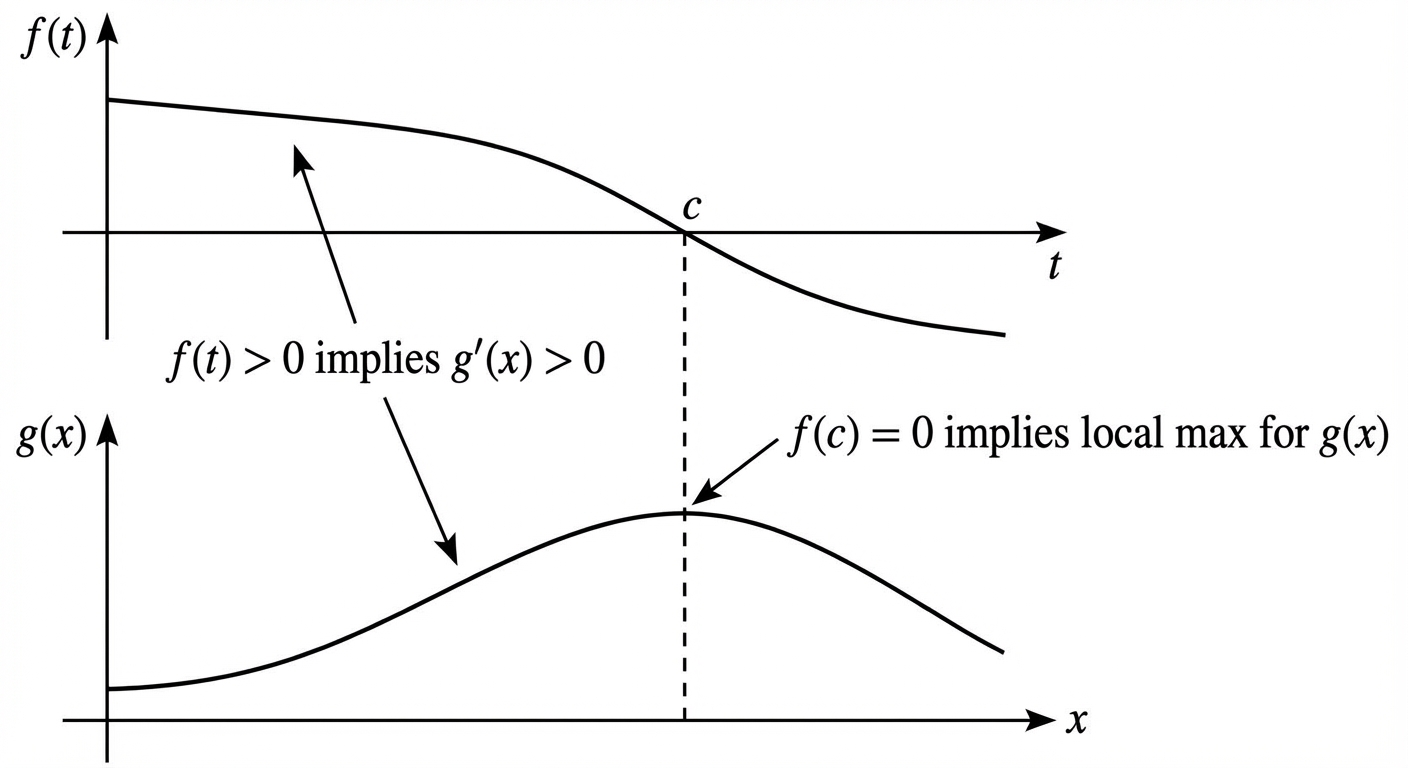
Since $g'(x) = f(x)$, the graph of $f$ serves as the derivative graph for $g(x)$.
| Property of Function $g(x)$ | Look for this on Graph of $f(t)$ |
|---|---|
| Increasing | $f(t)$ is positive (above the x-axis) |
| Decreasing | $f(t)$ is negative (below the x-axis) |
| Local Maximum | $f(t)$ changes from positive to negative |
| Local Minimum | $f(t)$ changes from negative to positive |
| Concave Up | $f(t)$ is increasing (slope of $f$ is positive) |
| Concave Down | $f(t)$ is decreasing (slope of $f$ is negative) |
| Point of Inflection | $f(t)$ changes from increasing to decreasing (or vice versa) |
Determining Values of $g(x)$
To find the specific value of $g(b)$, you must calculate the net signed area between the graph of $f$ and the t-axis from $a$ to $b$.
- Area above the axis adds to the value.
- Area below the axis subtracts from the value.
Applying Properties of Definite Integrals
Before calculating complex integrals, you can often simplify them using these standard properties. These are frequently tested in Multiple Choice questions where explicit functions are not given.
Key Properties
Zero Width Interval:
Reversing Limits of Integration:
If you switch the bounds, the sign changes.Constant Multiple:
Additivity (Splitting the Interval):
For any number $c$:
Worked Example: Additivity
Given: $\int0^5 f(x) dx = 10$ and $\int0^7 f(x) dx = 14$.
Find: $\int_5^7 f(x) dx$.
Solution:
Using the additivity property:
The Fundamental Theorem of Calculus Part 2: Definite Integrals
While Part 1 focuses on derivatives of integrals, Part 2 provides the method for evaluating definite integrals without using Riemann sums.
The Evaluation Theorem
If $f$ is continuous on $[a, b]$ and $F$ is any antiderivative of $f$ (meaning $F'(x) = f(x)$), then:
This theorem states that the net accumulation of change of a quantity over an interval is equal to the total change in the quantity.
Notation Reference
A common notation used during calculation is the vertical bar (evaluation bar):
Worked Example
Problem: Evaluate $\int_1^3 (3x^2 + 2) \, dx$.
Solution:
Find the antiderivative $F(x)$:
The antiderivative of $3x^2$ is $x^3$.
The antiderivative of $2$ is $2x$.
So, $F(x) = x^3 + 2x$.Apply the Evaluation Theorem:
Subtract:
Common Mistakes & Pitfalls
Even strong students lose points on these common errors. Watch out for:
Forgetting the Chain Rule in FTC Part 1:
- Incorrect: $\frac{d}{dx} \int_2^{x^2} f(t) dt = f(x^2)$
- Correct: You must multiply by $(x^2)'$. The result is $f(x^2) \cdot 2x$.
Confusing Height vs. Slope on Accumulation Graphs:
When analyzing $g(x) = \int_0^x f(t) dt$, students often look at the slope of $f(t)$ to determine if $g(x)$ is increasing. Remember: $g$ increases when $f$ is positive, not when $f$ is increasing.Order of Subtraction in FTC Part 2:
It is always $F(\text{Upper}) - F(\text{Lower})$. Flipping this ($F(a) - F(b)$) will result in a sign error.Assuming Area is Always Positive:
In definite integrals, area below the x-axis is negative. If a question asks for "Total Area" (geometric area), you must take the absolute value of the negative regions. If it asks for the "Value of the Integral," allow the negatives to subtract.