Mastering AP Calculus BC: Infinite Sequences and Series
Unit 10 Overview: From Lists to Sums
Unit 10 is widely considered the most challenging yet efficient unit in AP Calculus BC. It transitions from sequences (ordered lists of numbers) to series (sums of infinite lists) and culminates in Taylor Series, which allows us to represent complex functions (like $e^x$ or $\sin(x)$) as infinite polynomials.
Success in this unit requires mastering various convergence tests and understanding the concept of error bounds.
Sequences
Definitions and Limits
A sequence is an ordered list of numbers, usually generated by a formula. We denote a sequence as ${a_n}$.
- Notation: $a_n = \frac{n-1}{n}$ associated with integers $n \ge 1$ generates terms $0, \frac{1}{2}, \frac{2}{3}, \dots$
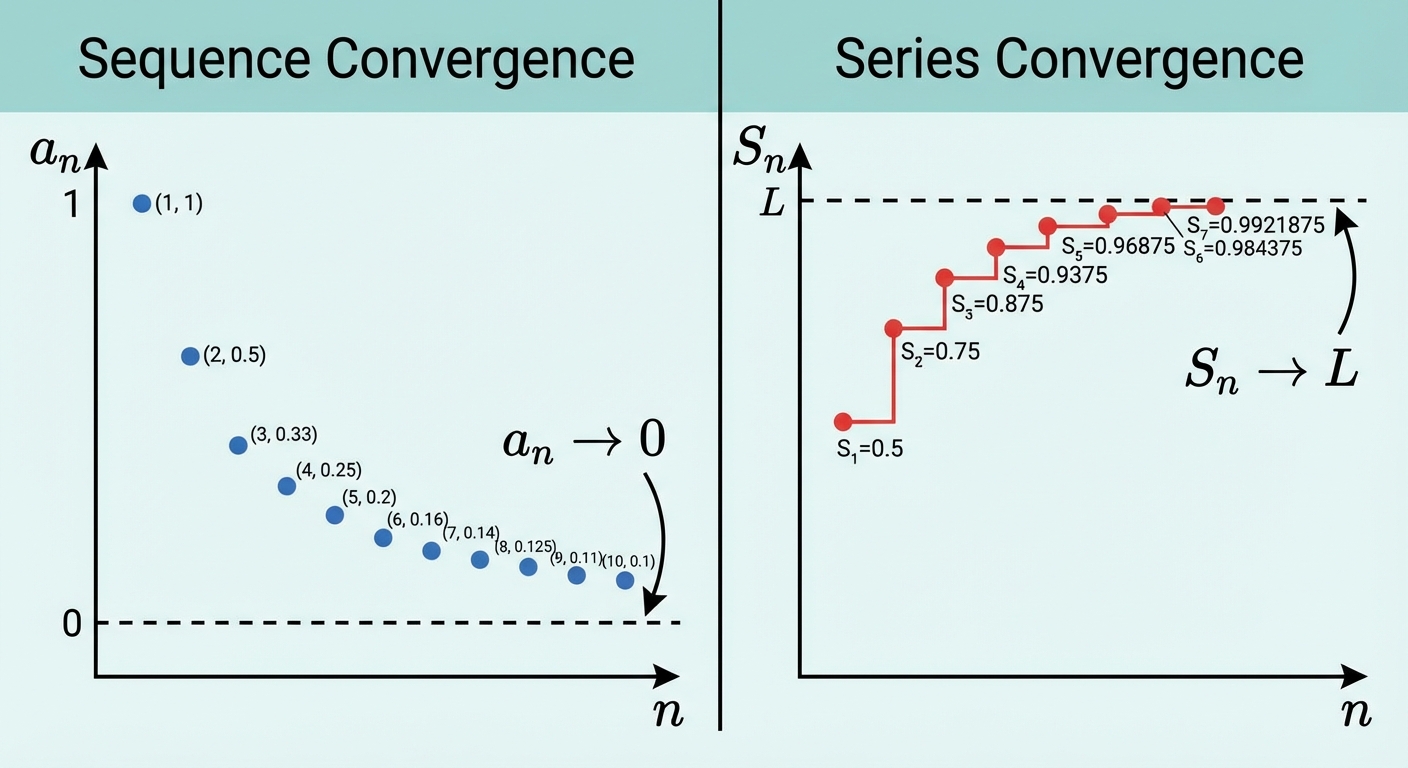
- Limit of a Sequence: We say a sequence converges to a limit $L$ if the terms eventually get arbitrarily close to $L$.
- If the limit does not exist or is infinite, the sequence diverges.
Key Property
Even if a sequence converges (e.g., $1, 1, 1, \dots$ converges to 1), the sum of that sequence (the series) might diverge. This is a critical distinction.
Infinite Series
An infinite series is the sum of the terms of a sequence, denoted as:
To determine if an infinite sum results in a finite number, we look at the Sequence of Partial Sums ($S_n$).
- Let $Sk$ be the sum of the first $k$ terms: $Sk = \sum{n=1}^{k} an$.
- Definition of Convergence: If the sequence of partial sums ${S_k}$ converges to a limit $S$ as $k \to \infty$, then the series converges to the sum $S$. Otherwise, the series diverges.
Fundamental Convergence Tests
1. Geometric Series
A series where each term is the previous term multiplied by a common ratio $r$.
Standard Form:
Rules:
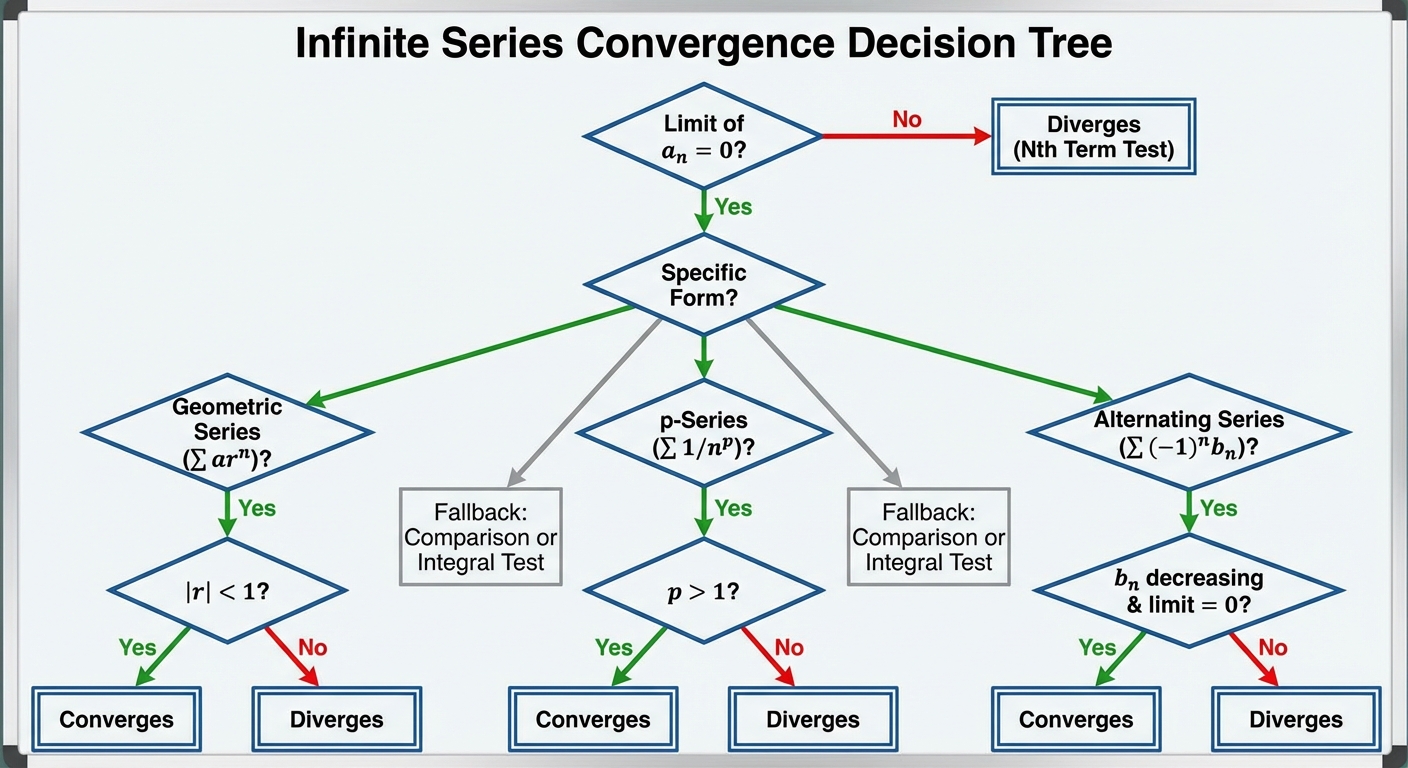
- Converges if $|r| < 1$.
- Diverges if $|r| \ge 1$.
- Sum Formula: If it converges, the infinite sum is:
Example:
$\sum_{n=0}^{\infty} 3(\frac{1}{2})^n$. Here $a=3$ and $r=1/2$. Since $|1/2| < 1$, it converges to $S = \frac{3}{1 - 0.5} = 6$.
2. The nth Term Test for Divergence
This is the first test you should perform mentally. It checks if the specific terms are approaching zero.
The Rule:
- If $\lim{n \to \infty} an \neq 0$, the series DIVERGES.
- If $\lim{n \to \infty} an = 0$, the test is INCONCLUSIVE. (The series might converge or diverge; you must use another test.)
Common Mistake: Never conclude a series converges because the limit is 0. The Harmonic Series ($1/n$) has a limit of 0 but diverges.
3. Integral Test
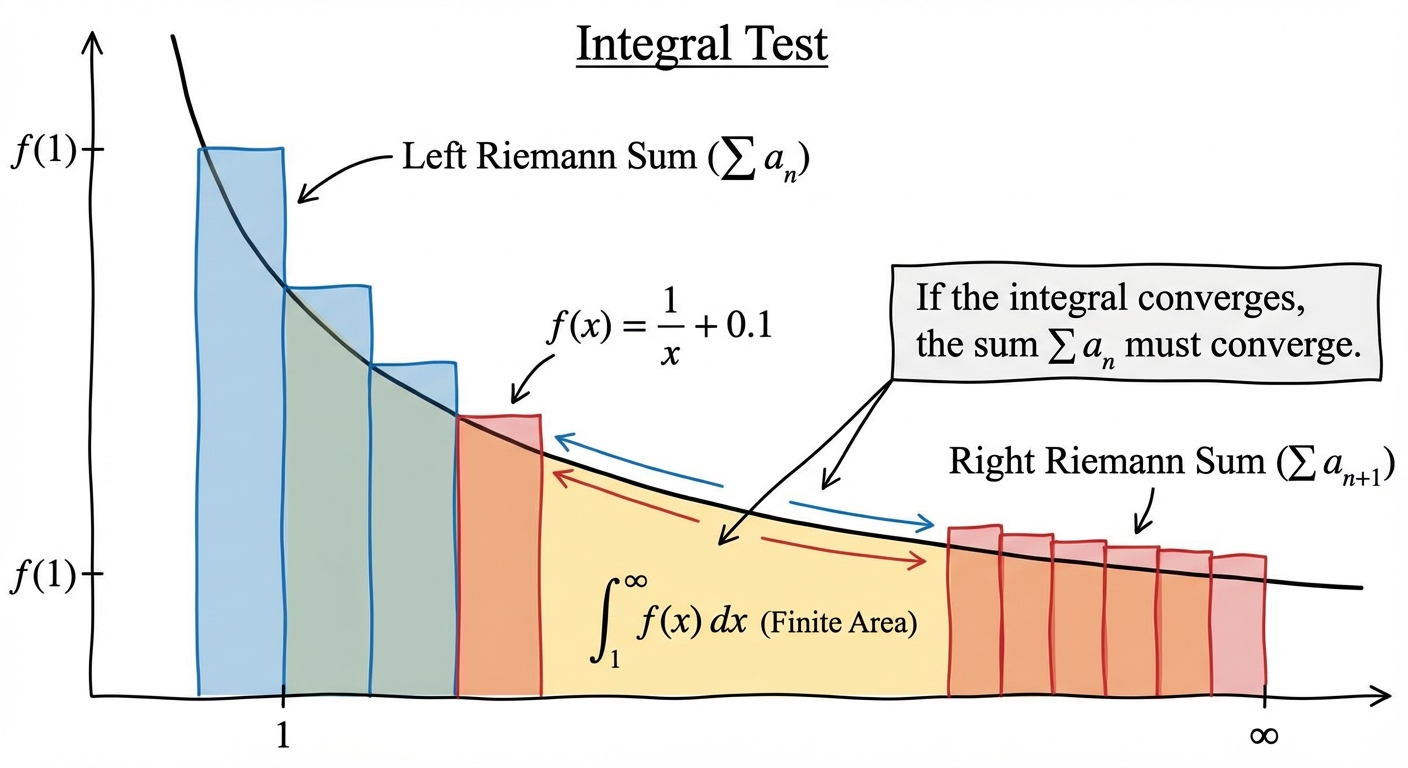
Used when $a_n$ can be modeled by a function $f(x)$.
Conditions: $f(x)$ must be Positive, Continuous, and Decreasing for $x \ge 1$.
Rule:
Either both converge or both diverge. Note: The value of the integral is not the value of the sum.
4. p-Series Test
Derived from the integral test, this is a quick shortcut.
Form: $\sum_{n=1}^{\infty} \frac{1}{n^p}$
Rules:
- Converges if $p > 1$.
- Diverges if $0 < p \le 1$.
Special Case: The Harmonic Series ($p=1$) is $\sum \frac{1}{n}$. It diverges.
Comparison Tests
When a series looks "similar" to a known Geometric or p-series, use comparison tests.
Direct Comparison Test (DCT)
Let $0 \le an \le bn$.
- If the larger series $\sum bn$ converges, the smaller series $\sum an$ converges.
- If the smaller series $\sum an$ diverges, the larger series $\sum bn$ diverges.
- Mnemonic: If you are smaller than a finite number, you are finite. If you are larger than infinity, you are infinite.
Limit Comparison Test (LCT)
Often easier to apply than DCT.
Form the limit of the ratio of the series in question ($an$) and a comparison series you choose ($bn$).
Rule: If $L$ is positive and finite ($0 < L < \infty$), then both series behave the same way (both converge or both diverge).
Alternating Series
Series whose terms switch signs, typically containing $(-1)^n$ or $\cos(n\pi)$.
Alternating Series Test (AST)
A series $\sum (-1)^n bn$ (where $bn > 0$) converges if two conditions are met:
- Limit: $\lim{n \to \infty} bn = 0$
- Decreasing: $b{n+1} \le bn$ for all $n$ (terms get smaller in magnitude).
Alternating Series Error Bound
If a series converges by AST, we can approximate the sum $S$ using a partial sum $S_n$. The error (remainder) is bounded by the absolute value of the first unused term.
Example: If you sum the first 10 terms, the error is less than the magnitude of term 11.
Absolute vs. Conditional Convergence
- Absolute Convergence: $\sum |a_n|$ converges.
- Conditional Convergence: $\sum an$ converges (usually by AST), but $\sum |an|$ diverges.
- Theorem: If a series converges absolutely, it implies the original series converges.
The Ratio Test
The most powerful test for series involving factorials ($n!$) or exponentials ($n^n, 2^n$).
Rules:
- If $L < 1$: Series Converges Absolutely.
- If $L > 1$ (or $\infty$): Series Diverges.
- If $L = 1$: Inconclusive (Try p-series or another test).
Power Series
A function defined by a series, centered at $c$:
Radius and Interval of Convergence
To find where the series is valid, use the Ratio Test: $\lim{n \to \infty} |\frac{a{n+1}}{a_n}| < 1$. This yields an inequality $|x-c| < R$.
- Radius (R): Half the length of the interval.
- Interval (IOC): Solve for $x$ to get $(c-R, c+R)$.
- Check Endpoints: You MUST manually test the endpoints $x = c-R$ and $x = c+R$ by plugging them into the original series and running a standard convergence test (like Harmonic or Alternating).
Taylor and Maclaurin Series
These allow us to represent non-polynomial functions as infinite polynomials.
Taylor Series Formula
Generates a series for $f(x)$ centered at $x=c$:
Maclaurin Series: A Taylor series centered at $c=0$.
The "Big Four" Maclaurin Series
You must memorize these for the AP exam:
- Metric Series (Geometric):
\frac{1}{1-x} = 1 + x + x^2 + \dots = \sum x^n \quad (|x|<1) - Exponential:
- Sine (Odd function, odd powers):
- Cosine (Even function, even powers):
Manipulating Series
You can create new series from known ones by:
- Substitution: Find series for $e^{2x}$ by swapping $x$ for $2x$ in the $e^x$ series.
- Differentiation/Integration: Term-by-term calculus preserves the radius of convergence (though endpoints might change behavior).
Lagrange Error Bound
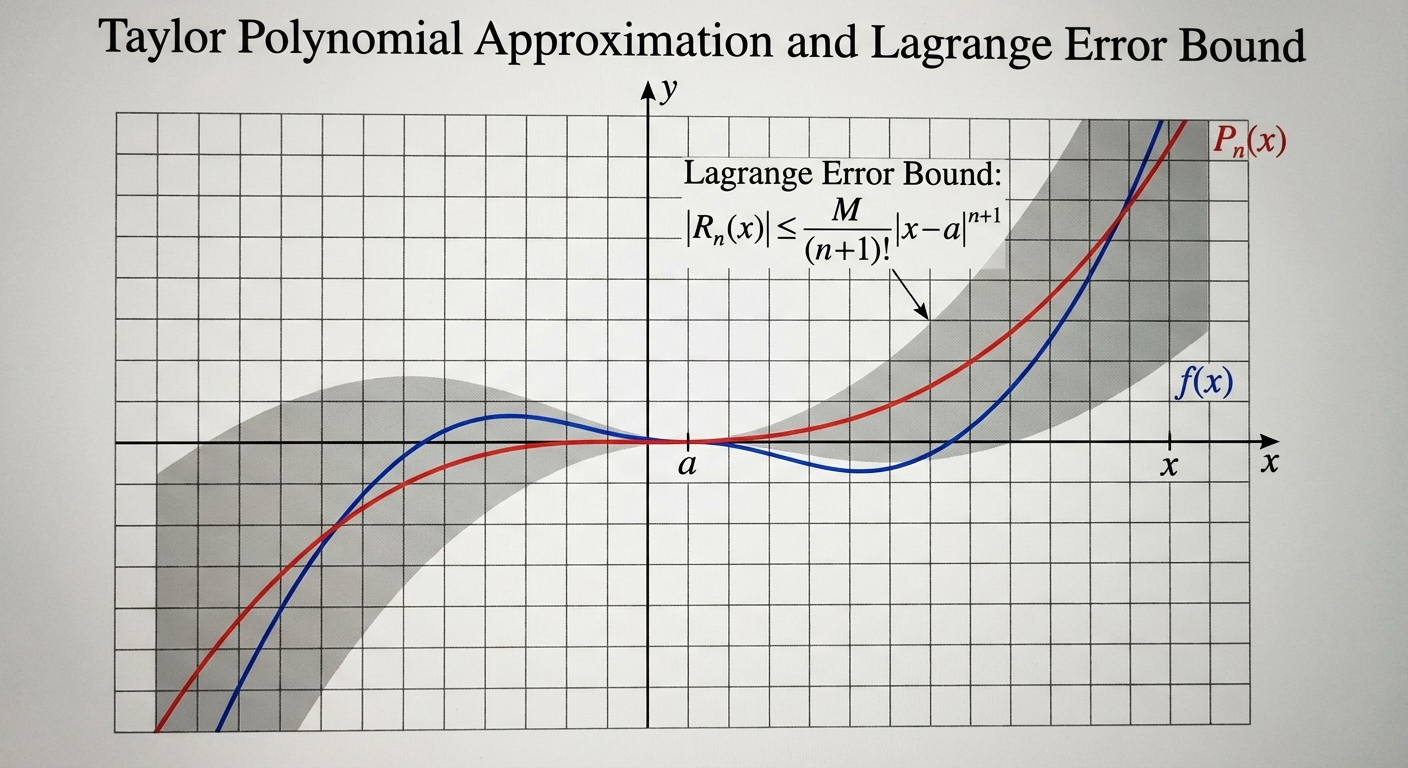
When we use a finite Taylor Polynomial $Pn(x)$ to approximate $f(x)$, the error ($Rn(x)$) is bounded by Lagrange's formula.
Formula:
Where:
- $n$: The degree of the polynomial used for approximation.
- $x$: The value we are approximating at.
- $c$: The center of the series.
- $M$: The maximum value of the absolute value of the $(n+1)^{th}$ derivative, $|f^{(n+1)}(z)|$, for all $z$ between $c$ and $x$.
Key Step: Finding $M$ is usually the hardest part. Look for the maximum possible value of the next derivative on the interval.
Common Mistakes & Pitfalls
- Limit of Sequence vs. Series: Finding $\lim an = 0$ does NOT mean $\sum an$ converges. It only means it might converge. This is the most common student error.
- Harmonic Series Trap: Students often assume $\sum 1/n$ converges because the terms get smaller. It diverges.
- Endpoint Testing: In Power Series questions, finding the interval $(-R, R)$ is only partial credit. You must test $x=-R$ and $x=R$ individually.
- Alternating Series Terms: When using AST or Error Bound, ensure you are looking at the magnitude of terms (ignore the negative signs) when checking for decreasing behavior.
- Lagrange M: Students often confuse the derivative order. If using a degree $n$ polynomial, you need the max of the $(n+1)$ derivative, not the $n$th.