Mastering Silver Age Prose: Pliny the Younger
Historical Context: The Silver Age of Latin Literature
While the AP Latin curriculum focuses heavily on the "Golden Age" authors (Caesar and Vergil), Unit 3 often introduces Pliny the Younger to develop Sight Reading skills and broaden cultural understanding. Pliny represents the Silver Age (approx. 14 AD – 138 AD), a period known for a shift in stylistic preferences from the balanced, periodic sentences of Cicero to a more pointed, epigrammatic, and varied style.
Pliny the Younger (Gaius Plinius Caecilius Secundus)
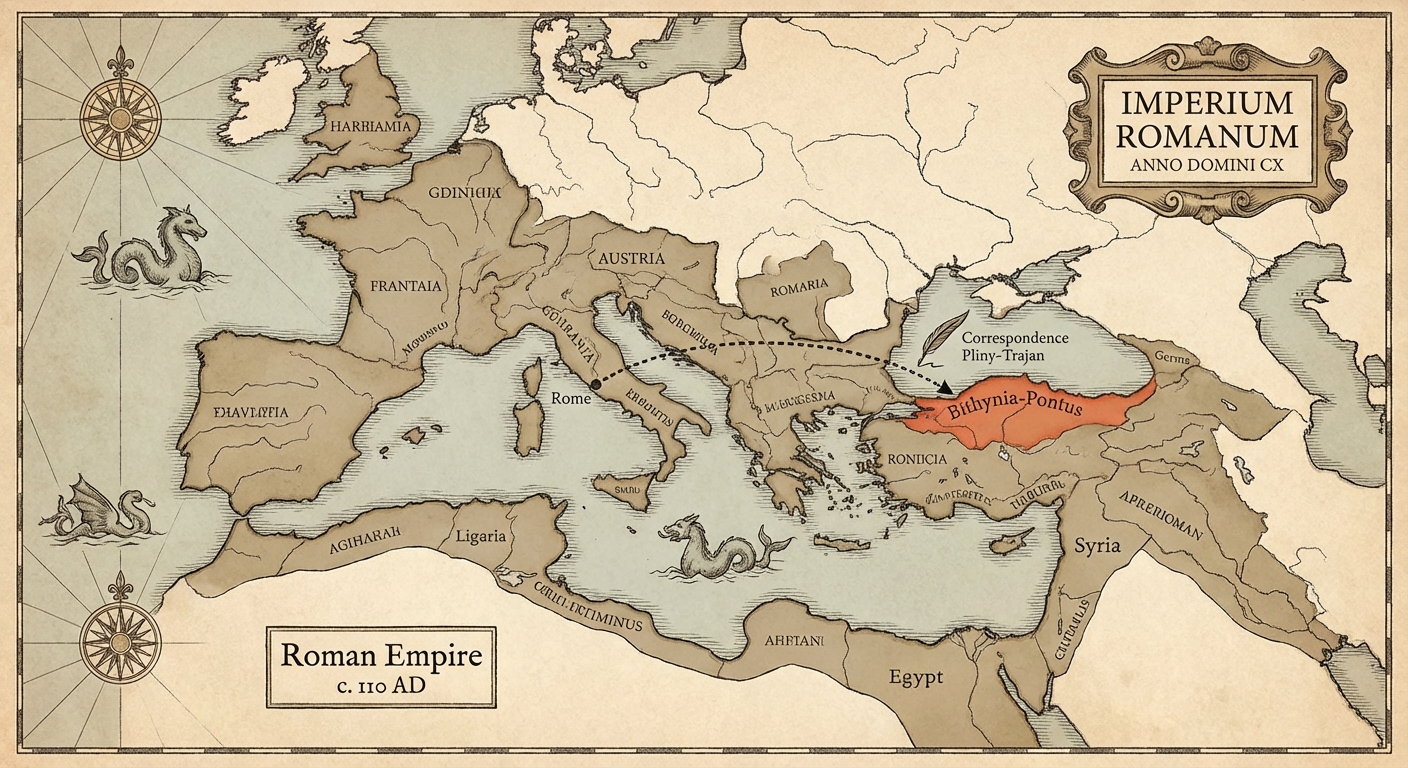
- Life & Role: Born ~61 AD, he was the nephew of the famous naturalist Pliny the Elder (who died at Pompeii). He rose through the cursus honorum to become a consul and eventually the governor of Bithynia-Pontus.
- The Epistulae: unlike Cicero's letters, which were often hasty and purely functional, Pliny wrote his letters with publication in mind. They are polished, literary works designed to showcase his culture, morality, and loyalty.
The Historical Timeline
To understand these letters, you must understand the emperors under whom Pliny lived:
- Domitian (81–96 AD): A transformative but often tyrannical emperor. Pliny survived the "Reign of Terror" but often reflects on the danger of those times.
- Nerva (96–98 AD): Short reign, restored stability.
- Trajan (98–117 AD): The "Optimus Princeps." Pliny served as his governor. The correspondence between them is unique in surviving Latin literature.
Stylistic Analysis: Pliny vs. Golden Age Prose
When transitioning from Caesar's De Bello Gallico to Pliny, students often struggle with the change in syntax. Pliny is a prime candidate for the Sight Reading portion of the AP exam.
Key Stylistic Differences
| Feature | Caesar (Golden Age) | Pliny (Silver Age) |
|---|---|---|
| Sentence Structure | Long, complex periodicity; verbs strictly at the end. | Shorter sentences; often asymmetrical; uses variatio (avoiding repetition). |
| Vocabulary | Restricted military/political lexicon. | Broad, colloquial, and sometimes poetic vocabulary. |
| Tone | Objective, detached, third-person (Caesar facit). | Subjective, personal, first-person (Ego censeo). |
| Grammar | Strict adherence to subjunctive rules. | Occasional Greek constructions; focus on brevitas (conciseness). |
Important Rhetorical Devices in Pliny
- Asyndeton: Omission of conjunctions to speed up the narrative (often used in ghost stories).
- Chiasmus: ABBA word order to contrast ideas.
- Litotes: Using a double negative to express a strong positive (e.g., non dubito - "I do not doubt" meaning "I am sure").
The Ghost Stories (Epistulae 7.27)
This letter is addressed to Licinius Sura and asks a philosophical question: Do ghosts exist (phantasmata), or are they figments of our fear?
The Three Narratives
Pliny uses a structure of three escalating stories to prove his point:
- Curtius Rufus: A minor story about a phantom woman (Africa personified) predicting Rufus's political rise and death.
- The Haunted House in Athens (The Core Story):
- The Setting: A house in Athens is cheap because it is haunted.
- The Hero: The philosopher Athenodorus rents it (a man of logic/reason).
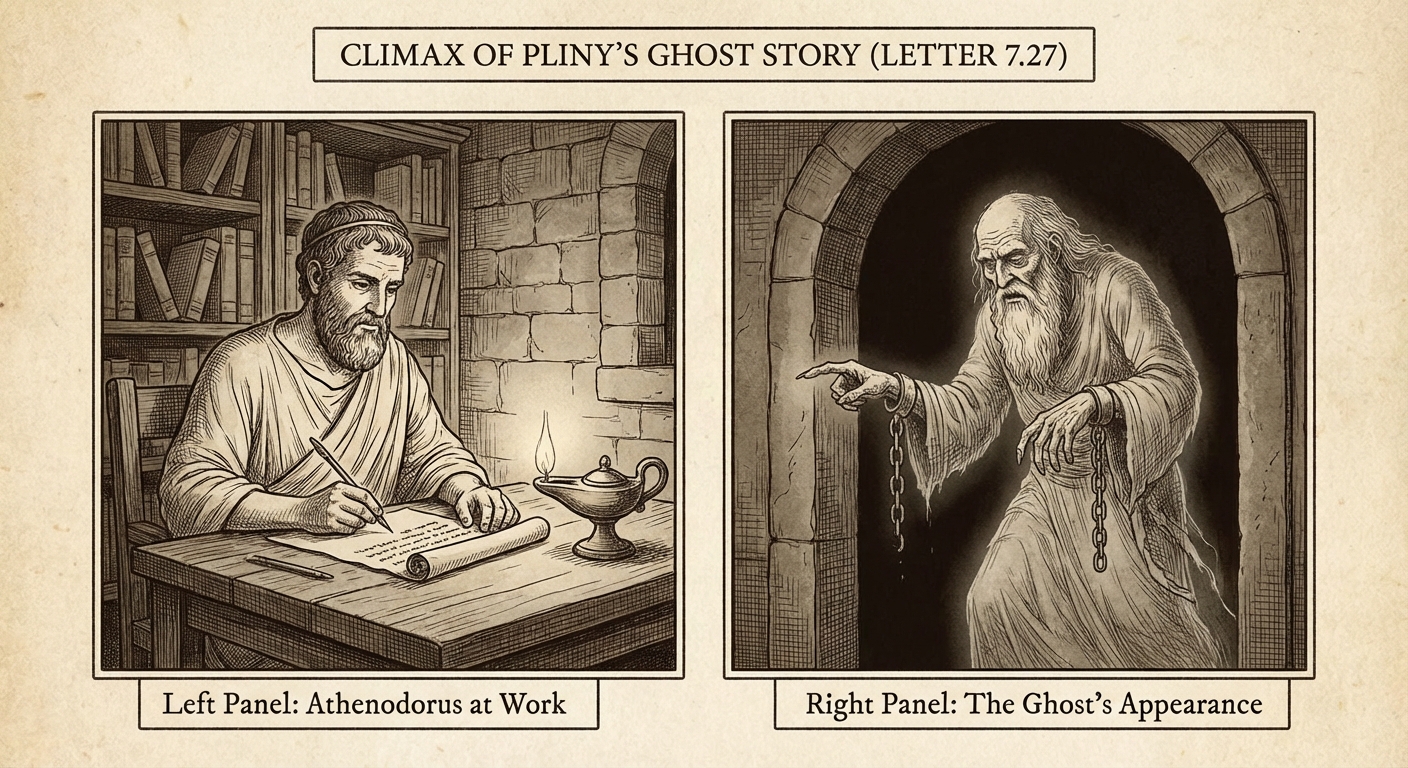
- The Encounter: While Athenodorus studies at night, he hears rattling chains (vincula). A ghost appears—an old man, emaciated, with beard and hair unkempt.
- The Climax: The ghost beckons. Athenodorus calmly finishes his work, then follows. The ghost vanishes in the courtyard.
- The Resolution: They dig up the spot the next day and find bones entangled in chains. Once buried properly (rite conditis), the haunting stops.
- The Household Slave: A slave in Pliny's own house wakes up with his hair cut off. Pliny interprets this as a sign he was not prosecuted during Domitian's reign (cutting hair = sign of an accused person).
Key Grammar Focus: Participation & Ablatives
In the Athens story, look for Present Active Participles describing the ghost's actions (e.g., quatiens, shaking) and Ablative Absolutes setting the scenes (e.g., signo dato, the signal having been given).
Letters to Trajan: The Christians (10.96 & 10.97)
This exchange is historically vital as the earliest non-Christian account of early Christian worship and Roman legal policy toward them.
Pliny's Letter (10.96)
Pliny writes to Trajan from Bithynia because he is unsure how to handle the trials of Christians. He admits he has never been present at such trials.
The Three Questions:
- Age: Should different ages be treated differently?
- Repentance: If they deny being Christian now, should they be pardoned?
- The Charge: Is the "name itself" (nomen ipsum) a crime, or only the "crimes associated with the name" (flagitia cohaerentia nomini)?
Pliny's Procedure:
- He asks them three times (interrogavi ipsos… iterum ac tertio).
- He threatens execution.
- If they persist, he executes them for "stubbornness" (contumacia), regardless of their faith.
- Roman Citizens possess the right of appeal and are sent to Rome.
The "Test":
Pliny requires the accused to:
- Pray to the Roman gods.
- Offer incense/wine to Emperor Trajan's statue.
- Curse Christ (male dicere Christo).
Trajan's Rescript (10.97)
Trajan replies with a famous administrative precedent:
- No Witch Hunts: Conquirendi non sunt ("They are not to be sought out").
- Repentance Works: If they deny being Christian and prove it (by worshipping gods), they are pardoned.
- No Anonymous Accusations: Anonymous pamphlets (libelli sine auctore) are to be ignored as they are a "bad precedent" (pessimi exempli) and not fitting for "our age."
Personal Correspondence: Letters to Calpurnia
These letters (e.g., 6.4, 6.7, 7.5) reveal the domestic side of the Roman aristocracy. They challenge the stereotype of pragmatic, loveless Roman political marriages.
Themes & Imagery
- Longing: Pliny writes about missing his wife while she is away recovering from illness.
- Substitution: He reads her letters over and over; he sits in her place in the room; he feels "tortured" by her absence.
- The "Modern" Husband: Pliny values Calpurnia not just for fertility, but for her intellect—she reads his books and memorizes his speeches. This highlights the education of elite Roman women.
Vocabulary of Emotion:
Look for words of suffering and affection: desiderium (longing), tormentum (torture), solacium (comfort), vestigia (traces/footsteps).
Teacher's Choice: Strategies for Sight Reading
Since Pliny is often used for the AP Latin Sight Reading section, you must apply specific strategies when encountering his prose without a dictionary.
1. The "Bracketing" Method
Pliny often interrupts his main clause with parenthetical thoughts or ablative absolutes. When you see a difficult sentence:
- Isolate the Main Subject (Nominative) and Main Verb.
- Put brackets
[ ]around subordinate clauses (beginning with ut, cum, dum, qui/quae/quod). - Put parentheses
( )around Ablative Absolutes.
2. Identifying Indirect Statements
Pliny reports speech frequently (e.g., the Christians describing their rituals).
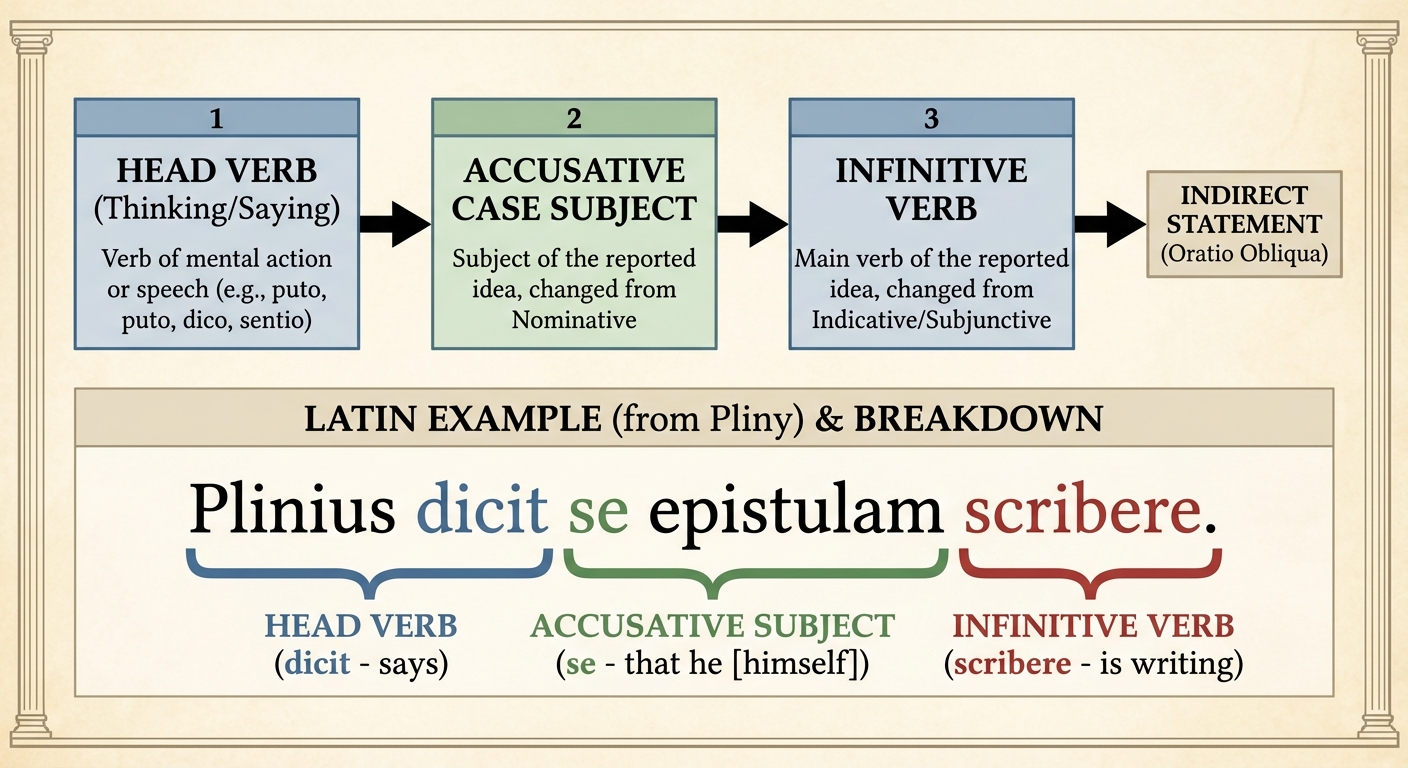
- Look for a "Head Verb" (saying, thinking, knowing) $\rightarrow$ Accusative Subject + Infinitive Verb.
- Example: Adfirmabant autem… se… solitos esse.
- Head verb: Adfirmabant (They affirmed)
- Accusative: se (that they)
- Infinitive: solitos esse (had been accustomed)
3. Handling the Subjunctive
In Pliny, the subjunctive is often used for:
- Indirect Questions: Interrogavi an essent Christiani (I asked whether they were Christians).
- Result Clauses: Esset is often triggered by tam, ita, or tantus.
- Characteristics: Sunt qui… (There are those who…).
Common Mistakes & Pitfalls
1. Confusing Verba Dicendi (Verbs of Speaking)
Students often miss indirect statements because they don't recognize the head verb. In Pliny, these aren't always simple "dixit." Watch for:
- Aio (I say/assert)
- Nego (I deny / say that… not)
- Fateor (I confess)
2. Mistranslating Autem, Quidem, and Tam
- Autem: Postpositive (never the first word). Usually means "however" or "moreover."
- Quidem: "Indeed" or "certainly." Note: Ne… quidem means "not even."
- Tam: "So." It almost always anticipates a Result Clause (ut…).
3. The "Historical Present"
Pliny often switches to the present tense while telling a past story (like the Ghost story) to make it feel immediate. You can translate this as past tense in English, but recognizing it prevents confusion about the timeline.
4. Cultural Context of "Christians"
Students often assume Pliny hated Christians. The text shows he was indifferent but obsessed with order. He executed them for obstinacy (refusing a magistrate's direct order), not inherent heresy. Understanding this legal distinction is key to answering reading comprehension questions.