Mechanisms of Genetic Inheritance: DNA Structure and Synthesis
The Structure of Nucleic Acids
To understand how genetic information is transmitted, you must first master the architecture of the molecule that holds the code. In AP Biology, understanding directionality and chemical bonding is just as important as memorizing the names of the bases.
Components of a Nucleotide
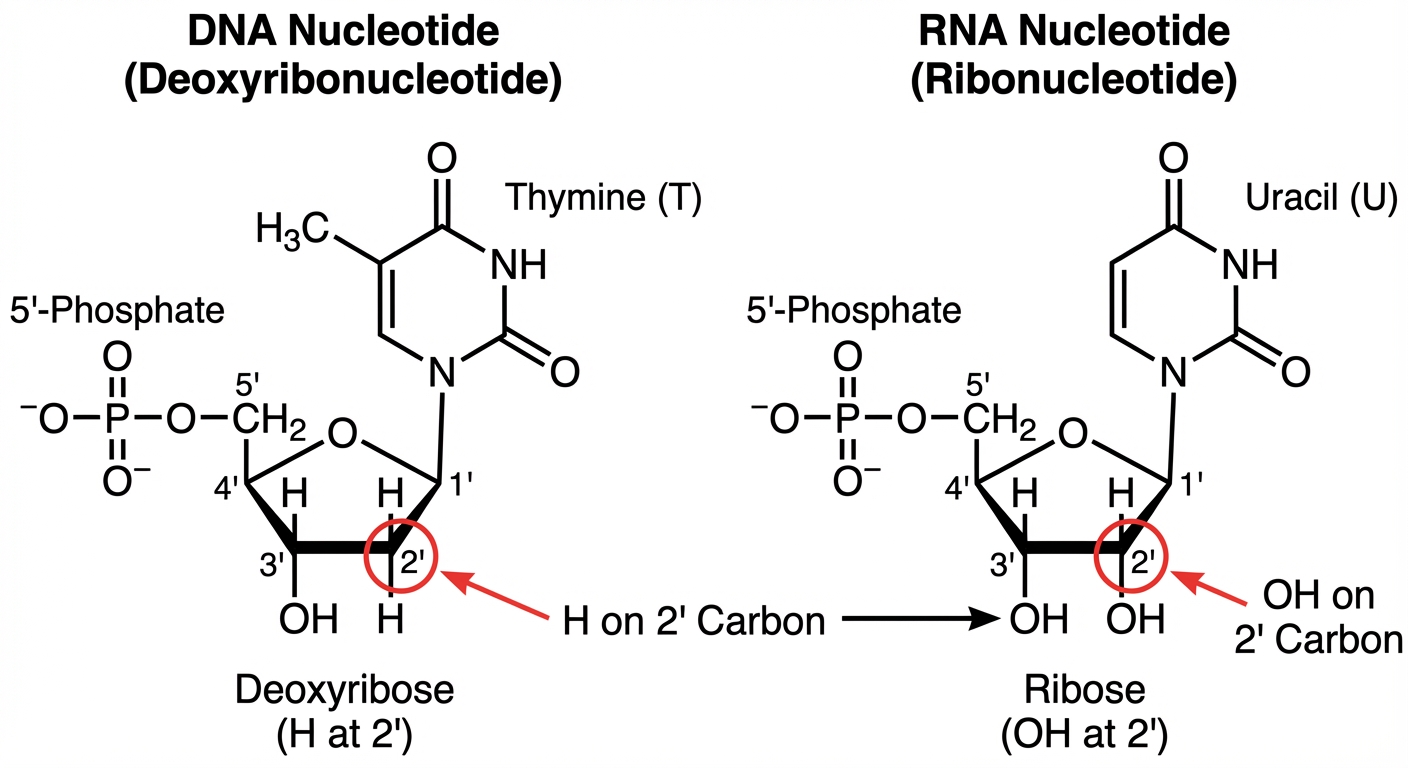
Nucleic acids (DNA and RNA) are polymers made of monomers called nucleotides. Every nucleotide consists of three distinct parts:
- Phosphate Group: Attached to the $5'$ carbon of the sugar. This group is negatively charged, giving DNA its overall negative charge.
- Pentose Sugar: A 5-carbon ring. In DNA, it is deoxyribose (lacks an oxygen at the $2'$ position); in RNA, it is ribose.
- Nitrogenous Base: Attached to the $1'$ carbon of the sugar.
Nitrogenous Bases
The bases are categorized by their chemical structure:
- Purines: Double-ring structures. Think: "Pure As Gold".
- Adenine ($A$) and Guanine ($G$).
- Pyrimidines: Single-ring structures. Think: "Cut the Py".
- Cytosine ($C$), Uracil ($U$, RNA only), and Thymine ($T$, DNA only).
The Double Helix and Antiparallelism
DNA exists as a double helix where two strands twist around each other. The hallmark of this structure is that the strands are antiparallel—they run in opposite directions alongside each other.
- One strand runs $5' \to 3'$, while the complementary strand runs $3' \to 5'$.
- The $5'$ end terminates with a free phosphate group.
- The $3'$ end terminates with a free hydroxyl ($-OH$) group.
Crucial Concept: Enzymes that interact with DNA (like DNA Polymerase) rely heavily on the specific chemical shape of the $3'$ hydroxyl group to function. They generally cannot attach to the $5'$ phosphate end.
Bonding Rules
Two types of chemical bonds stabilize the DNA structure:
- Covalent (Phosphodiester) Bonds: These form the strong "backbone" of the strand. They link the sugar of one nucleotide to the phosphate of the next.
- Hydrogen Bonds: These are weak interactions between the nitrogenous bases that hold the two strands together. It allows the DNA to be easily "unzipped" for replication.
- $A-T$ pairs form 2 hydrogen bonds.
- $G-C$ pairs form 3 hydrogen bonds (stronger interaction).
Chargaff's Rules
Erwin Chargaff discovered that in any DNA sample, the amount of adenine equals thymine, and guanine equals cytosine.
Comparison: DNA vs. RNA
| Feature | DNA | RNA |
|---|---|---|
| Sugar | Deoxyribose | Ribose |
| Strands | Double-stranded | Typically single-stranded |
| Bases | $A, T, C, G$ | $A, U, C, G$ |
| Function | Stores genetic information | Transmits and processes genetic info |
DNA Replication
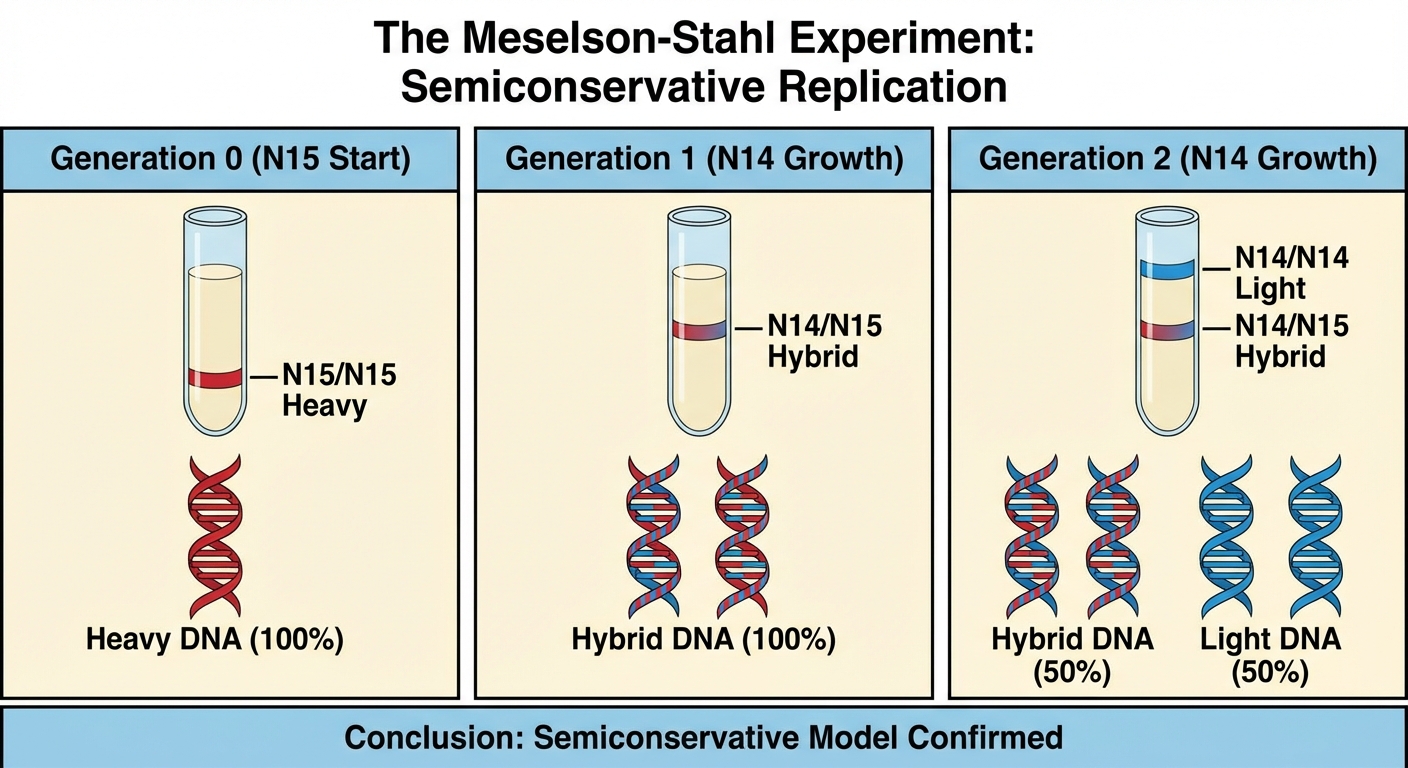
Replication is the process by which a cell copies its DNA prior to cell division. This process is semiconservative, meaning each newly formed double-stranded DNA molecule consists of one original (parental) strand and one newly synthesized strand.
The Replication Machinery (Enzymes)
Review the function of these key proteins. If you see a question about "unwinding" or "gluing," you need to identify the specific enzyme responsible.
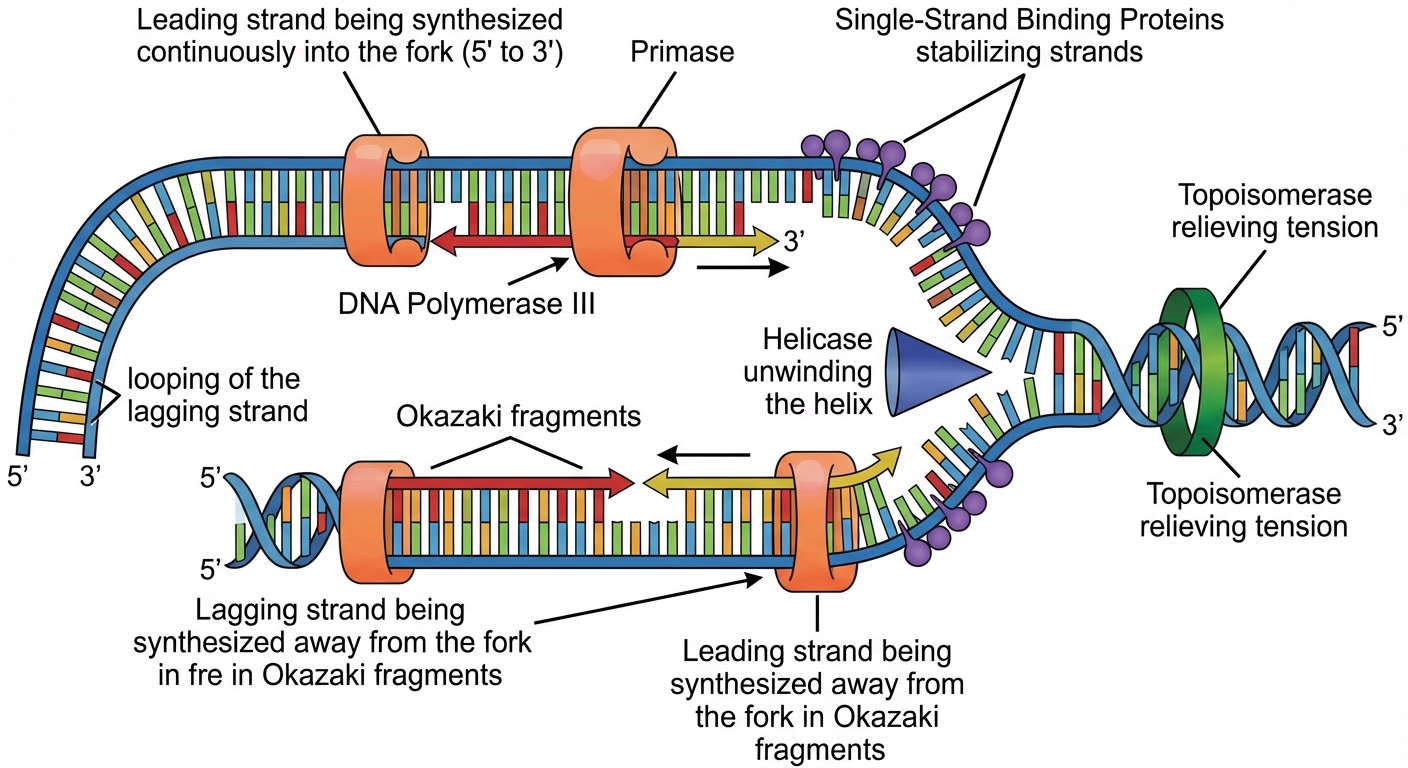
- Topoisomerase: Relaxes the supercoiling ahead of the replication fork to prevent the DNA from snapping due to tension.
- Helicase: Unzips the double helix by breaking the hydrogen bonds between bases.
- Primase: Synthesizes a short RNA primer to provide a $3'$ starting point for DNA polymerase.
- DNA Polymerase III: The main builder. It adds nucleotides to the $3'$ end of the new chain.
- DNA Polymerase I: Removes RNA primers and replaces them with DNA nucleotides.
- Ligase: Joins the sugar-phosphate backbones of Okazaki fragments (the "glue").
The Replication Process
Step 1: Initiation
Replication begins at specific sequences called Origins of Replication. Helicase opens the DNA, creating a "replication bubble."
Step 2: Elongation
This is where the directionality becomes critical. DNA Polymerase can ONLY add nucleotides to the $3'$ end of a growing strand. Therefore, the new strand acts like it is being built in a $5' \to 3'$ direction.
Because the two parent strands are antiparallel, they must be copied differently:
- The Leading Strand: Synthesized continuously toward the replication fork. It only requires one primer.
- The Lagging Strand: Synthesized discontinuously away from the replication fork. It is created in short segments called Okazaki fragments. Each fragment requires its own primer.
Step 3: Termination
Once the strands are copied, the RNA primers are removed by DNA Polymerase I and replaced with DNA. Ligase seals the gaps between the Okazaki fragments to ensure a continuous backbone.
Prokaryotes vs. Eukaryotes
While the chemistry is similar, the organization differs:
- Prokaryotes: Have a single, circular chromosome. They typically have one origin of replication.
- Eukaryotes: Have multiple linear chromosomes. They have multiple origins of replication per chromosome to speed up the process.
- Telomeres: Linear chromosomes have a problem—DNA polymerase cannot replicate the extreme $5'$ end of the lagging strand. This leads to shortening chromosomes over time. Telomeres are protective caps of repetitive DNA at the ends that get shortened instead of coding genes.
Summary of Common Mistakes
Confusing $5'$ and $3'$ Directions
- Mistake: Thinking DNA Polymerase reads $5' \to 3'$.
- Correction: DNA Polymerase reads the template strand $3' \to 5'$ so that it can build the new strand $5' \to 3'$. Always look at which end is being built.
Wait, Uracil?
- Mistake: Assuming Uracil is never involved in DNA replication.
- Correction: While the final DNA product has no Uracil, Primase builds RNA primers. Therefore, temporary Uracil nucleotides are present at the replication fork before DNA Polymerase I replaces them.
Bond Type Confusion
- Mistake: Thinking Helicase breaks covalent bonds.
- Correction: Helicase breaks hydrogen bonds (between bases). If you break the covalent bonds (phosphodiester), you are destroying the backbone of the DNA strand itself.
The "Original" Strand
- Mistake: Thinking one entire DNA molecule is "old" and the other is "new" after replication (Conservative model).
- Correction: In the Semiconservative model, every DNA molecule is a hybrid of one old strand and one new strand.