Comprehensive Guide to Global Conflict: WWI and Interwar Years
Unit 7: Global Conflict (1900–Present)
Shifting Power After 1900
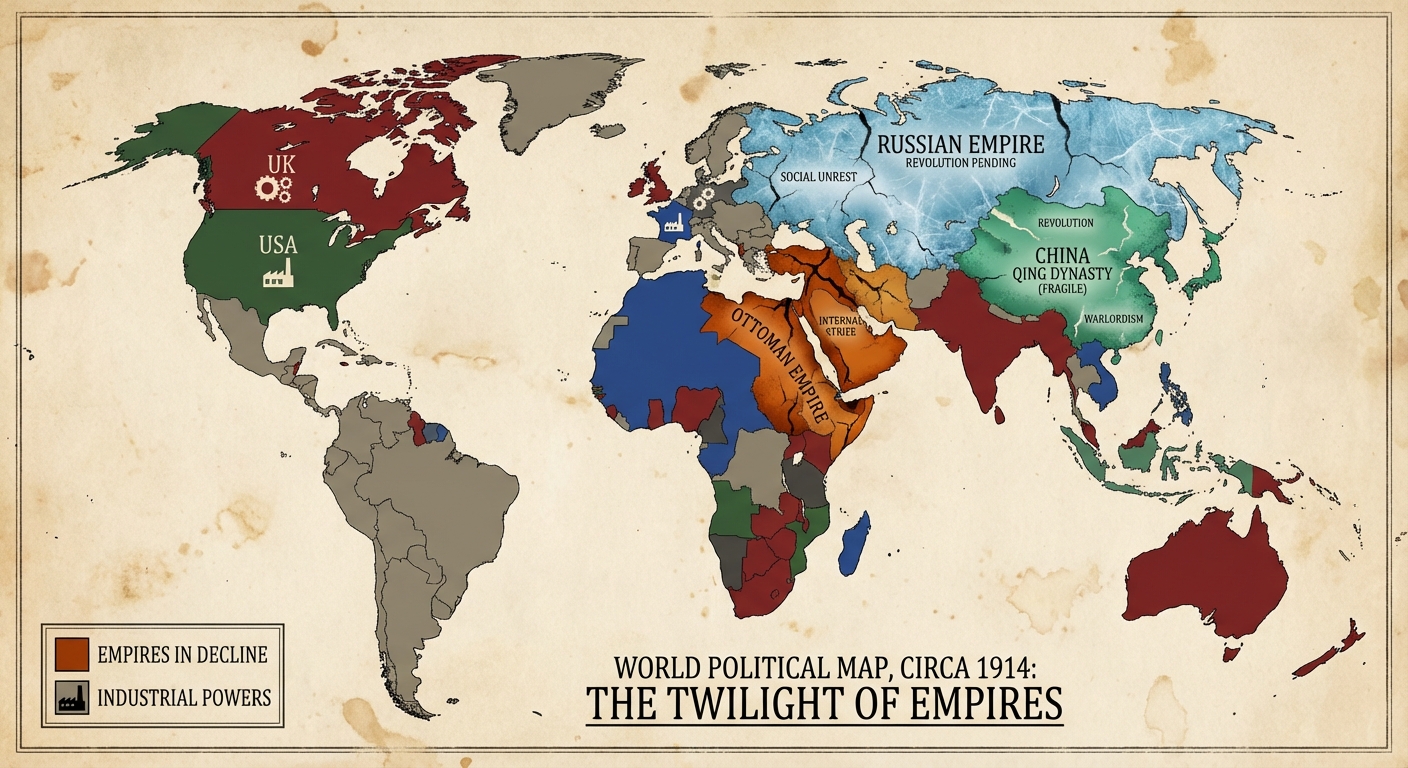
The 20th century began with a significant restructuring of global power. The dominant land-based empires of the previous era crumbled due to a combination of internal decay and external aggression, paving the way for new political systems and shifting the balance of power toward industrialized nation-states.
Collapse of Land-Based Empires
Three major empires collapsed in the early 1900s, often referred to as the "Sick Men" of their respective regions. Their fall was driven by an inability to compete economically and militarily with the industrialized West.
The Ottoman Empire:
- Internal factors: Ethnic nationalism (diverse populations wanting independence) and the failure of Tanzimat reforms to modernize successfully.
- The Young Turks: A reformist group that advocated for a constitution and Turkification (an effort to force Turkish culture on ethnic minorities), which further alienated Arabs and Armenians.
- Result: Sided with Germany in WWI and dissolved in 1922, replaced by the Republic of Turkey under Mustafa Kemal Ataturk.
The Qing Dynasty (China):
- Context: Centuries of foreign domination (Opium Wars, Spheres of Influence).
- Revolution of 1911: Led by Sun Yat-sen, overthrowing the emperor. Sun envisioned a democracy based on the "Three People's Principles": Nationalism, Democracy, and Livelihood.
- Note: While the dynasty fell, China entered a period of chaos and warlordism rather than immediate stability.
The Russian Empire:
- Issues: Slow industrialization, defeat in the Russo-Japanese War (1905), and widespread peasant dissatisfaction.
- Outcome: The Bolshevik Revolution (1917) replaced the Tsar with the world's first communist state, the Soviet Union.
The Mexican Revolution (1910)
Unlike the empire collapses above, this was a revolt against a dictator, Porfirio Díaz, who had allowed foreign investors (mostly US) to control Mexico's resources while 97% of peasants owned no land.
- Key Figures: Pancho Villa and Emiliano Zapata led peasant armies redistributing land.
- Result: The Constitution of 1917, which provided land redistribution, universal suffrage, and public education.
Causes of World War I
While the assassination of Archduke Franz Ferdinand was the spark, the underlying causes had been building for decades. Use the acronym M.A.I.N. to remember the long-term causes.
M.A.I.N. Causes
- Militarism: Aggressive military preparedness and the glorification of war.
- Example: The Naval Race between Great Britain and Germany (building Dreadnought battleships).
- Alliances: Secret agreements that turned a local conflict into a global one.
- Triple Entente: Britain, France, Russia.
- Triple Alliance: Germany, Austria-Hungary, Italy.
- Imperialism: Competition for colonies in Africa and Asia created tension between European powers (e.g., the Scramble for Africa).
- Nationalism: Intense pride in one's national identity.
- Self-Determination: The idea that peoples of the same ethnicity/language should have their own sovereign state. This was most volatile in the Balkans (the "Powder Keg of Europe"), where Serbs wanted liberation from Austria-Hungary.
The Spark
On June 28, 1914, Gavrilo Princip, a Serbian nationalist and member of the Black Hand, assassinated Archduke Franz Ferdinand (heir to the Austro-Hungarian throne). Within weeks, the alliance system activated, pulling the world into war.
Conducting World War I
World War I (1914–1918) was the first "modern" industrial war. It fundamentally changed how wars were fought and how societies supported them.
Total War
This is a critical concept for AP exams. Total War means a nation's entire population, economy, and resources are committed to the war effort.
- Economic Mobilization: Governments set quotas, prices, and wages. Factories were converted to produce munitions.
- Propaganda: Used to recruit soldiers, villainize the enemy (e.g., depicting Germans as "Huns"), and encourage civilians to buy war bonds.
- Women: Filled jobs in factories vacated by men, which eventually helped women gain suffrage (the right to vote) after the war.
New Technology and Tactics
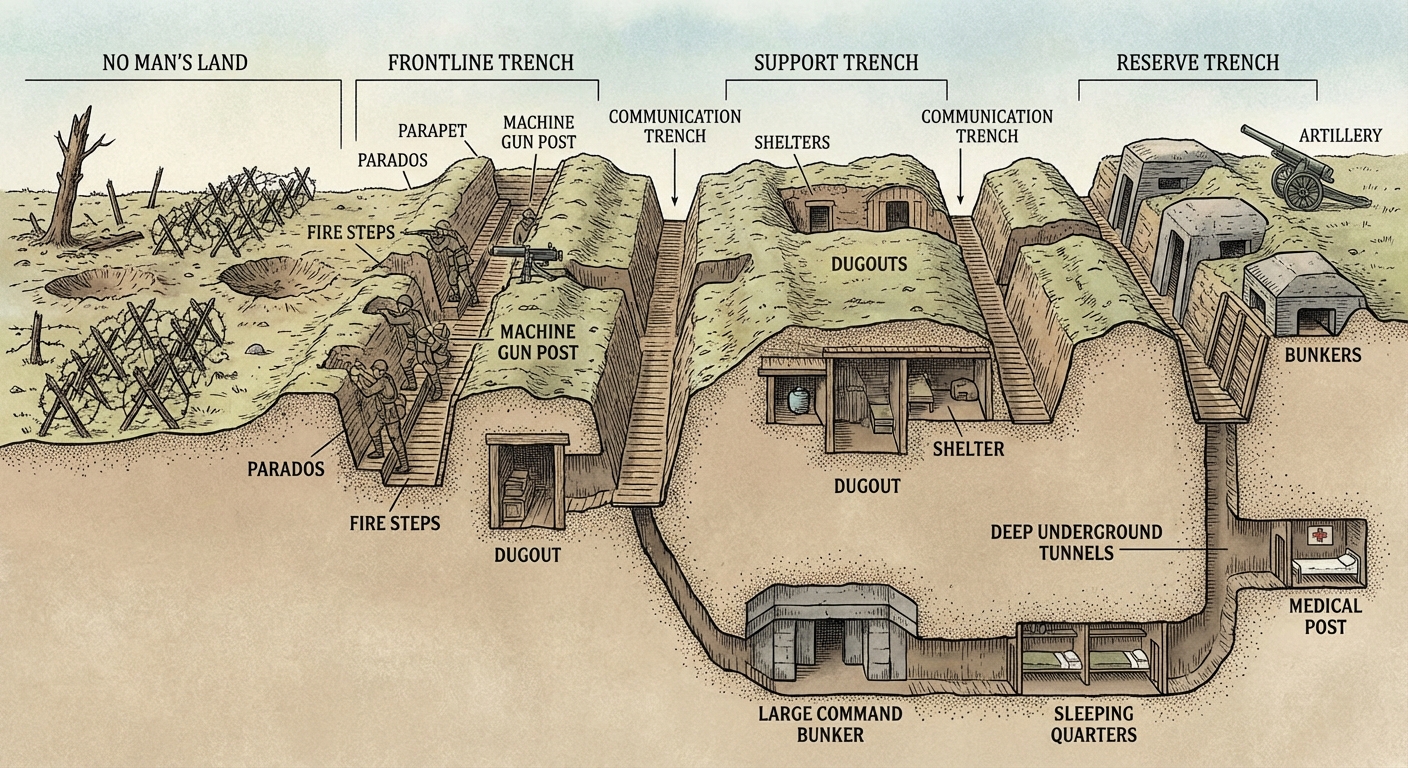
The war quickly turned into a stalemate on the Western Front due to trench warfare.
- Machine Guns: Made charges across "No Man's Land" suicidal.
- Poison Gas: Chlorine and mustard gas introduced psychological terror and mass casualties.
- Tanks & Airplanes: Introduced late in the war; tanks were used to break the trench deadlock, while planes were used for reconnaissance and eventually dogfights.
- U-Boats: German submarines used to disrupt supply lines.
A Global War
Though centered in Europe, the war was global because imperial powers used their colonies.
- Colonial Troops: Britain and France drafted soldiers from India, Africa, and Australia (ANZAC). These soldiers often fought in hopes of gaining independence or citizenship after the war.
- US Entry (1917): The US entered due to German unrestricted submarine warfare (sinking of the Lusitania) and the Zimmermann Telegram (Germany trying to ally with Mexico against the US).
The Peace Settlement and Aftermath
The war ended with the victory of the Allied Powers (Britain, France, US, Italy) and the dismantling of the Central Powers.
The Treaty of Versailles (1919)
The treaty was punitive (punishing) toward Germany, setting the stage for WWII.
- War Guilt Clause: Germany forced to accept full blame.
- Reparations: Germany had to pay billions in damages to the Allies.
- Territorial Loss: Germany lost its colonies and territory in Europe.
The Mandate System
Despite Wilson's call for self-determination, the Allies did not free colonial subjects. instead, the League of Nations created the Mandate System.
- Definition: Territories of the Central Powers (Ottoman and German colonies) were transferred to Allied stewardship (mostly Britain and France) instead of being given independence.
- Example: Britain took control of Palestine and Iraq; France took Syria.
Economy in the Interwar Period
The period between WWI and WWII (1919–1939) saw massive economic instability, culminating in the Great Depression.
The Great Depression (1929)
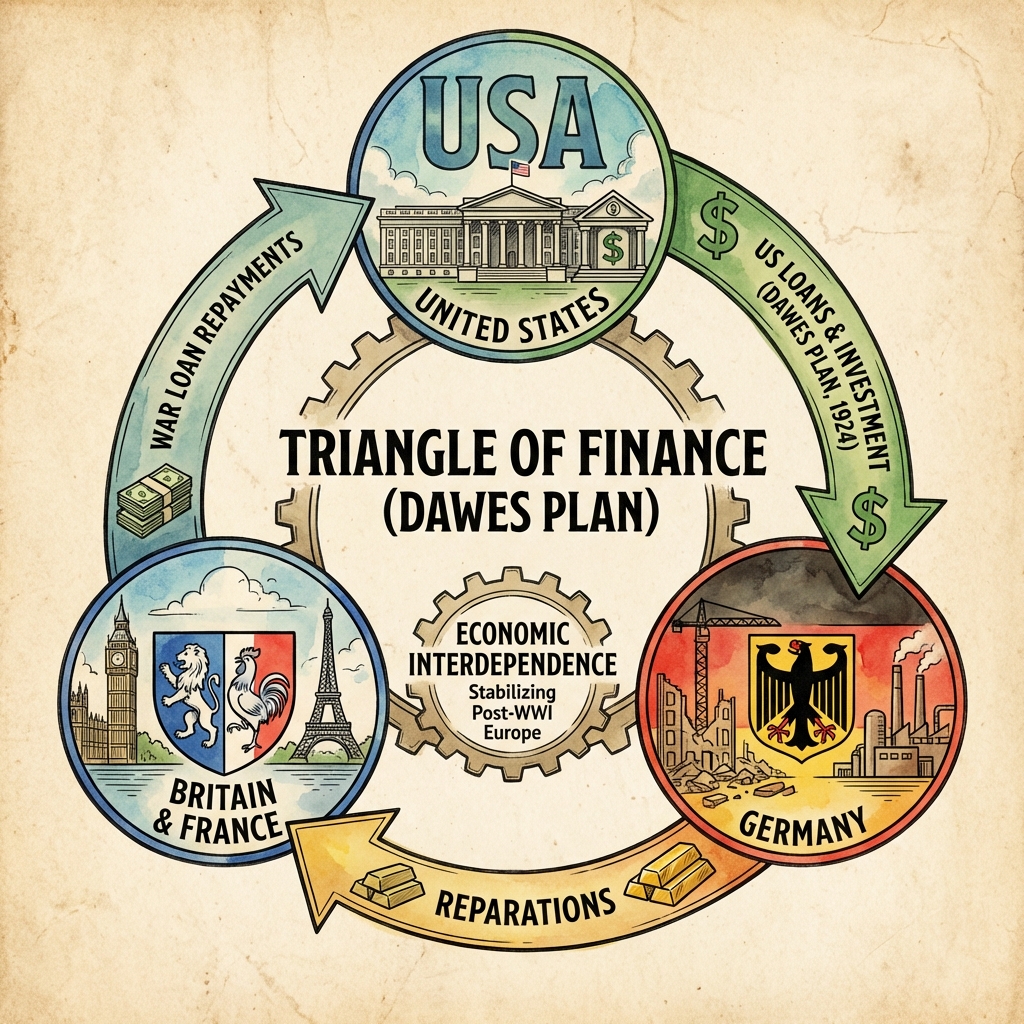
- Causes: Agricultural overproduction (driving prices down) and the US Stock Market Crash of 1929. Because Europe depended on US loans to rebuild, the crash caused a global ripple effect.
Responses to the Depression
Different political systems reacted differently to the economic crisis:
| System | Country | Strategy | Key Term |
|---|---|---|---|
| Liberal Democracy | USA | Government intervention to create jobs and social safety nets. | The New Deal (FDR) / Keynesian Economics (Deficit Spending) |
| Fascism | Germany / Italy | Hyper-nationalism, military buildup, and state control of industry to reduce unemployment. | Corporatism |
| Communism | USSR | The government took total control of land and industry. | Five-Year Plans |
The Soviet Economy
While the West suffered, the USSR industrialized rapidly under Joseph Stalin.
- Five-Year Plans: Set quotas for heavy industry (steel, electricity).
- Collectivization: Stalin forced peasants onto government-run farms (kolkhozes). This caused the Holodomor (a man-made famine in Ukraine resulting in millions of deaths) but successfully shielded the USSR from the global Great Depression.
Common Mistakes & Pitfalls
- Confusing the Alliances: Students often mix up the Triple Alliance (Germany, AH, Italy) with the Central Powers (Germany, AH, Ottomans). Italy switched sides in 1915! Memorize: "Italy initiated interaction with the Allies."
- Date of the Great Depression: It did not start immediately after WWI. The 1920s experienced a brief boom (The Roaring Twenties) before the crash in 1929.
- Russian Revolution Timeline: There were two revolutions in 1917. The first (March) removed the Tsar; the second (November/Bolshevik) brought the Communists to power. Do not think the Tsar was immediately replaced by Stalin; Lenin came first.
- Total War vs. Limited War: Remember that for the civilians back home, WWI was a Total War. If an implementation only involves the military, it is not Total War.