Rights and Resistance: Social Movements of Period 8 (1945–1980)
The African American Civil Rights Movement
During Period 8, the struggle for racial equality transformed from legal challenges into a mass movement of nonviolent direct action, and eventually, into more militant expressions of Black Power. This era is defined by the tension between establishing legal equality (de jure) and combating social reality (de facto).
Strategies of Resistance: The Three Prongs
To understand the movement's success, you must analyze the three distinct strategies utilized by activists:
- Legal Challenges: Led primarily by the NAACP (National Association for the Advancement of Colored People) and attorney Thurgood Marshall. Their goal was to use the Constitution to force the federal government to end segregation.
- Key Victory: Brown v. Board of Education (1954) overturned the "separate but equal" doctrine established in Plessy v. Ferguson.
- Nonviolent Direct Action: Popularized by Dr. Martin Luther King Jr. and the SCLC (Southern Christian Leadership Conference). This relied on civil disobedience—intentionally breaking unjust laws to provoke a reaction and gain media attention.
- Examples: The Montgomery Bus Boycott, the sit-ins in Greensboro, NC.
- Grassroots Organization: Led by students and younger activists, often through SNCC (Student Nonviolent Coordinating Committee). They focused on voter registration in the deepest parts of the South.
- Example: Freedom Summer (1964) in Mississippi.
Key Events and Turning Points
- The Greensboro Sit-Ins (1960): Four college students sat at a whites-only counter. This sparked a wave of sit-ins across the South, leading to the formation of SNCC.
- The Freedom Rides (1961): Activists (both black and white) rode buses into the South to test the enforcement of SCOTUS rulings outlawing segregation in interstate travel. They were met with mob violence, forcing the Kennedy administration to protect them.
- The Birmingham Campaign (1963): King launched protests in the "most segregated city in America." Police Commissioner Bull Connor used fire hoses and attack dogs on children. The televised brutality horrified the nation and pushed JFK to draft a civil rights bill.
- Writing Focus: "Letter from a Birmingham Jail" is a required document. In it, King argues that people have a moral responsibility to break unjust laws and take direct action rather than waiting for the courts.
- March on Washington (1963): Over 200,000 people gathered to support the civil rights bill, highlighted by King's "I Have a Dream" speech.
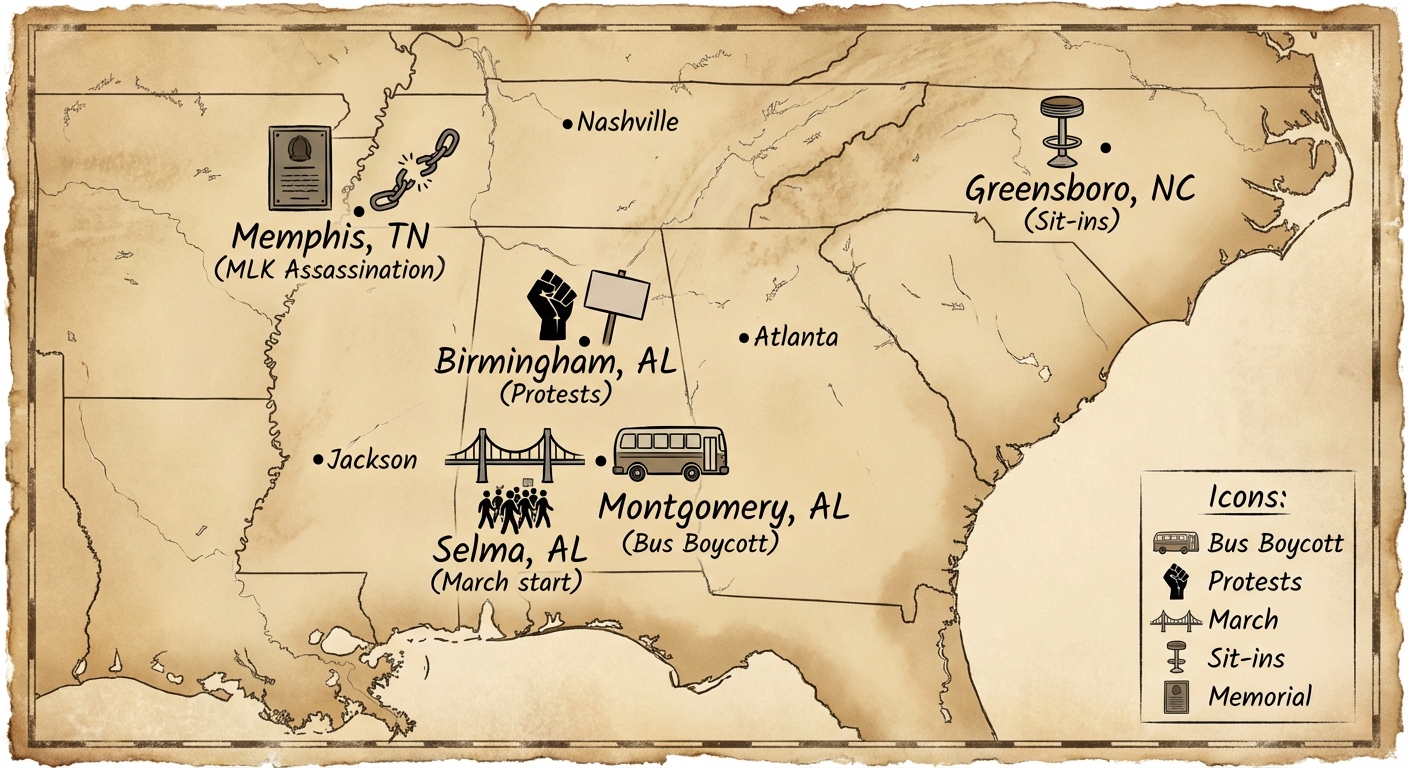
The Civil Rights Act and Voting Rights Act
Following the assassination of JFK, President Lyndon B. Johnson (LBJ) used his political capital and the memory of Kennedy to push through landmark legislation. These acts represent the peak of federal liberalism in the 20th century.
Legislative Comparison Table
| Legislation | Key Provisions | Historical Significance |
|---|---|---|
| Civil Rights Act of 1964 | Banned discrimination in public accommodations (hotels, restaurants) and employment based on race, religion, sex, or national origin. Established the EEOC (Equal Employment Opportunity Commission). | Effectively ended Jim Crow laws (de jure segregation) in the South. |
| 24th Amendment (1964) | Prohibited poll taxes in federal elections. | Removed a major economic cancel barrier used to disenfranchise poor African Americans. |
| Voting Rights Act of 1965 | Outlawed literacy tests and authorized federal registrars to register voters in areas with a history of discrimination. | Resulted in a massive increase in African American voter registration in the South; shifted Southern politics permanently. |
The Shift to Black Power
By 1965, legal segregation was ending, but economic inequality and police brutality remained issues in the North and West. Fractures appeared mainly between older, nonviolent leaders and younger, more radical activists.
- Malcolm X: Initially a minister for the Nation of Islam, he advocated for black separatism and self-defense ("by any means necessary") rather than integration. Although he later moderated his views before his assassination in 1965, he inspired the Black Power movement.
- Black Power: Popularized by Stokely Carmichael (leader of SNCC), this slogan emphasized racial pride, black economic independence, and a rejection of white help in the movement.
- The Black Panthers: Founded in Oakland (1966) by Huey Newton and Bobby Seale. They advocated for arming African Americans to monitor police behavior and created community programs like "Free Breakfast for Children."
Other Movements for Equality
The African American Civil Rights Movement created a template (protest tactics, language of rights) that other marginalized groups adopted. This is a crucial instance of causality in APUSH Period 8.
The Women’s Rights Movement (Second-Wave Feminism)
While First-Wave feminism (19th/early 20th century) focused on suffrage, Second-Wave Feminism (1960s-1970s) focused on economic and social equality.
- Spark: Betty Friedan published The Feminine Mystique (1963), challenging the cult of domesticity and the notion that women were fulfilled solely by homemaking.
- Organization: NOW (National Organization for Women) was founded in 1966 to advocate for equal pay and the Equal Rights Amendment (ERA).
- Victories:
- Title IX (1972): Banned agitation discrimination in education; most visible impact was in funding for women's high school and college sports.
- Roe v. Wade (1973): SCOTUS ruled that state laws prohibiting abortion were a violation of a woman's right to privacy.
- Failures: The ERA passed Congress but fell short of ratification by states, largely due to a conservative counter-movement led by Phyllis Schlafly.
The Latino/Chicano Movement
Mexican Americans fought against labor exploitation and educational neglect.
- Key Figure: Cesar Chavez and Dolores Huerta.
- Organization: The United Farm Workers (UFW).
- Tactics: They utilized the Delano Grape Strike and a nationwide consumer boycott of table grapes to force growers to agree to better wages and working conditions for migrant farmworkers.
The American Indian Movement (AIM)
Changing the federal policy from "termination" (assimilation) to self-determination.
- Formation: Founded in 1968 to address police brutality and systemic poverty.
- Tactics: Militant occupations of symbolic sites to draw attention to broken treaties.
- Alcatraz Island (1969): Occupied for 19 months to claim the land under an old treaty.
- Wounded Knee (1973): Protesters took over the town to protest corruption and federal failures; led to a standoff with the FBI.
The Gay Liberation Movement
- Catalyst: The Stonewall Inn Riots (1969) in NYC. A police raid on a gay bar turned into a multi-day violent protest.
- Impact: Shifted the movement from quiet assimilation efforts (Mattachine Society) to vocal "Gay Pride" and public visibility. Encouraged activists to "come out" as a political act.
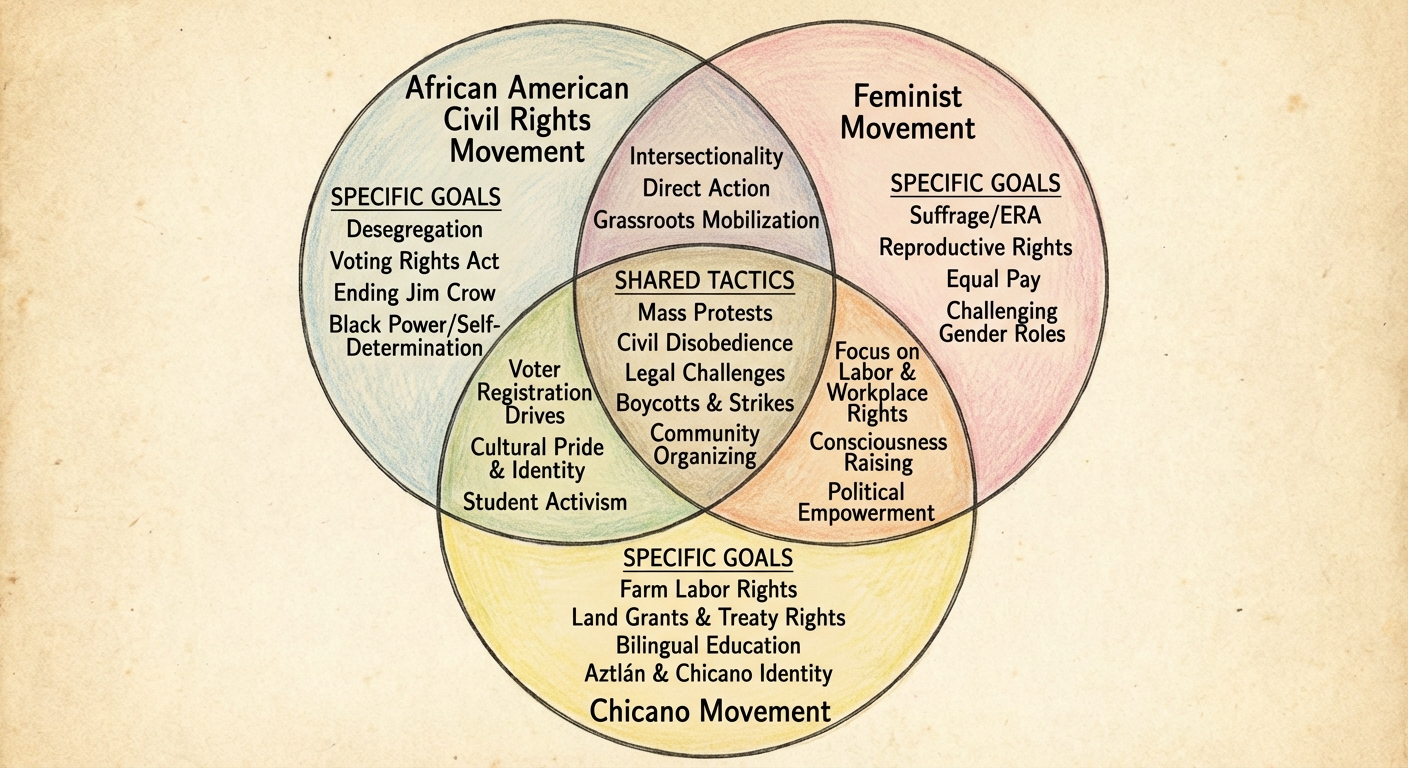
Common Mistakes & Pitfalls
Avoid these frequent errors on the DBQ and LEQ:
Confusing De Jure and De Facto Segregation:
- Mistake: Thinking the Civil Rights Act of 1964 ended all racism.
- Correction: It ended de jure (legal) segregation. It did not fix de facto (customary/economic) segregation, which is why riots (like Watts in 1965) still occurred after the laws passed.
Merging Timelines:
- Mistake: Placing Brown v. Board (1954) or the Montgomery Bus Boycott (1955) in Period 7.
- Correction: While they happened just before or at the start of the timeframe, the AP curriculum firmly roots the movement analysis in Period 8 (1945–1980).
Oversimplifying Resistance:
- Mistake: Assuming all white Southerners opposed civil rights or that all Northerners supported it.
- Correction: "Massive Resistance" was a specific Southern political strategy (Southern Manifesto), but there was also "white flight" and subtle discrimination in Northern cities.
Misunderstanding "Black Power":
- Mistake: Equating Black Power solely with violence.
- Correction: While it did advocate self-defense, its primary focus was self-reliance, economic empowerment, and cultural pride (e.g., the "Black is Beautiful" movement).