AP World History: Modern — Unit 5: Revolutions (c. 1750–1900)
5.1 The Enlightenment
Intellectual Foundations
The Enlightenment was an intellectual movement in the 17th and 18th centuries that emphasized reason, individualism, and skepticism of traditional authority (especially the Church and Absolute Monarchs). It provided the ideological basis for the revolutions that followed.
- Empiricism: Since Francis Bacon, the idea that knowledge comes from sensed experience (observation/experiments), not just tradition/religion.
- Natural Laws: Just as science has laws (gravity), society has natural laws that can be understood and improved.
Key Philosophers & Concepts
| Philosopher | Key Work | Core Ideas |
|---|---|---|
| Thomas Hobbes | Leviathan | Humans are naturally wicked. A strong absolute government is needed to keep order. |
| John Locke | Two Treatises | Natural Rights (Life, Liberty, Property). Tabula Rasa (blank slate). Government is a Social Contract: if the gov fails to protect rights, people have a Right to Revolt. |
| Montesquieu | Spirit of Laws | Separation of Powers (branches of government) and Checks and Balances to prevent tyranny. |
| Voltaire | Candide | Freedom of speech and Religious Tolerance. separation of church and state. |
| Rousseau | The Social Contract | The General Will: Governments should rule according to the will of the people. |
| Adam Smith | Wealth of Nations | Laissez-faire Capitalism. The "Invisible Hand" regulates the economy, not the government. |
Impact on Society
- Suffrage (Voting): Expanded slowly from aristocracy to land-owning men, eventually to all men.
- Abolitionism: Enlightenment ideas of equality clashed with slavery. Slave trade banned in Britain (1807) and US (1808).
- End of Serfdom: Peasant reforms in Europe (especially Russia later under Alexander II).
- Feminism:
- Mary Wollstonecraft (A Vindication of the Rights of Woman): Argued women are not inferior, just uneducated.
- Olympe de Gouges (Declaration of the Rights of Woman): French playwright calling for equality during the French Revolution.
- Seneca Falls Convention (1848): US gathering rallying for women's suffrage.
5.2 Nationalism and Political Revolutions
Nationalism is the intense loyalty to others who share one's language and culture. It served as a unifying force (Germany, Italy) and a force for breaking empires (Ottoman, Austrian).
The Atlantic Revolutions
These revolutions were inspired by Enlightenment ideals and inspired one another.
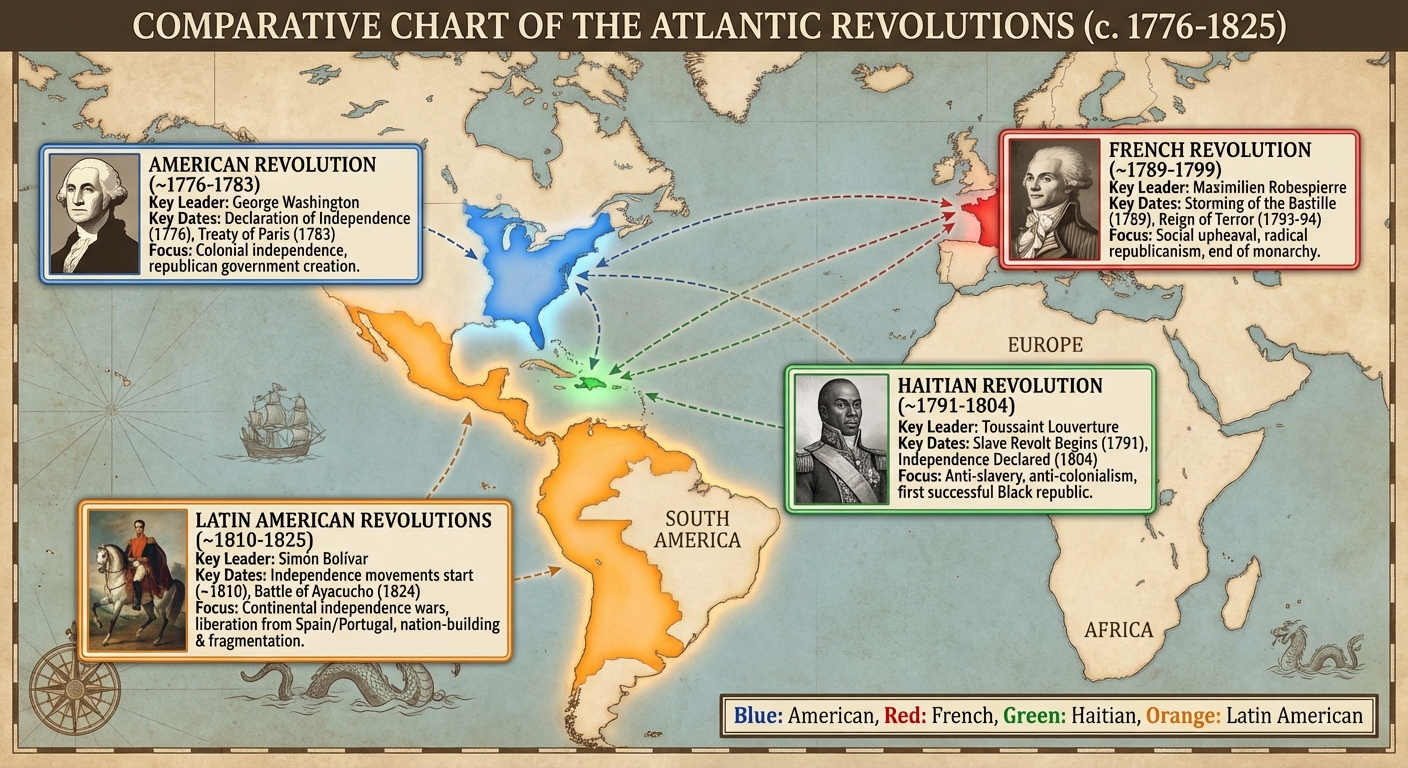
1. The American Revolution (1775–1783)
- Causes: "Taxation without representation" (Stamp Act, Tea Act), influence of Locke's ideas.
- Key Document: Declaration of Independence (Authored by Jefferson, heavily influenced by Locke).
- Outcome: Established a federal republic with separation of powers. Inspired the French Revolution.
2. The French Revolution (1789–1815)
- Causes: Debt from wars (including helping the US), social inequality of the Three Estates (Clergy, Nobility, Commoners).
- Key Events:
- National Assembly: The Third Estate breaks away; signs Declaration of the Rights of Man and of the Citizen.
- Reign of Terror: Radical Jacobins (led by Robespierre) execute opponents, including King Louis XVI. Committee of Public Safety rules.
- Rise of Napoleon: Overthrows the Directory (1799). Creates Napoleonic Code (equality of men, public education). Conquers much of Europe but sparks nationalist resistance elsewhere.
- Congress of Vienna (1815): After Napoleon's defeat, conservative European leaders (led by Metternich) reset borders to maintain a Balance of Power and suppress future revolutions.
3. The Haitian Revolution (1791–1804)
- Uniqueness: The only successful slave revolt in history and the first black-led country in the Western Hemisphere.
- Leaders: Toussaint L'Ouverture (general who organized the slaves) and Jean-Jacques Dessalines.
- Causes: Brutal slavery conditions on sugar plantations; inspiration from French Revolution rights.
- Comparison: Unlike the US/French revolutions, this was a complete overturning of the social hierarchy.
4. Latin American Revolutions (1810–1825)
- Social Context: Creoles (Europeans born in Americas) wanted power held by Peninsulares (born in Spain/Portugal). They did not generally want to give power to Mestizos, Natives, or Slaves.
- Key Figures:
- Simón Bolívar: "The Liberator" of Gran Colombia (Venezuela, Colombia, Ecuador). Wrote the Jamaica Letter outlining desire for independence and free markets.
- José de San Martín: Liberated Argentina, Chile, and Peru.
- Mexico: Started by Priest Miguel Hidalgo (supported by peasants/natives), but finished by Creole Elites (Iturbide) who feared losing power.
Unification Movements
Italian Unification (Risorgimento)
- Led by Count Cavour (Realpolitik diplomat in the North) and Giuseppe Garibaldi (Military leader of the "Red Shirts" in the South).
- Unified under the House of Savoy (King Victor Emmanuel II) in 1861.
German Unification (1871)
- Engineered by Prussian Chancellor Otto von Bismarck.
- Realpolitik: Politics based on practical methods, not theories or ethics.
- "Blood and Iron": Unification achieved through war (Franco-Prussian War) and industrial might, not liberal voting.
5.3–5.5 The Industrial Revolution
Origins: Why Britain First?
- Geography: Abundance of Coal and Iron; navigable rivers/canals; island status (isolated from continental wars).
- Resources: Timber and Cotton provided by colonies.
- Capital: Wealth from the Atlantic Slave Trade and colonization available for investment.
- Legal System: Protection of private property and patent laws.
- Agricultural Revolution:
- Enclosure Movement: Public lands closed off, forcing small farmers into cities (Urbanization) -> create a labor pool.
- Crop Rotation & Seed Drill: Increased food supply -> population boom.
Technological Developments
The Factory System
Replaced the Cottage Industry (Putting-out system). Concentrated production in one location using specialized labor (Division of Labor) and Interchangeable Parts (Eli Whitney).
First Industrial Revolution (c. 1760–1840)
- Focus: Textiles, Iron, Steam.
- Key Inventions:
- Spinning Jenny (James Hargreaves) & Water Frame (Richard Arkwright): Mechanized cotton spinning.
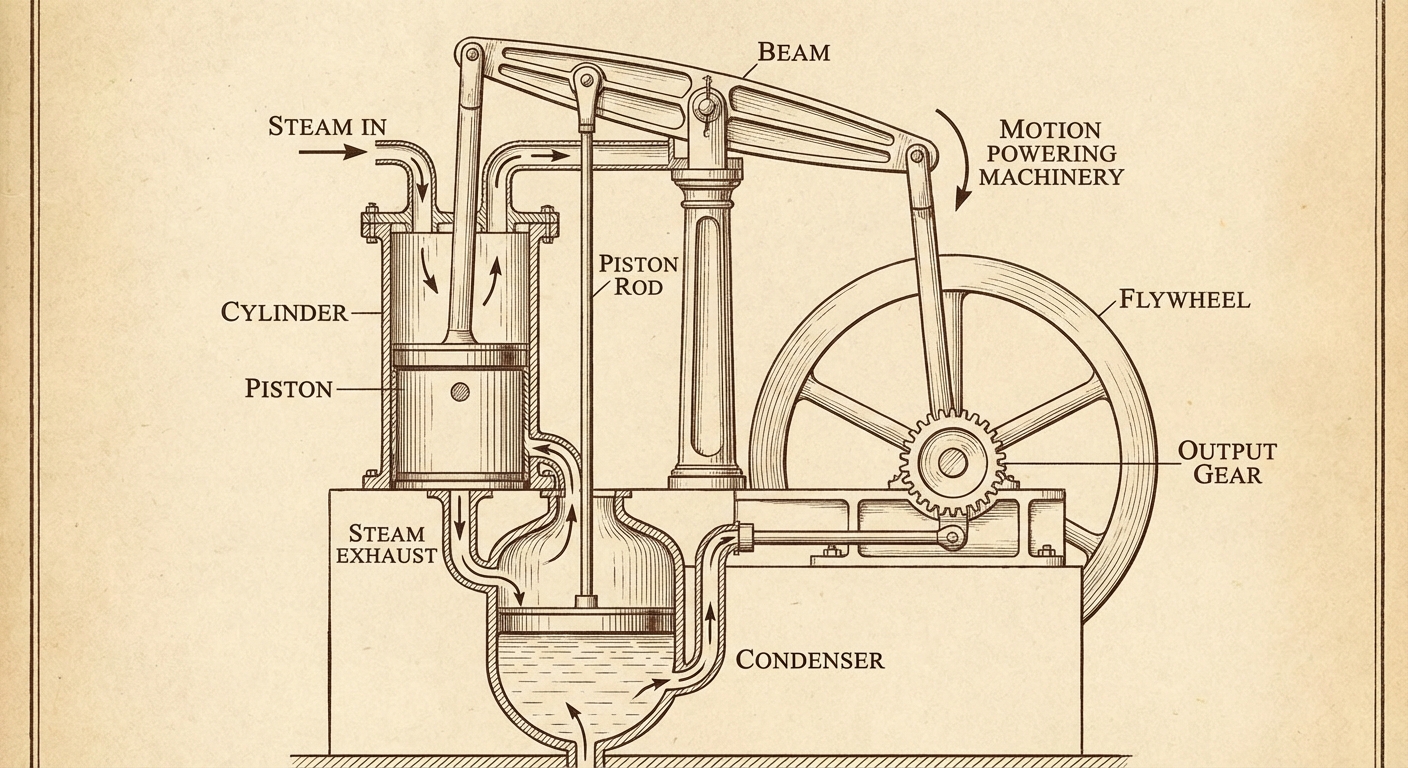
- Steam Engine (James Watt): Allowed factories to move away from rivers; powered locomotives and steamships.
Second Industrial Revolution (c. 1870–1914)
- Focus: Steel, Chemicals, Precision Machinery, Electronics.
- Key Inventions:
- Bessemer Process: Mass production of steel (stronger/lighter than iron).
- Electricity: Street lights, subways.
- Communication: Telegraph, Telephone, Radio.
- Internal Combustion Engine: Petroleum-based power (cars/planes later).
5.6 Government Role in Industrialization
Unlike Britain (where private investors led), other states played a direct role to catch up (State-Sponsored Industrialization).
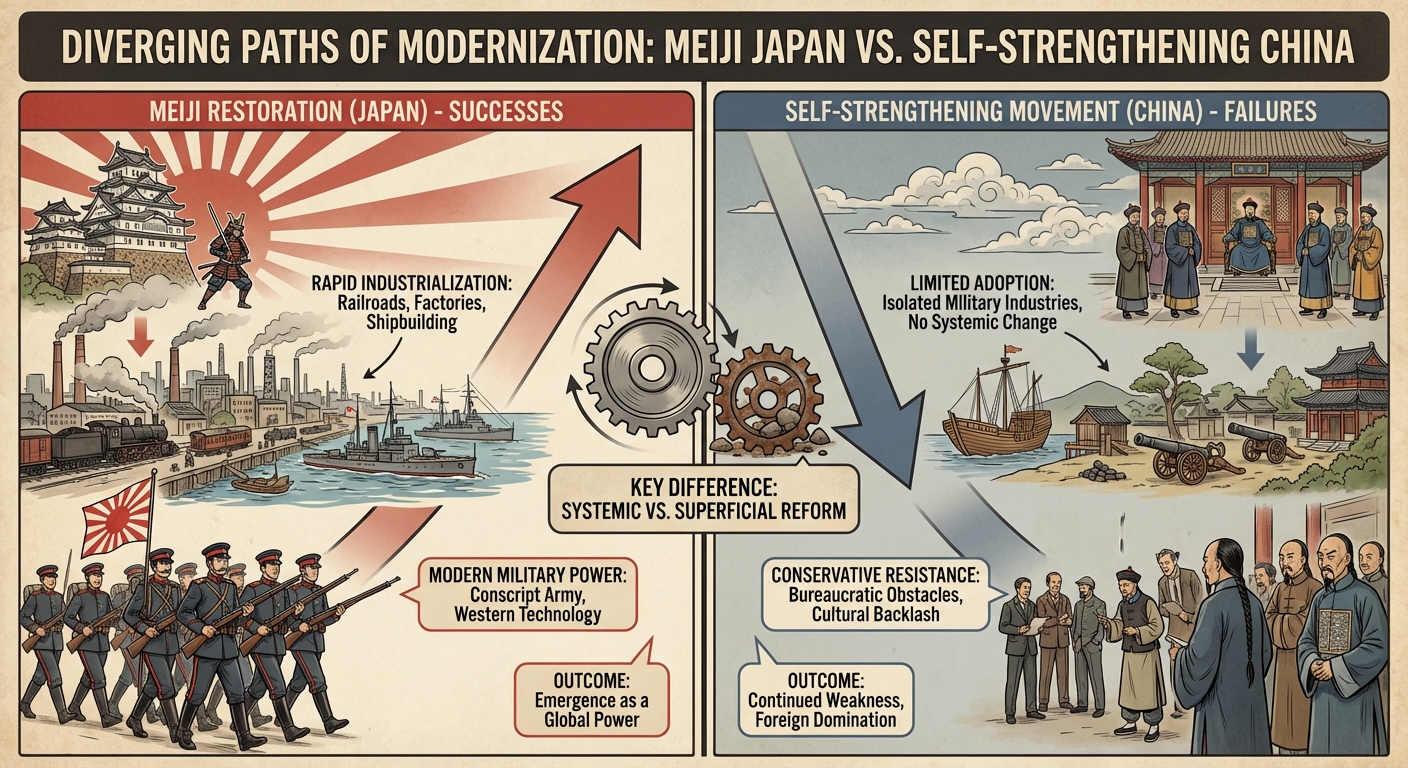
1. Japan (Meiji Restoration)
- Context: After US Commodore Matthew Perry forced Japan open (1853), the Shogunate fell. The Emperor was "restored" to power.
- Goal: Defend against Western Imperialism by adopting Western Industrialization ("Rich Country, Strong Army").
- Reforms: abolished feudalism (samurai -> bureaucracy), established Zaibatsu (powerful family business conglomerates), built railroads/ships.
2. Russia
- Sergei Witte: Finance minister who promoted heavy industry.
- Trans-Siberian Railroad: Linked Moscow to the Pacific, aiding trade and resource extraction (coal/iron/steel).
- Limit: Remained largely agricultural; industrialization led to a radical working class (Marxism).
3. Egypt
- Muhammad Ali: An Ottoman officer who acted as a semi-independent ruler.
- State-controlled cotton textile industry and weapons factories to compete with Europe. (Specifically distinct because the British eventually interfered to de-industrialize Egypt).
5.7 Economic Systems
Capitalism
- Adam Smith (Wealth of Nations, 1776).
- Laissez-faire: No government interference.
- Free Market: Supply and demand dictate prices.
- Transnational Companies: Large corporations operating across borders (e.g., HSBC banking, Unilever).
Responses to Capitalism (Socialism/Marxism)
- John Stuart Mill: Utilitarianism (reforms to benefit the greatest number of people, e.g., labor unions, child labor laws).
- Karl Marx & Friedrich Engels: The Communist Manifesto (1848).
- Theory: History is a class struggle between the Bourgeoisie (owners) and the Proletariat (workers).
- Prediction: Workers will violently overthrow owners, seize the "means of production," and create a classless, stateless society (Communism).
5.8 & 5.9 Social Effects and Responses
Social Structures
- Urbanization: Rapid growth of cities led to Tenements (slums), spread of diseases (Cholera), and pollution.
- New Class System:
- Industrial Middle Class: White-collar workers, managers, owners.
- Industrial Working Class: Blue-collar, manual labor, low wages.
- Women & Children:
- Working class women/children worked in mines/factories for lower pay.
- Middle class women limited by the Cult of Domesticity (idealizing the housewife role).
Labor Reform
- Labor Unions: Organizations of workers using collective bargaining and strikes to win rights.
- Wins: Minimum wage limits, 5-day work week, overtime pay.
- Factory Acts: Laws limiting child labor and setting safety standards.
Global Reactions to Modernization
Some empires tried to reform to keep up with the West but struggled against internal conservative forces.
- Ottoman Empire (Tanzimat Reforms):
- Attempts to secularize education, update laws (Ottomanism), and modernize the military.
- Failure: Blocked by the Janissaries and conservative religious scholars (Ulama); "Sick Man of Europe."
- Qing China (Self-Strengthening Movement):
- "Chinese Learning at the Base, Western Learning for Use."
- Tried to buy Western guns/ships while keeping Confucian values.
- Failure: Defeated by Japan in Sino-Japanese War (1895).
Common Mistakes & Pitfalls
- Confusing the "First" and "Second" Industrial Revolutions: Remember TEXTILES & STEAM = 1st; STEEL & ELECTRICITY = 2nd.
- Overstating Latin American Freedom: Students often think Latin American revolutions were "democratic." They were mostly transfers of power from Peninsulares to Creoles. The lives of indigenous people and mixed-race populations rarely improved immediately.
- Socialism vs. Communism: In this era, "Socialism" is the broad category of wanting social ownership/regulation. "Marxism/Communism" is the specific revolutionary roadmap drawn by Marx. Don't use them interchangeably without nuance.
- Geography Determinism: Don't just say "Britain had coal." Mention legal protections (private property) and capital (money from colonies) as equally important causes.
- Timing of events: The American Revolution (1776) happened before the French Revolution (1789). The Haitian Revolution overlapped with the later stages of the French Revolution.