Unit 8: Global Polarity and Ideological Conflict
Unit 8: Global Polarity and Ideological Conflict
Setting the Stage for the Cold War
The end of World War II marked a definitive shift in the global balance of power. The conflict decimated the infrastructure and economies of traditional Western European powers (Great Britain and France), leaving a power vacuum filled by two opposing superpowers.
The Shifting Balance of Power
By 1945, the United States and the Soviet Union emerged as the dominant global forces, but for vastly different reasons:
- The United States: Emerged economically strengthened giving it immense leverage. It also possessed the atomic bomb.
- The Soviet Union (USSR): Despite suffering massive casualties, it possessed the world's largest land army and occupied vast territories in Eastern Europe.
Breakdown of the Grand Alliance
The cooperation between the Allies crumbled quickly during two key conferences:
- Yalta Conference (Feb 1945): Stalin pledged to allow free elections in Eastern Europe but demanded a buffer zone against future German aggression. Germany was divided into four zones of occupation.
- Potsdam Conference (July 1945): Tensions flared as Truman (US) demanded free elections in Eastern Europe, which Stalin (USSR) refused, viewing them as anti-Soviet. The "Grand Alliance" effectively ended here.
The Cold War: Ideologies and Strategies
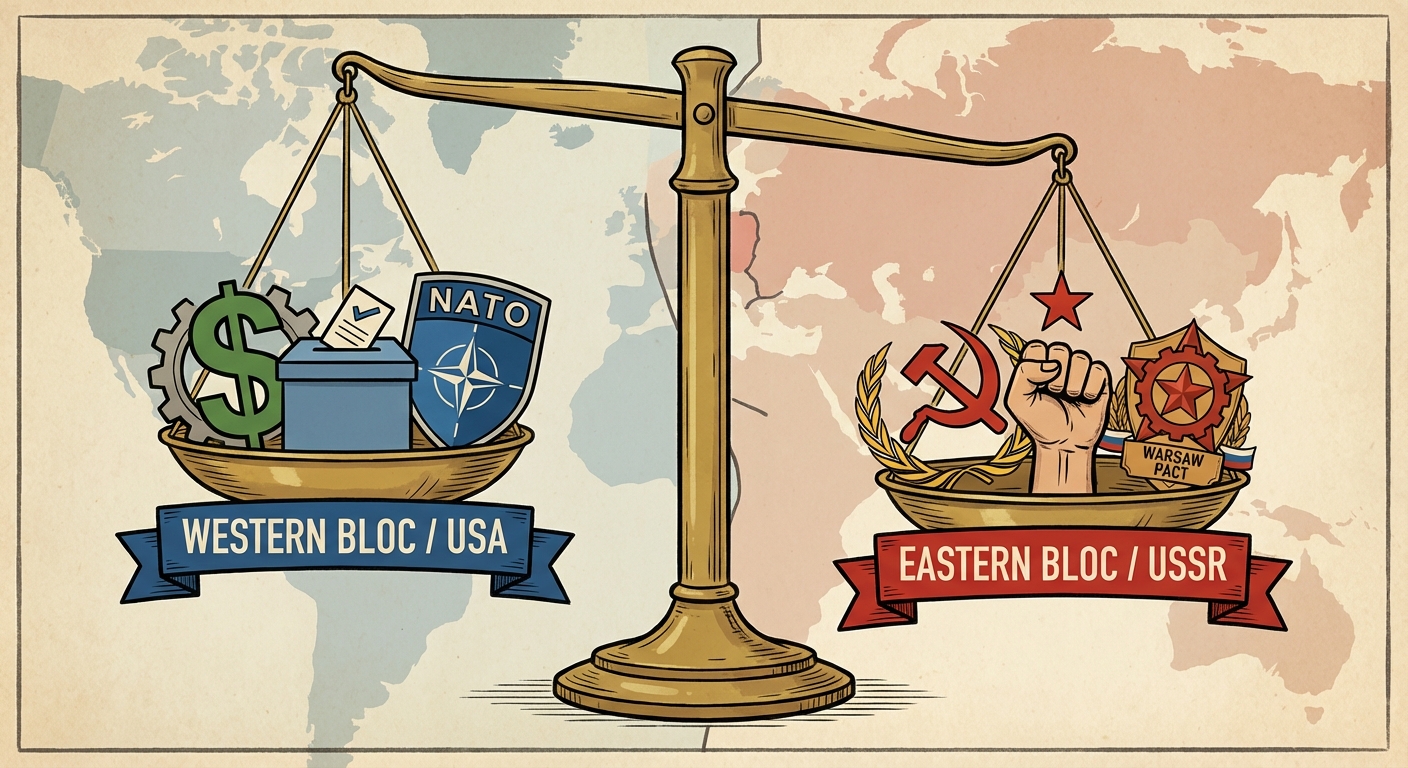
The Cold War was not a traditional military conflict; it was a struggle for geopolitical dominance between two antagonistic ideologies. It was "cold" because there was no large-scale direct fighting between the two superpowers, largely due to potential nuclear annihilation.
Ideological Comparison
To understand the conflict, you must understand the fundamental differences in how each side viewed the world:
| Feature | United States & The West | Soviet Union & The East |
|---|---|---|
| Economy | Capitalism: Private ownership, free markets. | Communism: State ownership, central planning. |
| Politics | Democracy: Elected leaders, multiple parties. | Authoritarianism: Single-party rule, dictatorship. |
| Goal | Containment of Communism; spread of democracy. | Worldwide spread of workers' revolutions (Communism). |
Containment and Methodology
The US adopted the foreign policy of Containment—the idea that communism must be stopped from spreading to new countries. This was articulated by diplomat George Kennan.
- The Truman Doctrine (1947): A pledge to provide economic and military aid to any country threatened by communism (specifically directed at Greece and Turkey).
- The Marshall Plan (1948): A massive economic aid package ($12 billion) offered to European nations to rebuild. The goal was to stabilize economies so that communism would not appeal to the flourishing working class.
The Non-Aligned Movement
Not all nations chose a side. Many newly independent nations in Asia and Africa wanted to avoid becoming pawns in the superpower struggle.
- Bandung Conference (1955): Representatives from 29 African and Asian nations met to oppose colonialism and form a "Third World" alternative.
- Key Leaders:
- Sukarno (Indonesia): Hosted the Bandung Conference.
- Kwame Nkrumah (Ghana): Advocated for Pan-Africanism and non-alignment.
- Jawaharlal Nehru (India): Promoted neutrality to receive aid from both sides.
Effects of the Cold War
The conflict reshaped global alliances, spurred technological races, and ignited violence in the developing world (the "Global South").
Military Alliances and Divisions
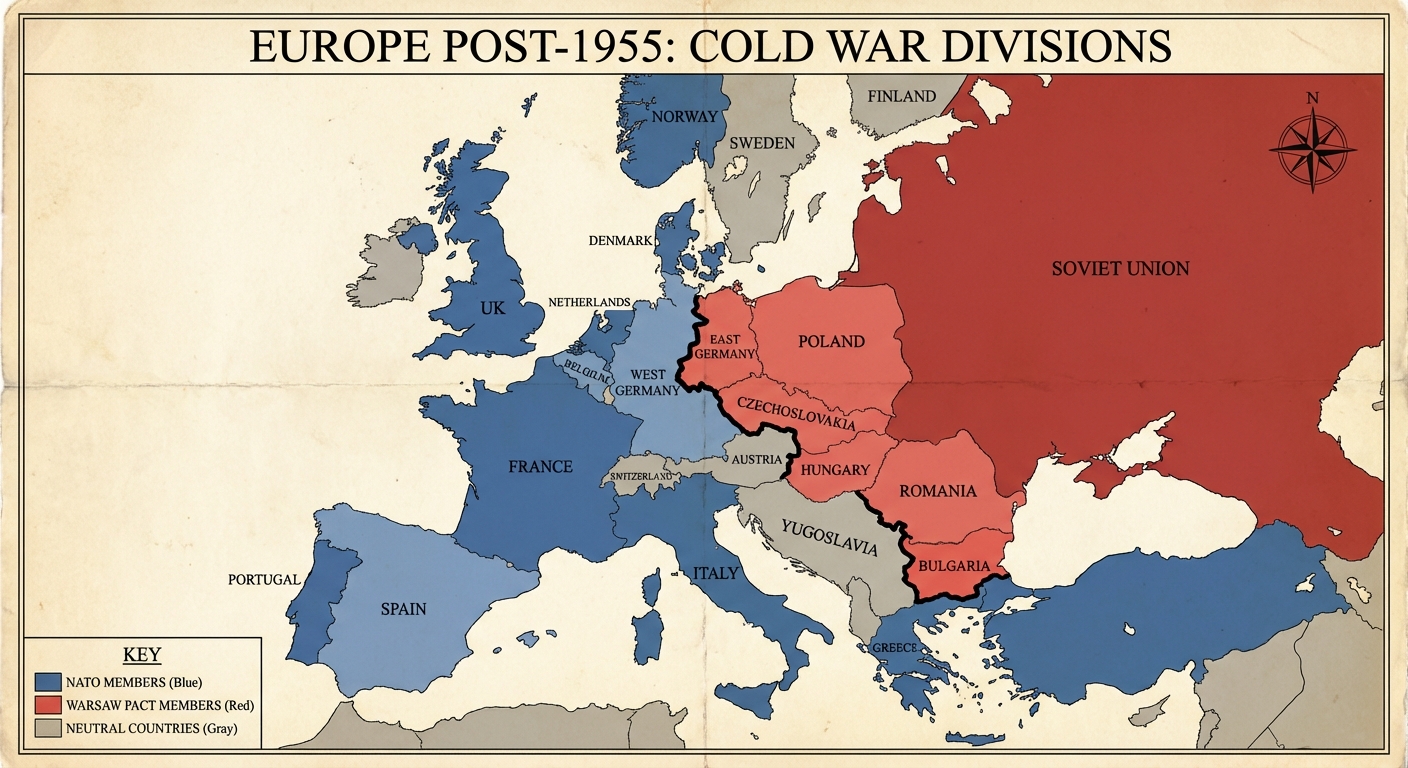
Europe became divided by what Winston Churchill famously called the Iron Curtain.
- NATO (North Atlantic Treaty Organization, 1949): A defensive military alliance of Western nations. An attack on one was an attack on all.
- Warsaw Pact (1955): The Soviet response; a military alliance of the USSR and its Eastern European satellite states (e.g., Poland, East Germany, Hungary).
The Arms and Space Race
The competition extended into technology and weaponry, driven by Mutually Assured Destruction (MAD). This theory posited that because both sides had enough nuclear weapons to wipe each other out, neither would attack first.
- Nuclear Proliferation: The US developed the H-Bomb in 1952; the Soviets followed in 1953.
- The Space Race: Seen as a test of which ideological system produced better technology.
- 1957: Soviets launch Sputnik (first satellite).
- 1969: US lands Apollo 11 on the moon.
Proxy Wars
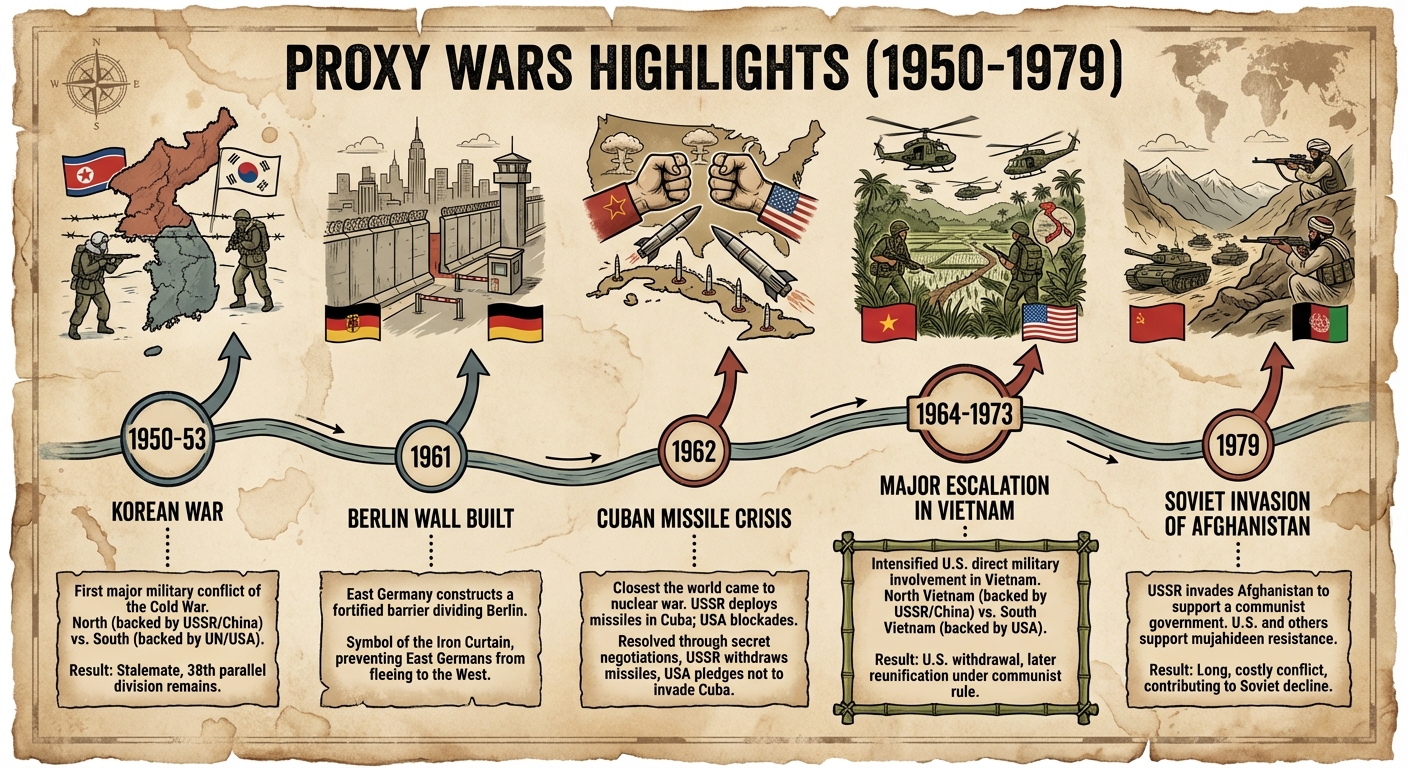
While the US and USSR did not fight directly, they funded and supplied opposing sides in Proxy Wars across Asia, Africa, and Latin America.
1. The Korean War (1950–1953)
- Context: North Korea (Communist, supported by USSR/China) invaded South Korea (supported by UN/US).
- Outcome: Broadly a stalemate. The envisioned victory did not happen, and the peninsula remains divided at the 38th Parallel.
2. The Vietnam War (1955–1975)
- Context: US intervention based on the Domino Theory—if one country falls to communism, neighbors will follow.
- Outcome: A major US defeat. Vietnam was unified under a communist government.
3. Crisis in Latin America: Cuba
- Cuban Missile Crisis (1962): The closest the world came to nuclear war. USSR placed missiles in communist Cuba (led by Fidel Castro). The US blockaded island until the USSR removed them.
4. The Angolan Civil War (1975–2002)
- Context: Following independence from Portugal, rival ethnic groups fought for control. The USSR/Cuba backed the MPLA, while the US/South Africa backed UNITA.
5. The Sandinista-Contra Conflict in Nicaragua
- Context: The socialist Sandinistas overthrew a dictatorship. The US, fearing another "Cuba," funded the Contras (counter-revolutionaries) to destabilize the government.
The Berlin Wall (1961–1989)
To stop citizens from fleeing communist East Germany into democratic West Berlin, the Soviets built a wall. It became the ultimate physical symbol of the Cold War's oppression and division.
Common Mistakes & Pitfalls
- Mistake: Believing the Cold War was only between the US and USSR.
- Correction: Remember the role of China (which sometimes clashed with the USSR) and the Non-Aligned Movement.
- Mistake: Thinking "Cold War" meant no violence.
- Correction: Millions died in Proxy Wars (Korea, Vietnam, Afghanistan). It was only "cold" for the superpowers themselves.
- Mistake: Confusing the dissolution dates.
- Correction: The Berlin Wall fell in 1989, but the Soviet Union did not officially collapse until 1991.
- Mistake: Assuming the Marshall Plan was military aid.
- Correction: The Marshall Plan was economic aid; the Truman Doctrine and NATO handled the military/political side.