Unit 2: Differentiation — The Definition of the Derivative
Unit 2: Differentiation — The Definition of the Derivative
Rates of Change: Average vs. Instantaneous
Calculus is fundamentally the study of change. To understand the derivative, you must first bridge the gap between algebra (average rate) and calculus (instantaneous rate).
The Average Rate of Change (AROC)
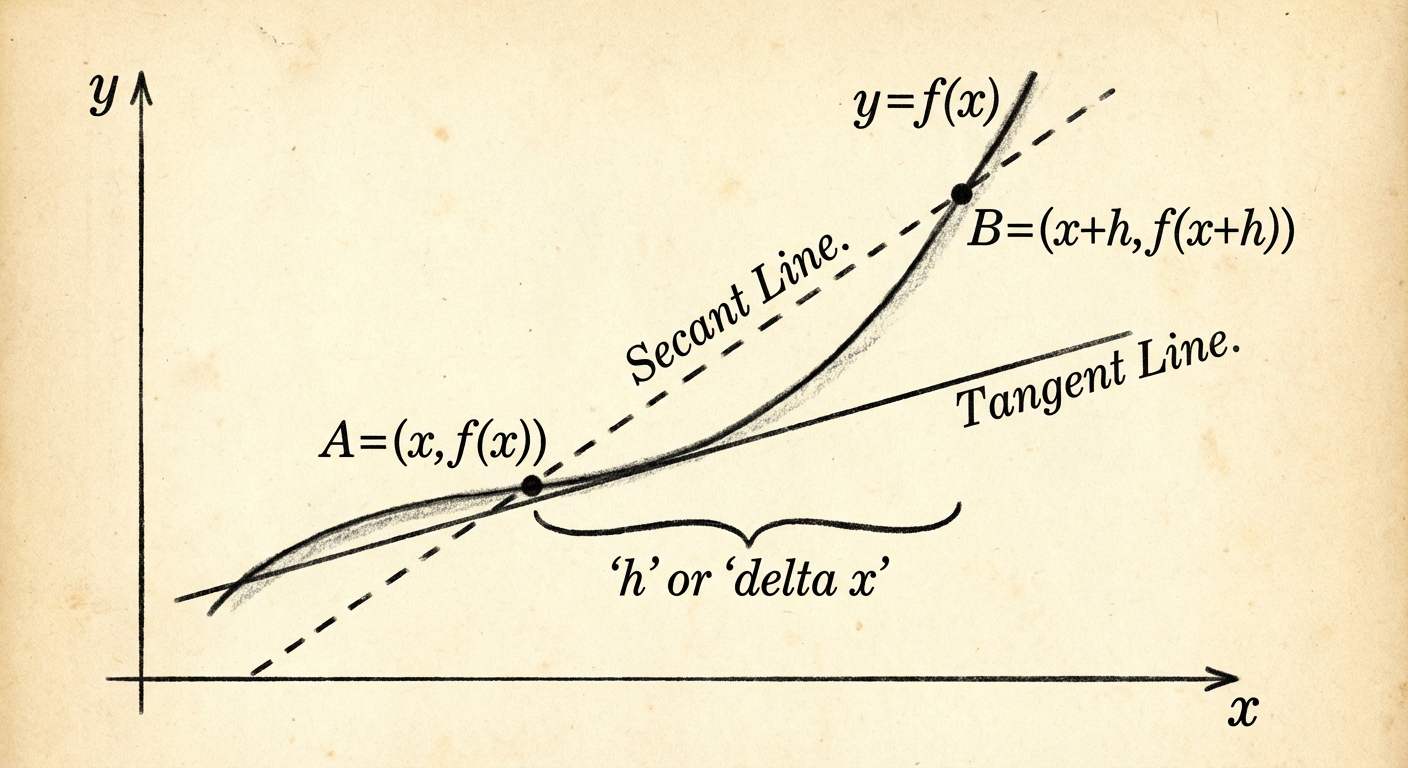
The Average Rate of Change of a function $f(x)$ over an interval $[a, b]$ tells you how much the function changed per unit of $x$, on average, between those two points. Geometrically, this defines the slope of the secant line connecting the points $(a, f(a))$ and $(b, f(b))$.
Formula:
The Instantaneous Rate of Change (IROC)
Imagine shrinking the interval $[a, b]$ until the two points act like a single point. This is the Instantaneous Rate of Change—the exact rate at which the function is changing at a specific moment. Geometrically, this is the slope of the tangent line to the curve at a specific point.
Since we cannot divide by zero (a "run" of zero), we use a limit to push the two points infinitely close together without ever letting them completely merge. This limit is the derivative.
Defining the Derivative of a Function
The derivative of a function $f(x)$, denoted as $f'(x)$, is the mathematical formula for the slope of the tangent line at any value $x$. There are two primary limit definitions you must recognize for the AP exam.
1. The Limit Definition (The "h" Definition)
This definition uses a variable $h$ (sometimes $\Delta x$) to represent the horizontal distance between two points on the graph: $(x, f(x))$ and $(x+h, f(x+h))$. As $h \to 0$, the secant line becomes the tangent line.
- Part 1 ($f(x+h) - f(x)$): The change in $y$ (rise).
- Part 2 ($h$): The change in $x$ (run).
2. The Alternative Definition at a Point
This form is used specifically to find the derivative at a constant value $x = a$. Instead of $h$, it compares a moving point $x$ to the fixed point $a$.
Note for AP Students: You will often see Multiple Choice questions asking you to identify which function is being derived based on the limit structure. For example, if you see $\lim_{h \to 0} \frac{(3+h)^2 - 9}{h}$, recognize that $f(x) = x^2$ and you are finding the derivative at $x=3$.
Notation Reference Table
Calculus was developed simultaneously by Newton and Leibniz, resulting in different notations. You must be fluent in all of them.
| Notation | Type | Usage |
|---|---|---|
| $f'(x)$ | Lagrange | Most common; reads "f prime of x" |
| $y'$ | Lagrange | Shorthand for simple equations |
| $\frac{dy}{dx}$ | Leibniz | Emphasizes rate of change ($ |
| frac{\Delta y}{\Delta x}$); reads "derivative of y with respect to x" | ||
| $\frac{d}{dx}[f(x)]$ | Operator | An instruction to "take the derivative of" the function inside |
Estimating Derivatives at a Point
Sometimes you are given a table of data values rather than an explicit algebraic function. In these cases, you cannot calculate the exact limit. instead, you must estimate the derivative.
To estimate $f'(c)$ given a table of values, use the Average Rate of Change (slope of the secant line) using the data points closest to $c$ on either side.
The Symmetric Difference Quotient
If you need to estimate $f'(3)$ and you have data for $x=2$ and $x=4$, use the points flanking the target:
Worked Example:
Given the table below, estimate $f'(5)$.
| $x$ | 2 | 4 | 6 | 8 |
| :--- | :-: | :-: | :-: | :-: |
| $f(x)$ | 10 | 18 | 24 | 35 |
- Identify neighbors: The value $x=5$ falls between $x=4$ and $x=6$.
- Apply slope formula:
Differentiability and Continuity
Differentiability implies that the derivative exists at a point (the graph is "smooth"). Continuity implies there are no breaks or holes. These two concepts have a strict logical relationship.
The Fundamental Theorem of Differentiability
Theorem: If a function $f$ is differentiable at $x = c$, then $f$ must be continuous at $x = c$.
Memory Aid:
"To be Differentiable, you must first be Continuous."
Think: To be a Dragon, you must be a Creature. (But not all Creatures are Dragons).
Where Differentiability Fails
A function fails to be differentiable at $x=c$ if the limit $\lim_{h \to 0} \frac{f(c+h)-f(c)}{h}$ does not exist. This happens in four specific scenarios:
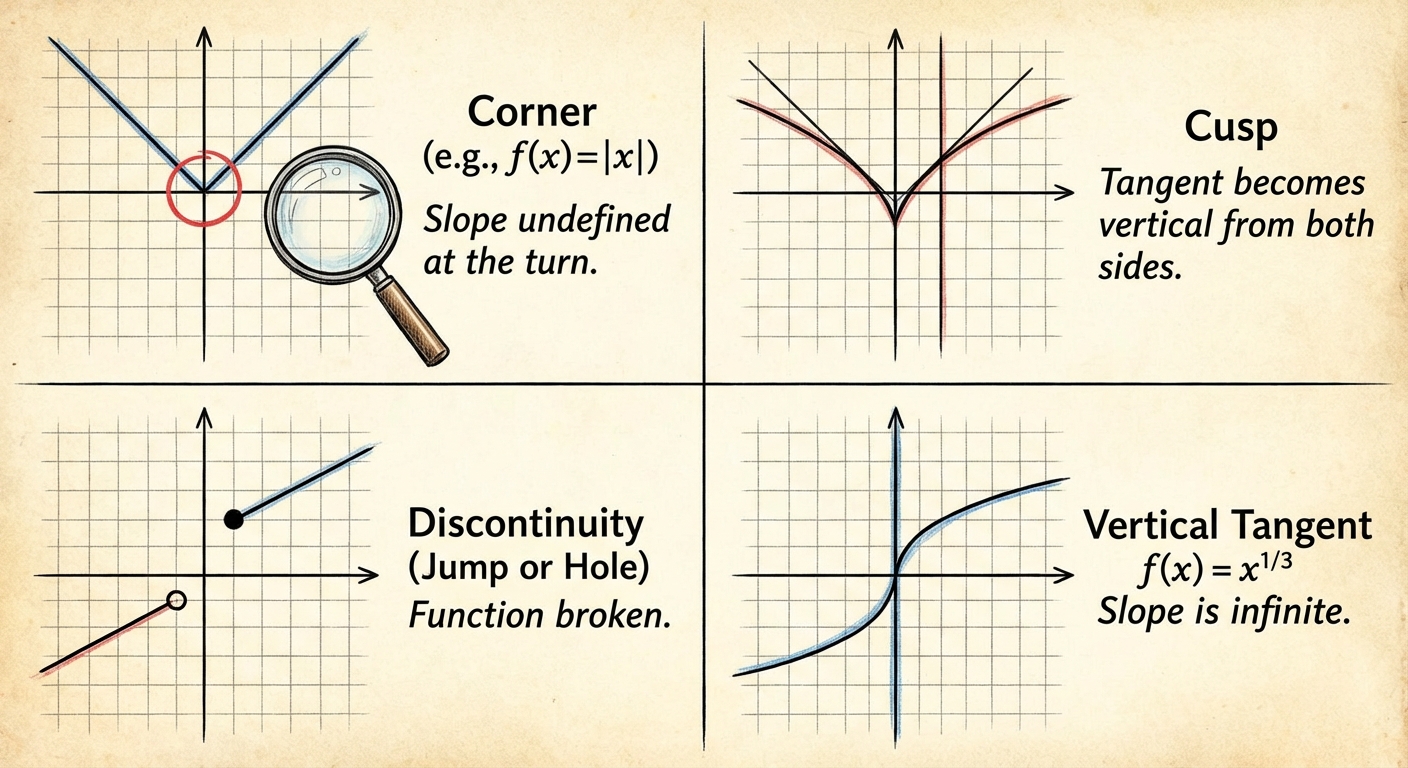
- Discontinuity: If the graph has a hole, jump, or asymptote, a tangent line cannot be defined (slope is undefined).
- Corner (Sharp Turn): The slopes coming from the left and right are different real numbers (e.g., $y = |x|$ at $x=0$). The "left-hand derivative" $\neq$ the "right-hand derivative."
- Cusp: An extreme sharp turn where the slopes approach $\infty$ and $-\infty$ from opposite sides (e.g., $y = x^{2/3}$ at $x=0$).
- Vertical Tangent: The curve is continuous and smooth, but simply goes strictly vertical for an instant ($y = x^{1/3}$ at $x=0$). The slope here is undefined (infinite).
Comparing Concepts table
| Condition | Implies Continuity? | Implies Differentiability? |
|---|---|---|
| Function is Differentiable | YES | YES |
| Function is Continuous | YES | MAYBE (Check for corners/cusps) |
| Function is Not Continuous | NO | NO (Impossible) |
Common Mistakes and Pitfalls
Confusing "Average" with "Instantaneous":
- Mistake: Using the derivative formula $f'(x)$ when the question asks for the "average rate of change."
- Correction: If you see the word "Average," use algebra (two points). If you see "Instantaneous," use calculus (derivative).
The "Point" Trap in Limits:
- Mistake: In the definition $\lim_{x \to a} \frac{f(x)-f(a)}{x-a}$, students limit $x \to 0$ instead of $x \to a$.
- Correction: Check the denominator. If it is $x-a$, you are approaching $a$. If it is just $h$ (or $\Delta x$), you are approaching 0.
Algebraic Cancellation Errors:
- Mistake: When simplifying the difference quotient $\frac{f(x+h)-f(x)}{h}$, students cancel the $h$ in the denominator with an $h$ inside a term (e.g., $\frac{2x + h}{h} \to 2x$).
- Correction: You must factor an $h$ out of the entire numerator before canceling with the denominator.
Assuming Continuity = Differentiability:
- Mistake: Assuming that because a line connects (is continuous), it has a derivative.
- Correction: Always check for sharp corners (like absolute value graphs). Continuity is a requirement, but not a guarantee.