Mastering Ancient Greek Art: Innovations in Form and Function
Ancient Mediterranean: Greek Art (Unit 2)
Greek art is one of the most significant foundations of the Western art tradition. It is characterized by the pursuit of Humanism (the belief that the human body and mind are perfectible), Rationalism (logic and mathematical order), and Idealism (representing the perfect form rather than the realistic one). Through the Archaic, Classical, and Hellenistic periods, Greek artists fundamentally changed how the human figure and architectural space were conceived.
The Aegean Precursors: Minoan and Mycenaean Art
Before the rise of the Greek city-states (polis), two majorBronze Age civilizations dominated the Aegean. Understanding them provides context for later Greek developments.
Minoan Art (c. 3000–1100 BCE)
Centered on the island of Crete (e.g., Palace at Knossos), Minoan art is often characterized by:
- Fluidity and Movement: Unlike Egyptian rigidity, figures are curvy and lively.
- Marine Motifs: Octopuses, dolphins, and flowing water refect their island geography.
- Open Architecture: Palaces were sprawling complexes with light wells and no defensive walls, suggesting a peaceful maritime power.
Mycenaean Art (c. 1600–1100 BCE)
Centered on the Greek mainland (e.g., Citadel at Mycenae), this culture was militarily aggressive.
- Cyclopean Masonry: Massive stone walls said to be built by Cyclops.
- Corbelled Arches: Stones stacked closer and closer until they meet (e.g., Lion Gate).
- Funerary Masks: Beaten gold masks (Repoussé) found in grave circles, emphasizing the status of warrior-kings.
Greek Pottery: Narrative and Form
Greek pottery served both utilitarian and ceremonial purposes. It is our primary source for understanding Greek painting, which has largely been lost.
Geometric to Red-Figure
- Geometric Period: Focus on linear designs and meander patterns.
- Black-Figure: Figures are painted in black slip against red clay; details are incised (scraped) into the black.
- Red-Figure: The background is painted black, leaving the figures in the red color of the clay. Details are painted on with a brush, allowing for much greater fluidity and anatomical detail than black-figure.
Key Work: Niobides Krater
- Period: Classical (c. 460–450 BCE).
- Technique: Red-figure.
- Innovation: It breaks the traditional isocephalism (where all heads are on the same level). Figures stand on different ground lines, attempting to suggest depth and landscape.
- Subject: One side shows the massacre of Niobe’s children by Artemis and Apollo (warning against hubris); the other shows a peaceful assembly of warriors seeking protection from Heracles.
Greek Sculpture: The Evolution of the Human Form
The portrayal of the human body evolved rapidly from stiff abstraction to hyper-realistic emotion.
1. Archaic Period (c. 600–480 BCE)
Sculpture here is heavily influenced by Egyptian stone carving but features nudity for men.
- Kouros (Male) / Kore (Female): Grave markers or votive offerings.
- The Archaic Smile: A slight, artificial upturn of the lips used to animate the face and indicate the figure is alive.
- Stance: Left foot forward, rigid arms, clenched fists.
Example: Anavysos Kouros
While the pose is rigid, the anatomy is more rounded and fleshy than earlier geometric styles, showing a move toward naturalism. The inscription asks the viewer to mourn a warrior slain by Ares.
2. Classical Period (c. 480–323 BCE)
Triggered by the Greek victory over the Persians, this period focused on perfection, mathematics, and the "Canon."
The Introduction of Contrapposto
This is the most critical definition in this unit.
- Definition: A posture where the weight is shifted onto one leg (the engaged leg), freeing the other leg to bend at the knee. This causes a tilt in the hips and shoulders.
- Effect: It breaks the symmetry of the body, making the figure look relaxed and capable of movement.
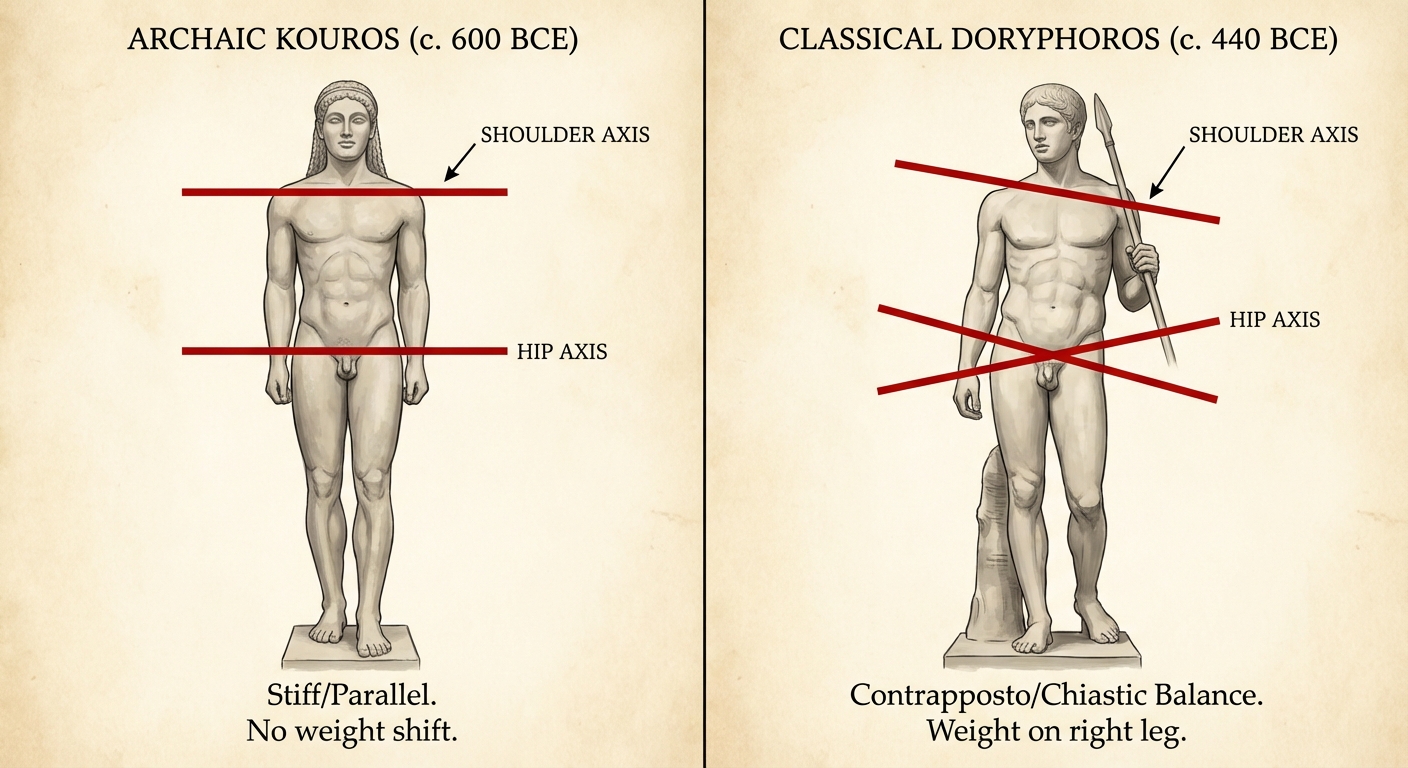
Key Work: Doryphoros (Spear Bearer)
- Artist: Polykleitos.
- Concept: Polykleitos wrote a treatise called "The Canon," arguing that perfect beauty comes from mathematical ratios between body parts.
- Chiastic Balance: A cross-balance. The right arm and left leg are relaxed; the left arm and right leg are tense.
Key Work: Grave Stele of Hegeso
- Context: High Classical (domestic art). A funerary marker for a wealthy woman.
- Style: "Wet drapery" style (clothes cling to the body to reveal anatomy) but performed with restraint. It depicts a quiet, domestic scene of Hegeso examining jewelry, emphasizing the patriarchal definition of women's lives in the home.
3. Hellenistic Period (c. 323–30 BCE)
Following the death of Alexander the Great, art spread to a wider, diverse empire. Idealism was replaced by emotion, drama, and movement.
Winged Victory of Samothrace:
Dramatic movement. It heralded a naval victory. The wind whips the heavy drapery against her body, creating distinct textures. It interacts with the environment (originally part of a fountain).Seated Boxer:
A distinct departure from the Classical ideal. The boxer is older, battered, bleeding, and defeated. It evokes pathos (sadness/pity) rather than admiration for perfection.
Greek Architecture: The Parthenon and the Acropolis
The Acropolis in Athens represents the height of Classical architecture, rebuilt under Pericles after the Persian destruction.
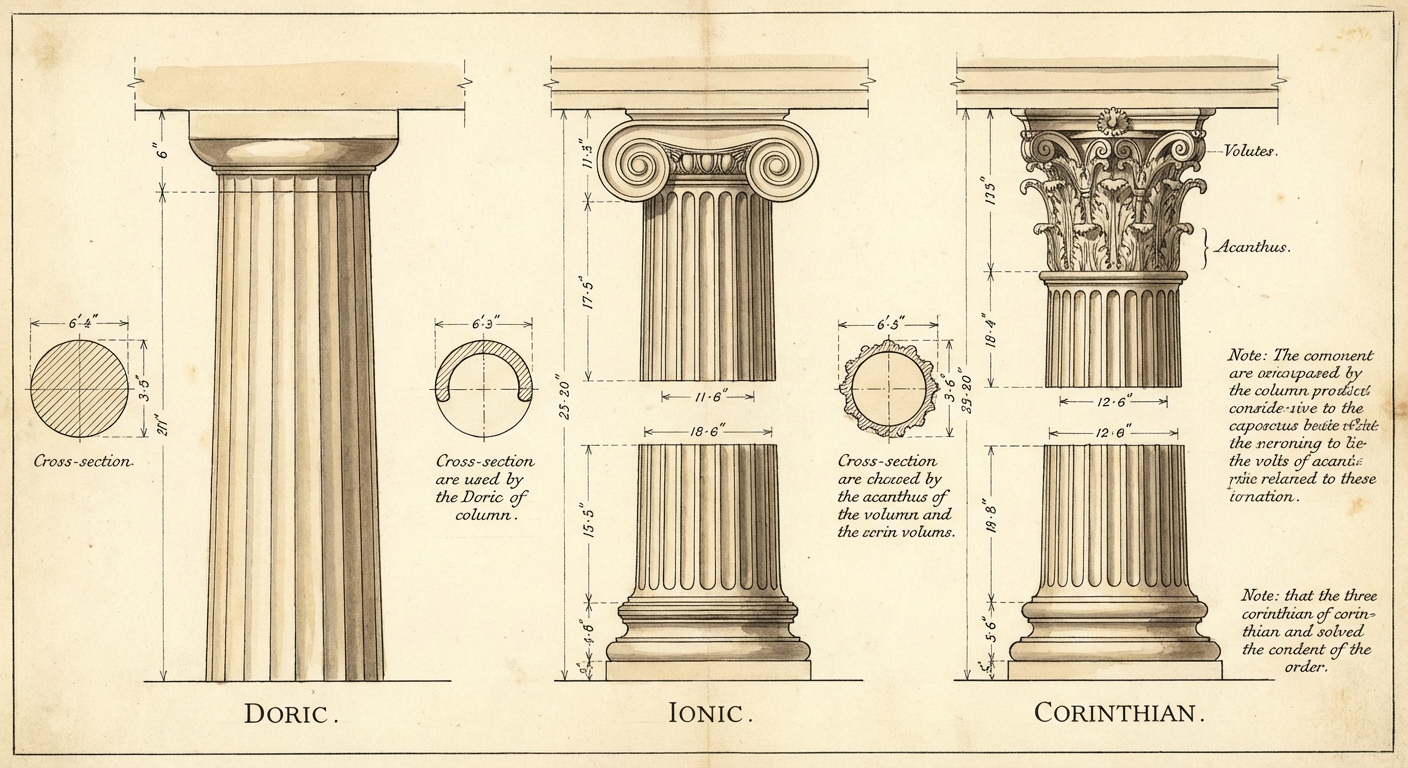
The Architectural Orders
| Order | Capital (Top of Column) | Characteristics | Significance |
|---|---|---|---|
| Doric | Plain, pillow-like cushion | Massive, sturdy, no base | Masculine, mainland Greece |
| Ionic | Volutes (scrolls) | Slender, has a base, continuous frieze | Feminine, Ionia (Islands) |
| Corinthian | Acanthus leaves | Decorative, ornate | Used rarely by Greeks, loved by Romans |
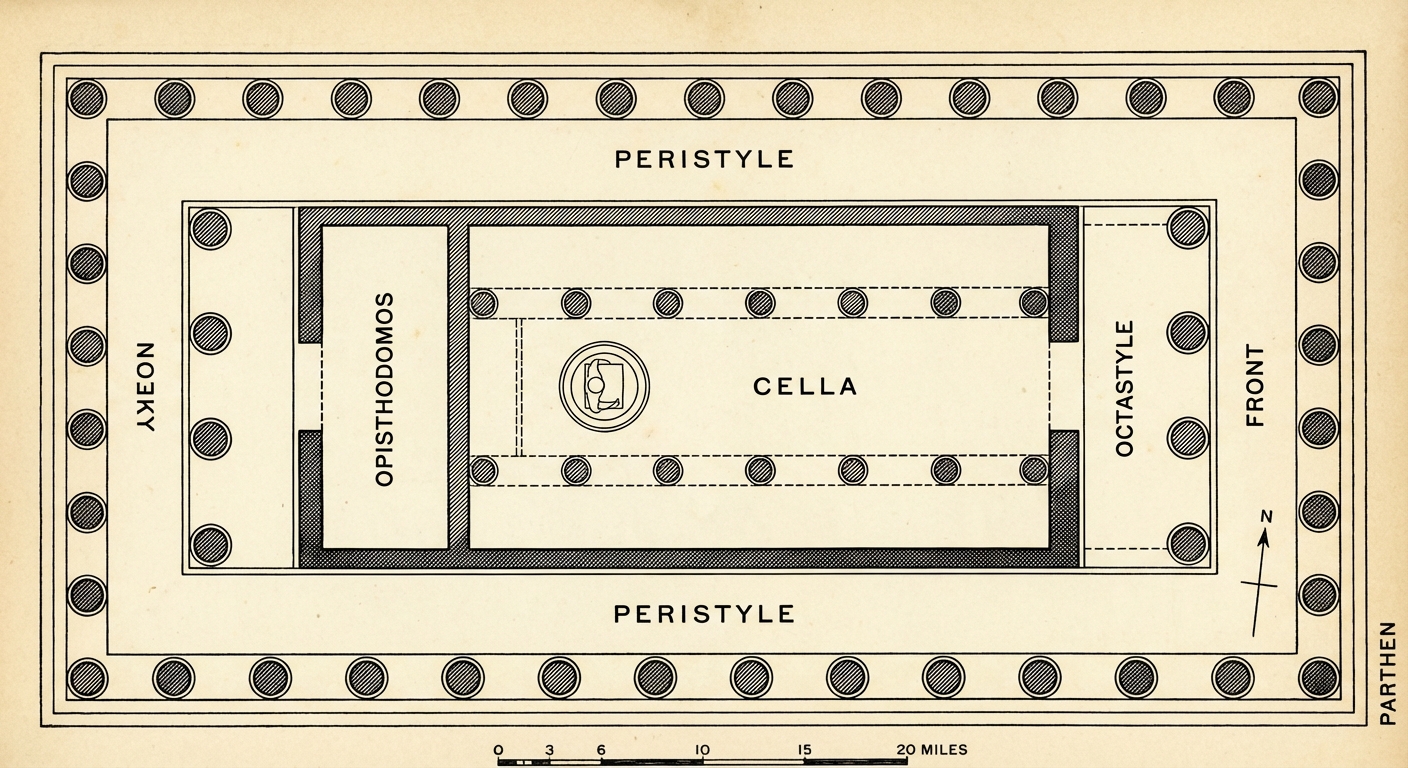
The Parthenon (447–432 BCE)
- Architects: Iktinos and Kallikrates.
- Function: Temple to Athena Parthenos (the Virgin) and a treasury.
- Mathematics: The building follows the formula . For example, there are 8 columns on the facade, so the flank has columns. This ratio ($4:9$) governs the entire structure.
Optical Corrections (The Pursuit of Perfection)
To ensure the building looked perfect to the human eye, the architects used visual refinements:
- Entasis: The columns swell slightly in the middle so they don't look hourglass-shaped from a distance.
- The floor curves upward in the center to prevent it from looking like it sags.
- The corner columns are slightly thicker to compensate for the bright light background.
Sculptural Program of the Acropolis
- Phidias: The director of sculpture.
- Helios, Horses, and Dionysus (pediment): Shows the birth of Athena. The figures are arranged to fit the triangular space of the pediment without changing scale (lying down in corners).
- Temple of Athena Nike: Tiny Ionic temple celebrating victory. features Nike Adjusting Her Sandal—a very human, intimate moment (High Classical).
Common Mistakes & Exam Pitfalls
Confusing Periods: You must be able to distinguish Archaic (stiff, smiling), Classical (calm, distinct expressionless face, contrapposto), and Hellenistic (emotional, twisting, dramatic).
- Correction: If the figure looks like it is in pain or fighting the wind, it is likely Hellenistic.
"The Greeks Invented Concrete": They did NOT. The Romans perfected concrete. The Greeks used cut stone and marble (ashlar masonry).
Misunderstanding the Parthenon Frieze: The inner Ionic frieze of the Parthenon (Plaque of the Ergastines) depicts a human procession (the Panathenaic Festival), not just mythology. This was hubristic—Athenians putting themselves on the temple of a god.
Isocephalism: Students often forget this term. In the Niobides Krater, the lack of isocephalism is the innovation. In the Ergastines frieze, isocephalism is used (heads all at the same level).
Male vs. Female Nudity: Archaic and Classical art generally celebrated male nudity (Kouros) but clothed women (Kore). Female nudity became acceptable only in the Late Classical (Aphrodite of Knidos) and Hellenistic periods.