Comprehensive Guide to The Global Tapestry (c. 1200–1450)
Unit Overview: The Global Tapestry
Topic: State Building and Cultural maintenance (c. 1200–1450)
AP Theme: How did states maintain power, and how did cultures spread?
This unit sets the stage for the modern era. The world in 1200 was not "globalized" in the modern sense, but it was deeply interconnected through regional trade networks (Silk Roads, Indian Ocean, Trans-Saharan). The primary focus of this unit is State Building: how civilizations governed themselves, used religion for legitimacy, and managed technological/cultural exchange.
1. Developments in East Asia
The Song Dynasty (960–1279)
The Song Dynasty is considered a Golden Age for China. Despite losing territory to northern nomads (the Jin), they flourished economically and culturally.
Governance and Bureaucracy
- Imperial Bureaucracy: A vast organization of appointed officials carried out the empire's policies. This system had been in place since the Qin but expanded under the Song.
- Civil Service Exam: To work in the bureaucracy, men had to pass rigorous exams based on Confucian texts. This created a Meritocracy (advancement based on ability, though the wealthy had easier access to education).
Economic Innovations
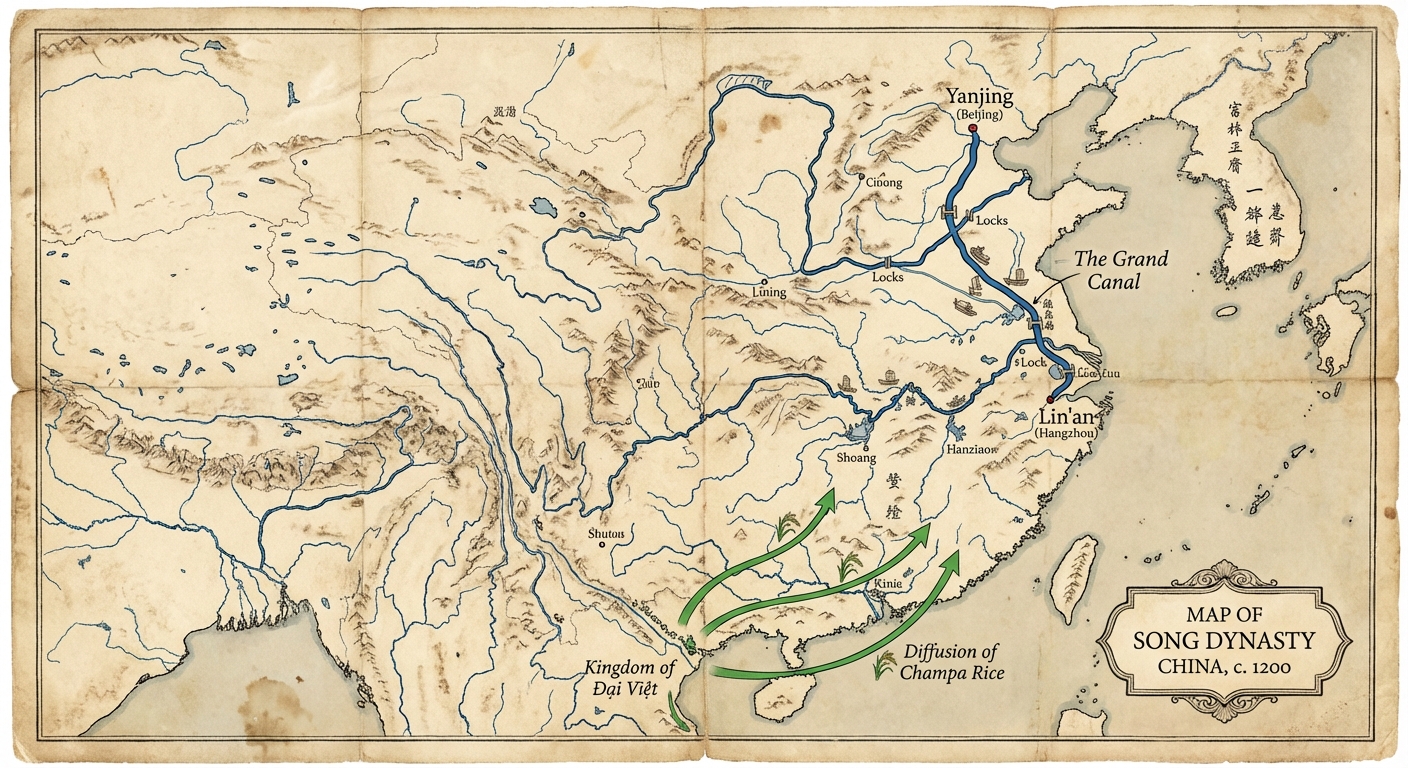
- Champa Rice: Fast-ripening, drought-resistant rice from Vietnam allowed for two harvests per year.
- Result: Population explosion (from 25% to 40% of the world's population).
- Grand Canal: An internal waterway transportation system extending over 30,000 miles. It linked the agricultural south to the populous north, creating a unified trading area.
- Proto-Industrialization: Community-based production of steel and porcelain. Artisans produced goods for commercial use (export) rather than just personal interactions.
Cultural Traditions
- Confucianism: The bedrock of Chinese society. It focused on social harmony through five relationships (e.g., Ruler/Subject, Father/Son).
- Filial Piety: The duty of family members to subordinate their desires to those of the male head of the family and to the ruler.
- Neo-Confucianism: rose in popularity between 770–840. It combined rational thought (Confucianism) with abstract ideas (Daoism and Buddhism). It emphasized ethics and was highly influential in Japan, Korea, and Vietnam.
- Buddhism: Arrived via the Silk Roads.
- Theravada: Focused on personal spiritual growth (strong in SE Asia).
- Mahayana: Focused on spiritual growth for all beings and service (strong in China/Korea).
- Zen (Chan) Buddhism: Syncretic faith mixing Buddhist doctrines with Daoist elements.
Influence on Neighbors
| Region | Relationship with China | Key Characteristics |
|---|---|---|
| Japan | Selective Borrowing | Adopted Buddhism and Confucianism but failed to centralize. evolved into Feudalism (Shogun > Daimyo > Samurai > Peasants) rather than a bureaucracy. |
| Korea | Tributary State | Closely emulated China's politics and culture. Adopted Confucianism and Civil Service exams (but restricted to aristocracy). |
| Vietnam | Adversarial | Adopted writing and architecture but resisted assimilation. Women in Vietnam had more independence (rejected foot binding) and nuclear families were preferred over extended ones. |
Common Mistake: Students often confuse the Song Dynasty with the Ming. The Song (1200s) predecessors the Mongols (Yuan). The Ming (1368+) came after the Mongols. This unit focuses mostly on the Song.
2. Developments in Dar al-Islam (The Islamic World)
In 1200, the Abbasid Caliphate (Golden Age) was crumbling politically but spreading culturally. Examples of Islamic state-building include non-Arab groups taking power.
Political Fragmentation & New Entities
As the Abbasid Caliphate fragmented, new Islamic entities emerged, often dominated by Turkic peoples:
- Mamluk Sultanate (Egypt): Mamluks were enslaved ethnic Turks purchased to serve as soldiers. They seized control of the government in Egypt (1250–1517), prospering by facilitating trade in cotton and sugar between the Islamic world and Europe.
- Seljuk Turks: Rulers (calling themselves Sultans) from Central Asia who conquered parts of the Middle East, reducing the Abbasid Caliph to a religious figurehead.
- Delhi Sultanate (India): (See South Asia section).
Intellectual Innovations (The Golden Age)
While Europe was in the "Dark Ages," Baghdad (House of Wisdom) and Spain (Al-Andalus) preserved and expanded knowledge.
- Nasir al-Din al-Tusi: Celebrated Islamic scholar. Contributed to astronomy, law, logic, ethics, mathematics, philosophy, and medicine.
- 'A'ishah al-Ba'uniyyah: A Sufi master and poet, representing the high literacy and contribution of women in Sufi orders.
- Transfers: The Islamic world transferred Greek classics (translated into Arabic), Indian mathematics (0–9 "Arabic" numerals), and papermaking from China to Europe.
Sufism
Sufi missionaries played a crucial role in spreading Islam. Unlike the intellectual/legalistic approach of orthodox Muslims, Sufis emphasized introspection, emotion, and a mystical relationship with Allah. This adaptability allowed Islam to blend with local cultures in India and SE Asia.
3. Developments in South and Southeast Asia
South Asia (India)
India was characterized by decentralization and religious diversity (Hinduism vs. Islam).
The Arrival of Islam
- Delhi Sultanate (1206–1526): Islamic forces conquered the city of Delhi. They introduced the Jizya (tax on non-Muslims). However, they never fully converted the masses, as Hinduism was deeply ingrained.
- Qutub Minar: A massive tower built over a Hindu temple, symbolizing Islamic influence and dominance in northern India.
The Bhakti Movement
A Hindu reaction to the rigid caste system and Islam's egalitarianism. Bhakti followers focused on a strong emotional attachment to a specific deity rather than studying texts. Similar to Sufi Muslims, Bhakti saints appealed to the lower castes and women.
Southeast Asia
Strategically important because of the Spice Islands and shipping lanes (Straits of Malacca). Politics here were defined by control of trade routes.
Sea-Based Kingdoms
- Srivijaya Empire (670–1025): A Hindu kingdom based on Sumatra. Built its navy and prospered by charging fees for ships traveling between India and China.
- Majapahit Kingdom (1293–1520): Buddhist kingdom based on Java; sustained power by controlling sea routes.
Land-Based Kingdoms
- Khmer Empire (Angkor) (802–1431): Located in Cambodia/Laos. Famous for complex irrigation and drainage systems.
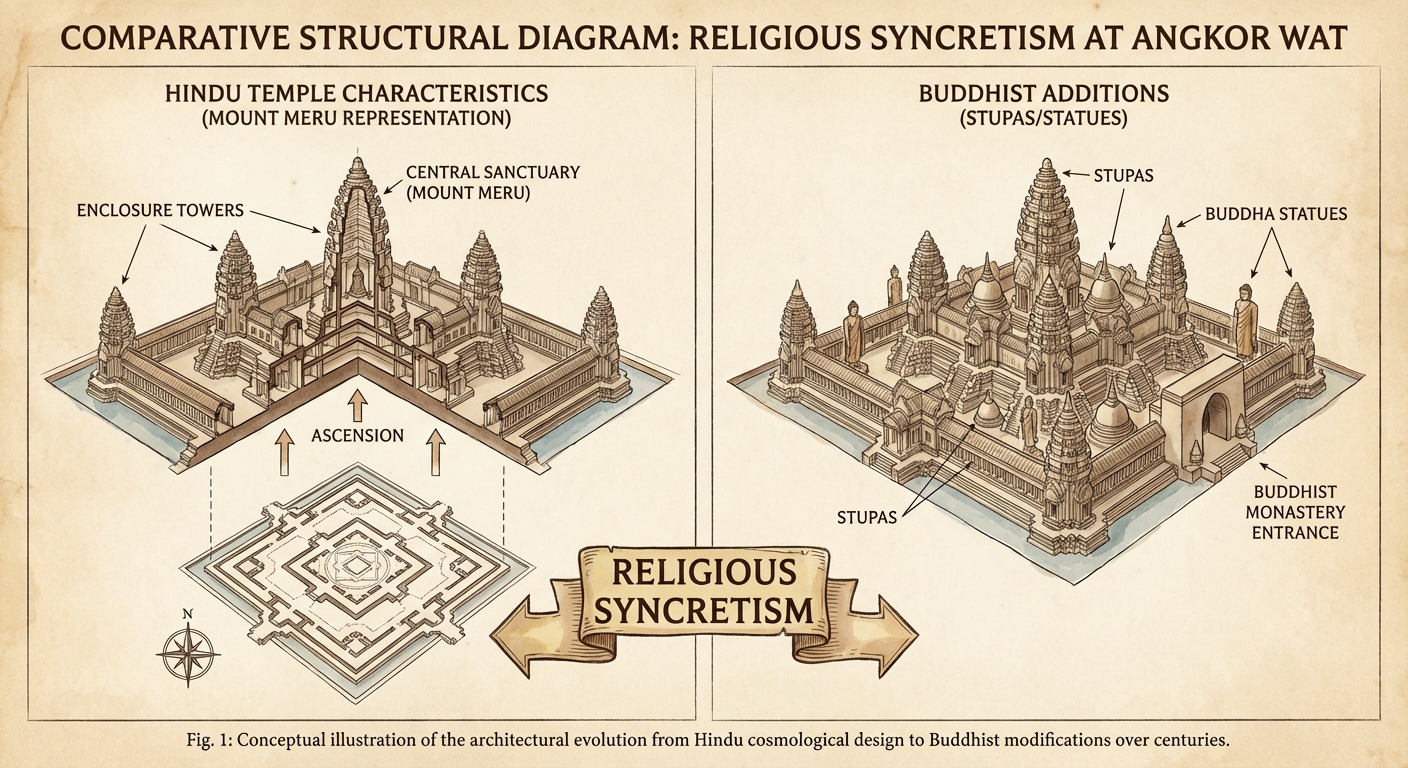
- Angkor Wat: Originally a massive Hindu temple, later converted to Buddhist. This architecture shows the syncretism (blending) of Indian religions in SE Asia.
4. Developments in the Americas
Unlike Afro-Eurasia, the Americas were isolated from the global trade networks, yet developed massive, complex states.
North America
- Mississippian Culture: Built enormous earthen mounds.
- Cahokia: The largest city (near modern St. Louis) with a population of 40,000. It was a trading hub with a rigid class structure (Great Sun chief).
- Chaco & Mesa Verde: Cultures in the arid SW USA who built homes in cliff sides using bricks.
The Aztecs (Mexica)
- Location: Central Mexico / Tenochtitlán (capital).
- Tribute System: The Aztecs conquered neighbors but allowed them to stay in power as long as they paid tribute (goods, sacrifices, money). This provided revenue without the cost of a direct bureaucracy.
- Chinampas: "Floating gardens" built on Lake Texcoco to increase agricultural space.
- Theocracy: Ruled by religious leaders. Known for human sacrifice to ensure the sun would rise.
The Inca
- Location: Andes Mountains (Peru/South America).
- Mit'a System: Unlike the Aztec tribute of goods, the Inca required mandatory public service (labor). Men between 15–50 provided agricultural or construction labor (roads).
- Infrastructure: The Carpa Nan was a massive roadway system (25,000 miles) used by the military and government runners.
- Animism: belief that elements of the physical world could have supernatural powers (Huaca).
| Feature | Aztec | Inca |
|---|---|---|
| Control | Tribute System (Indirect) | Bureaucracy & Mit'a (Direct) |
| Environment | Swampy lakes (Chinampas) | Mountains (Terrace Farming) |
| Writing | Glyphs / Codices | Quipu (Knotted strings) |
5. Developments in Africa
Africa was not isolated; it was deeply connected via trans-regional trade.
Inland Africa (Kinship Groups)
Before large centralized states, many parts of Sub-Saharan Africa used Kin-based networks, where families governed themselves. As populations grew, competition led to larger kingdoms.
West Africa (Trans-Saharan Trade)
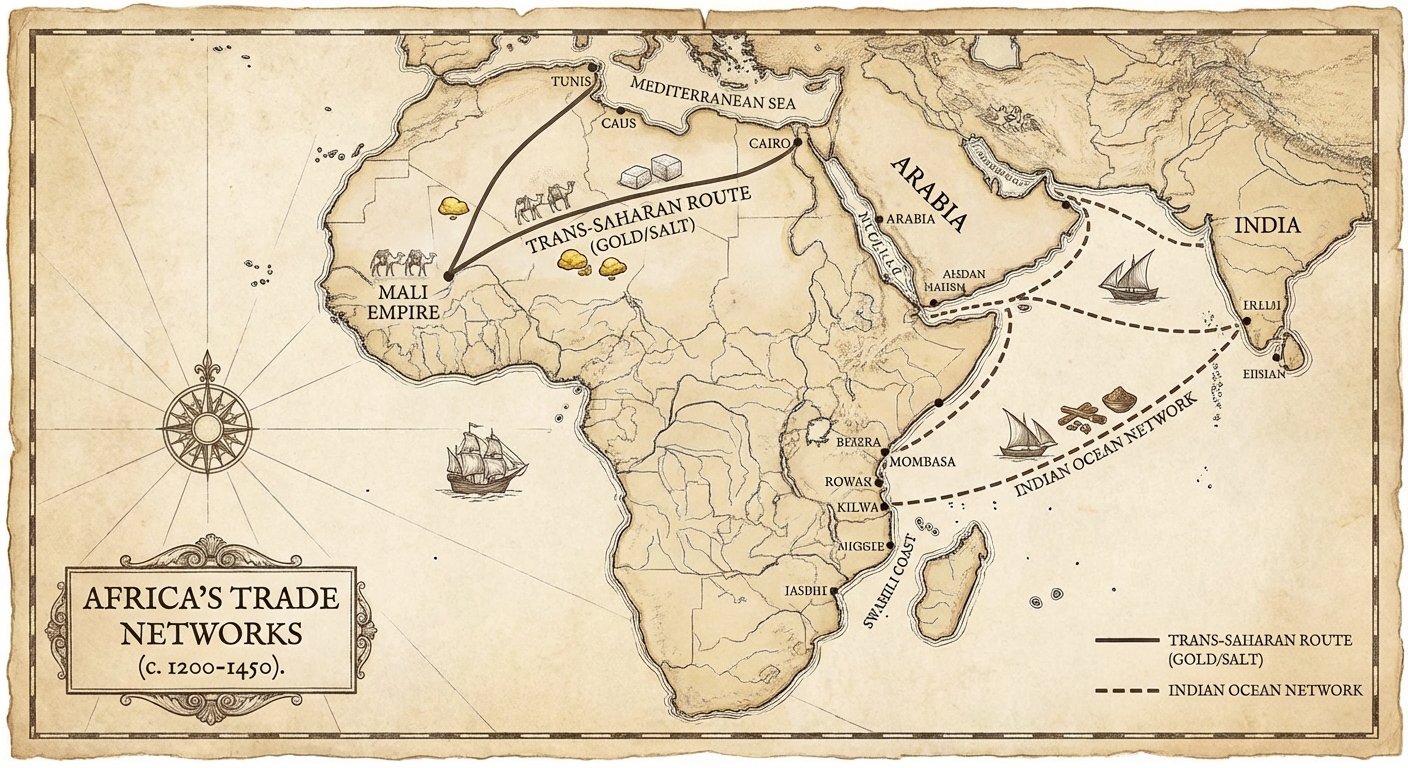
- Mali Empire: Rose to power by controlling the gold and salt trade.
- Mansa Musa: His pilgrimage to Mecca (Hajj) displayed Mali's insane wealth to the world and deepened Islamic ties in West Africa.
- Timbuktu: Became a center of Islamic learning.
East Africa (Indian Ocean Trade)
- Swahili City-States: Centers like Kilwa and Mombasa. "Swahili" is a syncretic language blending Bantu (African) grammar with Arabic vocabulary.
- Great Zimbabwe: A massive walled city (stone architecture without mortar) in SE Africa. It dominated the gold trade to the coast but declined due to overgrazing.
Ethiopia (Axum)
An island of Christianity in a sea of Islam. Ethiopian Christianity developed independently, blending with ancestor veneration. Built massive rock-hewn churches.
Key Term: Gryots (Griots): Oral storytellers in Africa. They preserved history and lineage. They held immense power because they could sing a king's praises or destroy his legacy.
6. Developments in Europe
From 1200–1450, Europe was transitioning from the decentralized Middle Ages toward the centralized Renaissance.
Feudalism: A Decentralized System
Following the fall of Rome, Europe had no central protection.
- Monarch: Grants land (Fiefs) to Lords.
- Lords: Provide military service to King; grant land to Knights.
- Peasants (Serfs): Tied to the land. They farmed in exchange for protection. This is Manorialism (the economic functioning of the estate).
- Three-Field System: Crop rotation (one field wheat, one legumes, one fallow) increased population.
Changes in the Structure
- Rise of Monarchies: Kings began to grow in power (France, Holy Roman Empire).
- Magna Carta (1215): King John of England was forced to sign this, giving nobles certain rights (limited the King’s power).
- The Crusades (1095–1200s): Religious wars to reclaim the Holy Land. While military failures, they opened Europe to global trade and knowledge from the Islamic world.
- Renaissance: A rebirth of interest in Greek/Roman art and culture, sparked by the rise of a middle class (Bourgeoisie) and trade.
Comparison Summary
| Concept | East Asia | Dar al-Islam | Europe | Americas |
|---|---|---|---|---|
| State Building | Bureaucracy & Civil Service | Caliphates (Religious authority) | Feudalism -> Monarchies | Tribute (Aztec) vs Direct (Inca) |
| Religion | Neo-Confucianism / Buddhism | Islam (Sunni/Shia/Sufi) | Christianity (Catholic) | Animism / Polytheism |
| Role of Women | Foot binding (low status) | Veiling (but property rights existed) | Serfs/Domestic (low status) | Matrilineal in some areas (Mississippian) |
Common Mistakes & Pitfalls
- Confusing Historical Periods: Do not attribute firearms or global maritime empires (Columbus) to Unit 1. This unit is before 1492. Gunpowder existed in China, but "Gunpowder Empires" is Unit 3.
- Generalizing "Muslims": Don't treat the Islamic world as a monolith. By 1200, it was politically fragmented (Mamluks vs. Seljuks vs. Delhi) even if religiously unified.
- Ignoring the Americas/Africa: AP exams frequently test Great Zimbabwe, the Inca Mit'a system, or the Ethiopian churches. Do not skip these.
- Feudalism vs. Manorialism: Feudalism is the political/military system (Lords/Vassals). Manorialism is the economic system (Peasants farming the land).
- Neoconfucianism vs. Confucianism: Be specific. In the Song Dynasty, it was Neo-Confucianism (blended with Buddhism) that governed society, not the ancient pure form.