Unit 4: Contemporary Movements, Culture, and Social Debates
African American Contributions to Arts and Culture
This section examines how African American artistic expression evolved from the Civil Rights Era into the 21st century. It focuses on how art serves as a tool for political engagement, identity formation, and the re-examination of history.
The Black Arts Movement (BAM)
Often described as the "spiritual sister of the Black Power concept," the Black Arts Movement (mid-1960s to mid-1970s) marked a distinct shift from the integrationist themes of the Harlem Renaissance. Instead of proving Black humanity to white audiences, BAM artists created art by Black people, for Black people.
- Key Philosophy: Art must be political and serve the liberation of Black people.
- Amiri Baraka: A central figure who founded the Black Arts Repertory Theatre/School in Harlem. His work emphasized a distinct Black aesthetic that rejected Western standards.
- Literature: Sonia Sanchez and Nikki Giovanni used poetry to critique racism and celebrate Black resilience.
Contemporary Visual Arts and Reimagining History
In the late 20th and early 21st centuries, Black visual artists began deconstructing historical narratives to expose the trauma and erasure of the Black experience.
- Kehinde Wiley: Famous for his naturalistic portraits of Black subjects posed against lush, decorative backgrounds evoking Old Master paintings. His work challenges the exclusion of Black bodies from Western art history.
- Kara Walker: Utilizes black-cut silhouettes to depict grotesque and violent scenes of the Antebellum South. Her work forces viewers to confront the brutal realities of slavery that are often romanticized.
- Basquiat: Jean-Michel Basquiat brought graffiti into the fine art world, using a neo-expressionist style to critique colonialism, class struggle, and racism.
Hip-Hop and Contemporary Cultural Expression
Hip-hop is not merely a genre of music but a comprehensive cultural movement that emerged as a response to post-industrial decay, neglect, and displacement in urban centers.
Origins and The Four Pillars
Hip-hop originated in the South Bronx during the early 1970s (traditionally dated to a party hosted by DJ Kool Herc in 1973). It developed as a creative outlet for youth facing economic disenfranchisement.
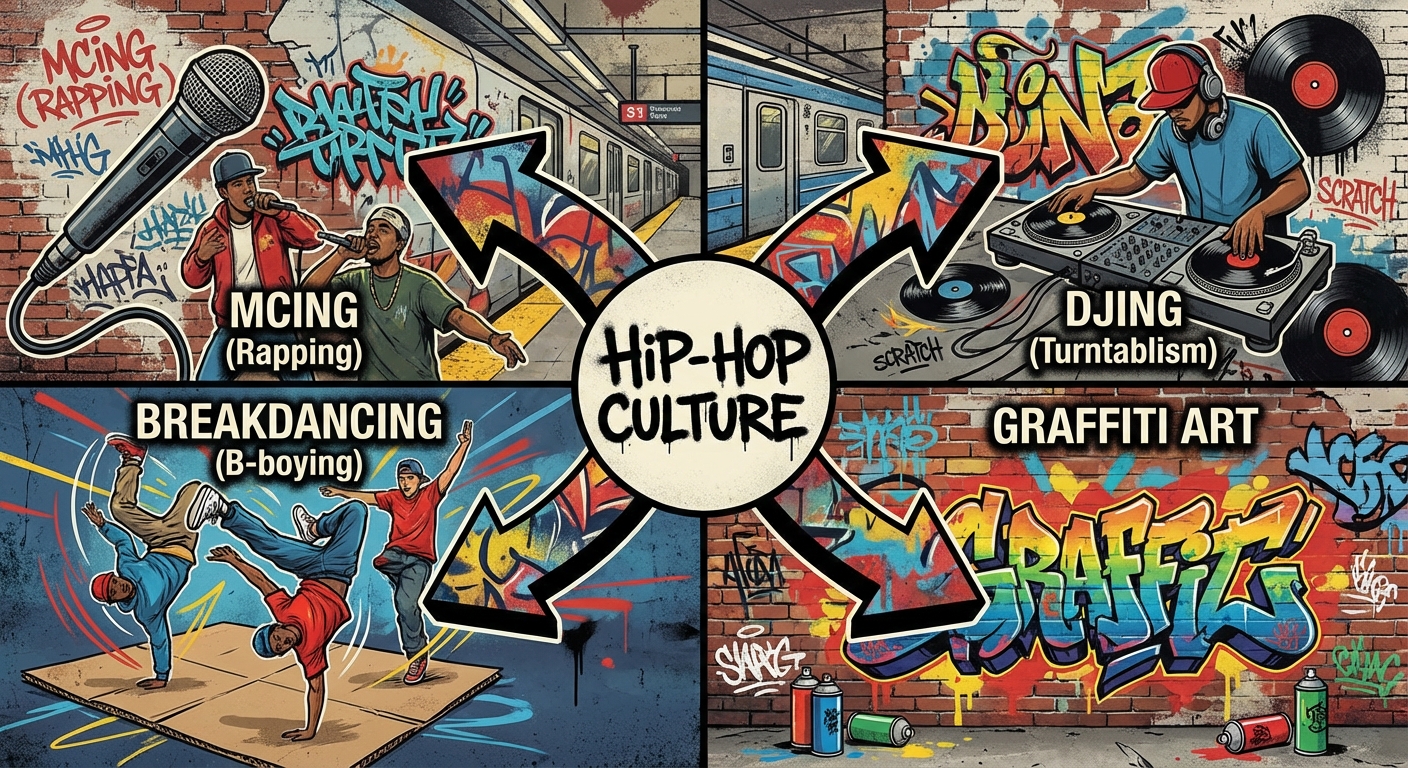
To understand Hip-hop fully, you must recognize its four foundational elements:
- DJing (Turntablism): The manipulation of records to create continuous breaks.
- MCing (Rapping): Spoken or chanted rhyming lyrics.
- Breakdancing (B-boying/B-girling): A dynamic style of dance including power moves and freezes.
- Graffiti Writing: Visual art often done in public spaces as an act of reclaiming territory.
Hip-Hop as Social Commentary
While early hip-hop was party-oriented, it quickly evolved into a medium for social justice and reporting on the conditions of Black life.
- "The Message" (1982): Grandmaster Flash and the Furious Five released this track, often cited as the first prominent hip-hop song to provide a grim narrative of inner-city poverty rather than party escapism.
- The Golden Age (Late 80s - 90s): Artists like Public Enemy and Queen Latifah used the genre to address police brutality, misogyny (and misogynoir), and political apathy. Public Enemy’s Chuck D famously called hip-hop "the CNN of the ghetto," highlighting its role as an alternative news source for marginalized communities.
Debates on Reparations and Structural Inequality
This topic covers the economic and political arguments regarding compensation for the descendants of enslaved people and the victims of Jim Crow policies.
The Case for Reparations
Reparations refers to the act of making amends for a wrong doing, specifically the systemic economic disenfranchisement of African Americans. The debate moved from the fringe to the mainstream in the 21st century.
- Historic Context: The unfulfilled promise of "40 Acres and a Mule" (General Sherman's Special Field Orders No. 15) serves as the historical anchor for this debate.
- Ta-Nehisi Coates: His influential 2014 essay, "The Case for Reparations," argued that reparations are not just for slavery, but for the ongoing policies that prevented Black wealth accumulation, such as redlining and predatory lending (contract selling).
The Racial Wealth Gap
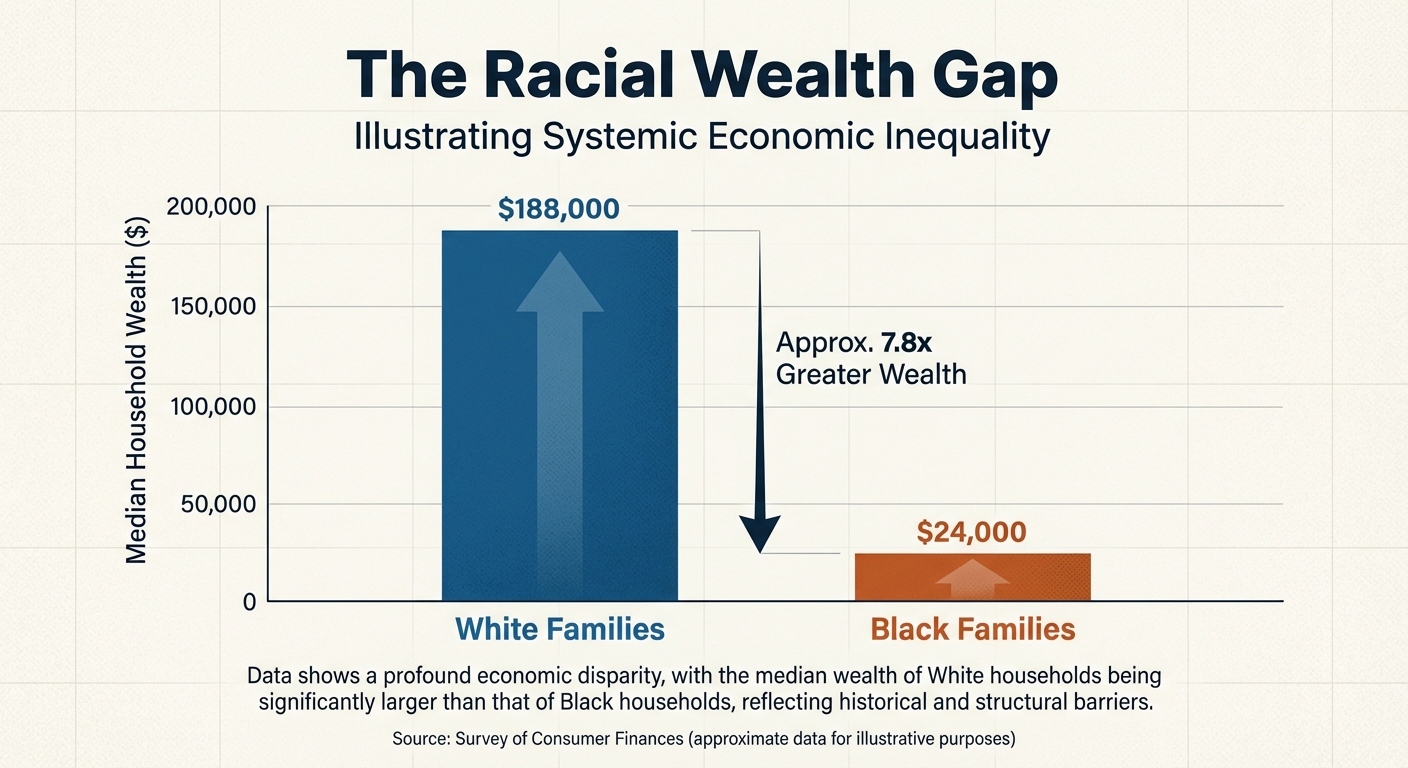
The primary argument for reparations is the Racial Wealth Gap. Wealth (assets minus debt) is intergenerational. Because African Americans were systematically excluded from wealth-building mechanisms (like the GI Bill housing benefits), a massive disparity exists today.
Legislative Efforts
- H.R. 40: A bill first introduced by Rep. John Conyers in 1989 and reintroduced annually. It does not demand immediate payment but establishes a commission to study and develop reparation proposals.
African American Identity in the 21st Century
Modern identity politics moves beyond a monolithic view of "Blackness," embracing complexity, intersectionality, and future-looking narratives.
Intersectionality
Coined by legal scholar Kimberlé Crenshaw in 1989, Intersectionality is a framework for understanding how various forms of inequality (like racism, sexism, and classism) operate together and exacerbate each other.
- Concept: A Black woman does not experience racism and sexism as separate events; she experiences a unique convergence of both.
- Application: This framework helped highlight the erasure of Black women in both the feminist movement (which often centered white women) and the Civil Rights movement (which often centered Black men).
Afrofuturism
Afrofuturism is a cultural aesthetic that combines science fiction, history, and fantasy to explore the African American experience and aim to connect those from the African Diaspora to their forgotten African ancestry.
- Octavia Butler: A pioneering science fiction author whose novels (e.g., Kindred, Parable of the Sower) explored power hierarchies and survival.
- Black Panther: The Marvel film brought Afrofuturist aesthetics (technological advancement combined with African tradition, free from colonization) to a global mainstream audience.
Black Feminism and LGBTQ+ Identity
Contemporary movements emphasize that Black liberation must include all Black people, specifically centering those marginalized within the community.
- The Combahee River Collective Statement (1977): A foundational text that argued, "If Black women were free, it would mean that everyone else would have to be free since our freedom would necessitate the destruction of all the systems of oppression."
- Modern Movements: The Black Lives Matter movement was founded by three Black women (Alicia Garza, Patrisse Cullors, and Opal Tometi), two of whom identify as queer, explicitly centering LGBTQ+ voices in the fight against state violence.
Common Mistakes & Pitfalls
- Confusing Eras: Students often conflate the Harlem Renaissance (1920s) with the Black Arts Movement (1960s/70s). Remember: Harlem Renaissance = "New Negro," artistic excellence to prove worth. Black Arts Movement = "Black Power," art as a weapon for liberation.
- Misunderstanding Intersectionality: It is not just about "diversity" or having multiple identities. It is specifically a legal and sociological framework about how systems of power overlap to create unique oppression.
- Simplifying Reparations: Do not assume reparations is only about slavery. The strongest academic arguments (like Coates's) focus heavily on 20th-century housing discrimination (redlining) as the primary driver of today's wealth gap.
- Hip-Hop as Party Music: While entertainment is a factor, for AP purposes, always analyze Hip-Hop through the lens of resistance, oral history, and territorial reclamation.