Contemporary China: Global, Environmental, and Societal Issues
Unit 6: Environmental, Political, and Societal Challenges
This unit explores the complex challenges facing modern China as it balances rapid economic growth with sustainability, social stability, and global influence. For the AP Exam, focus on understanding the causes, effects, and cultural perspectives surrounding these issues.
Economic Challenges and Global Trade
Trade Disputes and Global Relations
China’s rise as a global economic superpower has led to significant friction with other nations, particularly regarding trade balances, intellectual property, and market access.
US-China Trade War:
- Origins: The conflict centers on the massive trade deficit (US buying more from China than vice versa), allegations of intellectual property (IP) theft, and forced technology transfers (requiring foreign companies to share tech to enter the Chinese market).
- Tariffs: Both nations have imposed tariffs (taxes on imports) on billions of dollars of goods. This impacts industries like soy farming in the US and manufacturing in China.
- Decoupling/De-risking: Many Western nations are now seeking to "de-risk," reducing reliance on Chinese supply chains for critical goods like semiconductors and pharmaceuticals.
Other International Disputes:
- Australia & Canada: Tensions have flared over political issues leading to Chinese bans or tariffs on goods like Australian wine/coal and Canadian canola.
- WTO Role: The World Trade Organization acts as a mediator, though dispute resolution is often slow.
Key Economic Initiatives
To sustain growth and expand influence, the Chinese government has launched several massive strategic plans.
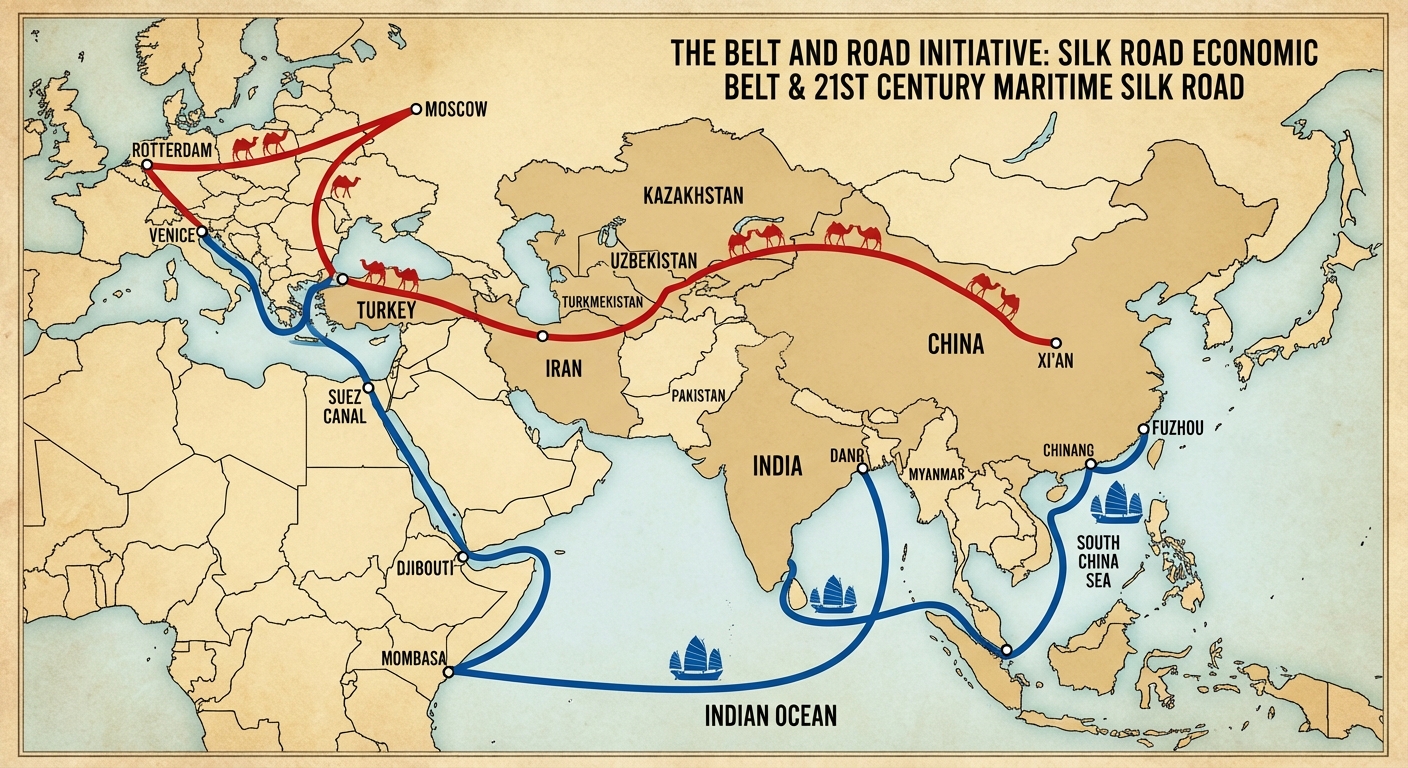
- The Belt and Road Initiative (BRI) (一带一路):
- Concept: A global infrastructure development strategy aimed at reviving the ancient Silk Road.
- Scope: Investments in over 140 countries involving ports, railways, highways, and energy grids connecting Asia, Africa, and Europe.
- Goal: Enhance trade connectivity and expand China's geopolitical influence.
- Criticism: Western nations criticize it as "debt-trap diplomacy," where developing nations default on loans and are forced to lease key assets (like ports) to China.
- Made in China 2025 (Twelfth & Thirteenth Five-Year Plans):
- Goal: Transition China from being the "factory of the world" (cheap labor/low quality) to a high-tech manufacturing powerhouse.
- Key Sectors: Robotics, aerospace, green energy vehicles, and biotechnology.
- Strategy: Heavy government subsidies and R&D investment.
Internal Economic Stability: Housing and Debt
- The Real Estate Bubble: Real estate accounts for roughly 25-30% of China s GDP. For decades, property was viewed as the safest investment for Chinese households.
- Ghost Cities: Over-speculation and government targets led to the construction of entire cities with infrastructure but few residents.
- Evergrande Crisis: Major developers like Evergrande accummulated massive debt ($300B+). Government crackdowns on borrowing (the "Three Red Lines" policy) triggered liquidity crises, leaving millions of homes unfinished and rattling global markets.
Environmental Issues (环境保护)
China is the largest emitter of greenhouse gases, a byproduct of its rapid industrialization. However, it is also the world's largest investor in green energy.
Pollution Challenges
- Air Pollution (Smog/Fog Haze - 雾霾): Major cities often suffer from high PM2.5 levels, largely due to coal burning for electricity and heating, as well as vehicle exhaust.
- Water & Soil: Industrial runoff has contaminated major waterways. Desertification makes the north (Beijing) prone to sandstorms.
- Climate Change Impact: China is highly vulnerable to rising sea levels (coastal cities like Shanghai) and extreme weather events (flooding in the Yangtze basin).
Government Response and Green Initiatives
- Dual Carbon Goals:
- Carbon Peak: Peak emissions by 2030.
- Carbon Neutrality: Net-zero emissions by 2060.
- Renewable Energy Leadership: China leads the world in solar panel and wind turbine production.
- Green Transportation: aggressive promotion of New Energy Vehicles (NEVs) through subsidies and license plate lotteries (it is easier to get a license plate for an EV than a gas car in Shanghai/Beijing).
Societal Challenges: Education and Work
The Education System
The Gaokao (高考):
- The National College Entrance Examination is the most critical event in a student's life. It is the sole determinant for university admission.
- Format: Covers Chinese, Math, English, and a composite Science or Humanities subject.
- Impact: Creates intense pressure (). Families sacrifice years for preparation. It is viewed as a meritocratic social equalizer, but it is extremely grueling.
Rural vs. Urban Divide (The Hukou System):
- Household Registration (Hukou): Social benefits (schooling, healthcare) are tied to a person's place of birth. Migrant workers in cities cannot easily send their children to urban public schools.
- Left-Behind Children: millions of children remain in rural villages with grandparents while parents work in cities, leading to educational inequality.
Work Culture and Demographics
- 996 Culture: A practice in the tech industry of working 9 am to 9 pm, 6 days a week. It marks the intense competition of the Chinese job market.
- Tangping (Lying Flat - 躺平): A counter-cultural movement among youth rejecting the rat race. Instead of striving for high-paying jobs and property, they choose to do the bare minimum to get by.
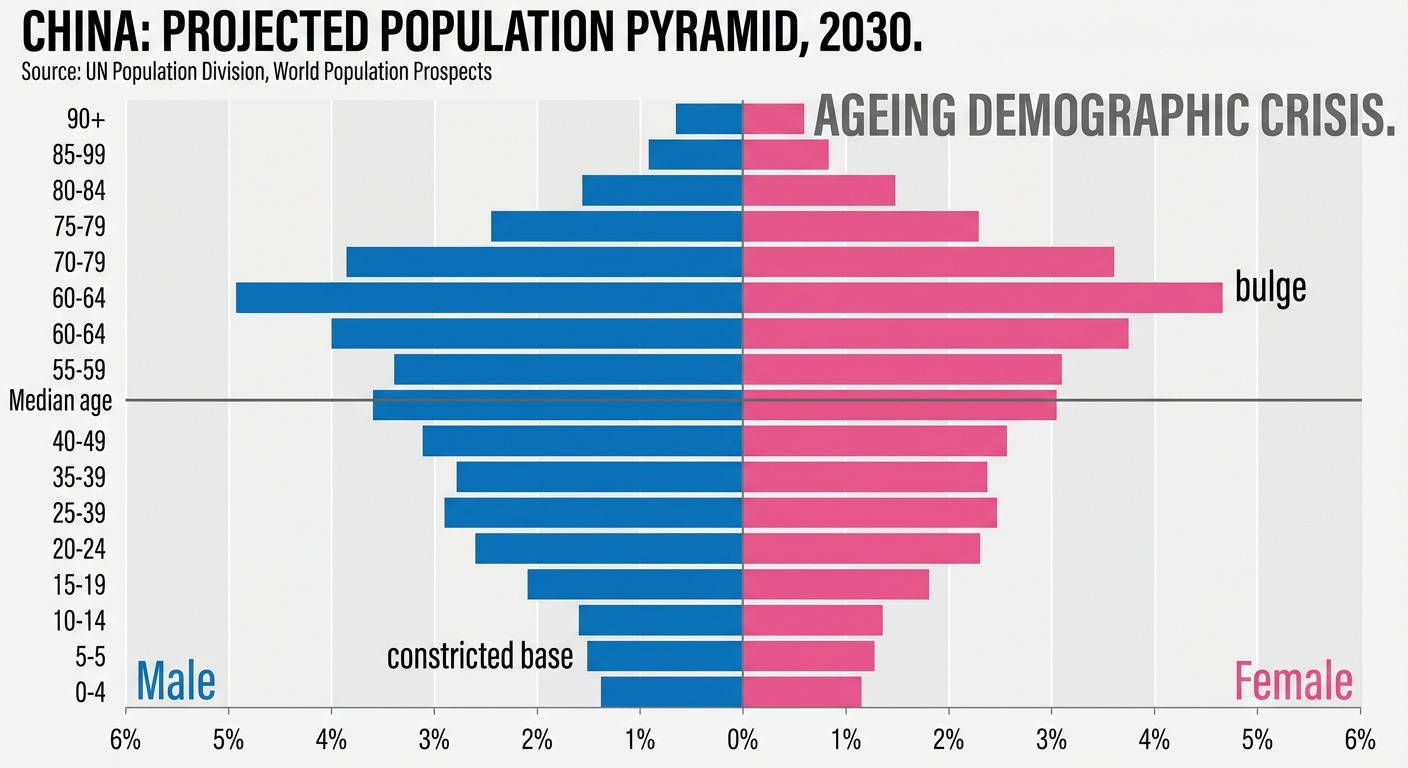
- Demographic Crisis:
- Aging Population: Due to the One-Child Policy (1980–2016), the workforce is shrinking while the retiree population grows.
- New Policies: The government now allows three children and actively encourages larger families, but high costs of living and education discourage young couples from having kids.
Political Disputes and Sovereignty
Territorial Integrity
- Taiwan: The PRC claims Taiwan is a province of China. Tensions rise over US arms sales to Taiwan and visits by foreign officials. The "One China Principle" is a diplomatic red line for Beijing.
- South China Sea: China claims historical rights (the "Nine-Dash Line") to resources in the sea, conflicting with claims from Vietnam, the Philippines, and Malaysia. This leads to naval standoffs and island building.
- India Border: Long-standing skirmishes occur in the Himalayas (Aksai Chin / Arunachal Pradesh).
Human Rights Concerns
- Xinjiang (Uighurs): Western governments and the UN have accused China of detaining over a million ethnic Uighurs (a Muslim minority) in "re-education camps." China claims these are vocational centers for de-radicalization and poverty alleviation.
- Censorship and The Great Firewall:
- The government strictly controls the internet, blocking platforms like Google, Facebook, and foreign news.
- Domestic alternatives (WeChat, Weibo, Baidu) are monitored for "sensitive" keywords.
Common Mistakes & Pitfalls
- Confusing Policies: Do not say "One Child Policy" is the current law. It ended in 2016. Use "Three Child Policy" for current context, but acknowledge the legacy of the One Child Policy causes today's aging problem.
- Over-generalizing Pollution: While pollution is bad, avoid saying "everyone wears masks because of smog." Mask-wearing was common for hygiene pre-COVID, and air quality in cities like Beijing has significantly improved in the last 5 years.
- Misunderstanding "Face" (Mianzi): In work culture, "saving face" isn't just about vanity; it's a critical mechanism for social harmony. Publicly correcting a boss or elder is a major cultural taboo.
- Geography Errors: Do not confuse Hong Kong (Special Administrative Region) with Taiwan. They have different political statuses and histories.