AP Physics C: Mechanics — Unit 4 Study Guide
Defining the Center of Mass
In AP Physics C: Mechanics, analyzing systems with multiple components or extended bodies requires a simplified approach. We treat the system as if all its mass were concentrated at a single point called the Center of Mass (CoM). This point represents the average position of the matter in a system or object.
From a dynamic perspective, if you push an object at its center of mass, it will move in a straight line without rotating. If you push it anywhere else, it will rotate around the center of mass while translating.
1. Discrete Systems of Particles
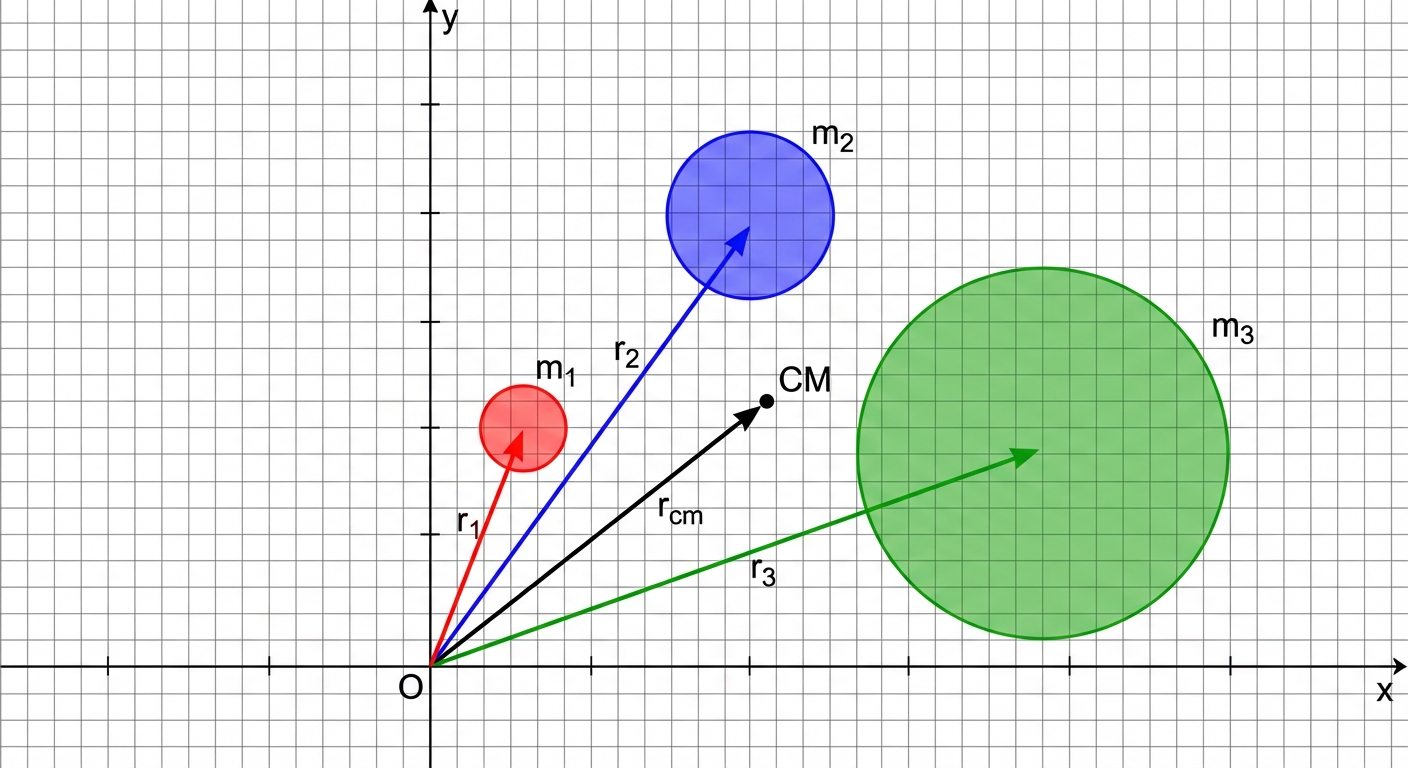
For a system made of individual, separate particles (point masses), the center of mass is the mass-weighted average position of all particles.
Mathematical Formulation
In one dimension along the x-axis:
Where:
- $M$ is the total mass of the system ($M = \sum m_i$)
- $x_i$ is the coordinate of the $i$-th particle
In three dimensions, we treat each coordinate axis independently:
Alternatively, using position vectors $\vec{r}$:
Worked Example: The Three-Mass System
Problem: Three masses are placed on an $x-y$ plane: $2\text{ kg}$ at $(0,0)$, $3\text{ kg}$ at $(4,0)$, and $5\text{ kg}$ at $(2,3)$. Find the coordinates of the center of mass.
Solution:
Calculate Total Mass ($M$):
Calculate $x{cm}$:
Calculate $y{cm}$:
Answer: The CoM is at $(2.2, 1.5)$.
2. Continuous Objects (Integration)
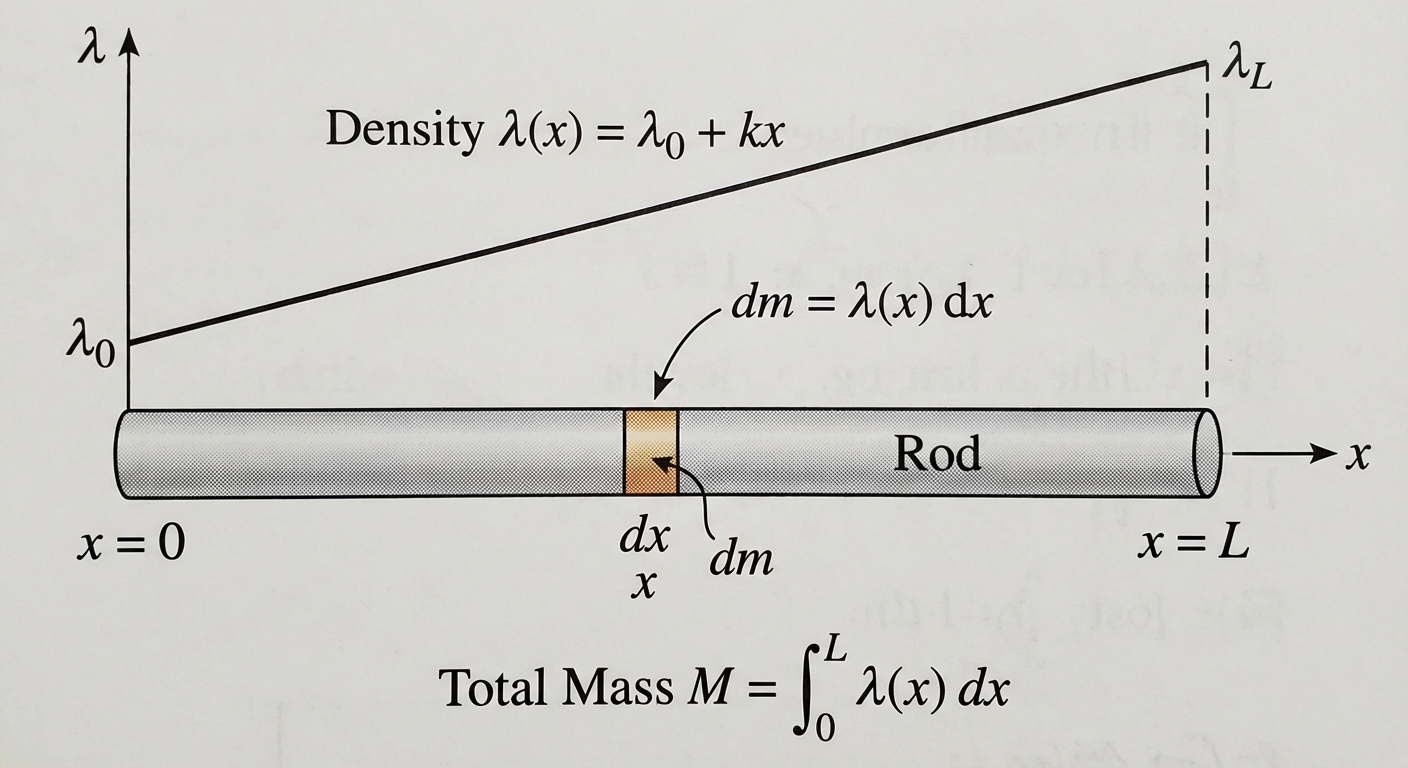
Real-world objects are not made of discrete dots; they are continuous. For these objects, we replace the summation $\Sigma$ with an integral $\int$ and the discrete mass $m_i$ with an infinitesimal mass element $dm$.
To solve this integral, you must express $dm$ in terms of spatial coordinates ($dx$, $dy$, or $dr$) and density.
Density Definitions
Depending on the shape of the object, use the appropriate density:
| Type | Symbol | Definition | Relationship | Usage |
|---|---|---|---|---|
| Linear Density | $\lambda$ (lambda) | Mass per unit length | $dm = \lambda dx$ | Rods, wires |
| Surface Density | $\sigma$ (sigma) | Mass per unit area | $dm = \sigma dA$ | Plates, disks, shells |
| Volume Density | $\rho$ (rho) | Mass per unit volume | $dm = \rho dV$ | Spheres, solid cylinders |
Uniform vs. Non-Uniform Density
- Uniform Objects: Density is constant. The CoM is located at the geometric center (centroid). For example, the CoM of a uniform sphere is its exact center.
- Non-Uniform Objects: Density varies with position (e.g., $\lambda = kx$). You must integrate.
Worked Example: Non-Uniform Rod
Problem: A thin rod of length $L$ lies along the x-axis from $x=0$ to $x=L$. Its linear mass density varies as $\lambda(x) = \alpha x$, where $\alpha$ is a constant. Find the x-coordinate of the CoM.
Solution:
Define $dm$:
Since it is a 1D rod, $dm = \lambda dx = (\alpha x) dx$.Calculate Total Mass ($M$):
Set up Numerator ($\int x dm$):
Divide properties:
Answer: The center of mass is at $x = \frac{2}{3}L$ (closer to the heavier, denser end).
3. Motion of the Center of Mass
Understanding how the CoM moves is critical for solving multi-body problems, collisions, and explosions. The key principle is that internal forces do not affect the motion of the Center of Mass.
Velocity and Acceleration
By taking the derivative of the position vector with respect to time, we get:
Velocity of CoM:
Note: The total momentum of the system is the total mass multiplied by the velocity of the CoM.
Acceleration of CoM:
Newton's Second Law for Systems
Multiplying the acceleration equation by $M$, we arrive at a powerful generalization of Newton's Second Law:
- $\vec{F}_{net, external}$: Sum of forces acting on the system from the outside.
- Internal forces (Newton's 3rd Law pairs like tension between connected blocks or forces during a collision) cancel out and sum to zero.
Applications
1. Conservation of Momentum
If $\vec{F}{net, external} = 0$, then $\vec{a}{cm} = 0$. This means $\vec{v}_{cm}$ is constant. The Center of Mass continues to move in a straight line at a constant speed, regardless of what the parts of the system do (collide, bounce, explode).
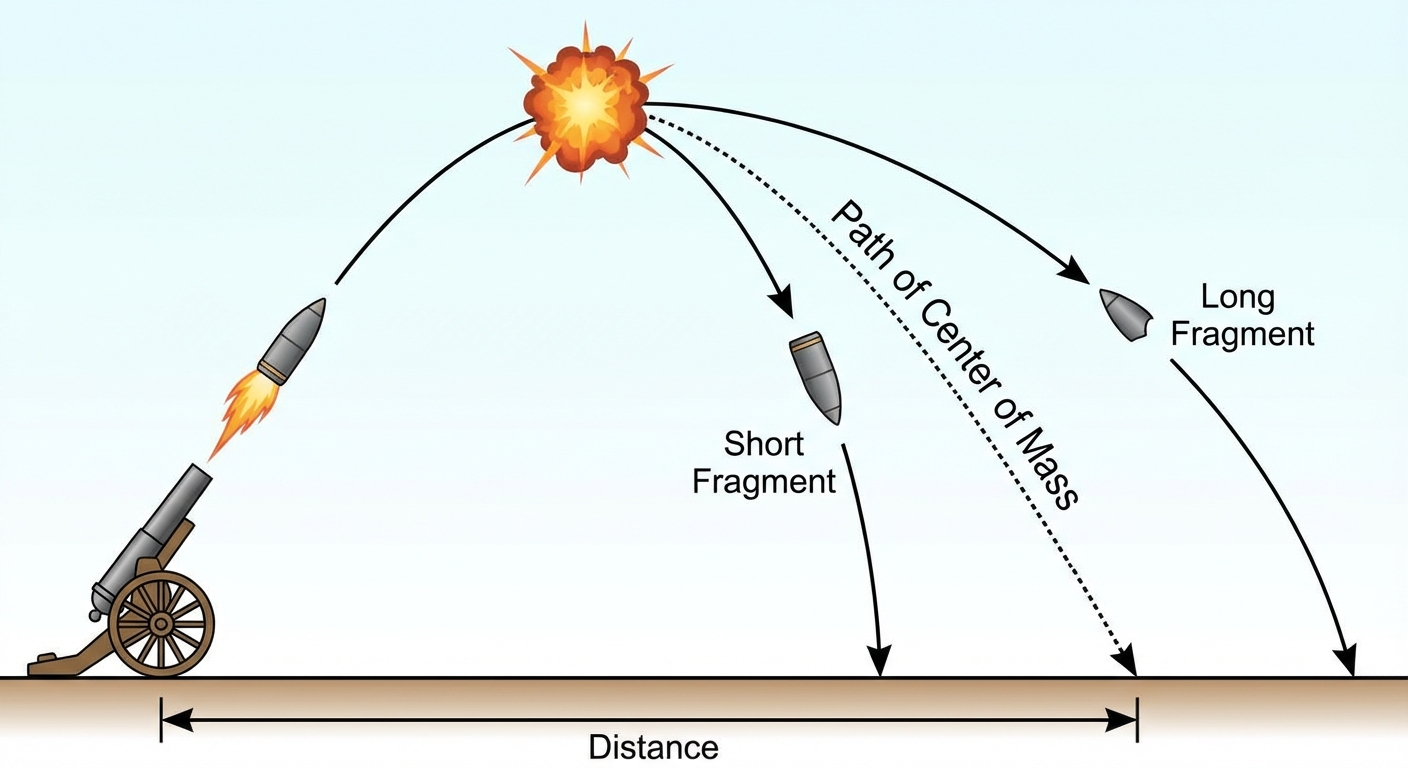
2. Projectile Motion with Explosions
If a projectile launches into the air and explodes into fragments at the peak, the fragments will fly in different directions, but the Center of Mass of the system continues along the original parabolic trajectory (until a fragment hits the ground).
4. Common Mistakes & Exam Tips
Pitfalls Avoidance Strategy
- Mixing up $m$ and $M$: In the integration formula $\frac{1}{M} \int x dm$, students often forget the $\frac{1}{M}$ term or forget to calculate $M$ separately first. Always integrate to find total mass $M$ unless it is given as a constant variable.
- Coordinate System Neglect: Position $x_i$ can be negative! If a mass is at $x = -2$, that negative sign is crucial in the weighted average. Always draw your axes first.
- Internal Forces Confusion: A person walking on a boat is an internal force. The system's CoM does not move relative to the water (assuming friction is negligible), but the boat moves backward to compensate for the person moving forward.
- Uniform vs. Non-Uniform: Do not assume the CoM is at $L/2$ unless the problem states the object has "uniform density" or "constant mass distribution."
Memory Aid: "The Weighted Balance"
Think of the formula $x{cm} = \frac{\sum mi x_i}{M}$ like calculating a grade point average.
- $x_i$ is the grade (value).
- $m_i$ is the credit hours (weight).
- $M$ is the total credit hours.
Heavier masses pull the CoM closer to them, just like a 5-credit 'A' pulls your GPA up more than a 1-credit 'A'.