Module 3: Fundamentals of Mechanical Energy
Defining Work in Physics
In everyday language, "work" implies physical or mental effort. In physics, however, Work ($W$) is rigorously defined as the transfer of energy that occurs when a force exerts an influence on an object while moving it over a given distance.
Work is a scalar quantity, meaning it has magnitude but no direction. However, it can be positive or negative, which indicates whether energy is being added to or removed from the system.
Calculating Work by a Constant Force
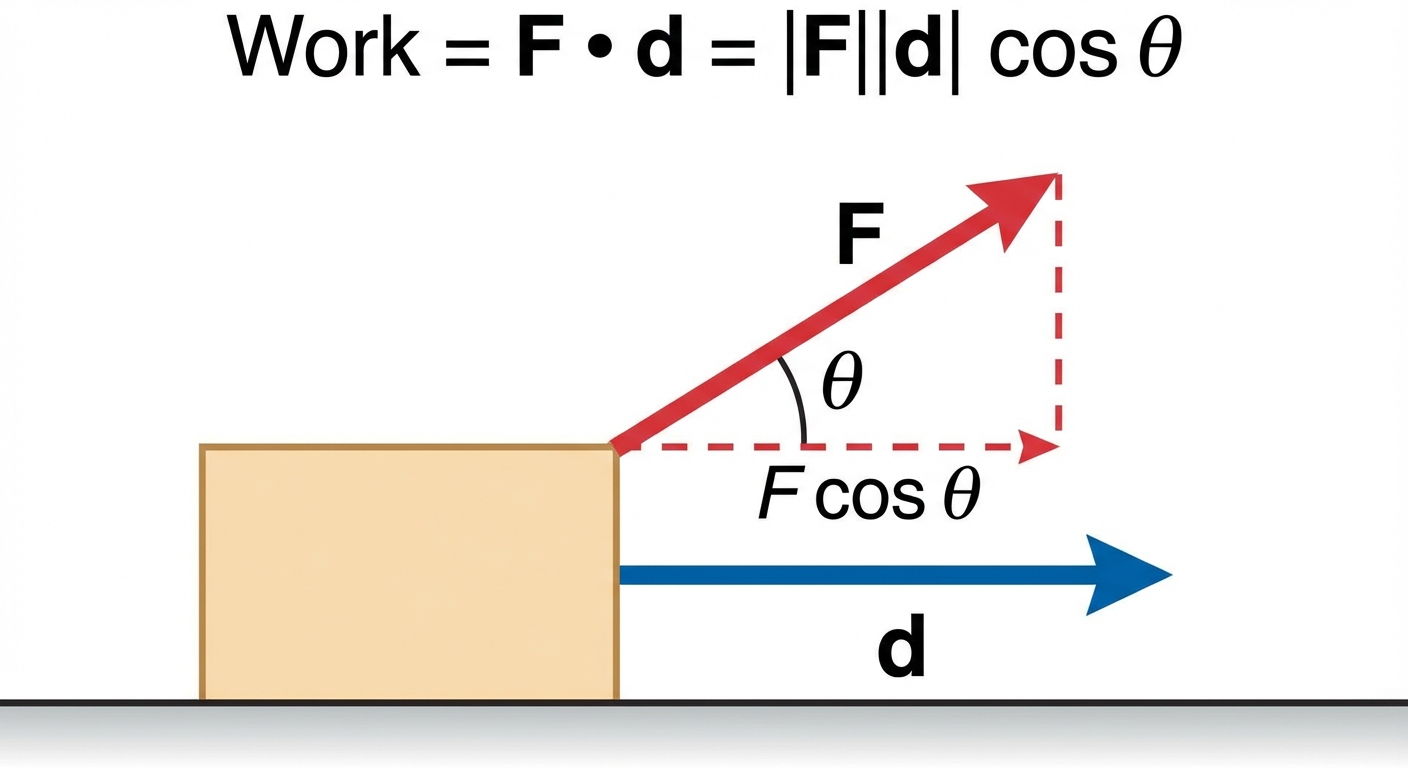
The fundamental equation for work done by a constant force is the dot product of the Force vector and the Displacement vector:
W = \vec{F} \cdot \vec{d} = Fd\cos\theta
Where:
- $F$ is the magnitude of the force (in Newtons, N)
- $d$ represents the displacement (in meters, m)
- $\theta$ is the angle between the force vector and the displacement vector
The unit of Work is the Joule (J), where $1 \text{ J} = 1 \text{ N} \cdot \text{ m}$.
The Sign of Work
The angle $\theta$ determines the nature of the energy transfer:
- Positive Work ($0^\circ \le \theta < 90^\circ$): The force generally points in the direction of motion. The force represents an input of energy into the system (e.g., pushing a car to speed it up).
- Negative Work ($90^\circ < \theta \le 180^\circ$): The force has a component opposite to the direction of motion. The force removes energy from the object (e.g., kinetic friction slowing down a sliding box).
- Zero Work ($\theta = 90^\circ$): If the force is perpendicular to the displacement, $\cos(90^\circ) = 0$. No energy is transferred. (e.g., the Normal Force on a block sliding horizontally does zero work).
Work from Graphs (Variable Force)
Forces are not always constant (e.g., stretching a rubber band). When force varies with position, we generally cannot use $Fd\cos\theta$.
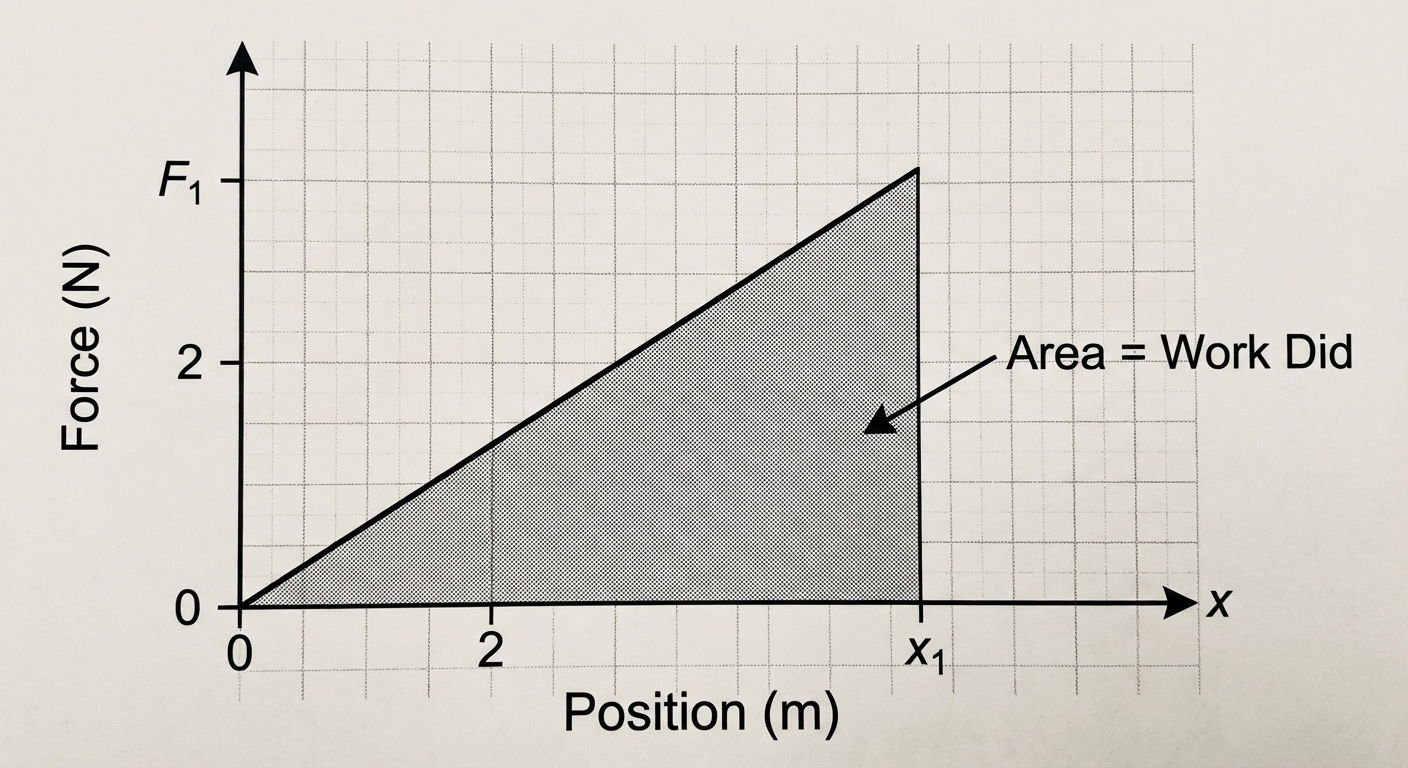
Instead, we look at a Force vs. Displacement Graph.
- The area under the curve of an $F$ vs. $x$ graph represents the work done.
- Area above the x-axis is positive work; area below is negative work.
Translational Kinetic Energy
Translational Kinetic Energy ($K$) is the energy an object possesses due to its motion through space. The term "translational" specifies that the center of mass is moving from one location to another (as opposed to just spinning in place, which is rotational kinetic energy).
The Formula
For an object of mass $m$ moving at speed $v$:
K = \frac{1}{2}mv^2
Key Properties
- Scalar Quantity: Like work, $K$ is scalar and is always positive (or zero). You cannot have negative kinetic energy because mass is positive and $v^2$ obliterates any negative sign relative to velocity direction.
- Velocity Dependence: Because $v$ is squared, a small change in speed results in a large change in energy. If you double your speed, your kinetic energy quadruples.
Example Scenario
A 1000 kg car accelerates from 10 m/s to 20 m/s.
- Initial $K_i = \frac{1}{2}(1000)(10)^2 = 50,000 \text{ J}$.
- Final $K_f = \frac{1}{2}(1000)(20)^2 = 200,000 \text{ J}$.
- Even though speed only doubled, the energy increased by 150,000 J.
Potential Energy
Potential Energy ($U$) is energy stored in a system due to the relative positions or configuration of its parts. Is it often called "stored" energy because it has the potential to be converted into kinetic energy.
Crucial AP Distinction: Potential energy exists strictly within a system of two or more objects interacting via a conservative force (like gravity or a spring). A single object cannot have potential energy.
Gravitational Potential Energy ($U_g$)
This is the energy associated with the separation between an object and Earth.
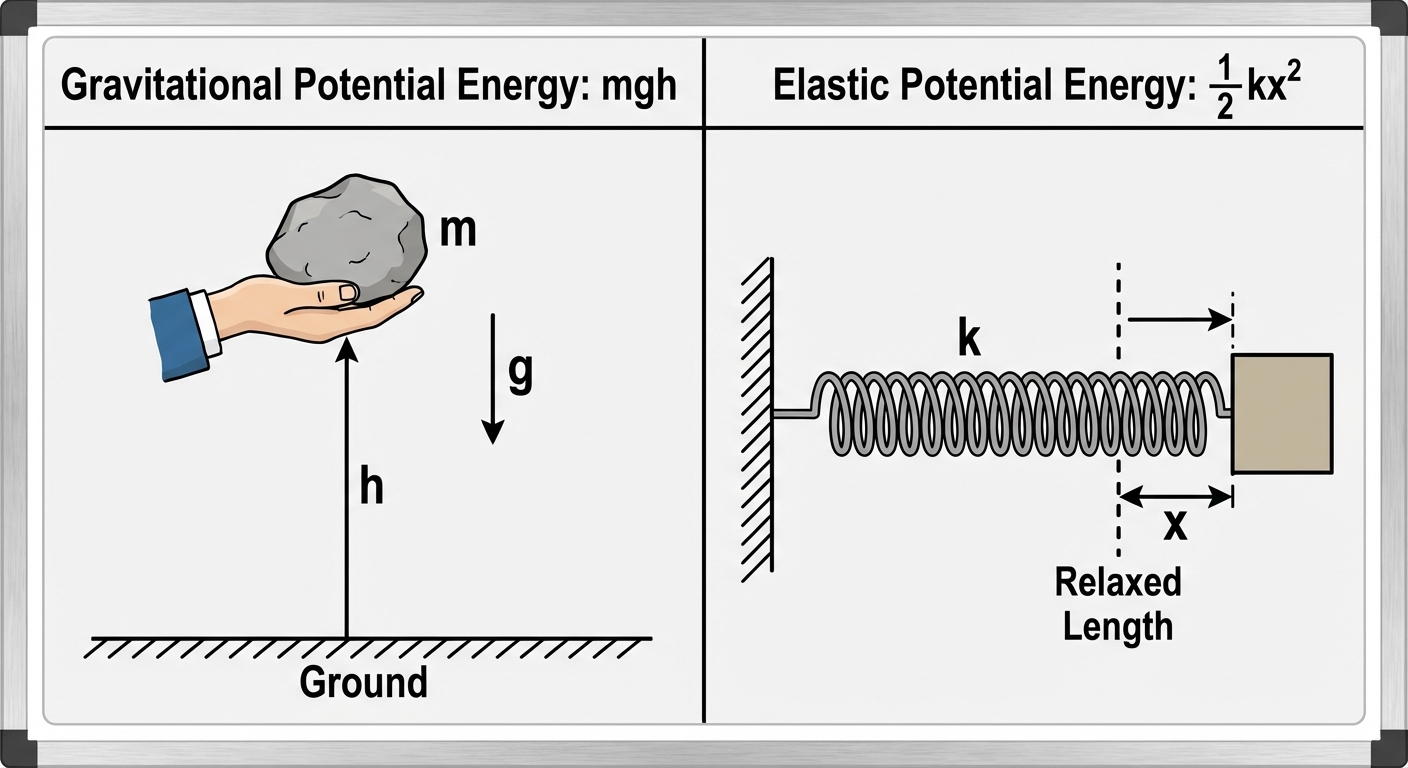
When close to the Earth's surface (where $g$ is constant), the formula is:
\Delta U_g = mg\Delta y
Often written simply as $U_g = mgh$, where:
- $m$ = mass (kg)
- $g$ = acceleration due to gravity (approx $9.8 \text{ m/s}^2$ or $10 \text{ m/s}^2$ on the AP exam)
- $h$ = vertical height above a reference level
The Reference Line: You can choose any horizontal level to be $h=0$ (the floor, the ceiling, the lowest point in the problem). The physics depends only on the change in height ($ \Delta y$), not the absolute height.
Elastic Potential Energy ($U_s$)
This is energy stored in an elastic object (like a spring or rubber band) when it is deformed (stretched or compressed) from its equilibrium position.
Recall Hooke's Law for the force required to deform a spring: $F_s = -kx$. Integrating this force yields the energy equation:
U_s = \frac{1}{2}kx^2
Where:
- $k$ = Spring constant (N/m), a measure of stiffness.
- $x$ = displacement from the natural/equilibrium length (transverse or longitudinal).
| Feature | Gravitational PE ($U_g$) | Elastic PE ($U_s$) |
|---|---|---|
| Requires | Object + Earth | Object + Spring |
| Variable dependence | Linear with height ($h$) | Quadratic with extension ($x^2$) |
| Force Type | Constant (near surface) | Variable (increases with $x$) |
Common Mistakes & Pitfalls
1. The "Effort" Trap
Mistake: Assuming that if you push hard, you are doing interesting work.
Correction: If the object does not move ($d=0$), Work is zero regardless of how much you sweat. Similarly, if you carry a heavy box horizontally at a constant velocity, the force (upwards) and displacement (horizontal) are perpendicular ($90^\circ$). Work done by your lifting force is zero.
2. Negative Work Confusion
Mistake: Thinking negative work creates "negative energy."
Correction: Work is energy transfer. Negative work means energy is being taken out of the specific object or system you are analyzing (usually turned into heat via friction or transferred to another object).
3. Spring Force vs. Spring Energy
Mistake: Mixing up the formulas $Fs = kx$ and $Us = \frac{1}{2}kx^2$.
Correction:
- Use Linear ($kx$) for Forces and Free Body Diagrams.
- Use Quadratic ($kx^2$) for Energy conservation equations.
4. System Definition (The AP Trap)
Mistake: Double counting gravity.
Correction:
- Scenario A: Your system is "The Ball." Earth is external. Gravity acts as an external force doing Work. ($W_{ext}$)
- Scenario B: Your system is "The Ball + Earth." Gravity is an internal force. You do NOT calculate work done by gravity; instead, you account for Gravitational Potential Energy ($U_g$) inside the system.
5. Velocity Squares
Mistake: Forgetting to square velocity in $K = \frac{1}{2}mv^2$.
Correction: Check your units. $kg \cdot (m/s)$ is momentum. $kg \cdot (m/s^2)$ is Force. $kg \cdot (m/s)^2 = kg \cdot m^2/s^2$ is Joules (Energy).