Mastering Political Participation: Voting and Elections
Voting and Elections in the United States
Voting Rights and Models of Voting Behavior
Suffrage (the right to vote) in the United States has expanded gradually from a privilege of property-owning white males to a near-universal right for adult citizens. Understanding this evolution and how people decide to vote is critical for the AP exam.
Constitutional Amendments and Acts
The expansion of the electorate is primarily defined by the following constitutional changes and federal laws:
- 15th Amendment (1870): Prohibits prohibiting voting rights based on race, color, or previous condition of servitude. (Historically circumvented by Jim Crow laws like grandfather clauses and literacy tests).
- 17th Amendment (1913): established the direct election of U.S. Senators by popular vote rather than by state legislatures.
- 19th Amendment (1920): Prohibits denying the right to vote based on sex (gave women the vote).
- 24th Amendment (1964): Eliminated the poll tax in federal elections, removing a financial barrier used to disenfranchise poor and African American voters.
- Voting Rights Act of 1965: Federal legislation that enforced the 15th Amendment. It outlawed literacy tests and required states with histories of discrimination to get federal approval (preclearance) before changing election laws.
- 26th Amendment (1971): Lowered the voting age from 21 to 18 (spurred by the Vietnam War draft).
Models of Voting Behavior
Political scientists categorize the reasoning behind a voter's choice into four distinct models. You will likely see scenarios asking you to identify which model is being used.
- Rational Choice Voting: Voting based on what is perceived to be in the citizen's individual best interest. The voter weighs the costs and benefits.
- Retrospective Voting: Voting to decide whether the party or candidate in power should be re-elected based on the recent past. (e.g., "Am I better off now than I was four years ago?")
- Prospective Voting: Voting based on predictions of how a party or candidate will perform in the future. Requires the voter to trust campaign promises.
- Party-Line Voting: Supporting a party by voting for candidates from one political party for all public offices across the ballot (also known as straight-ticket voting).
Voter Turnout
Voter Turnout refers to the percentage of eligible voters who cast a ballot in an election. The U.S. generally has lower turnout compared to other Western democracies.
Structural Barriers to Voting
Even with universal suffrage, specific rules can make voting harder:
- Voter Registration: Unlike many democracies with automatic registration, U.S. citizens must take initiative to register.
- Photo ID Laws: Some states require government-issued ID to vote. Proponents argue it prevents fraud; opponents argue it suppresses turnout among poor and minority voters who lack IDs.
- Election Scheduling: Elections are held on Tuesdays (workdays), which may prevent working-class citizens from voting.
Demographics of Political Participation
Who actually votes? Certain demographic characteristics are strong predictors of turnout.
| Demographic Factor | Trend |
|---|---|
| Education | The single best predictor. Higher education = higher turnout. |
| Age | Older citizens (60+) vote at the highest rates; voters 18-24 vote at the lowest. |
| Race | Whites generally vote at higher rates than minorities, though the gap narrows when controlling for socioeconomic status. Black voter turnout has risen significantly in recent decades. |
| Gender | Women vote at slightly higher rates than men. |
| Religious Engagement | Those active in religious communities are more likely to vote. |
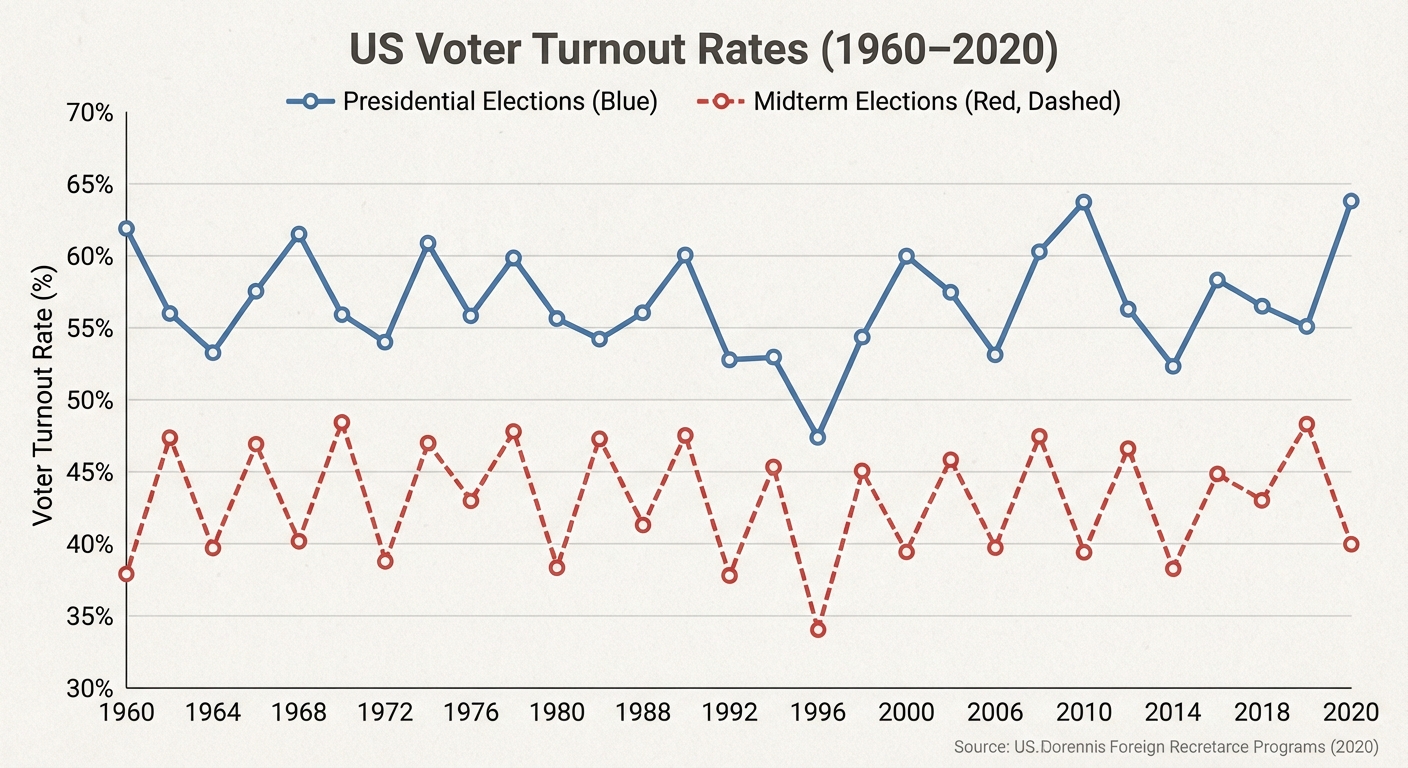
Factors Influencing Turnout
- Political Efficacy: A citizen's belief that their vote matters and that they can understand/influence politics. High efficacy leads to high turnout.
- Type of Election: Presidential elections usually have the highest turnout (~55-60%), while Midterm Elections (congressional elections halfway through a president's term) have much lower participation (~35-40%).
Elections and Campaigns
The Road to Nomination
Before the general election, parties must choose their contenders.
- Primary Elections: Elections in which voters choose the candidates from each party who will run in the general election.
- Open Primary: Voters may choose on election day which party's primary they want to vote in (allows independents to participate).
- Closed Primary: Only voters registered in advance with the party can vote in its primary (encourages party loyalty).
- Caucuses: A meeting of local party members to register their preference among candidates running for office. (Iowa is the most famous first caucus).
The General Election & The Electoral College
The U.S. uses a unique system to elect the President, established in Article II of the Constitution.
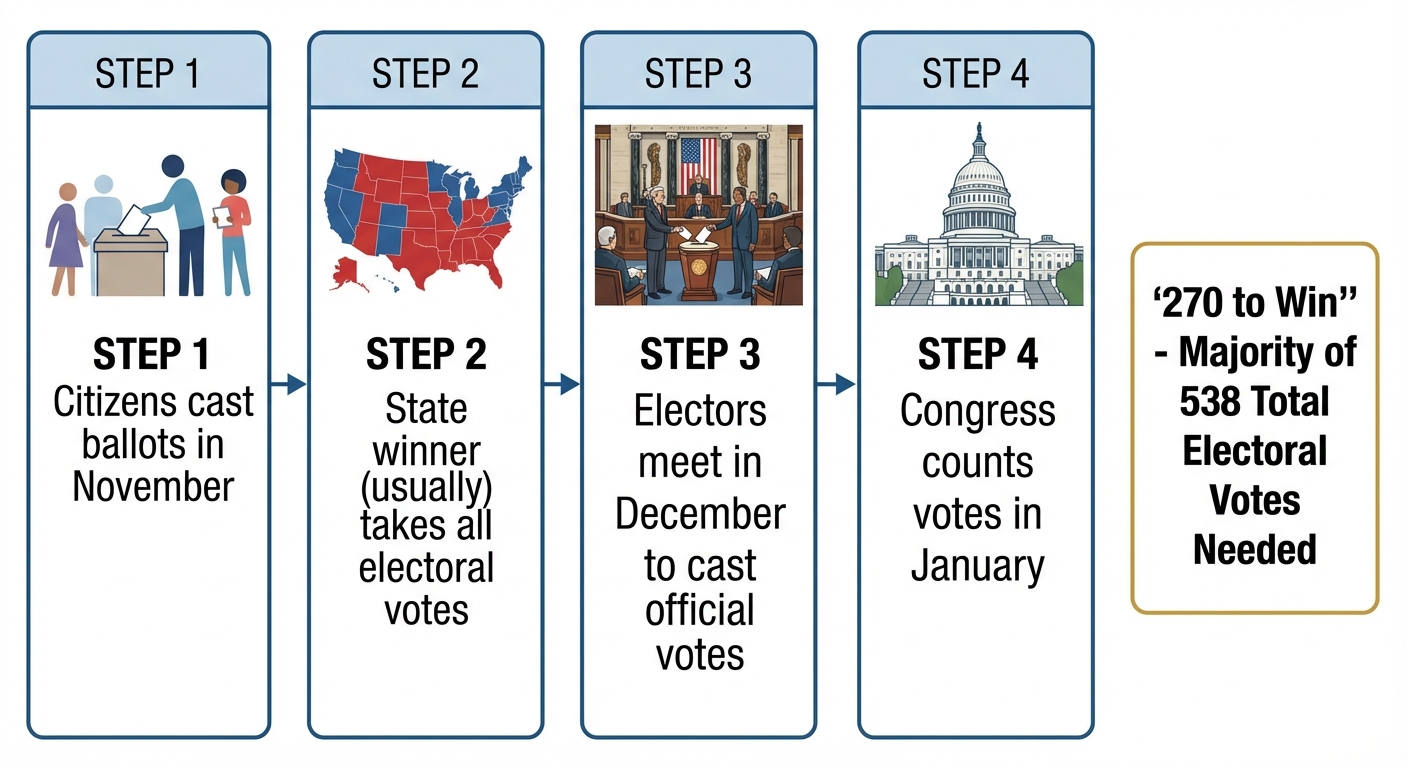
- The System: Voters vote for a specific candidate, but they are actually voting for a slate of electors pledged to that candidate.
- The Math: Total electors = 538 (435 House + 100 Senate + 3 for D.C.). A candidate needs a majority (270) to win.
- Winner-Take-All: In 48 states, the candidate who wins the popular vote gets ALL of that state's electoral votes. (Maine and Nebraska are the exceptions—they allocate by congressional district).
- Strategic Implications: Candidates focus exclusively on Swing States (Battleground States) where the polls are close. Safe states (solidly Red or Blue) are often ignored during campaigns.
Congressional Elections and Incumbency
While presidents operate under the Electoral College, members of Congress are elected by direct popular vote. The most powerful force in these elections is the Incumbency Advantage—the tendency of those already holding office to win reelection.
Why Incumbents Win:
- Name Recognition: Voters know who they are.
- Franking Privilege: The ability of members to mail letters to their constituents free of charge.
- Casework: Services performed by members of Congress for constituents (e.g., helping grandma get her missing Social Security check).
- Pork Barrel Spending: Bringing federal money/projects back to the district.
Campaign Finance
This is a high-frequency topic on the AP Exam. You must understand the tension between free speech (spending money) and electoral fairness (preventing corruption).
Key Legislation and Rulings
Federal Election Campaign Act (FECA) of 1974
- Created the Federal Election Commission (FEC) to enforce campaign laws.
- Required disclosure of donors and amounts.
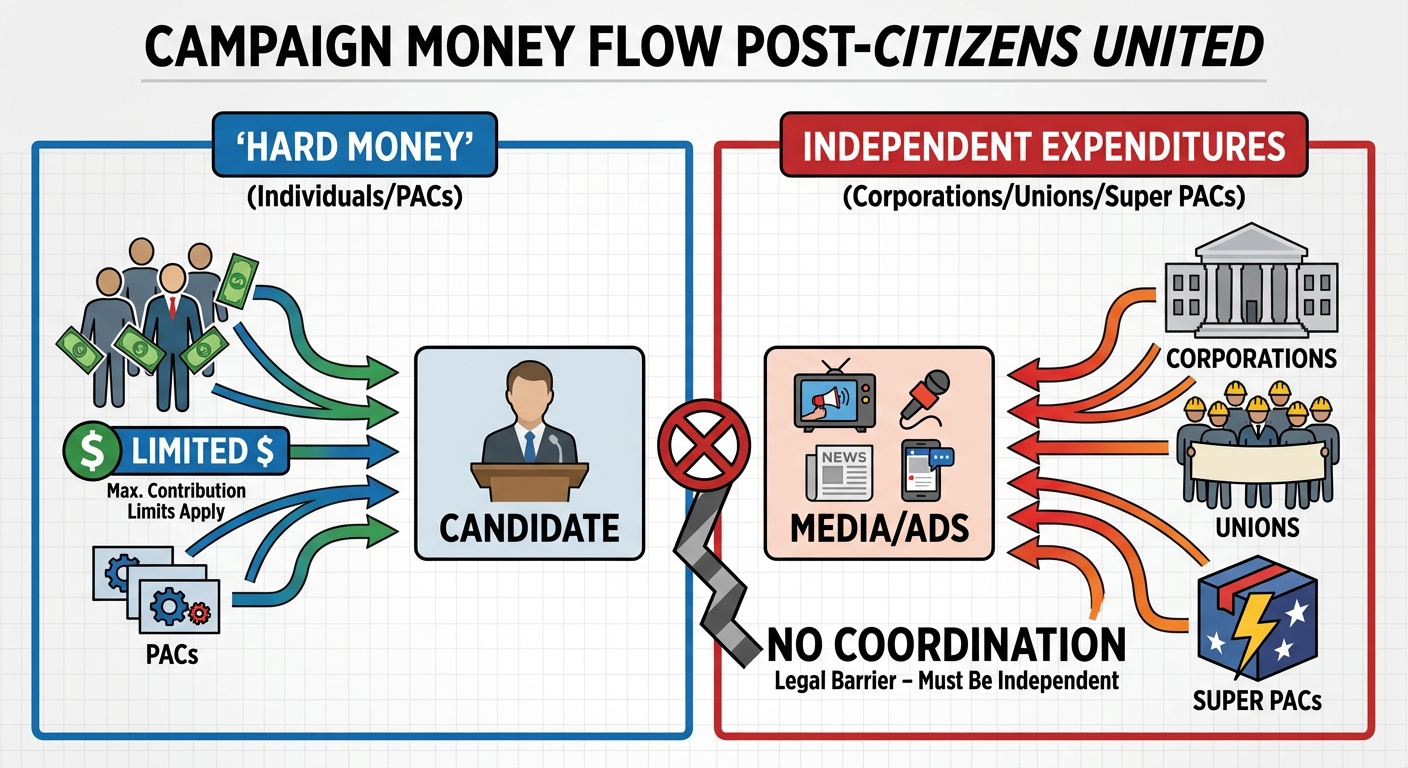
- Placed limits on direct contributions to candidates (Hard Money).
Bipartisan Campaign Reform Act (BCRA) of 2002
- Also known as the McCain-Feingold Act.
- Banned Soft Money (unlimited contributions to parties for general "party building" rather than specific candidates).
- Placed limits on "Stand By Your Ad" provisions (e.g., "I am Joe Biden and I approve this message") to reduce attack ads.
Citizens United v. FEC (2010) — REQUIRED SCOTUS CASE
- The Issue: Could the government limit independent political spending by corporations and unions?
- The Ruling: The Supreme Court ruled that political spending is a form of protected speech under the First Amendment.
- The Impact: Corporations and Labor Unions can spend unlimited amounts of money on ads and political tools, as long as they operate independently of the candidate's campaign. This ruling led to the creation of Super PACs.
Types of Political Action Committees (PACs)
| Feature | Traditional PAC | Super PAC (Independent Expenditure-Only Committee) |
|---|---|---|
| What is it? | Private group raised to distribute funds | Orgs resulting from Citizens United |
| Donation Limits | Limited (e.g., $5,000 per candidate) | Unlimited fundraising |
| Spending Rules | Can give directly to candidates | CANNOT give to candidates; must spend independently (ads) |
| Disclosure | Must disclose donors to FEC | Must disclose donors to FEC |
Common Mistakes & Pitfalls
- Confusing the Primary vs. General Election: Remember, primaries narrow the field within a party; the general election chooses the final officeholder. The electorate in primaries is usually more ideological (further left or right) than the moderate general electorate.
- "Soft Money" vs. "Dark Money": Soft money (banned by BCRA) was unregulated money to parties. Dark money refers to non-profit groups (501c4s) that do not have to disclose their donors.
- The Electoral College Vote: Students often think the popular vote decides the presidency. It does not. A candidate can win the popular vote but lose the election (e.g., 2000, 2016).
- Citizens United: Do not say "Corporations can donate to candidates." Citizens United allows corporations to spend money on independent ads, not write checks to candidate campaigns.