Mastering Performance: Collaboration, Synthesis, and Delivery
Big Idea 5: Team, Transform & Transmit
Welcome to the final stage of the AP Seminar inquiry cycle. If Big Ideas 1 through 4 were about gathering ingredients and cooking the meal (research and argumentation), Big Idea 5 is about plating the dish and serving it to the customer.
This unit focuses on EU 5.1, 5.2, and 5.3 from the College Board curriculum. It is not just about public speaking; it is about the strategic adaptation of written research into a compelling performance and the ability to work cohesively within a group.
1. The "Team" Aspect: Collaboration and Cohesion
Collaboration in AP Seminar is assessed specifically during Performance Task 1 (Team Project). It requires more than just dividing work; it requires synthesis.
The Difference Between Cooperation and Collaboration
- Cooperation: "I do slide 1, you do slide 2, and we glue them together." (This leads to disjointed presentations and low scores).
- Collaboration: "We analyze how my economic perspective conflicts with your ethical perspective to create a nuanced solution." (This leads to high scores).
Synthesizing Individual Research (The IRR to TMP Shift)
For the Team Multimedia Presentation (TMP), you must move from individual findings to a unified team argument.
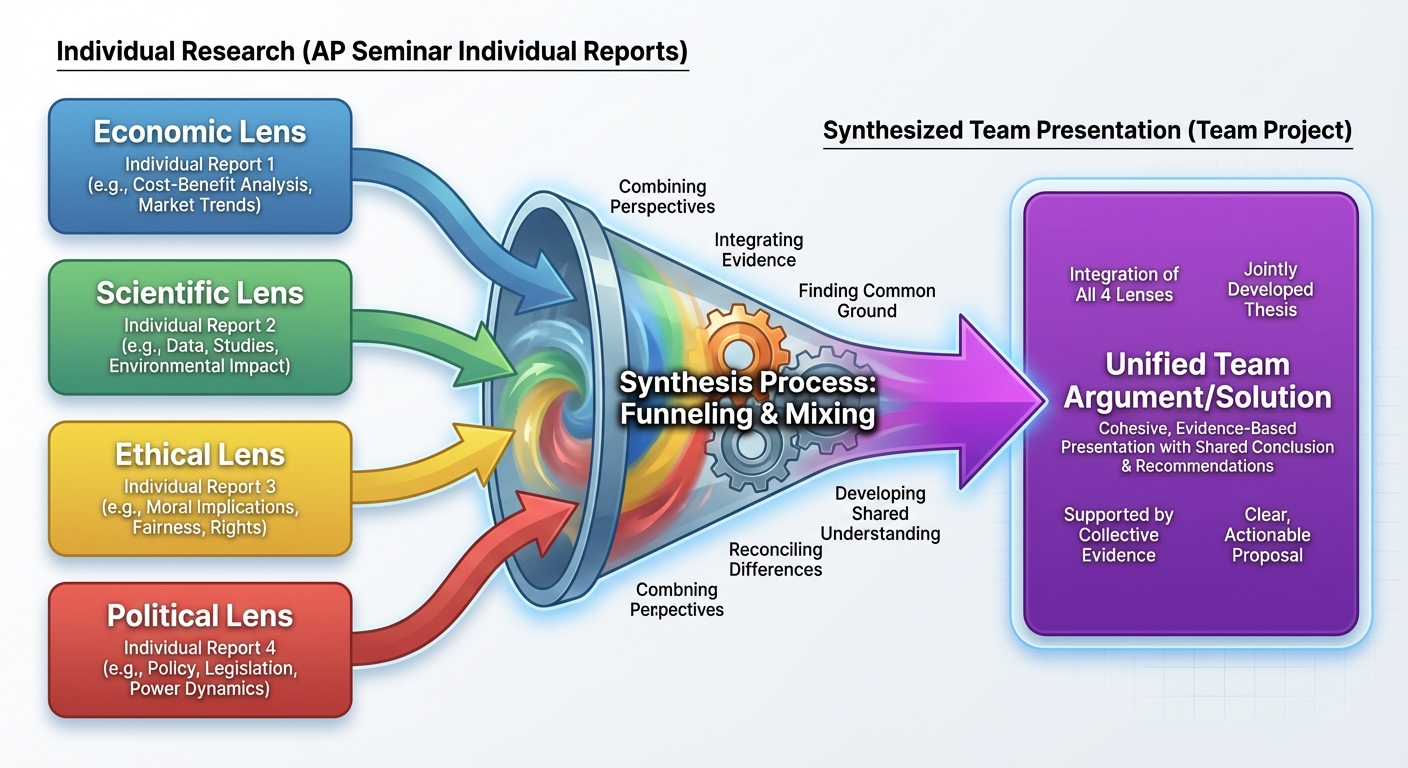
- Identify Connections: Look for points of intersection between your Individual Research Reports (IRRs). Does the Scientific perspective support the Economic one? Does the Ethical perspective challenge the Political one?
- Construct a New Thesis: Your team argument cannot just be a summary of 4 papers. It must be a new, holistic claim that considers all lenses investigated.
- Unified Voice: Even though different people speak, the presentation should sound like one cohesive narrative, not a series of disconnected book reports.
Team Norms and Conflict Resolution
High-performing teams establish protocols early:
- Roles: Who is the timer? The skeptic? The designer?
- Deadlines: Set internal deadlines 48 hours before the actual due date.
- Consensus Building: How will you decide on a solution if the team disagrees? (e.g., Majority vote vs. Unanimous consent).
Tip: In the Oral Defense, you may be asked how your team resolved a specific disagreement. Keep a log of these moments!
2. The "Transform" Aspect: Adapting Arguments
Transformation refers to changing the medium of your argument. You are transforming a dense, academic written paper (IRR or IWA) into an engaging auditory and visual experience.
Audience Analysis
According to the AP rubric, you must adapt your message for a specific context. Ask yourself:
- Knowledge Level: Does the audience know the technical jargon? (If not, simplify or define).
- Attention Span: They cannot re-read a sentence like they can in an essay. You must use signposting (verbal cues like "First," "However," "Consequently") to guide them.
- Engagement: How will you hook them immediately? (An anecdote, a shocking statistic, a rhetorical question).
Visual Design Principles
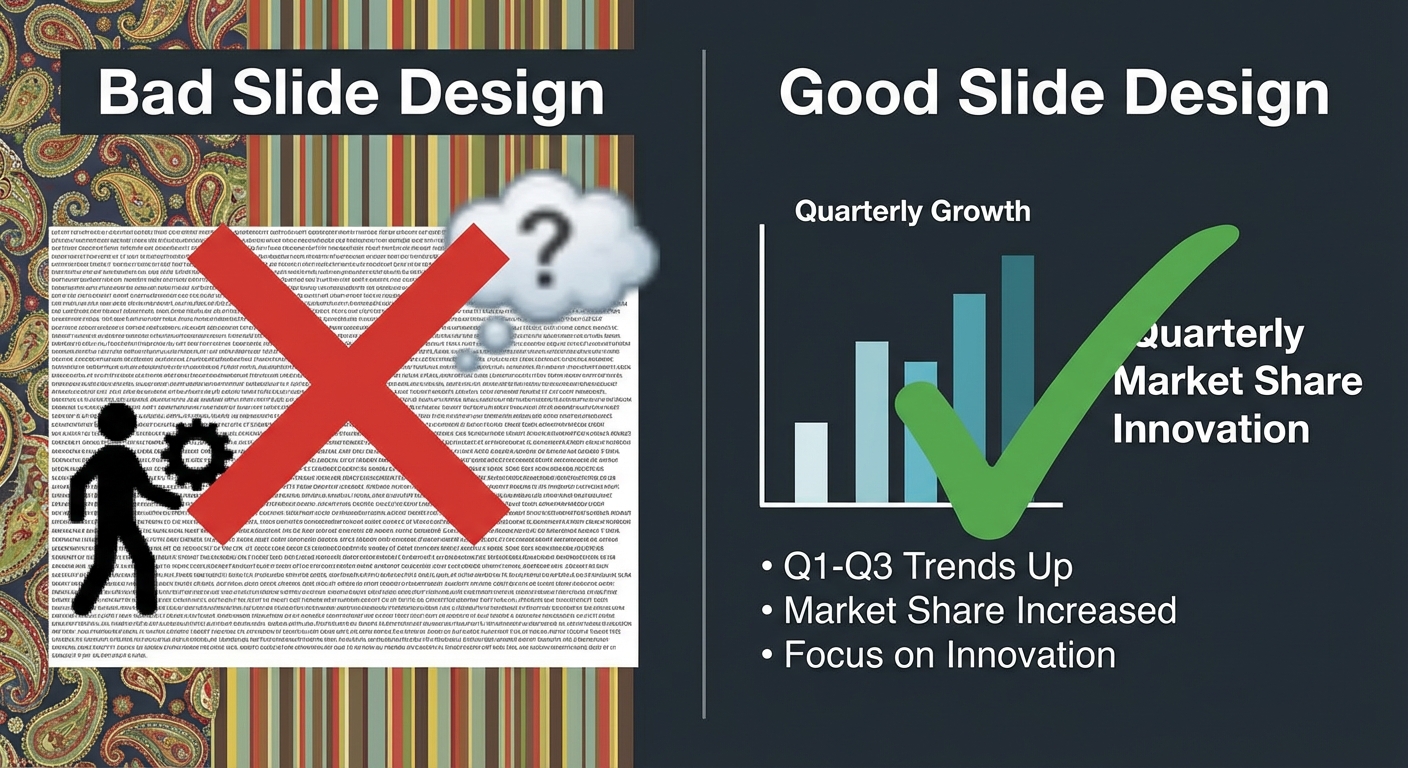
Your slides (multimedia) are part of your argument, not just wallpaper. Avoid "Death by PowerPoint."
| Do NOT | DO |
|---|---|
| Write full paragraphs on the slide. | Use bullet points (max 5-6 words each). |
| Read from the slide. | Use the slide to visualize data (graphs, charts). |
| Use low-resolution, decorative clipart. | Use high-quality images that serve as evidence. |
| Use distracting animations/transitions. | Use clean, consistent fonts and colors. |
Converting Text to Speech
- Written Argument: Passive voice, complex sentence structures, dense data.
- Oral Argument: Active voice, shorter sentences, repetition for emphasis.
Example:
- Written: "The exacerbation of climatic shifts has precipitated a decline in agrarian output."
- Oral: "Climate change is hurting our farms. As temperatures rise, crop yields fall."
3. The "Transmit" Aspect: Delivery and Defense
This section covers the actual performance (Presentation) and the Q&A (Oral Defense).
Non-Verbal Communication
Your credibility (Ethos) is affected by how you present. Use the PVLEGS mnemonic:
- P - Poise: Stand detailed, feet shoulder-width apart. Don't sway.
- V - Voice: Project to the back of the room. Vary your pitch (don't be monotone).
- L - Life: Show passion and interest in your topic. If you are bored, the audience is bored.
- E - Eye Contact: Scan the room. Do not stare at the teacher or the screen. Look at your audience.
- G - Gestures: Use natural hand movements to emphasize points. Avoid hands in pockets.
- S - Speed: Slow down. Nervous speakers tend to rush. Use pauses for effect.
The Oral Defense (OD)
This is where many students lose points. After the presentation, the teacher asks questions. This is not a quiz on your memory; it is a test of your reflection and process.
Types of OD Questions:
- Process/Collaboration: "How did the group decide to include Student A's perspective over Student B's?"
- Research/Evidence: "Which source was most influential in shaping your conclusion?"
- Implications/Future: "If you had more time, what additional perspective would you research?"
The Formula for a Perfect Answer:
- Acknowledge: Restate the question or pivot specifically to it.
- Identify: Name the specific source, team member, or limitation.
- Explain: Give the "Why" or "How."
- Connect: Relate it back to the overall argument or conclusion.
Critical Rule: In the Team Oral Defense, any team member can answer any question, but it is best if the most relevant person starts and others add on briefly to show unity.
4. Reflection: The Cycle of Inquiry
Learning Objective 5.3 emphasizes reflecting on one's own learning. This is not just "feeling good" about the project; it is metacognitive analysis.
Key Reflection Questions for Exam Prep
- Limitation Analysis: What did your research fail to cover? Admitting a limitation actually strengthens your argument by showing honesty.
- Perspective Shift: Did you change your mind during the research? Why? (e.g., "I used to think X, but after reading Expert Y, I realized Z").
5. Common Common Mistakes & Pitfalls
| Mistake | Why it hurts your score | Correction |
|---|---|---|
| The "Frankenstein" Presentation | It's obvious when a group just pasted 4 separate slide decks together. There is no flow or improved argument. | Create a "Master Deck" with unified formatting. Write a transition script that links Speaker A to Speaker B. |
| The Wall of Text | The audience reads the slide instead of listening to you. | Adhere to the 5x5 rule: No more than 5 bullets, no more than 5 words per bullet. Use images as evidence. |
| Script Reading | Reading directly from note cards destroys eye contact and engagement. | Use cue cards with keywords only (no full sentences). Memorize your opening and closing statements. |
| "I think" Statements | Phrases like "I feel like…" or "In my opinion…" weaken academic credibility. | Use evidence-based language: "The data suggests…" or "Analysis of [Source] indicates…" |
| Vague Oral Defense Answers | Answering "We worked well together" is too generic. | Be specific: "When we disagreed on the budget solution, we used Miller's cost-benefit analysis to decide…" |
Summary Checklist for Big Idea 5
- [ ] Collaboration: Have we synthesized our lenses into one solution?
- [ ] Audience: Is the language appropriate? Have we defined terms?
- [ ] Visuals: Are the slides clean, high-contrast, and evidence-based?
- [ ] Attribution: Do we verbally cite sources? (e.g., "As Dr. Smith notes in her 2020 study…")
- [ ] Defense: Are we prepared to answer specific questions about our research sources and group dynamics?
By mastering Team, Transform, and Transmit, you move from being a student who knows things to a scholar who can influence others.