AP Seminar Big Idea 2: Critical Inquiry Frameworks
Introduction to Understand and Analyze
In AP Seminar, Big Idea 2: Understand and Analyze is the engine that drives your research. While Big Idea 1 involves asking questions, Big Idea 2 is about processing the answers. It requires you to dismantle arguments like a mechanic dismantling an engine—identifying the parts, seeing how they connect, and judging whether the machine works efficiently.
The essential goal is to move beyond passive reading (knowing what a text says) to critical analysis (understanding how and why the author constructs their argument). This skill set is tested heavily in Enduring Issues Assessment Part A and is foundational for the Individual Research Report (IRR).
Foundations of Critical Reading
Before you can evaluate an argument, you must comprehend the source material. This goes beyond summarizing; it involves identifying the structural skeleton of the text.
The Argument Structure Hierarchy
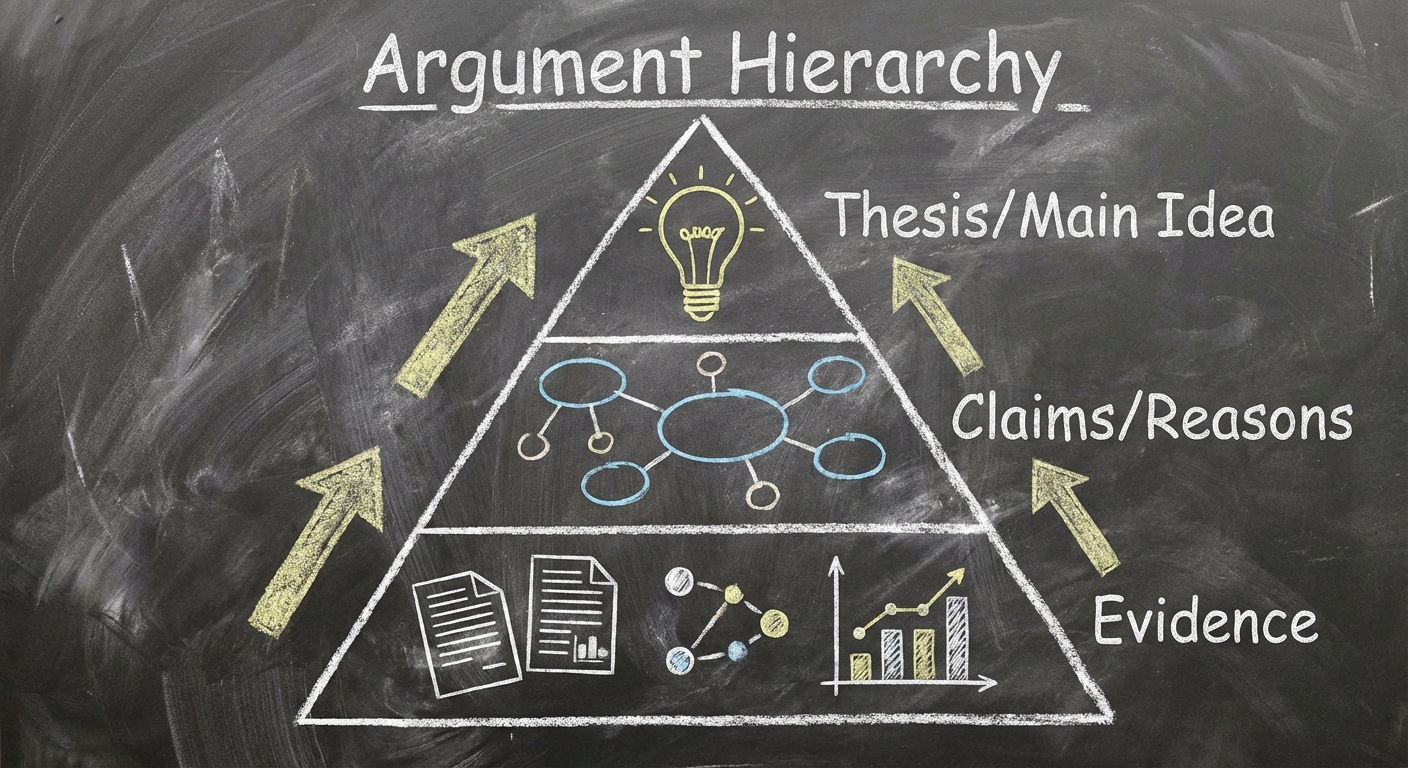
Understanding a text requires identifying three distinct levels of rhetoric:
- Thesis / Main Idea: The central, overarching assertion the author is trying to prove.
- Claims: The supporting points or "pillars" that hold up the thesis.
- Evidence: The data, quotes, facts, or statistics that support the claims.
Reading Strategies for Analysis
- Annotating for Function: Do not just highlight interesting facts. Highlight the function of sentences. Is this sentence a claim? Is it a concession? Is it a rebuttal?
- Contextualization: You must place the text in its proper context. Ask yourself:
- When was this written? (Historical context)
- Who wrote it? (Authorial context)
- Where was it published? (Publication context)
Anatomy of an Argument: Line of Reasoning
One of the most frequent terms you will see in AP Seminar instructions is Line of Reasoning (LOR). Many students confuse this with "evidence," but they are different.
Definition: The Line of Reasoning is the logical arrangement of claims and evidence that leads to a conclusion. It is the "path" the author takes you on.
Identifying the LOR
To find the LOR, look at the transitions and connections between paragraphs. Ask: Does the author build the argument sequentially? Do they present a counter-argument and then smash it? Do they list causes to predict an effect?
| Transition Type | Signal Words | Function in LOR |
|---|---|---|
| Contrast | However, On the other hand, Conversely | Shifts perspective or introduces a counter-claim |
| Addition | Furthermore, Moreover, Additionally | Reinforces a previous claim with more depth |
| Causation | Consequently, Therefore, As a result | specific evidence is linking to a conclusion |
| Conclusion | Ultimately, Thus, In sum | Summarizes the path taken |
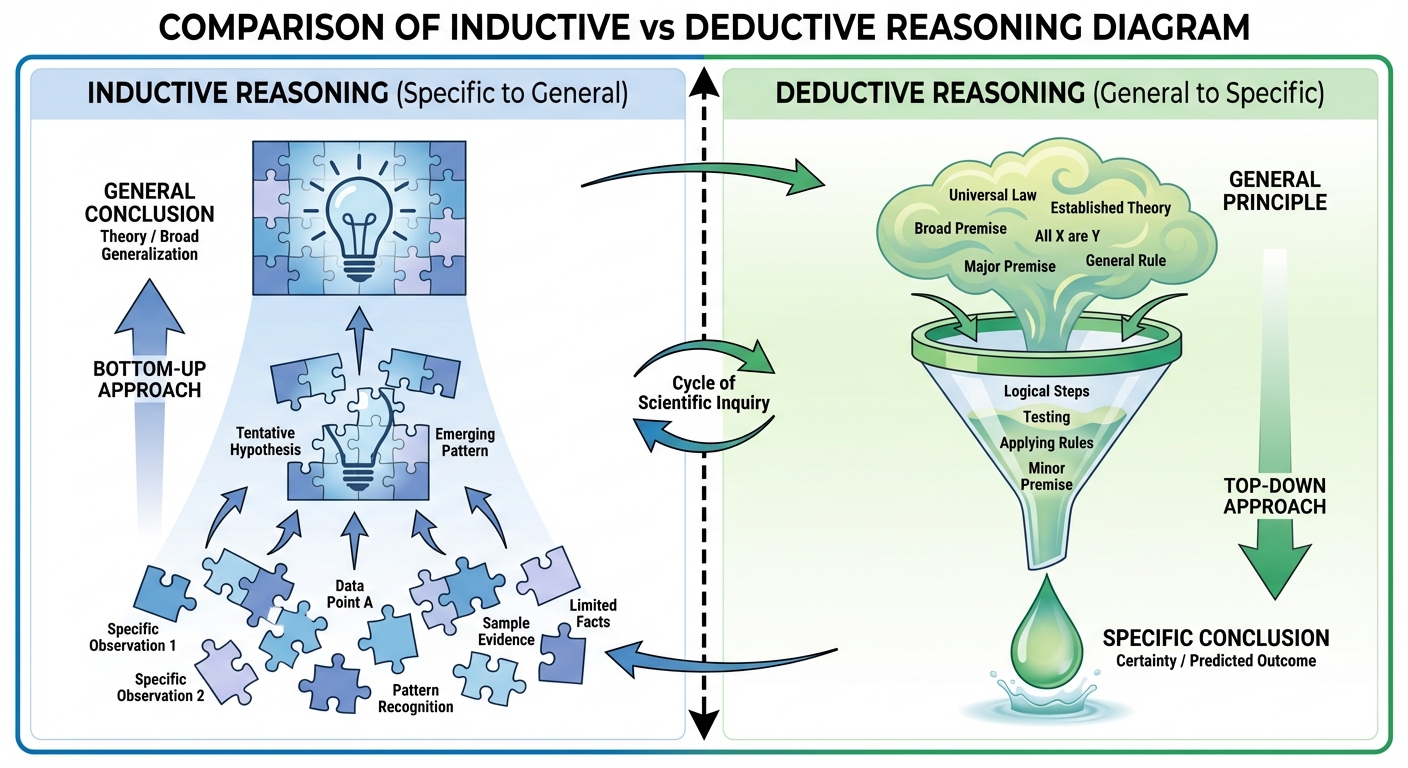
Inductive vs. Deductive Reasoning
- Inductive Reasoning: Moving from specific observations to a general conclusion. (E.g., "Every swan I've seen is white; therefore, all swans are white.") Risk: Generalizations may be hasty.
- Deductive Reasoning: Moving from general truths to a specific conclusion. (E.g., "All men are mortal. Socrates is a man. Therefore, Socrates is mortal.") Risk: If the premise is wrong, the conclusion is wrong.
Evaluating Perspectives and Lenses
In AP Seminar, you must distinguish between a Lens and a Perspective. Confusing these is a major pitfall in the Individual Research Report (IRR).
The Definitions
- Lens: A filter or category through which a topic is viewed. It is broad.
- Examples: A Scientific Lens, an Ethical Lens, an Economic Lens.
- Perspective: A specific viewpoint or stance regarding the topic, often differing between stakeholders.
- Example: Within the "Economic Lens" regarding minimum wage, a Business Owner's Perspective might be that it hurts profits, while a Worker's Perspective is that it is necessary for survival.
Key Concept: A single source usually contains one perspective, but a research paper must synthesize multiple perspectives.
Assessing Credibility and Reliability
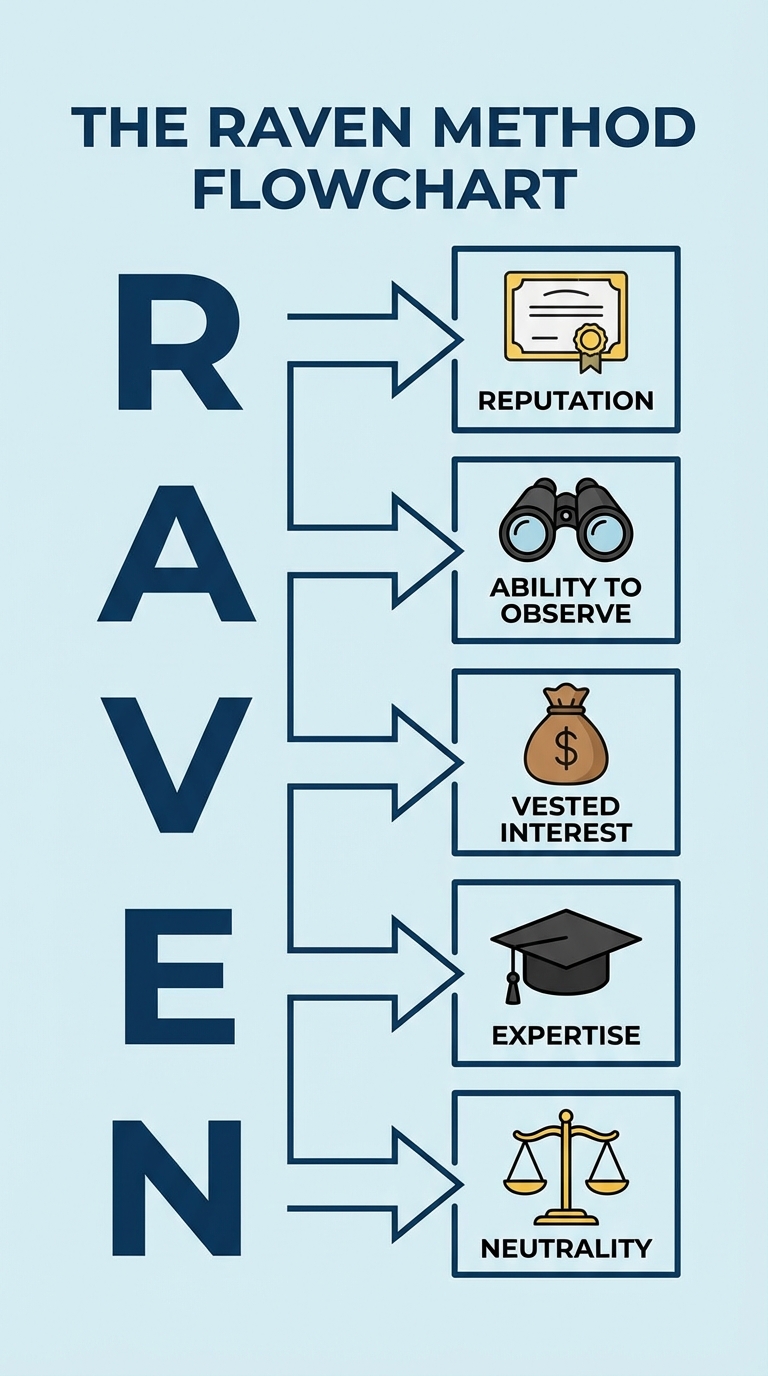
Not all information is created equal. You must test sources for validity. The most common framework used in AP Seminar is RAVEN.
The RAVEN Analysis Strategy
When evaluating a source (especially for your annotated bibliography or limitation section), check:
- R - Reputation: What is the standing of the author or publication? (e.g., The New York Times vs. a personal blog).
- A - Ability to Observe: Was the author actually there? Do they have access to the primary data?
- V - Vested Interest: Does the author gain something (money, status) from you believing them? This indicates potential bias.
- E - Expertise: Does the author have relevant degrees or experience in this specific field?
- N - Neutrality: Is the tone objective, or is it emotionally charged?
Bias vs. Limitation
Students often use these interchangeably, but they are different in AP Seminar grading criteria.
- Bias: A personal prejudice or inclination that prevents objective judgment. (e.g., An article written by a Tobacco CEO arguing that smoking is safe).
- Limitation: A structural weakness in the study or argument that is not necessarily intentional. (e.g., A medical study that only surveyed 10 people is limited by sample size, not necessarily biased).
Logical Fallacies (Flaws in Reasoning)
To critique an argument effectively (Big Idea 2), you must spot where the logic breaks down. These are called fallacies.
- Hasty Generalization: Drawing a broad conclusion from a tiny amount of evidence.
- Example: "It snowed in May today, so global warming doesn't exist."
- Ad Hominem: Attacking the person rather than their argument.
- Example: "You can't trust Dr. Smith's data on diet because he is overweight."
- Straw Man: Misrepresenting an opponent's argument to make it easier to attack.
- Example: "My opponent wants to ban cars!" (When the opponent actually just proposed stricter emissions standards).
- Post Hoc / False Causality: Assuming that because B happened after A, A caused B.
- Example: "I wore red socks and we won the game; my socks caused the win."
- False Dilemma (Either/Or): Presenting only two extreme options when a middle ground exists.
- Example: "We either ban all plastic starting tomorrow, or the ocean dies."
Common Mistakes to Avoid in Big Idea 2
1. Summary is NOT Analysis
- Mistake: Writing, "The author says that pollution is bad and lists three reasons."
- Correction: "The author constructs a moral argument against pollution by utilizing emotional anecdotes to appeal to the reader's sense of duty."
- Tip: Use verbs like constructs, juxtaposes, implies, qualifies, and corroborates rather than just "says."
2. Confusing "Fact" with "Evidence"
- Mistake: Assuming a fact makes an argument strong.
- Correction: Facts are neutral. Evidence is how a fact is used to support a claim. You must analyze if the evidence actually links to the claim (Relevance) and if there is enough of it (Sufficiency).
3. Ignoring the Counter-Argument
- Mistake: Thinking a strong argument ignores the other side.
- Correction: The strongest arguments acknowledge opposing views and refute them. If a text ignores the opposition completely, that is a weakness you should point out in your analysis.
4. Vague Claims of "Bias"
- Mistake: "The author has a bias."
- Correction: Almost everyone has bias. You must explain how that bias impacts the credibility of the argument. Does it render the data useless, or is it just a perspective? Use the RAVEN test to be specific.