Unit 5: Heredity - Complex Patterns of Inheritance
Variations on Mendel's Laws
While Gregor Mendel laid the foundation for modern genetics, nature often operates outside the binary rules of "dominant" and "recessive." In AP Biology, understanding Non-Mendelian Genetics requires looking at how alleles interact, where genes are located, and how the environment influences expression. These concepts explain the complexity of traits like human blood type, skin color, and genetic disorders.
Degrees of Dominance
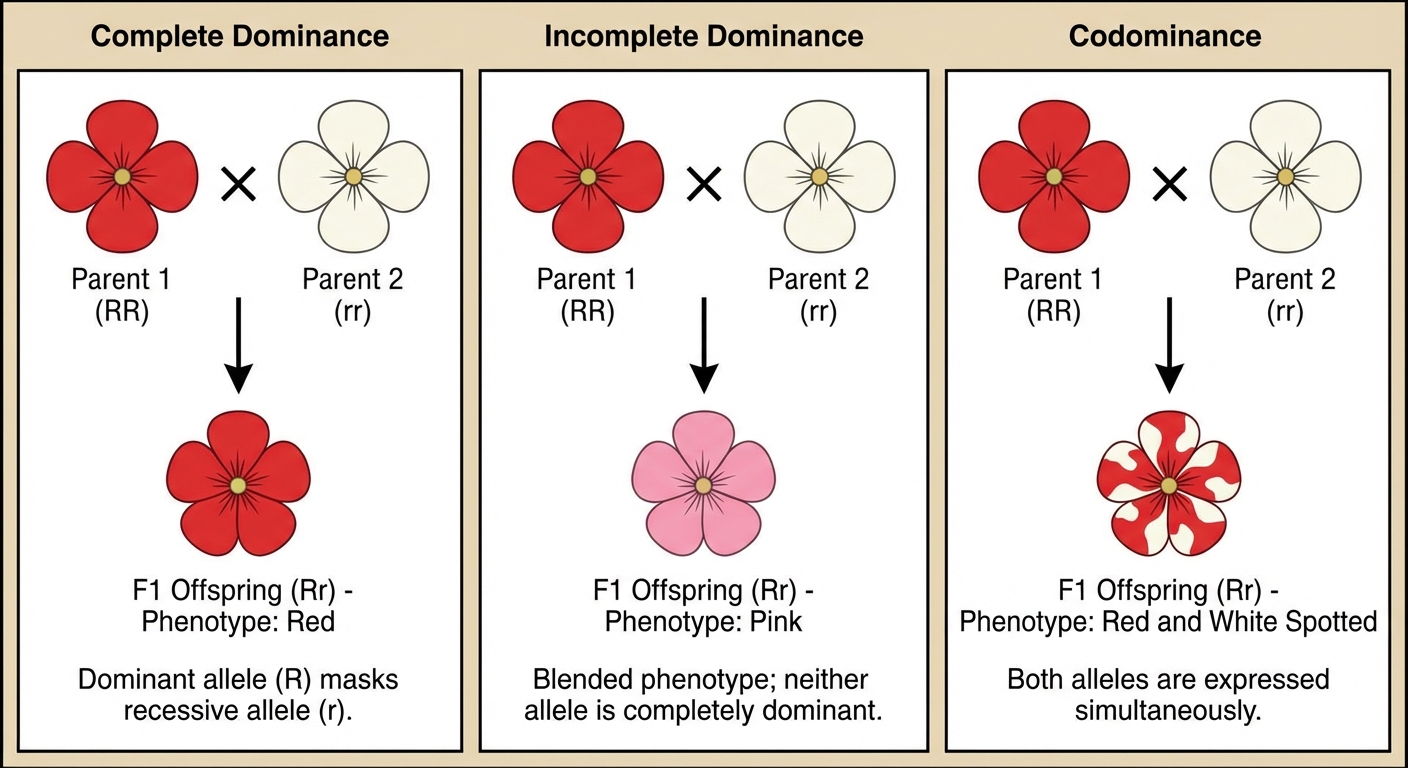
Mendel studied traits where one allele completely masked another (Complete Dominance). However, many genes show more complex relationships.
Incomplete Dominance
In incomplete dominance, neither allele is completely dominant. The heterozygote phenotype is an intermediate, or "blend," of the two homozygous phenotypes.
- Notation: Often uses exponents or primes (e.g., $C^R C^W$) rather than capital/lowercase letters to avoid measuring dominance.
- Example: In Snapdragons, crossing a red flower ($C^R C^R$) with a white flower ($C^W C^W$) produces pink offspring ($C^R C^W$).
Codominance
In codominance, both alleles are fully expressed simultaneously in the heterozygote. There is no blending; distinct patches of both phenotypes appear.
- Mnemonic: Co-dominance is like Co-captains. Both captains are on the field giving orders at the same time.
- Example: Roan cows have coats with both distinct red hairs and white hairs, not pink hairs.
Multiple Alleles and Polygenic Inheritance
Students often confuse these two concepts. The key difference is the number of genes involved.
| Feature | Multiple Alleles | Polygenic Inheritance |
|---|---|---|
| Definition | A single gene has more than two possible alleles in the population. | A single phenotype is determined by the additive effects of two or more genes. |
| Individual Limit | An individual still only inherits two alleles (one from each parent). | An individual inherits multiple alleles across multiple loci. |
| Phenotype Distribution | Distinct categories. | A continuous bell-curve continuum. |
| Example | ABO Blood Groups: Determined by alleles $I^A$, $I^B$, and $i$. | Human Height or Skin Color: Controlled by many genes interacting to determine the final trait. |
Note on Blood Types: The ABO system demonstrates both multiple alleles and codominance. $I^A$ and $I^B$ are codominant to each other, but both are completely dominant over $i$ (type O).
Chromosomal Inheritance
The Chromosomal Theory of Inheritance states that genes have specific loci (positions) on chromosomes, and it is the chromosomes that undergo segregation and independent assortment.
Sex-Linked Traits
Genes located on sex chromosomes (X or Y) exhibit unique inheritance patterns. In humans, most sex-linked importance focuses on the X-chromosome because it is larger and carries more genes.
- X-Linked Recessive Traits: These are more common in biological males ($XY$) than females ($XX$).
- Males differ because they are hemizygous—they only have one X chromosome. If they inherit a recessive allele, they express the trait because there is no second X to mask it.
- Females must inherit two copies of the allele to express the trait.
- Examples: Red-green color blindness, Hemophilia, Duchenne Muscular Dystrophy.
Linked Genes & Recombination
Mendel’s Law of Independent Assortment only applies to genes on different chromosomes (or those very far apart on the same chromosome). Genes located close together on the same chromosome are linked genes; they tend to be inherited together as a unit.
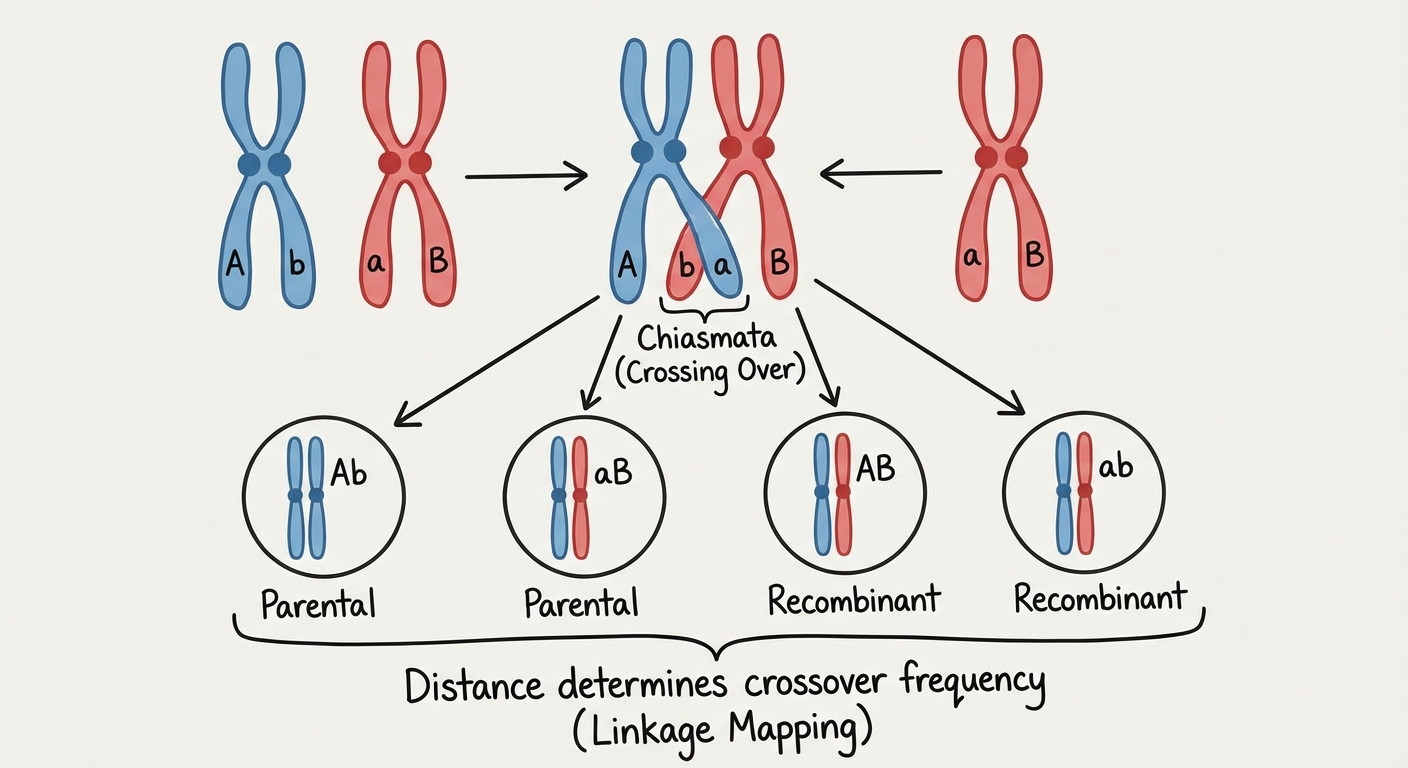
However, linkage is not absolute. During Prophase I of Meiosis, crossing over can separate linked alleles.
Recombination Frequency
Geneticists use the frequency of crossing over to map the distance between genes.
- Parental Types: Offspring with phenotypes matching one of the original P-generation parents (indicating no crossover occurred).
- Recombinant Types: Offspring with new combinations of phenotypes distinct from the parents.
To calculate the recombination frequency:
Mapping Rules
- Map Units: 1% Recombination Frequency = 1 Map Unit (or centimorgan, cM).
- Distance & Likelihood: The farther apart two genes are, the higher the probability of a crossover event occurring between them.
- The 50% Limit: If two genes have a recombination frequency of 50%, they are effectively unlinked (either on different chromosomes or very far apart on the same one). They assort independently.
Non-Nuclear Inheritance
Not all DNA is in the nucleus. Mitochondria and chloroplasts contain their own circular DNA.
- Maternal Inheritance: In animals, mitochondria are transmitted by the egg, not the sperm. Therefore, mitochondrial traits are passed from the mother to all her offspring (both male and female).
- This pattern violates Mendelian ratios entirely. If a female has a mitochondrial disorder, all her children inherit it. Interactions with fathers do not impact the transmission.
Environmental Effects on Phenotype
Genotype is not the sole determinant of phenotype. The environment interacts with gene expression, a concept known as phenotypic plasticity.
Examples of Plasticity
- Hydrangeas: The color of the flower depends on the pH of the soil. Acidic soil produces blue flowers; basic soil produces pink flowers. The genotype is the same; the environment alters the phenotype.
- Himalayan Rabbits/Siamese Cats: These animals carry a gene for dark fur pigment that is active only at low temperatures. Consequently, only their extremities (ears, nose, paws) which are cooler than the body core, develop dark fur.
- Stomata Density: Plants can adjust the density of stomata (pores) on their leaves based on atmospheric $CO_2$ levels.
Chromosomal Abnormalities
Errors during meiosis can lead to large-scale chromosomal changes.
Nondisjunction
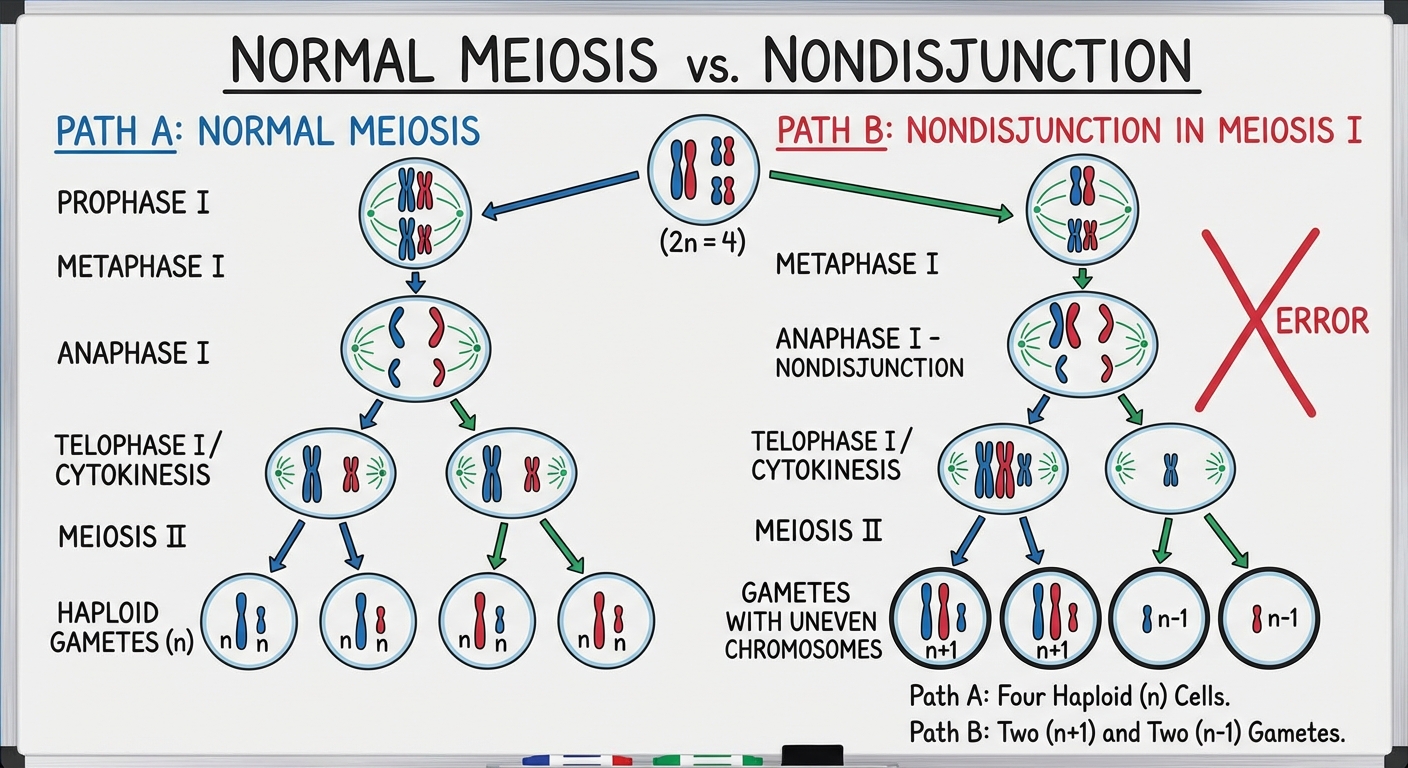
Nondisjunction occurs when homologous chromosomes (Meiosis I) or sister chromatids (Meiosis II) fail to separate properly.
- Result: Gametes with too many ($n+1$) or too few ($n-1$) chromosomes.
- Aneuploidy: Following fertilization, the zygote has an abnormal number of chromosomes.
- Trisomy 21 (Down Syndrome): Three copies of chromosome 21.
- Turner Syndrome (XO): A female missing an X chromosome.
Common Mistakes & Pitfalls
Confusing Multiple Alleles vs. Polygenic:
- Mistake: Thinking blood type is polygenic because there are three types (A, B, O).
- Correction: Blood type is one gene with multiple alleles. Polygenic traits (like height) involve many genes working together.
Sex-Linked vs. Sex-Limited:
- Mistake: Assuming if a trait only shows up in males, it is Y-linked.
- Correction: Y-linked traits are rare. Most sex-specific patterns in AP questions are X-linked recessive. Check if the mother passed it to the son (X-linked).
Misinterpreting Recombination Frequency:
- Mistake: Thinking a recombination frequency of 60% means genes are 60 map units apart.
- Correction: Recombination frequency maxes out at 50%. If you calculate higher than that, the genes are assorting independently, and you cannot map the distance using this method.