Mastering Argument Analysis: Validity, Fallacies, and Nuance
The Anatomy of Reasoning: Evaluating Evidence
In AP English Language Unit 7, the focus shifts from simply identifying rhetorical choices to critically evaluating the validity and strength of an argument. To determine if an argument is successful, you must analyze the connection between the claim and the evidence.
The Line of Reasoning
The line of reasoning refers to the logical sequence of claims and evidence that leads to a conclusion. A successful argument acts like a chain; if one link (premise) is weak or unconnected, the entire argument (conclusion) fails.
When evaluating an author's reasoning (or checking your own), apply the RAS test:
- Relevance: Does the evidence directly support the specific claim being made? Irrelevant evidence constitutes a non sequitur (it does not follow).
- Accuracy: Is the evidence verifiable and factually correct? Inaccurate data invalidates the warrant (assumption) connecting the evidence to the claim.
- Sufficiency: Is there enough evidence to support the magnitude of the claim? A sweeping generalization backed by a single anecdote is insufficient.
Toulmin Model Elements
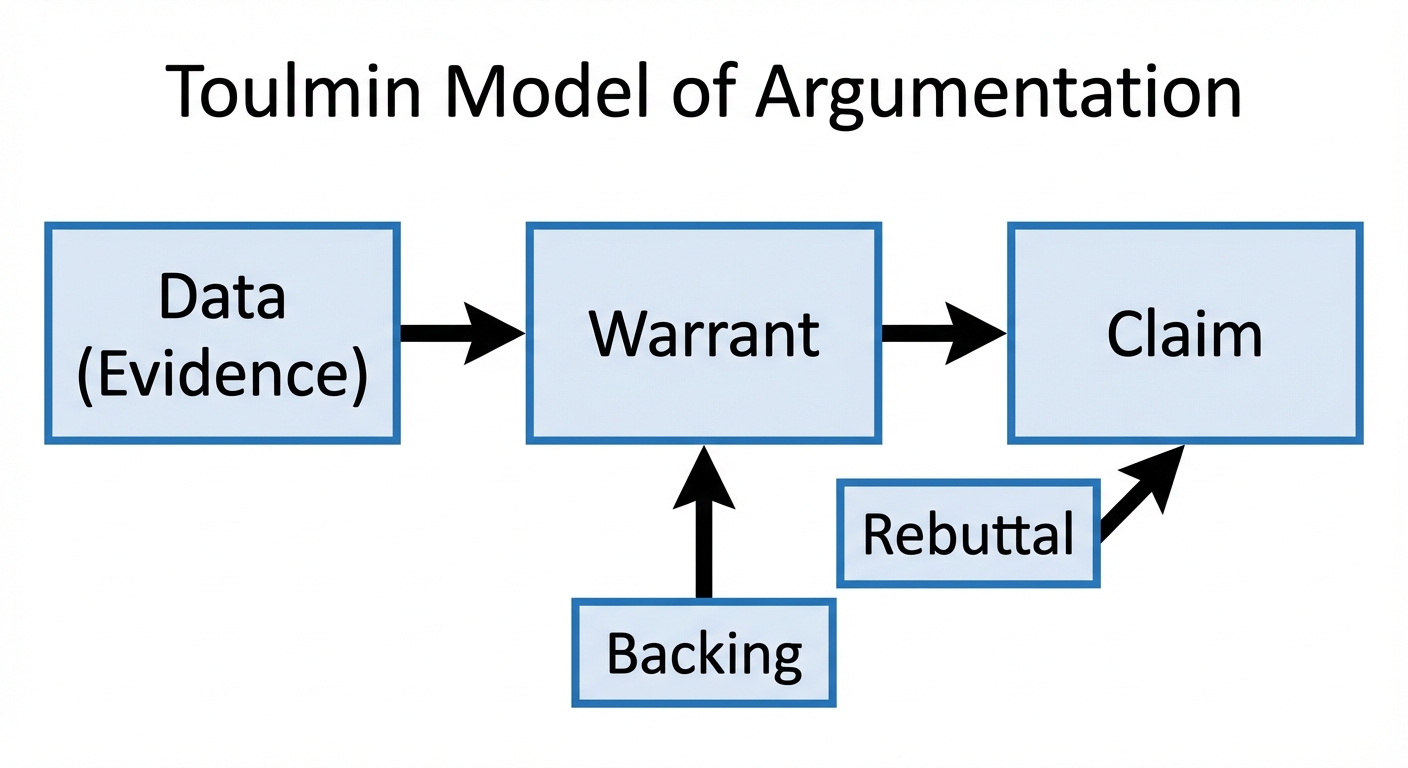
Understanding the components of a logical argument helps in dissection. Stephen Toulmin's model identifies key parts:
- Claim: The main argument.
- Data (Evidence): Facts or reasons to support the claim.
- Warrant: The underlying assumption that connects the data to the claim.
- Backing: Support for the warrant.
Navigating Logical Fallacies
Arguments become unsuccessful when they rely on logical fallacies. A logical fallacy is a potential vulnerability or weakness in an argument. On the AP Exam, you do not necessarily need to memorize the Latin names, but you must be able to explain why the reasoning is flawed.
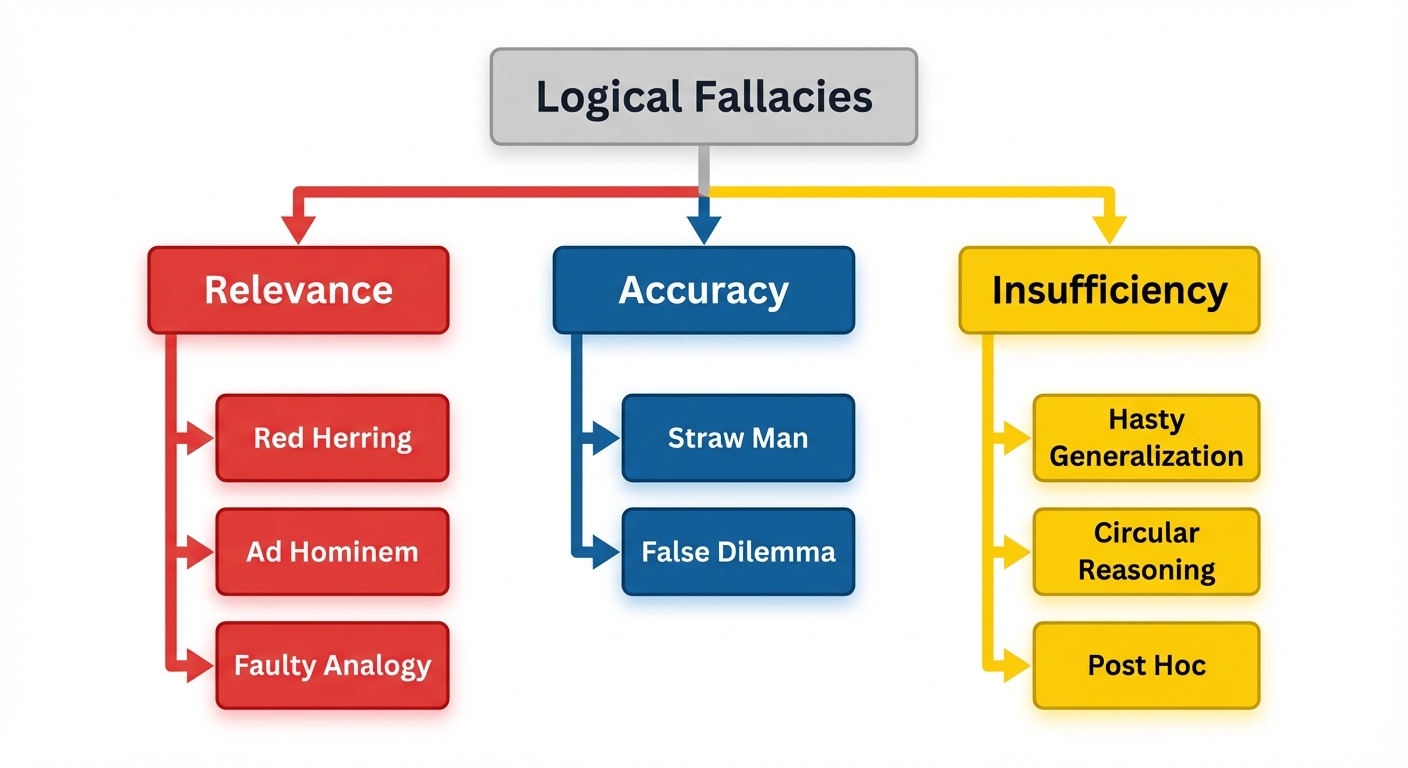
Fallacies are generally categorized into three groups: Fallacies of Relevance, Accuracy, and Insufficiency.
1. Fallacies of Relevance
These occur when the evidence constitutes a "red herring"—it distracts from the actual issue.
| Fallacy | Definition | Example |
|---|---|---|
| Ad Hominem | Attacking the character of the speaker rather than their argument. | "We shouldn't listen to his economic plan; he cheated on his wife." |
| Red Herring | Introducing an irrelevant topic to divert attention. | "I know I forgot to do the dishes, but look at how well I did on my math test!" |
| Faulty Analogy | Comparing two things that are not comparable in relevant aspects. | "Banning soda is like banning cars; both can be dangerous." |
2. Fallacies of Accuracy
These occur when the evidence is inevitably false or intentionally misleading.
- Straw Man: Intentionally misrepresenting an opponent's argument to make it easier to knock down.
- Example: "My opponent wants to cut military spending. Clearly, he wants to leave the country defenseless against enemies."
- False Dilemma (Either/Or): Presenting two extreme options as the only possibilities.
- Example: "We either ban all guns or we let crime overrun our streets."
3. Fallacies of Insufficiency
These occur when the evidence is insufficient to prove the conclusion.
- Hasty Generalization: Drawing a broad conclusion from a small sample size.
- Example: "My Toyota broke down yesterday; therefore, all Toyotas are unreliable trash."
- Circular Reasoning: Repeating the claim as a way to provide evidence.
- Example: "The law should be obeyed because it is illegal to break the law."
- Post Hoc Ergo Propter Hoc: Confusing correlation with causation.
- Formal Logic: $A \text{ happened before } B \implies A \text{ caused } B$ (This is false logic).
- Example: "I wore my lucky socks and we won the game; the socks caused the win."
Constructing Effective Arguments
To move from a "passable" argument to a sophisticated, "successful" argument (scoring high on the FRQ Row B), you must embrace complexity.
Nuance and Qualification
Absolute statements are the enemy of credibility. The world is rarely black and white. Complex arguments typically use qualifiers—words that limit the scope of a claim to make it defensive and accurate.
- Avoid: All, always, never, every, undeniably.
- Use: Many, often, rarely, some, primarily, likely.
Example Transformation:
Weak/Absolute: "Technology destroys human interaction."
Strong/Qualified: "While technology facilitates global communication, excessive reliance on it can diminish the depth of face-to-face interactions among adolescents."
Counter-Argumentation: Concession and Refutation
Ignoring the opposing side makes an argument seem immature or biased. Addressing the counter-argument strengthens your position.
- Concession: Acknowledge that a specific part of the opposing argument is true or reasonable. This builds ethos (credibility).
- Refutation (Rebuttal): Explain why, despite the valid point conceded, your argument is still stronger or more important.
Common Structure:
"Admittedly, [Counter-Argument] is true because [Evidence]. However, [My Argument] carries more weight because [Stronger Evidence/Reasoning]."
Common Mistakes & Pitfalls
- Confusing Causation with Correlation: Just because two data points trend together (e.g., ice cream sales and shark attacks) does not mean one causes the other (both are caused by summer heat).
- ** attacking the Person (Ad Hominem):** On the exam, never criticize the author of a text personally. Criticize their strategies or logic, not their character.
- The "Slippery Slope" Trap: Avoid arguing that a minor action will inevitably lead to a catastrophic chain of events without providing the logical links in between.
- Assuming the Audience Agrees: Do not assume "everyone knows" something. Provide the warrant. If your audience doesn't accept your underlying assumption, they won't accept your claim.