APES Unit 2: Species Survival, Tolerance, and Evolution
Ecological Tolerance
Defining Range of Tolerance
Ecological Tolerance (also known as the Law of Tolerance) refers to the range of conditions, such as temperature, salinity, flow rate, and sunlight, that an organism acts within. Every species has a distinct range of abiotic conditions under which it can survive, grow, and reproduce.
Specific abiotic factors that dictate tolerance usually include:
- Terrestrial: Temperature, precipitation, soil grouping, wind.
- Aquatic: Salinity, temperature, flow rate, dissolved oxygen (DO), pH.
The Tolerance Curve
The relationship between an abiotic factor and the population size of a species is typically represented by a bell curve. This curve is divided into three distinct zones:
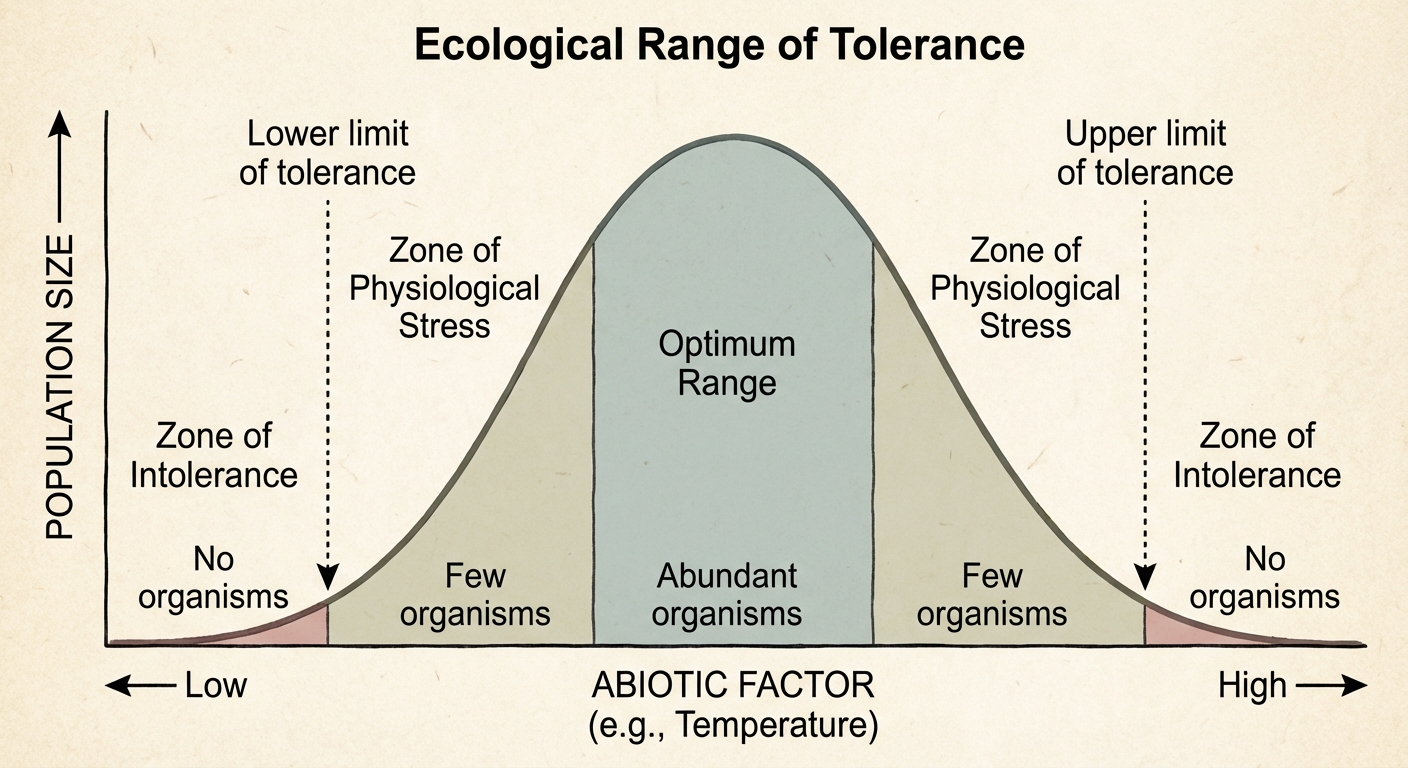
Optimum Range
- The center of the curve (the peak).
- Conditions are ideal for the species.
- Result: Organisms survive, grow, and reproduce at their maximum rate. Biodiversity for the species is highest here.
Zone of Physiological Stress
- Located on the slopes on either side of the optimum range.
- Conditions are present, but not ideal (e.g., slightly too hot or too acidic).
- Result: Organisms may survive, but they experience stress. Growth is stunted, reproduction rates drop significantly, and the immune system may be compromised, making them vulnerable to disease.
Zone of Intolerance
- The "tails" of the graph.
- Conditions are too extreme (too high or too low).
- Result: The organisms cannot survive. Thermal shock, suffocation (lack of oxygen), or desiccation occurs here.
Generalists vs. Specialists
The width of the tolerance curve determines if a species is a generalist or a specialist.
- Generalists (e.g., Raccoons, Rats): Have a broad range of tolerance. They can survive in varying temperatures and eat a variety of foods.
- Specialists (e.g., Giant Pandas, Koalas): Have a narrow range of tolerance. They require very specific climate conditions or food sources.
Exam Tip: Changes in abiotic factors (like Climate Change) hurt specialists first. If the environment shifts outside their narrow optimum range, they enter the zone of intolerance quickly.
Adaptations and Natural Selection
The Mechanism of Adaptation
An adaptation is a genetic trait that increases an individual's fitness (ability to survive and reproduce) in a specific environment. Adaptations are result of Natural Selection.
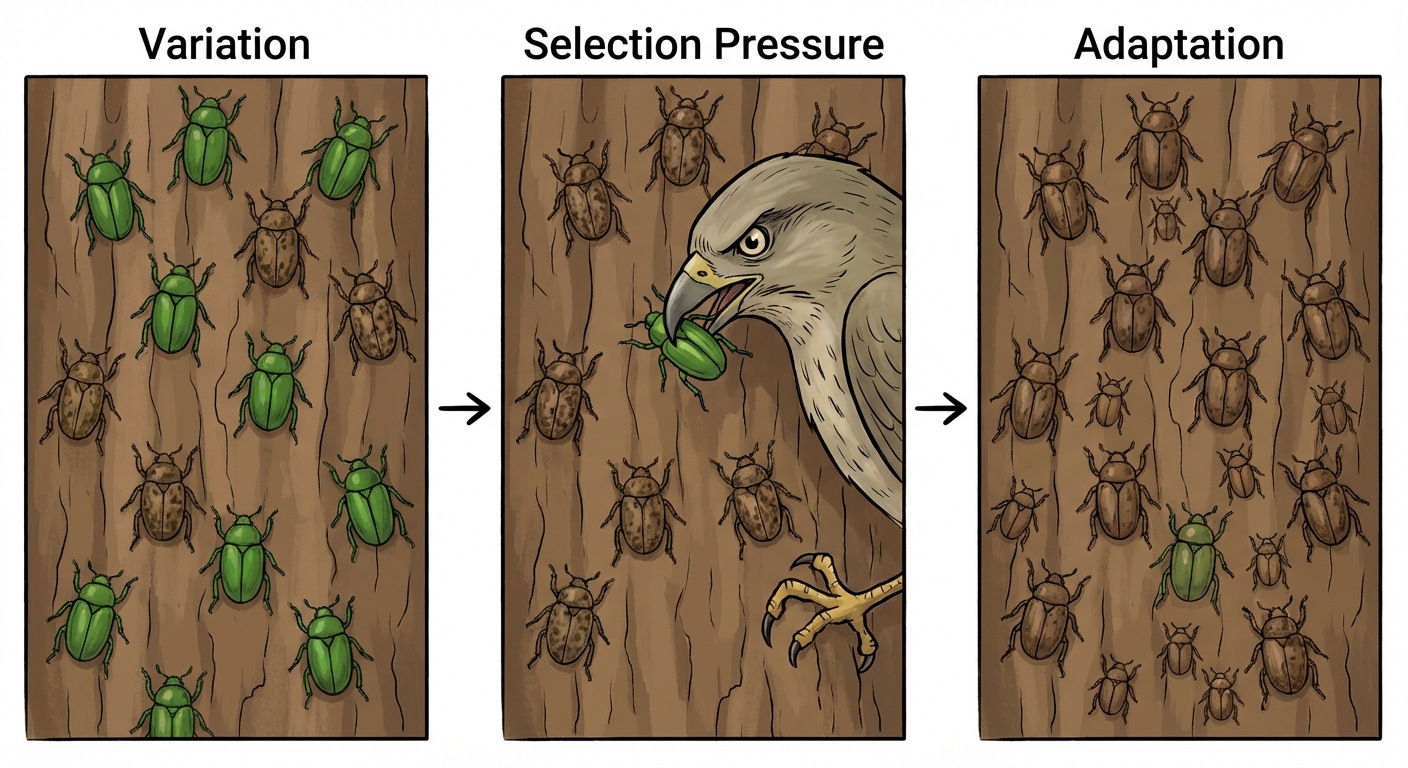
It is crucial to understand the sequence of events:
- Variation: A population contains genetic diversity (mutations/recombination).
- Selective Pressure: An environmental change occurs (e.g., drought, new predator, temperature rise).
- Survival of the Fittest: Individuals with the advantageous trait survive; those without it die or reproduce less.
- Reproduction: Survivors pass the trait to offspring.
- Adaptation: Over generations, the frequency of the trait increases in the population.
Types of Adaptations
Adaptations can be categorized into three main types:
| Type | Definition | Example |
|---|---|---|
| Structural | Physical features of an organism's body. | The thick fur of a polar bear for insulation; the beak shape of Darwin's finches. |
| Physiological | Internal body processes or cellular biochemistry. | A mangrove tree excreting excess salt through leaves; antifreeze proteins in distinct fish species. |
| Behavioral | Actions an individual takes to survive. | Bird migration to avoid cold; desert animals seeking shade during peak heat (nocturnal activity). |
Environmental Changes and Evolution
Ecosystems are dynamic, not static. Disruptions can be:
- Periodic: Occurring at repeated intervals (e.g., tides, seasons).
- Episodic: Occurring occasionally but irregularly (e.g., El Niño/La Niña events, hurricanes).
- Random: Unpredictable events (e.g., meteor impacts, volcanic eruptions).
If the environment changes, a population must adapt (genetically change over generations) or migrate. If they cannot do either, they face extinction.
The Pace of Evolution
For a species to adapt to a new environment, the genetic trait must already exist in the population's gene pool.
- rapidly reproducing species (bacteria, insects) adapt quickly because new generations (and mutations) occur fast.
- K-selected species (elephants, humans) adapt slowly. If the environment changes faster than the species can evolve, extinction is likely.
Common Mistakes & Pitfalls
1. Individuals vs. Populations
- The Mistake: Thinking an individual animal adapts during its lifetime.
- The Reality: Individuals acclimate (adjust temporarily); populations adapt (evolve genetically) over generations. You cannot grow a thicker coat because it got cold; you either have the genes for it or you don't.
2. "Need" vs. Selection
- The Mistake: Saying "The giraffes grew longer necks because they needed to reach the leaves."
- The Reality: Evolution is not intention-based. Giraffes with randomly longer necks survived better and reproduced. The "need" does not create the genetic trait.
3. Misreading the Tolerance Graph
- The Mistake: Confusing the Y-axis (Population Size) with the X-axis (Abiotic Factor).
- The Reality: The peak of the curve is not "high temperature" or "high salinity"—it is the "high number of individuals." The X-axis tells you what the condition is (e.g., pH 7).
4. Generalists vs. Invasive Species
- The Mistake: Assuming all generalists are invasive species.
- The Reality: While invasive species are almost always generalists (because they must survive in a new environment), not all generalists are invasive. They are simply flexible.