Unit 4: Advanced Analysis of Short Fiction II
Comparison and Contrast of Characters
In Unit 4, the analysis of character moves beyond simple identification of traits. The College Board focuses on complexity—how characters interact, conflict, and serve as mirrors for one another to develop the distinct meaning of a text.
Character Foils and Their Function
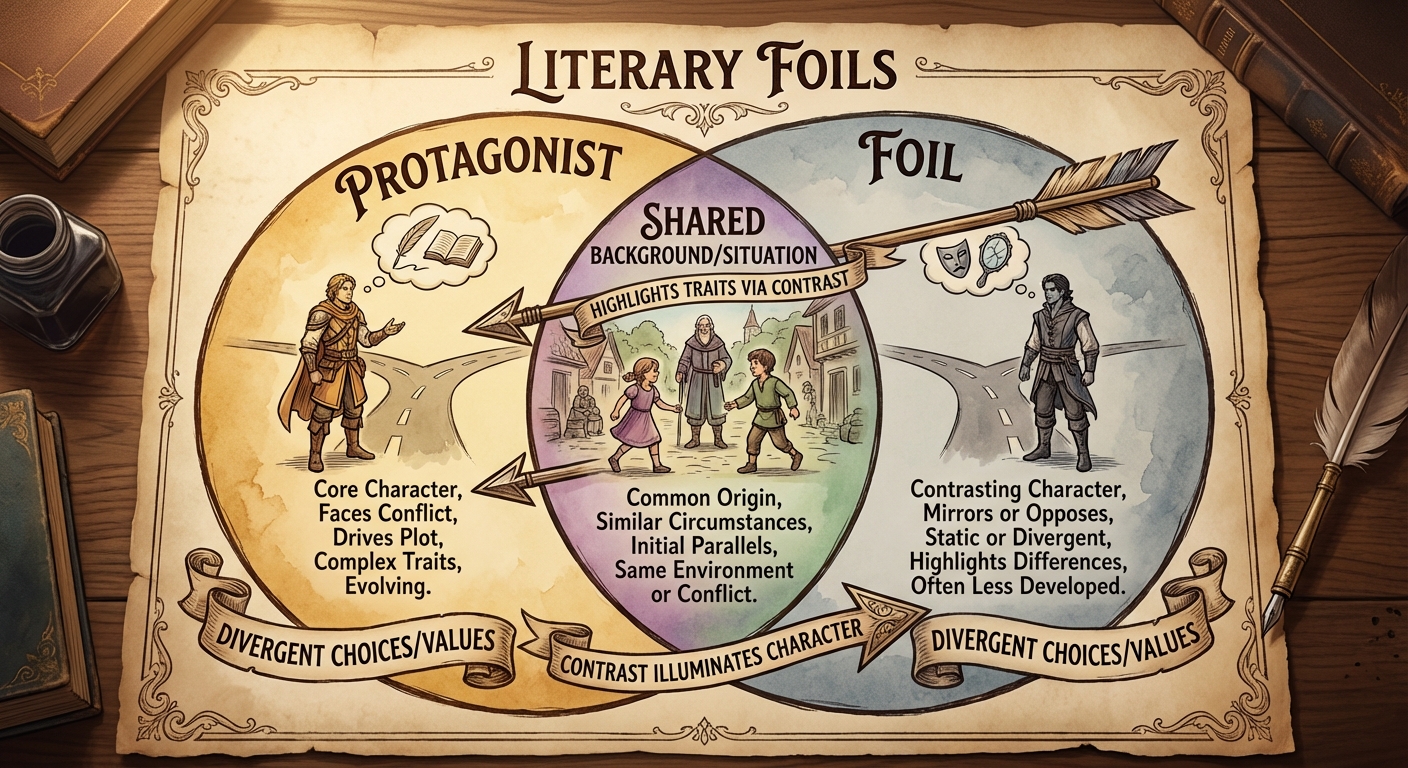
A literary foil is a character whose qualities contrast with those of another character (usually the protagonist). The purpose of a foil is not simply to create conflict, but to highlight specific traits of the protagonist through opposition.
When analyzing foils, look for:
- Contrasting Values: Does one character represent tradition while the other represents progress? (e.g., Dee vs. Maggie in Alice Walker’s Everyday Use).
- Reactions to Adversity: How two characters handle the same crisis often reveals the story’s thematic stance.
- Mirrored Backgrounds: Often, foils share a similar background or social standing but make vastly different choices.
Relationship Dynamics and Change
The interaction between characters acts as a catalyst for narrative progression. In Short Fiction II, you must track how these relationships cause dynamic characters to undergo internal change (epiphany).
- Power Dynamics: Who holds the power in the relationship? Does it shift? A shift in power usually signals the climax or a turning point in the narrative.
- Catalytic Interaction: A static character (one who does not change) often interacts with a dynamic character to trigger the dynamic character's development.
The "Crucible" of Setting
Short stories often place contrasting characters in a "crucible"—a confined setting or intense situation that forces interaction (e.g., the grandmother and the Misfit in O'Connor's A Good Man Is Hard to Find). When analyzing comparisons, ask: How does the setting force these opposing forces to collide?
Symbols and Motifs
Unit 4 prohibits treating symbols as "Easter eggs" with hidden meanings. Instead, you must analyze how objects, actions, or events accrue figurative meaning through the context of the story.
Distinguishing Symbols from Motifs
Students frequently confuse these two terms. It is essential to differentiate them to write precise analysis essays.
| Feature | Symbol | Motif |
|---|---|---|
| Definition | A physical object, character, or place that represents an abstract idea. | A recurring element, image, or structure that emphasizes a theme. |
| Frequency | Can appear just once or twice (though often repeats). | Must repeat significantly throughout the narrative. |
| Scope | specific representation (e.g., "The black box" represents blind tradition). | Broad pattern (e.g., images of decay or rot appearing in houses, clothes, and bodies). |
Contextual vs. Conventional Symbols
- Conventional Symbols: Objects that carry widely recognized cultural meanings (e.g., a dove = peace; spring = rebirth).
- Contextual (Literary) Symbols: Objects that gain meaning only within the specific framework of the story.
- Example: In The Yellow Wallpaper, the wallpaper structure is a contextual symbol for the entrapment of the narrator's mind and societal constraints. It would not mean this in a different story.
To determine if an object is a symbol, apply the Prominence Test:
- Is the object described in excessive detail?
- Does the object appear at critical plot turning points?
- Does the character interacting with the object have a strong emotional reaction to it?

Multiple Interpretations
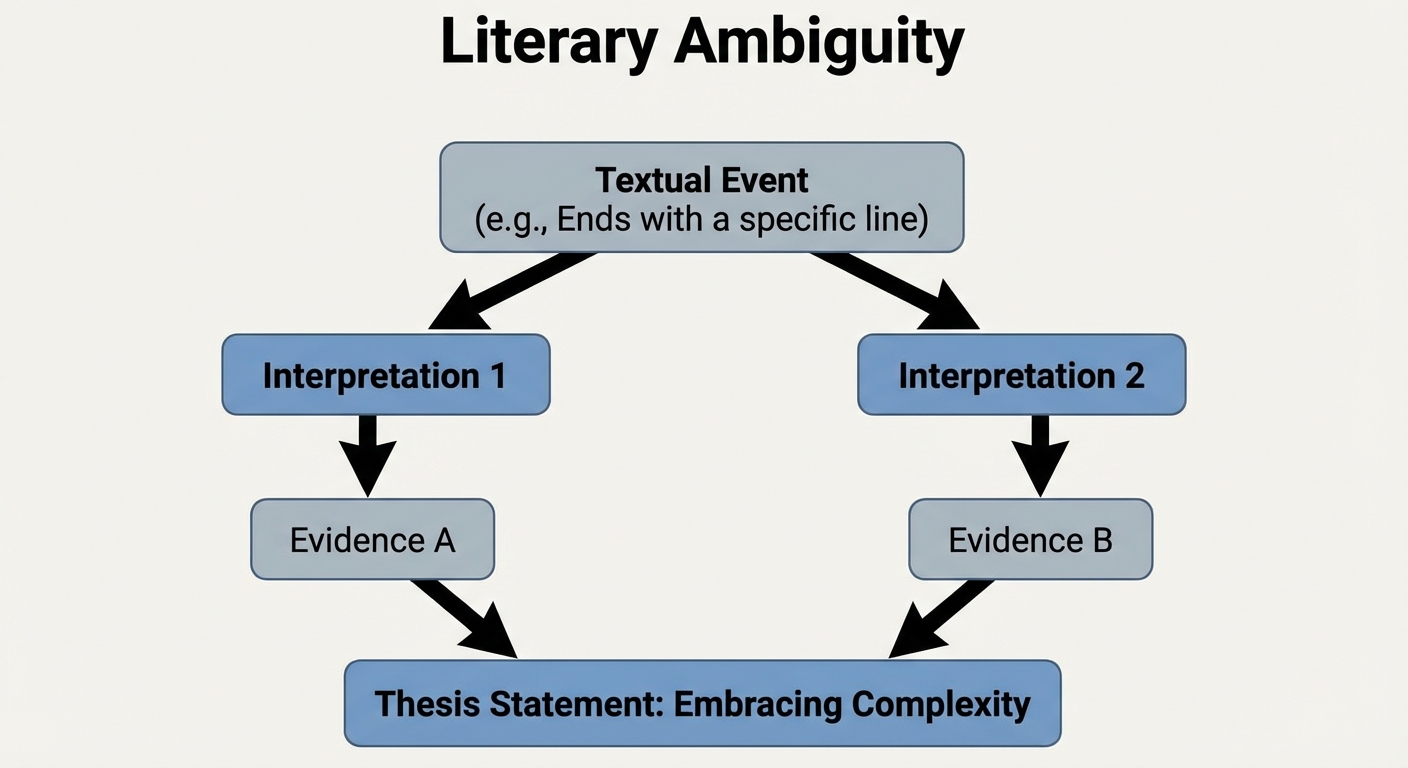
The highest level of literary analysis (and a requirement for a high score on the AP Exam) is the ability to acknowledge and navigate ambiguity. High-quality literature often refuses a single valid interpretation.
The Concept of Ambiguity
Ambiguity is not a mistake by the author; it is a deliberate choice to allow for complexity. A text is ambiguous when:
- The ending is open or unresolved.
- A character's motivation can be read in two contradictory ways.
- The moral stance of the narrative text is unclear (e.g., Unreliable Narrators).
Constructing Arguments for Complexity
When you encounter a prompt asking for an interpretation of a complex text, avoid simplifying the story into "Good vs. Bad." Instead, use a thesis structure that embraces tension.
The Interpretation Formula:
Example Case Study: The Story of an Hour
Kate Chopin’s The Story of an Hour offers a classic study in multiple interpretations regarding Mrs. Mallard’s death:
- Interpretation A (Tragedy): She dies of "joy that kills"—the shock of seeing her husband alive is too much happiness after her grief.
- Interpretation B (Irony): She dies of devastation—having tasted freedom for one hour, the realization that she is once again "shackled" to her marriage causes her heart to fail.
To score well, you would likely argue for Interpretation B, using the support of the text's imagery (open windows, blue skies) to refute the characters' internal diagnosis (Interpretation A).
Common Mistakes & Pitfalls
1. The "Hidden Meaning" Fallacy
- Mistake: Thinking a symbol is a secret code the author hid for you to find.
- Correction: Symbols are functional tools. Don't say "The darkness stands for death." Say "The recurring darkness creates an atmosphere of foreboding that foreshadows the protagonist's demise."
2. Confusing "Contrast" with "Conflict"
- Mistake: Assuming that because two characters contrast, they must fight.
- Correction: Foils can be friends or allies (e.g., Sherlock Holmes and Dr. Watson). Their contrast highlights different approaches to problem-solving, even if they are on the same side.
3. Ignoring Contradictory Evidence
- Mistake: Cherry-picking quotes that support your view and ignoring quotes that contradict it.
- Correction: If you find evidence that contradicts your thesis, do not ignore it. Use it to build nuance. (e.g., "Although the protagonist acts selfishly in scene X, his ultimate sacrifice in scene Y suggests…").
4. Over-Simplifying Themes
- Mistake: Reducing a complex story to a cliché moral like "Don't judge a book by its cover."
- Correction: AP Literature themes are observations about the human condition, not advice. (e.g., "The story reveals how societal expectations can erode individual identity.")