Comprehensive Guide to Unit 4: Vectors, Matrices, and Linear Transformations
Fundamentals of Plane Vectors
Vectors in Two Dimensions
A vector is a mathematical object that possesses both magnitude (length) and direction. In AP Precalculus, we primarily analyze vectors in a two-dimensional plane.
Vector Notation and Components
Vectors are often represented by directed line segments (arrows) or algebraic pairs.
- Standard Form: $\vec{v} = \langle a, b \rangle$
- $a$ is the horizontal component.
- $b$ is the vertical component.
- Unit Basis Vectors: $\vec{v} = a\mathbf{i} + b\mathbf{j}$, where $\mathbf{i} = \langle 1, 0 \rangle$ and $\mathbf{j} = \langle 0, 1 \rangle$.
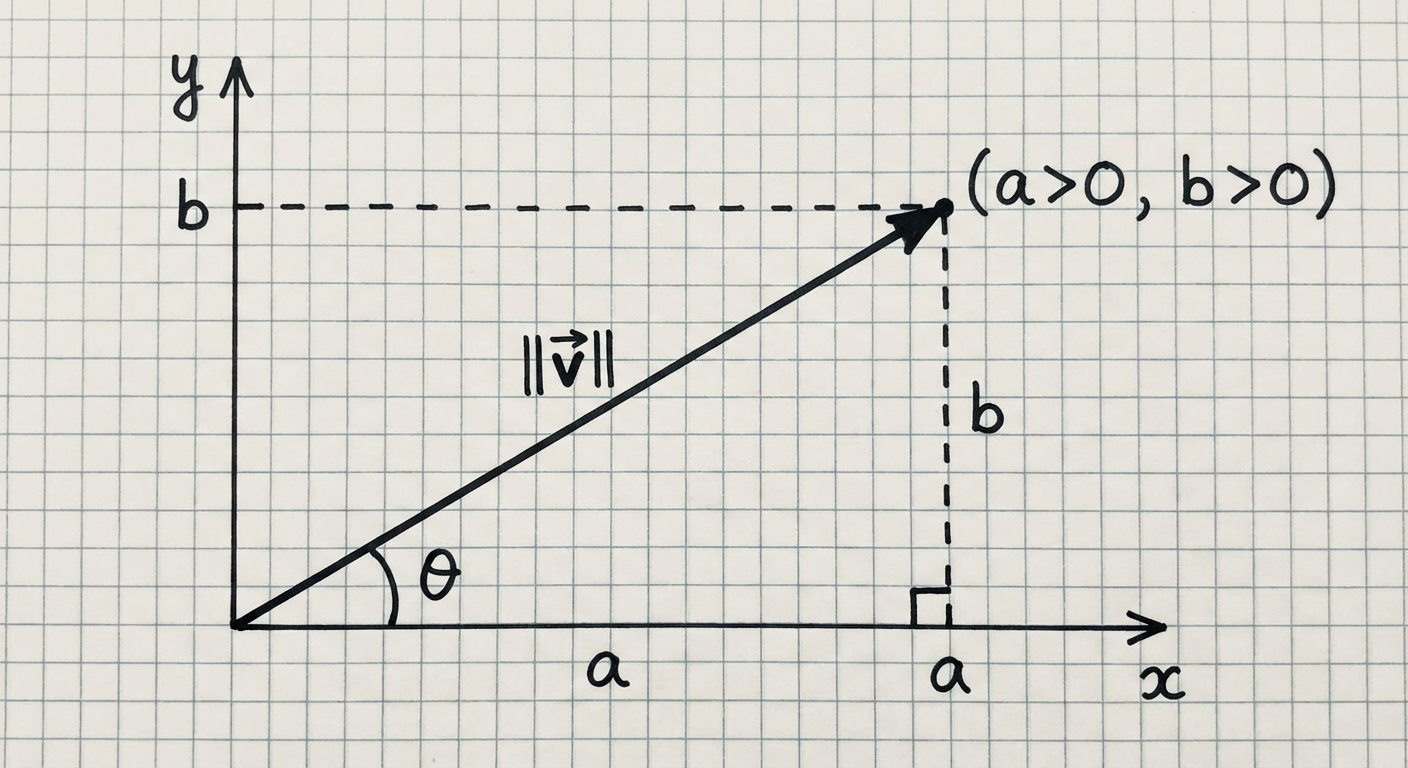
Magnitude and Direction
Given a vector $\vec{v} = \langle a, b \rangle$:
- Magnitude (Length): Calculated using the Pythagorean theorem.
- Direction Angle ($\theta$): The angle the vector makes with the positive x-axis.
- Note: You must adjust $\theta$ based on the quadrant where $(a,b)$ lies.
Vector Arithmetic
We can perform arithmetic operations on vectors component-wise.
- Vector Addition: $\vec{u} + \vec{v} = \langle u1 + v1, u2 + v2 \rangle$
- Geometrically: This follows the head-to-tail method (triangle rule) or parallelogram rule.
- Scalar Multiplication: $k\vec{v} = \langle ka, kb \rangle$
- Scales the length by $|k|$.
- If $k < 0$, the direction reverses.
Vector-Valued Functions
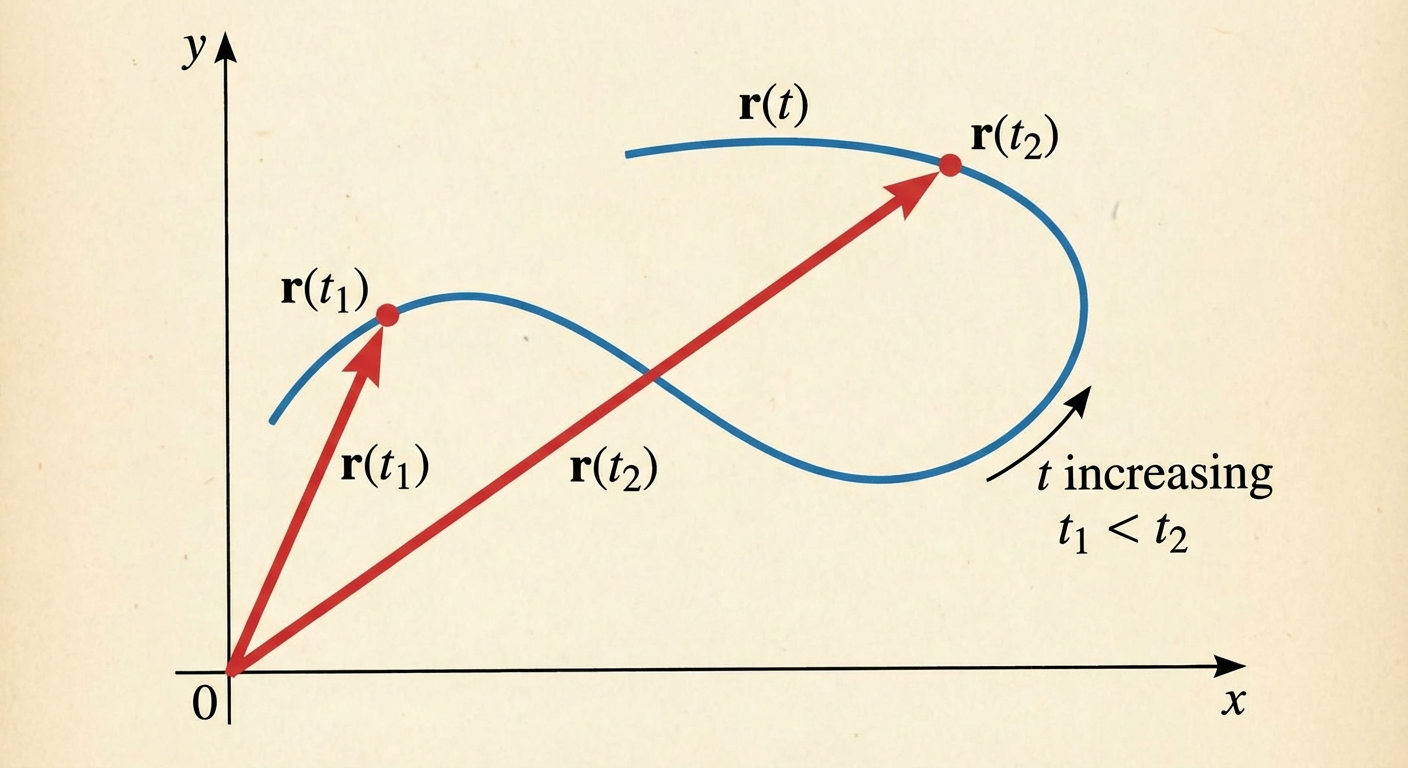
A vector-valued function takes a scalar input (typically time, $t$) and outputs a vector.
Motion Along a Curve
This concept ties directly to parametric equations. While parametric equations describe $x$ and $y$ separately, a vector-valued function describes the position vector pointing from the origin to the point $(x(t), y(t))$ on the curve.
- Input domain: The set of allowed $t$ values.
- Output range: Variations of the position vector $\vec{r}(t)$.
Example:
If $\vec{r}(t) = \langle t^2, 2t \rangle$ for $t \ge 0$:
- At $t=1$, position is $\langle 1, 2 \rangle$.
- At $t=2$, position is $\langle 4, 4 \rangle$.
Matrices and Matrix Operations
A matrix is a rectangular array of numbers arranged in rows and columns. A matrix with $m$ rows and $n$ columns has dimensions $m \times n$.
Basic Operations
- Addition/Subtraction: Only possible if dimensions represent the exact same size. Add corresponding entries.
- Scalar Multiplication: Multiply every entry in the matrix by the scalar constant $k$.
Matrix Multiplication
This is a non-commutative operation (order matters).
- Condition: To multiply Matrix $A$ ($m \times n$) by Matrix $B$ ($n \times p$), the number of columns in $A$ must equal the number of rows in $B$.
- Result: The resulting matrix will have dimensions $m \times p$.
To find the entry in row $i$ and column $j$ of the product, find the dot product of row $i$ from the first matrix and column $j$ from the second matrix.
Linear Transformations and Matrices
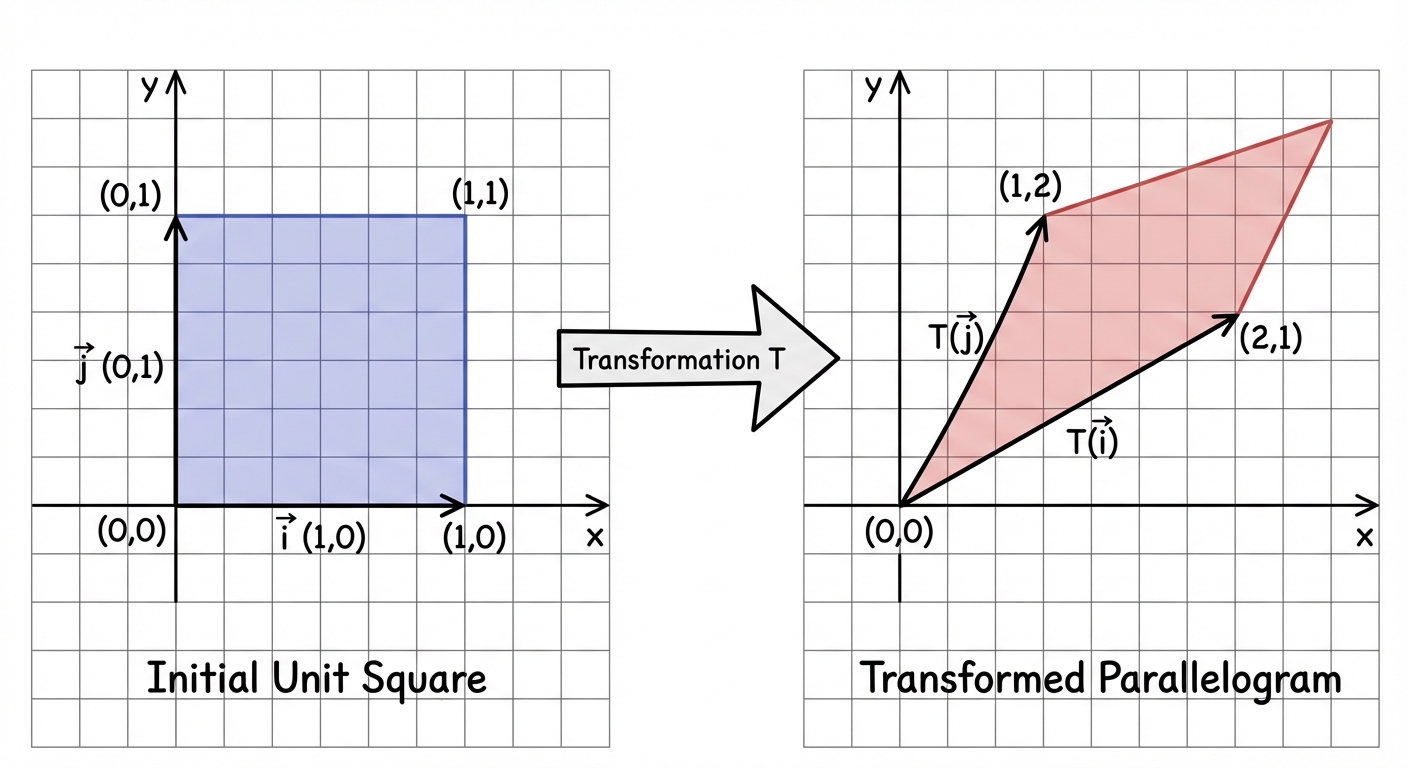
Matrices can be viewed as functions that map (transform) vectors from one position to another. The input is a vector $\vec{x}$, and the function is the matrix multiplication $T(\vec{x}) = A\vec{x}$.
Geometric Interpretation on the Plane
For a $2 \times 2$ matrix transforming a $2 \times 1$ vector:
- The Identity Matrix ($I$): $\begin{bmatrix} 1 & 0 \ 0 & 1 \end{bmatrix}$ leaves a vector unchanged.
- Zero Matrix: Maps all vectors to $\langle 0, 0 \rangle$.
- Dilation: $\begin{bmatrix} k & 0 \ 0 & k \end{bmatrix}$ scales the vector by factor $k$.
- Reflection (over x-axis): $\begin{bmatrix} 1 & 0 \ 0 & -1 \end{bmatrix}$ flips the y-coordinate.
- Rotation (90° CCW): $\begin{bmatrix} 0 & -1 \ 1 & 0 \end{bmatrix}$ maps $\langle 1, 0 \rangle \to \langle 0, 1 \rangle$ and $\langle 0, 1 \rangle \to \langle -1, 0 \rangle$.
Matrices as Functions
Just as we analyze functions for inverses and domain, we analyze matrices similarly.
The Determinant
For a $2 \times 2$ matrix $A = \begin{bmatrix} a & b \ c & d \end{bmatrix}$, the determinant is:
Significance of the Determinant:
- Area Scale Factor: The absolute value $|\det(A)|$ represents the factor by which the matrix scales the area of a region. If $\det(A) = 2$, shapes become twice as large after transformation.
- Invertibility: If $\det(A) = 0$, the matrix squashes the plane into a line or a point (loss of dimension). Such a matrix has no inverse (it is singular).
The Inverse Matrix
The inverse matrix $A^{-1}$ "undoes" the transformation of $A$. It exists only if $\det(A) \neq 0$.
Property: $A \cdot A^{-1} = I$ (The Identity Matrix).
If we view a matrix as a function $f(\vec{v}) = A\vec{v}$, then the inverse function is $f^{-1}(\vec{v}) = A^{-1}\vec{v}$.
Common Mistakes & Pitfalls
- Matrix Multiplication Order: Students often think $AB = BA$. This is false for matrices. Always maintain strict left-to-right order.
- Determinant Denominator: When calculating the inverse, remember to divide by the determinant ($ad-bc$). If you multiply by it, your result is wrong.
- Vector Direction (Quadrants): When finding $\theta = \tan^{-1}(b/a)$, the calculator gives the reference angle. You must visualize the point $(a,b)$ to determine the correct quadrant (e.g., adding $180^\circ$ or $\pi$ if vectors are in Q2/Q3).
- Dimension Mismatch: Attempting to multiply a $2 \times 2$ matrix by a $1 \times 2$ (row) vector instead of a $2 \times 1$ (column) vector. The inner dimensions must match.