AP Biology Unit 7: Mechanisms of Microevolution
Unit 7: Natural Selection — Population Genetics
Population Genetics Fundamentals
Population Genetics is the study of how genetic principles apply to entire populations. While classical genetics (Mendelian) focuses on single matings, population genetics looks at the allele frequencies within a specific group and how they change over time.
Key Definitions
- Population: A localized group of individuals capable of interbreeding and producing fertile offspring.
- Gene Pool: The aggregate of all copies of every type of allele at all loci in every individual in a population.
- Fixed Allele: Occurs if all members of a population are homozygous for the same allele (only one allele exists for that gene).
- Microevolution: A change in allele frequencies in a population over generations. This is evolution on its smallest scale.
If the frequency of alleles in a population is changing (e.g., the percentage of a "Tall" gene is increasing), then evolution is occurring.
Hardy-Weinberg Equilibrium
The Hardy-Weinberg Principle describes a hypothetical, non-evolving population. It serves as a null hypothesis for evolutionary biologists. By comparing real-world data to this mathematical model, scientists can determine whether evolution is occurring and what forces might be driving it.
The 5 Conditions for Equilibrium
For a population to remain in Hardy-Weinberg Equilibrium (i.e., NO evolution is occurring), all five of the following conditions must be met:
- No Mutation: The gene pool is not modified.
- Random Mating: Individuals mate without preference for specific genotypes.
- No Natural Selection: Differences in survival and reproductive success do not exist.
- Extremely Large Population Size: The population is large enough to prevent Genetic Drift (random fluctuations).
- No Gene Flow: No movement of individuals (and their alleles) into or out of the population.
Memory Aid: The "Five Fingers" of Evolution
To remember the things that cause evolution (disrupt equilibrium), map them to your hand:
- Pinky (Small): Small population (Genetic Drift)
- Ring Finger (Ring): Non-random mating
- Middle Finger (M): Mutation
- Pointer (Movement): Gene Flow
- Thumb (Thumbs up/down): Natural Selection (adaptation)
The Mathematical Formulas
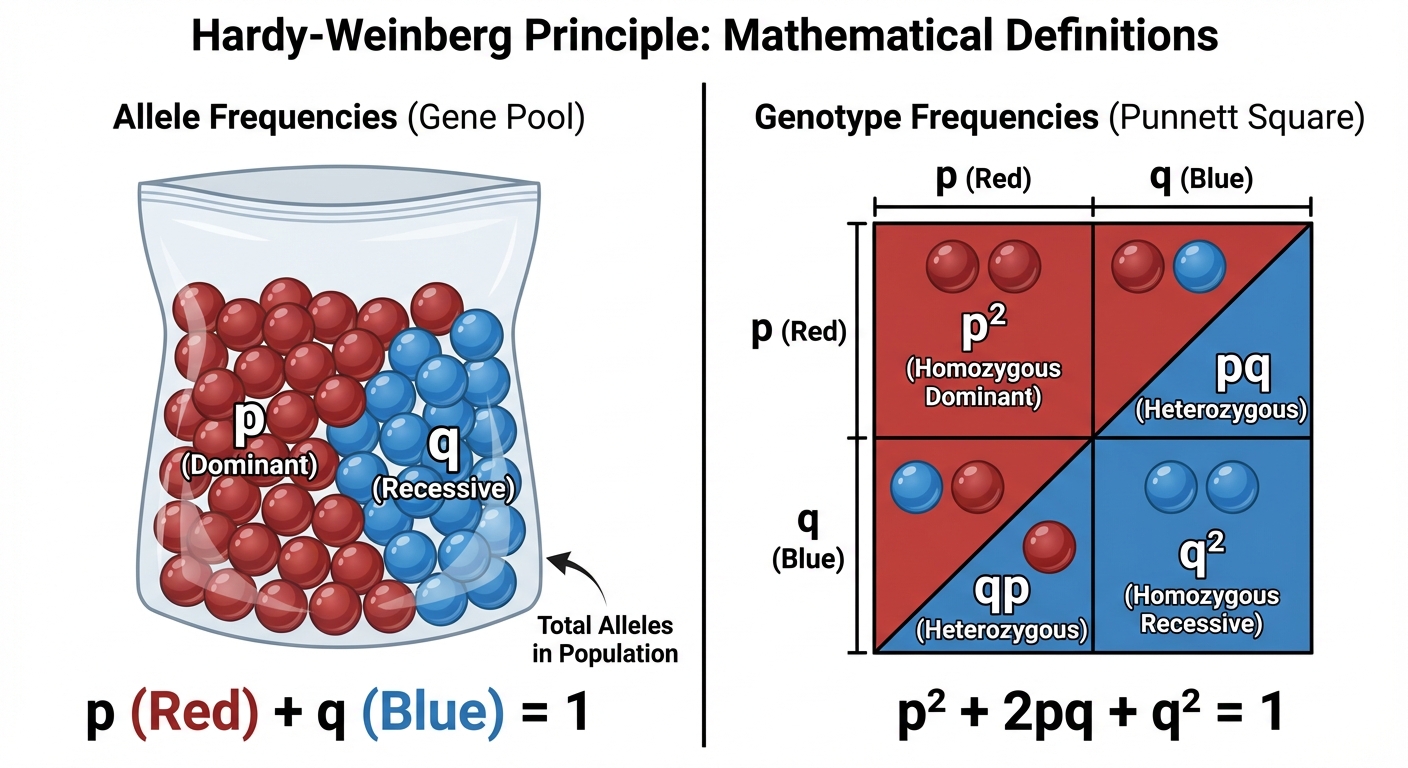
There are two primary equations you must memorize for the AP Exam. These apply to a gene with two alleles (one dominant, one recessive).
Allele Frequencies:
- $p$ = Frequency of the dominant allele (e.g., A)
- $q$ = Frequency of the recessive allele (e.g., a)
Genotype Frequencies:
- $p^2$ = Frequency of homozygous dominant individuals (AA)
- $2pq$ = Frequency of heterozygous individuals (Aa)
- $q^2$ = Frequency of homozygous recessive individuals (aa)
Worked Example: Calculating Heterozygotes
Problem: In final exams for a population of sheep, the wool color white (W) is dominant over black (w). You count the sheep and find that 16% of the population has black wool. Assuming the population is in Hardy-Weinberg equilibrium, what percentage of the population is heterozygous?
Solution Strategy:
Identify what is given: You are given the frequency of the recessive phenotype (black wool). This represents the genotype $ww$ or $q^2$.
Find the allele frequency ($q$):
The frequency of the recessive allele is 0.4.Find the dominant allele frequency ($p$):
Calculate the heterozygous frequency ($2pq$):
Answer: 48% of the population is heterozygous.
Variations in Populations
When the conditions of Hardy-Weinberg are not met, allele frequencies change. This section covers the specific mechanisms that introduce variation or alter frequencies, distinct from Natural Selection (which is covered in other sections of Unit 7).
Genetic Drift
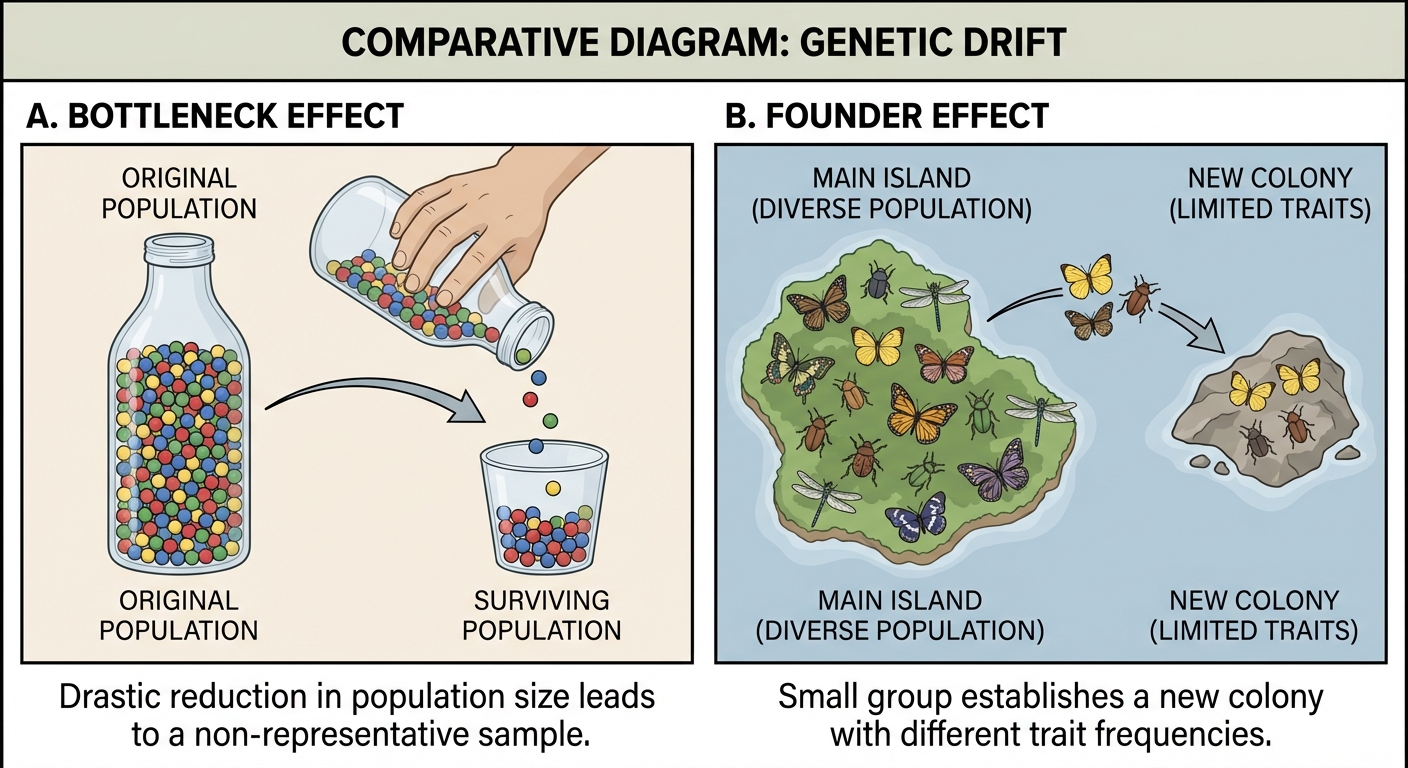
Genetic Drift describes unpredictable fluctuations in allele frequencies from one generation to the next. It is most significant in small populations and tends to reduce genetic variation through the loss of alleles.
There are two main types of Genetic Drift:
The Founder Effect:
- Occurs when a few individuals become isolated from a larger population.
- The new gene pool is not reflective of the original source population.
- Example: Members of the Amish community in Pennsylvania are descended from a small group of founders; they have a high frequency of the allele for Ellis-van Creveld syndrome (polydactyly) compared to the general population.
The Bottleneck Effect:
- Occurs when a sudden change in the environment (fire, flood, human activity) drastically reduces the size of a population.
- By chance alone, certain alleles may be overrepresented, underrepresented, or eliminated among survivors.
- Example: The Cheetah population experienced a severe bottleneck in the past. Today, they have extremely low genetic diversity, making them susceptible to disease.
| Feature | Bottleneck Effect | Founder Effect |
|---|---|---|
| Cause | Severe reduction in population size (disaster) | Colonization by a small subgroup |
| Genetic Result | Loss of variation; survivors dictate new pool | Gene pool differs from source population |
| Randomness | Highly Random | Highly Random |
Gene Flow
Gene Flow is the transfer of alleles into or out of a population due to the movement of fertile individuals or their gametes (e.g., pollen drifting in the wind).
- Effect: Gene flow tends to reduce genetic differences between populations. If extensive enough, it can blend two populations into a single gene pool.
- Contrast with Drift: While Drift is random and reduces diversity within a single small population, Gene Flow introduces new alleles (increasing diversity within that specific population) or homogenizes allele frequencies across different populations.
Mutation
Mutation is a change in the nucleotide sequence of an organism's DNA.
- It is the ultimate source of new alleles.
- On its own, mutation rates are generally too low to cause significant changes in allele frequencies in one generation (microevolution), but it provides the raw material upon which Natural Selection and Genetic Drift act.
Common Mistakes & Pitfalls
Confusing $p$ with $p^2$ (or $q$ with $q^2$):
- The Mistake: A student reads "9% of the population is recessive" and sets $q = 0.09$.
- The Correction: If the problem mentions a phenotype or a group of individuals (e.g., "has the disease"), you are looking at the genotype frequency ($q^2$ or $p^2$). If the problem says "allele frequency," you are looking at $p$ or $q$. Always start by solving for $q^2$ if given phenotypic data.
Assuming Dominant Alleles are Most Common:
- The Mistake: Believing that because an allele is dominant, it will inevitably increase in frequency.
- The Correction: Dominance only refers to the protein expression in a heterozygote, not its evolutionary fitness. Polydactyly (extra fingers) is dominant, but very rare.
Misinterpreting Hardy-Weinberg Equilibrium:
- The Mistake: Thinking that a population must be in equilibrium.
- The Correction: Real populations are rarely in H-W equilibrium. The formula is a tool to prove that evolution is happening by showing that the numbers don't match the prediction.