Unit 1: The Formation of the African Diaspora
Origins of the Transatlantic Slave Trade
The Transatlantic Slave Trade was not a random event; it was a systematic economic enterprise driven by the concept of Mercantilism and the explosion of European demand for cash crops. To understand the origins, you must first distinguish the nature of slavery itself as it evolved during this period.
Chattel Slavery vs. African Systems of Servitude
One of the most critical conceptual distinctions in this course is the difference between indigenous forms of servitude in Africa and the system established by Europeans in the Americas.
- Indigenous Servitude within Africa: Often resulted from warfare (prisoners of war), debt, or crimes. It was generally not hereditary, and enslaved individuals famously retained rights to marry, own property, and eventually integrate into the captor's kinship network.
- Chattel Slavery: A system where one person has total ownership of another. In the Americas, this became a racialized and hereditary system. The enslaved person was treated legally as property (chattel) rather than human, stripping them of all rights.
| Feature | Indigenous African Servitude | Transatlantic Chattel Slavery |
|---|---|---|
| Status | Often temporary or social integration focused | Permanent and hereditary |
| Legal rights | Could marry, own property, testify | No rights; defined as property |
| Basis | War captives, debt repayment, crime | Race and economic necessity |
| Function | Domestic labor, military service, status symbol | Commercial agricultural production |
The Economic Drivers
The primary catalyst for the trade was the labor-intensive cultivation of sugar, followed by tobacco and cotton. The Portuguese were the first to ship captive Africans to the Americas, specifically to Brazil, establishing the blueprint for the plantation economy.
The Triangular Trade System
The trade operated on a complex, three-legged economic route known as the Triangular Trade. This created an interdependent global economy linking Europe, Africa, and the Americas.
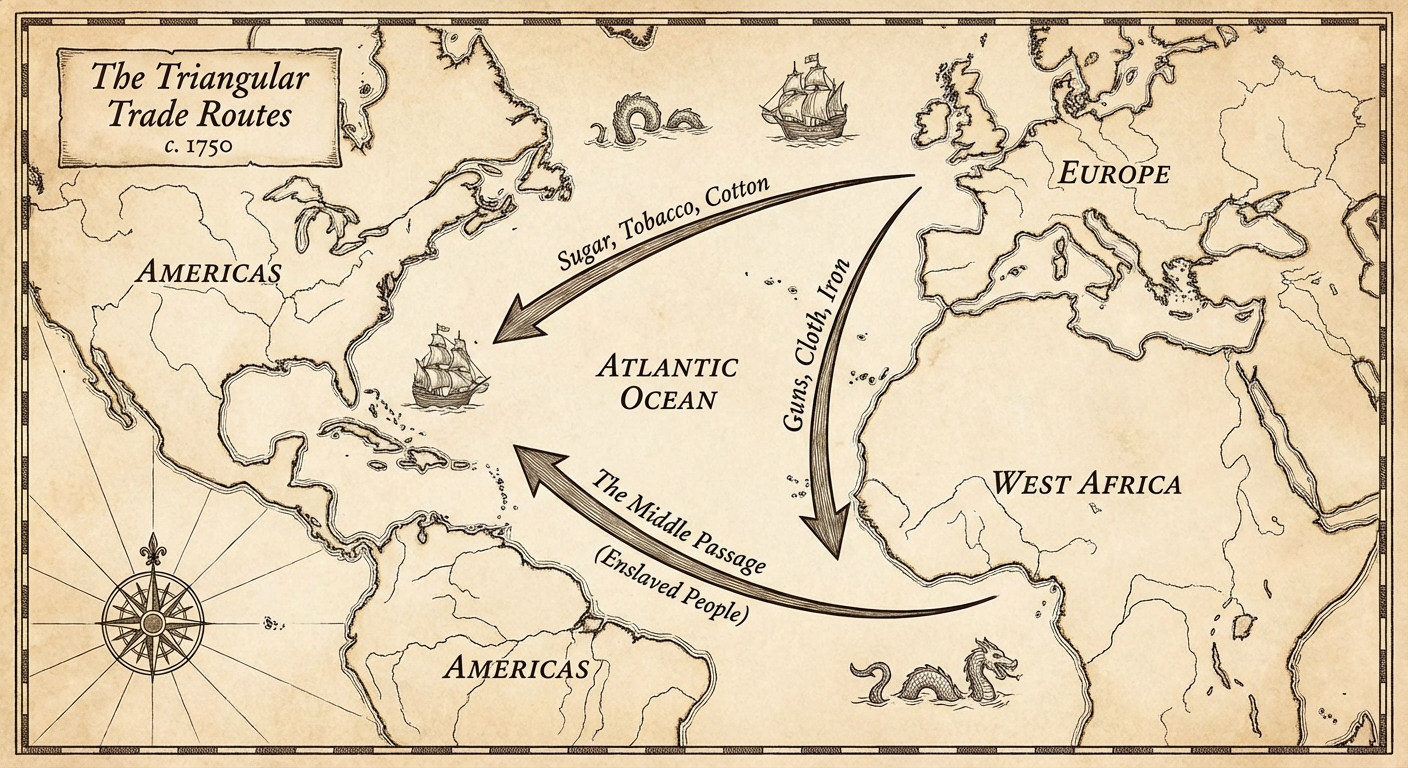
- Leg 1 (Europe to Africa): European merchants shipped manufactured goods (guns, cloth, iron, rum) to Africa.
- Leg 2 (Africa to the Americas): This is the Middle Passage. Enslaved Africans were transported across the Atlantic to be sold.
- Leg 3 (Americas to Europe): Raw materials produced by slave labor (sugar, molasses, tobacco, cotton) were shipped back to Europe for manufacturing.
The Role of African Polities
It is essential to understand that the trade involved collaboration. European traders typically stayed on the coast in fortified posts (factories) or paid taxes to local rulers. African elites and merchants sold captives—often obtained through warfare or raids—to Europeans in exchange for technological and prestige goods, particularly firearms, which exacerbated conflicts within the continent.
The Middle Passage
The Middle Passage refers specifically to the harrowing oceanic voyage of enslaved Africans from the West African coast to the Americas. It is widely considered one of the most horrific events in human history.
Conditions and "The Floating Tomb"
Before boarding, captives were often held in Barracoons (fortified enclosures) on the coast (e.g., Elmina Castle in Ghana). Once aboard:
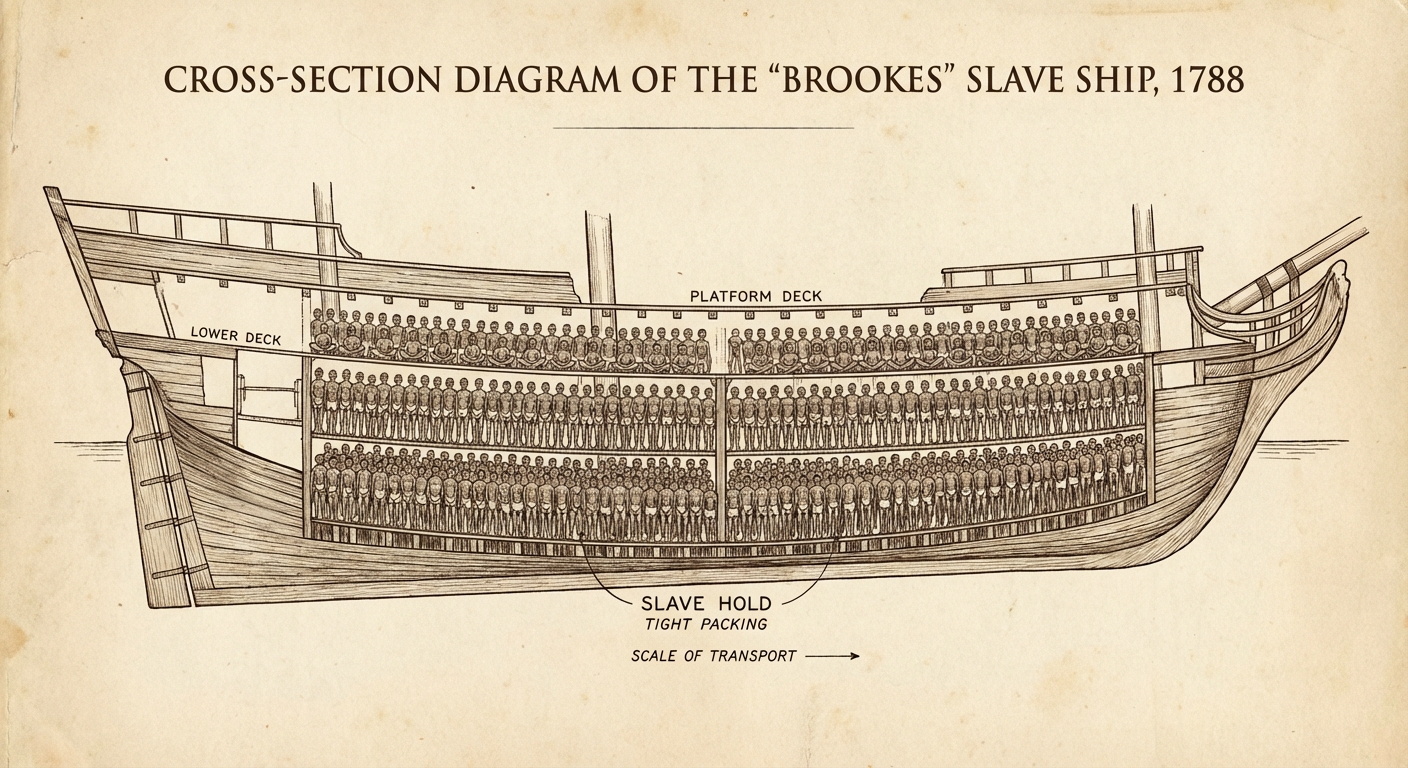
- Tight Packing: Most captains utilized "tight packing," squeezing as many humans as possible into the hold (often with less space than a coffin) based on the calculation that higher volume would offset the inevitable mortality rate.
- Mortality: Experts estimate that 10% to 20% of captives died during the voyage due to dysentery (the "bloody flux"), smallpox, dehydration, and suicide.
Resistance at Sea
Contrary to the misconception of passivity, resistance was constant.
- Insurrections: Roughly 10% of voyages experienced rebellions. The most famous example (though late in the trade's history) is the rebellion on the Amistad (1839).
- Acts of Agency: Resistance also included refusal to eat (leading to forced feeding with a device called the speculum oris) and suicide by jumping overboard, believing their spirits would return to Africa.
The African Diaspora and Cultural Retention
The African Diaspora refers to the mass dispersion of peoples from Africa during the Transatlantic Slave Trades. While the physical bodies were transported, the culture was not erased; it was adapted.
Creolization and Syncretism
Enslaved Africans came from diverse ethnic groups (Igbo, Yoruba, Kongo, Akan, etc.). In the Americas, these cultures blended with European and Indigenous American elements—a process called Creolization.
1. Religious Syncretism
Syncretism is the blending of different religious beliefs into a new system. Enslaved people often hid their traditional deities (orishas or loas) behind Catholic saints to avoid persecution.
- Vodou (Haiti): A blend of Fon/Ewe beliefs and Catholicism.
- Santería (Cuba): A blend of Yoruba beliefs (Regla de Ocha) and Catholicism.
- Candomblé (Brazil): A blend of Yoruba, Fon, and Bantu beliefs with Catholicism.
2. Foodways and Language
- Food: Many staples of "Southern" or "Caribbean" cuisine are African in origin, including okra, yams, black-eyed peas, and rice cultivation techniques brought from the Windward Coast.
- Language: Pidgin and Creole languages developed as a way for diverse African groups to communicate with each other and Europeans. A prime example is Gullah Geechee (coastal South Carolina/Georgia), which retains significant African grammar and vocabulary.
Common Mistakes & Pitfalls
The "Passive Victim" Myth:
- Mistake: Thinking enslaved Africans passively accepted their fate.
- Correction: Resistance began immediately in Africa, continued in the barracoons, persisted on the ships, and evolved on the plantations. Agency was never lost.
Confusing Indentured Servitude with Chattel Slavery:
- Mistake: Believing the early Virginia system was immediately chattel slavery.
- Correction: In the very early 1600s, some Africans were treated as indentured servants. However, laws rapidly changed (e.g., the 1662 Virginia law stating children follow the condition of the mother) to solidify hereditary chattel slavery.
Homogeneity of "Africa":
- Mistake: Referring to the continent as a single culture.
- Correction: The trade affected specific regions (Senegambia, Gold Coast, Bight of Benin, West Central Africa). Each had distinct political structures, religions, and responses to the trade.