AP Calculus AB Unit 5: Analytical Applications of Differentiation Study Guide
5.1 The Mean Value Theorem (MVT) & Rolle’s Theorem
Theoretical Framework
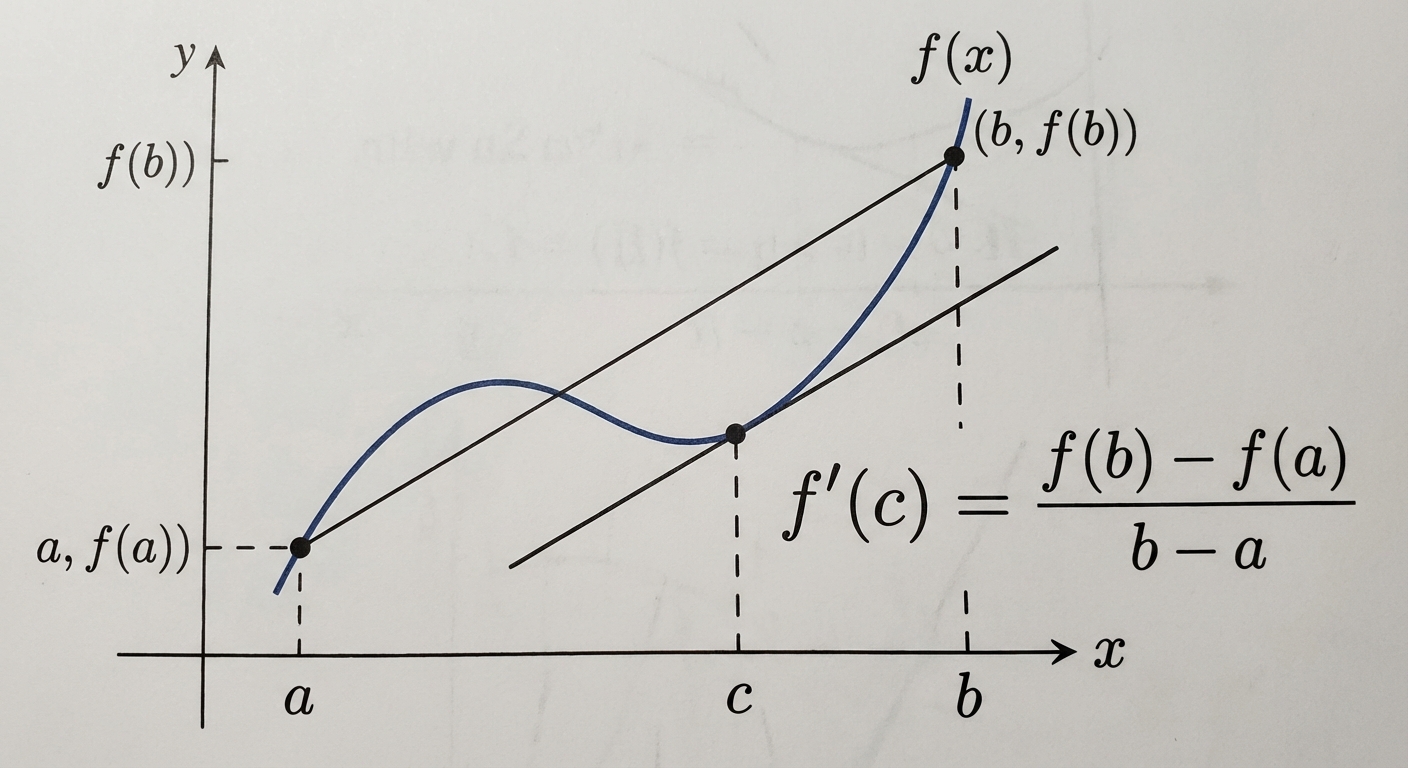
The Mean Value Theorem is one of the most critical existence theorems in Calculus. It establishes a connection between the average rate of change over an interval and the instantaneous rate of change at a specific point within that interval.
The Mean Value Theorem (MVT)
Hypotheses (Conditions):
For a function $f(x)$ defined on an interval $[a, b]$:
- $f(x)$ must be continuous on the closed interval $[a, b]$.
- $f(x)$ must be differentiable on the open interval $(a, b)$.
Conclusion:
There exists at least one number $c$ such that $a < c < b$ where:
Translation: There is at least one point where the slope of the tangent line equals the slope of the secant line connected endpoints $a$ and $b$.
Rolle's Theorem
Rolle’s Theorem is a special case of the MVT where the starting and ending $y$-values are the same ($f(a) = f(b)$).
Conclusion:
If $f(a) = f(b)$, then there exists at least one $c$ in $(a, b)$ such that:
Translation: Somewhere between two points with the same height, the graph must turn around, meaning there is a horizontal tangent.
5.2 The Extreme Value Theorem (EVT)
Absolute (Global) Extrema
The Extreme Value Theorem guarantees the existence of maximums and minimums under specific conditions.
The Theorem:
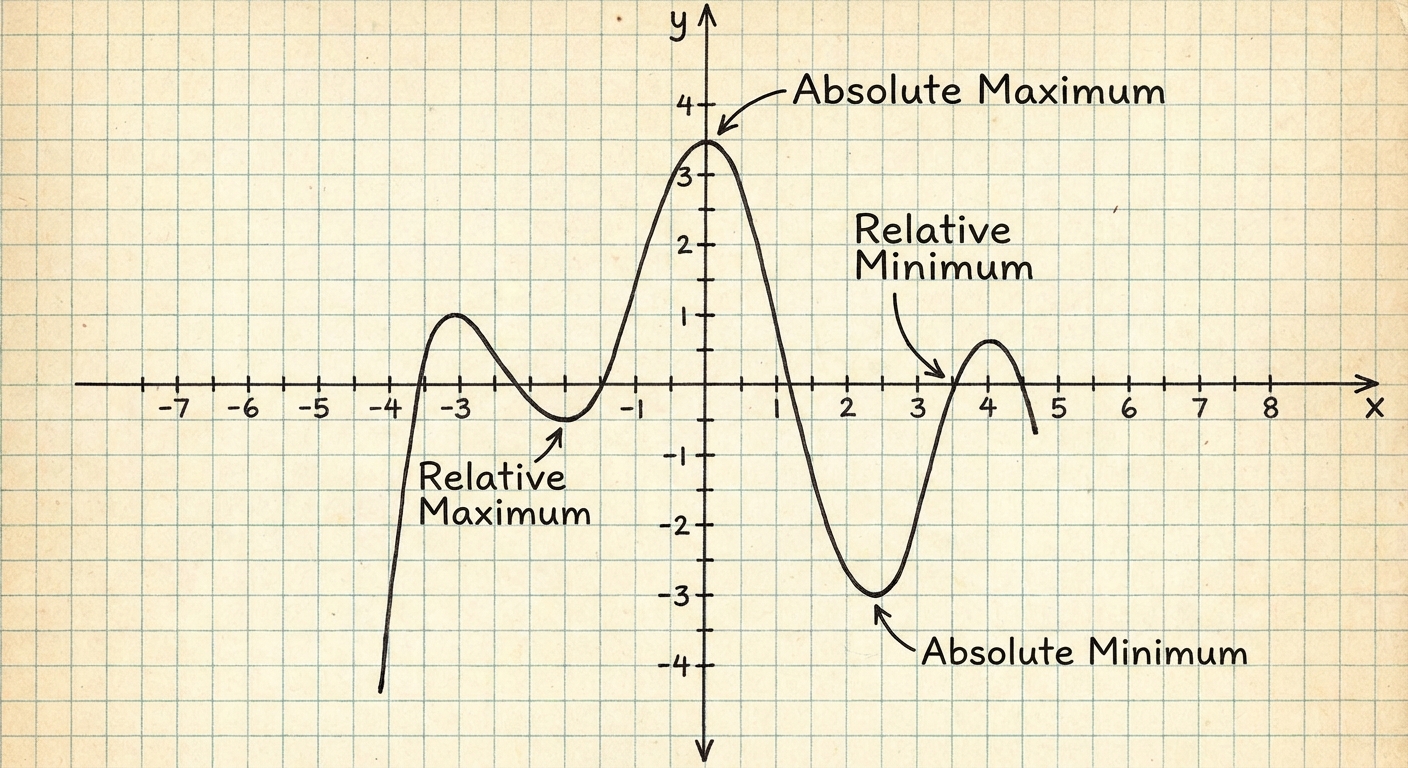
If a function $f(x)$ is continuous on a closed interval $[a, b]$, then $f(x)$ has both an absolute maximum and an absolute minimum on that interval.
Local (Relative) vs. Absolute (Global)
- Absolute Extrema: The highest or lowest $y$-value on the entire domain or interval.
- Relative Extrema: The highest or lowest $y$-value relative to the points immediately surrounding it (hills and valleys).
5.3 First Derivative Analysis: Increasing & Decreasing Intervals
The sign of the first derivative tells us the direction of the function.
Definitions
- If $f'(x) > 0$ on an interval, $f(x)$ is increasing.
- If $f'(x) < 0$ on an interval, $f(x)$ is decreasing.
Finding Critical Points
A Critical Point is a point in the domain of $f$ where:
- $f'(x) = 0$ (Horizontal tangent)
- $f'(x)$ is undefined (Corner, Cusp, or Vertical Tangent)
Procedure: The Number Line Test
- Find the domain of $f(x)$.
- Find $f'(x)$ and determine all Critical Points.
- Place Critical Points on a number line.
- Test a value in each sub-interval in the derivative $f'(x)$.
Example: $f(x) = x^3 - 6x^2 + 9x + 2$
- Differentiate: $f'(x) = 3x^2 - 12x + 9$
- Find Critical Points:
Critical points at $x=1$ and $x=3$. - Test Intervals:
- $x < 1$ (Test 0): $f'(0) = 9$ (Pos) $\rightarrow$ Increasing
- $1 < x < 3$ (Test 2): $f'(2) = 12 - 24 + 9 = -3$ (Neg) $\rightarrow$ Decreasing
- $x > 3$ (Test 4): $f'(4) = 48 - 48 + 9 = 9$ (Pos) $\rightarrow$ Increasing
5.4 Using the First Derivative Test for Local Extrema
Once sign analysis is complete, we classify the critical points.
The First Derivative Test:
At a critical point $c$:
- If $f'$ changes from Positive to Negative $\rightarrow$ Relative Maximum (The graph goes up, then down).
- If $f'$ changes from Negative to Positive $\rightarrow$ Relative Minimum (The graph goes down, then up).
- If $f'$ does not change signs $\rightarrow$ Not an extrema (Plateau).
Applying to Example Above:
- At $x=1$, signs shift $+ \to -$, so $x=1$ is a Relative Max.
- At $x=3$, signs shift $- \to +$, so $x=3$ is a Relative Min.
5.5 Finding Absolute Extrema: The Candidates Test
When looking for the Absolute Max/Min on a closed interval, you cannot rely solely on the First Derivative Test. You must use the Candidates Test.
Steps for Candidates Test:
- Confirm $f(x)$ is continuous on the closed interval $[a, b]$.
- Find all critical points inside $(a, b)$.
- Evaluate the original function $f(x)$ at:
- All Critical Points
- The Endpoints ($a$ and $b$)
- Compare the $y$-values. The highest is the Absolute Max; the lowest is the Absolute Min.
Common Mistake: Students often forget to check the endpoints. The absolute max often occurs at the start or end of the interval, not just at the peaks/valleys.
5.6 Concavity and Points of Inflection
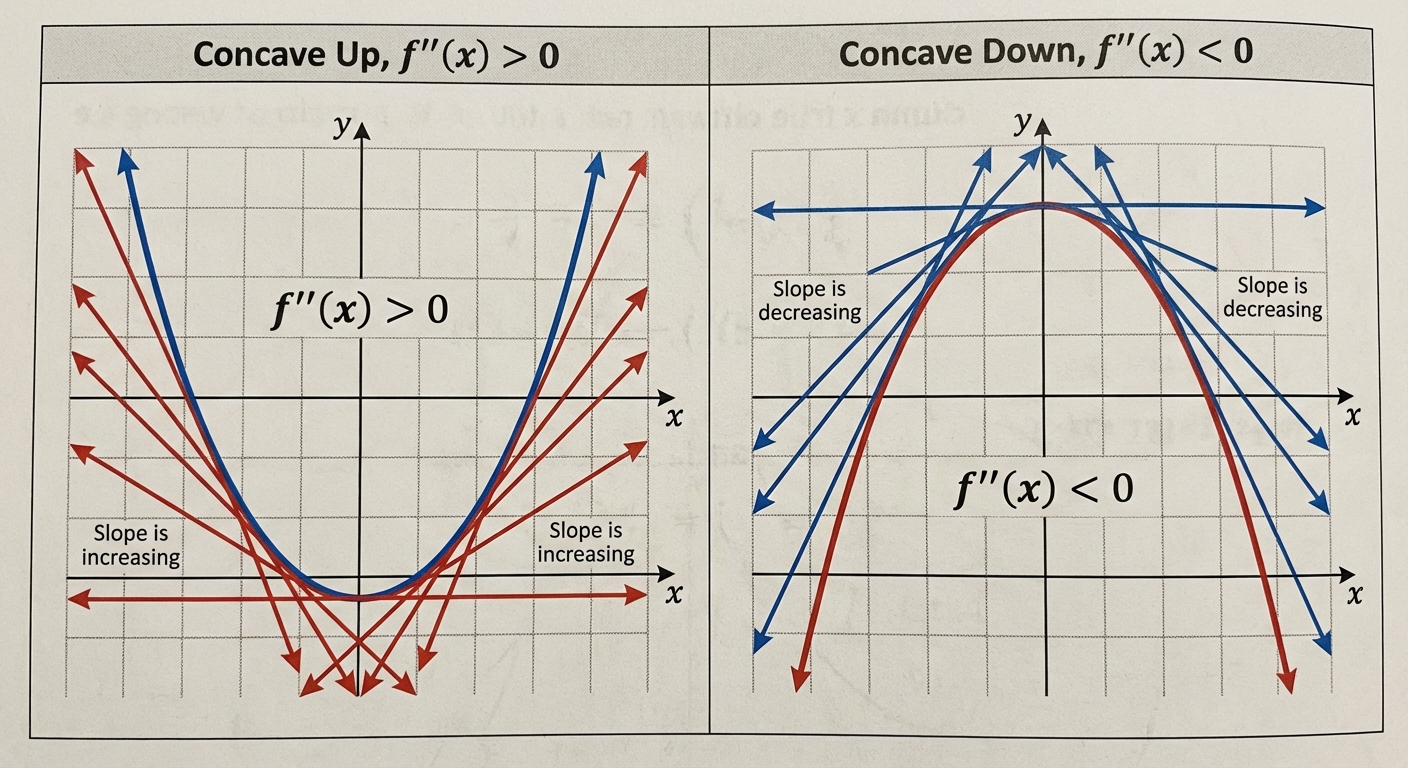
Concavity refers to the curvature of the graph—whether it opens up or down. This is determined by the second derivative, $f''(x)$.
Definitions
- Concave Up: $f(x)$ acts like a cup holding water. Slopes ($f'$) are increasing.
- Condition: $f''(x) > 0$
- Concave Down: $f(x)$ acts like a frown. Slopes ($f'$) are decreasing.
- Condition: $f''(x) < 0$
Point of Inflection (POI)
A Point of Inflection is a point where the graph changes concavity.
Conditions for a POI at $x=c$:
- The tangent line must exist at $c$ ($f$ is differentiable or has a vertical tangent).
- $f''(x)$ must change signs at $x=c$.
Note: $f''(c)=0$ is NOT sufficient to prove a POI. You must verify the sign change.
Example from previous function:
$f'(x) = 3x^2 - 12x + 9$
- Second Derivative: $f''(x) = 6x - 12$
- Find PIPs (Possible Inflection Points): Set $f''(x) = 0 \rightarrow 6x=12 \rightarrow x=2$.
- Sign Check:
- $x < 2$: $f''$ is Negative (Concave Down)
- $x > 2$: $f''$ is Positive (Concave Up)
- Since sign changes, $x=2$ is a Point of Inflection.
5.7 The Second Derivative Test (For Extrema)
This is an alternative method to determining if a critical point is a max or min without creating a full sign chart for $f'$.
The Rule:
Let $c$ be a critical point where $f'(c) = 0$.
- If $f''(c) > 0$ (Concave Up) $\rightarrow$ $c$ is a Relative Minimum.
- If $f''(c) < 0$ (Concave Down) $\rightarrow$ $c$ is a Relative Maximum.
- If $f''(c) = 0$, the test is inconclusive. (You must go back and use the First Derivative Test).
Mnemonic:
- $f''$ is Positive $(+)$ $\rightarrow$ Happy Face $\cup$ $\rightarrow$ Minimum at the bottom.
- $f''$ is Negative $(-)$ $\rightarrow$ Sad Face $\cap$ $\rightarrow$ Maximum at the top.
5.8 Connecting f, f', and f''
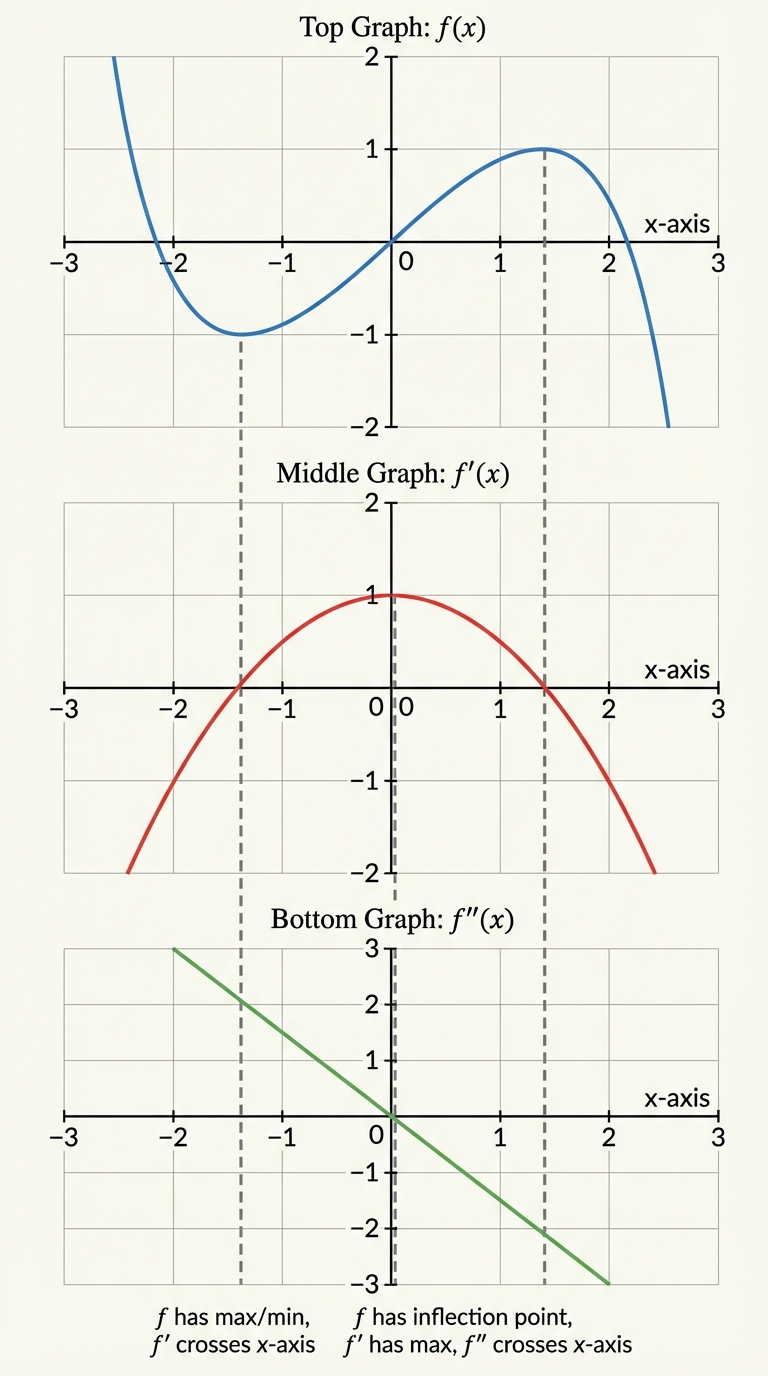
Understanding the relationship between the graph of a function and its derivatives is crucial for multiple-choice questions.
| Feature of $f(x)$ | Behavior of $f'(x)$ (Slope) | Behavior of $f''(x)$ (Concavity) |
|---|---|---|
| Increasing | Is Positive Above $x$-axis | N/A |
| Decreasing | Is Negative Below $x$-axis | N/A |
| Relative Max | Changes Pos to Neg ($x$-intercept) | Negative (usually) |
| Relative Min | Changes Neg to Pos ($x$-intercept) | Positive (usually) |
| Concave Up | Increasing (Going uphill) | Positive (Above $x$-axis) |
| Concave Down | Decreasing (Going downhill) | Negative (Below $x$-axis) |
| POI | Relative Max or Min (Peak/Valley) | Changes Sign ($x$-intercept) |
5.9 Optimization
Optimization involves finding the "best" value (maximum profit, minimum cost, minimum distance, max area) in real-world scenarios.
General Strategy
- Draw a Picture: Label constant values and variables.
- Primary Equation: Write the formula for the quantity you want to maximize/minimize.
- Constraint: Find an equation relating the variables (e.g., restricted amount of fencing).
- Substitution: Use the constraint to rewrite the Primary Equation in terms of a single variable.
- Domain: Identify the feasible interval $[a, b]$ for the variable.
- Calculus: Find $f'$, set to 0, and find critical points.
- Verification: Use the First Derivative Test or Candidates Test (if closed interval) to confirm max/min.
- Answer the Question: Check if it asks for the $x$-value or the resulting max/min dimension.
Summary of Common Mistakes & Pitfalls
- Forgetting Conditions: You cannot apply MVT, Rolle's, or EVT without stating that the function is continuous (and differentiable for MVT) on the specific interval.
- Relative vs. Absolute: Finding a local max does not mean you found the absolute max. Always check endpoints on closed intervals.
- Second Derivative Logic: A common error is thinking $f''(c)=0$ automatically means an inflection point. It is only a candidate; the sign must change.
- Misinterpreting Graphs: Do not confuse the graph of $f'$ with the graph of $f$. If looking at the graph of $f'$, a maximum represents a point of inflection for $f$, not a max for $f$.
- Incorrect Inconclusive Test: If the Second Derivative Test yields 0, do not say "there is no extrema." Say "the test fails" and use the First Derivative test instead.