AP Biology Unit 2: Comprehensive Guide to Membrane Structure & Permeability
Plasma Membranes: The Fluid Mosaic Model
The plasma membrane is the boundary that separates the living cell from its surroundings. It is best described by the Fluid Mosaic Model, a concept that frames the membrane as a mosaic of protein molecules bobbing in a fluid bilayer of phospholipids.
1. Phospholipids: The Foundation
The structural framework of the membrane consists of a phospholipid bilayer. Phospholipids are amphipathic molecules, meaning they possess both a hydrophilic (water-loving) region and a hydrophobic (water-fearing) region.
- Hydrophilic Head: Composed of a phosphate group and glycerol. It is polar and oriented outward toward the aqueous environment (both extracellular and intracellular).
- Hydrophobic Tails: Composed of two fatty acid chains. These are nonpolar and orient inward, away from water.
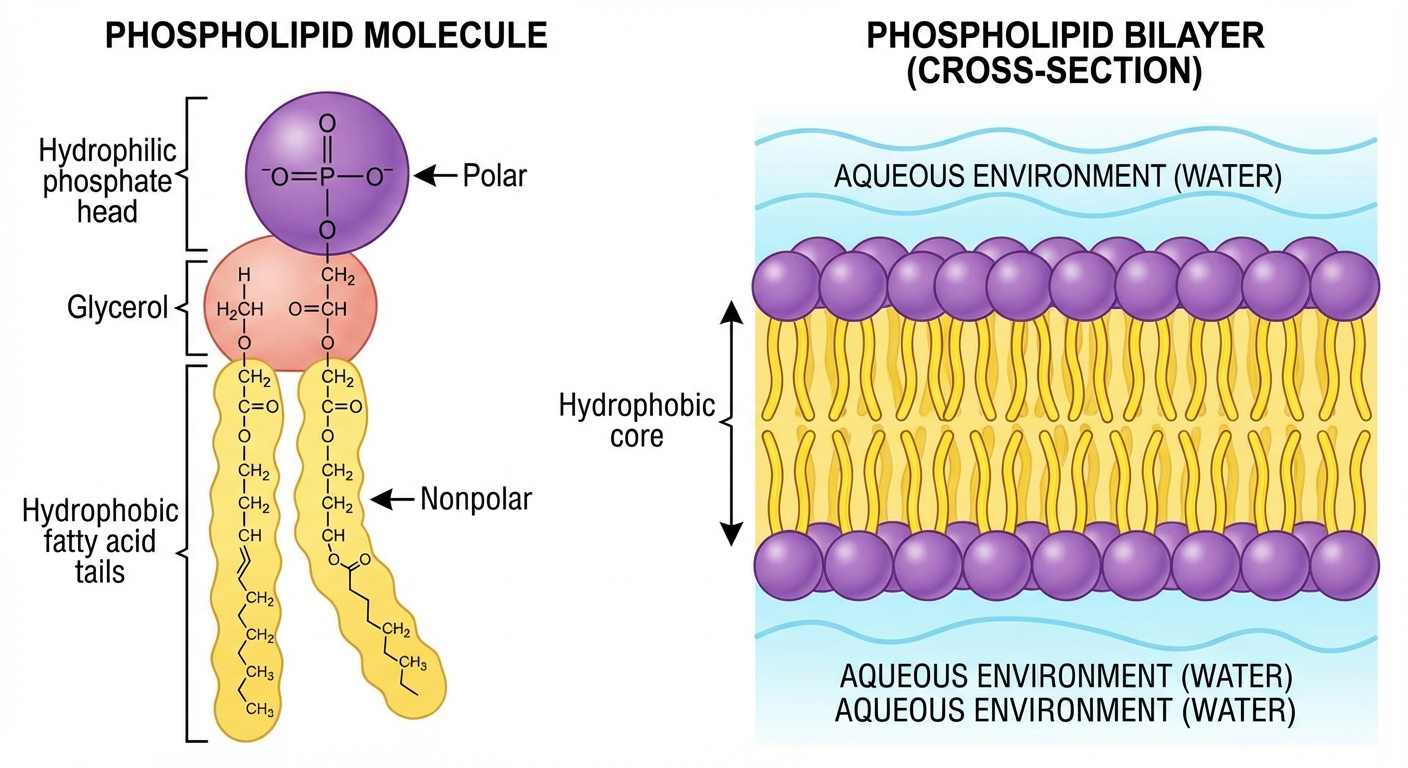
Membrane Fluidity
Membranes are not static sheets of molecules locked rigidly in place. They are held together primarily by weak hydrophobic interactions.
- Movement: Most lipids and some proteins shift laterally (side-to-side) very frequently ($~10^7$ times per second). Flip-flopping across the membrane is rare because the hydrophilic head typically cannot pass through the hydrophobic core.
- Fatty Acid Saturation:
- Unsaturated tails: Have kinks due to double bonds ($C=C$). This prevents tight packing, increasing fluidity.
- Saturated tails: Pack together tightly, increasing viscosity (making the membrane more solid).
2. Cholesterol: The "Fluidity Buffer"
Cholesterol is a wedge-shaped steroid found in animal cell membranes. It acts as a temperature buffer for membrane fluidity:
- High Temperatures (e.g., human body temp): Cholesterol restrains phospholipid movement, preventing the membrane from becoming too liquid.
- Low Temperatures: It hinders the close packing of phospholipids, preventing the membrane from solidifying.
3. Membrane Proteins
While lipids form the fabric, proteins determine the membrane's specific functions.
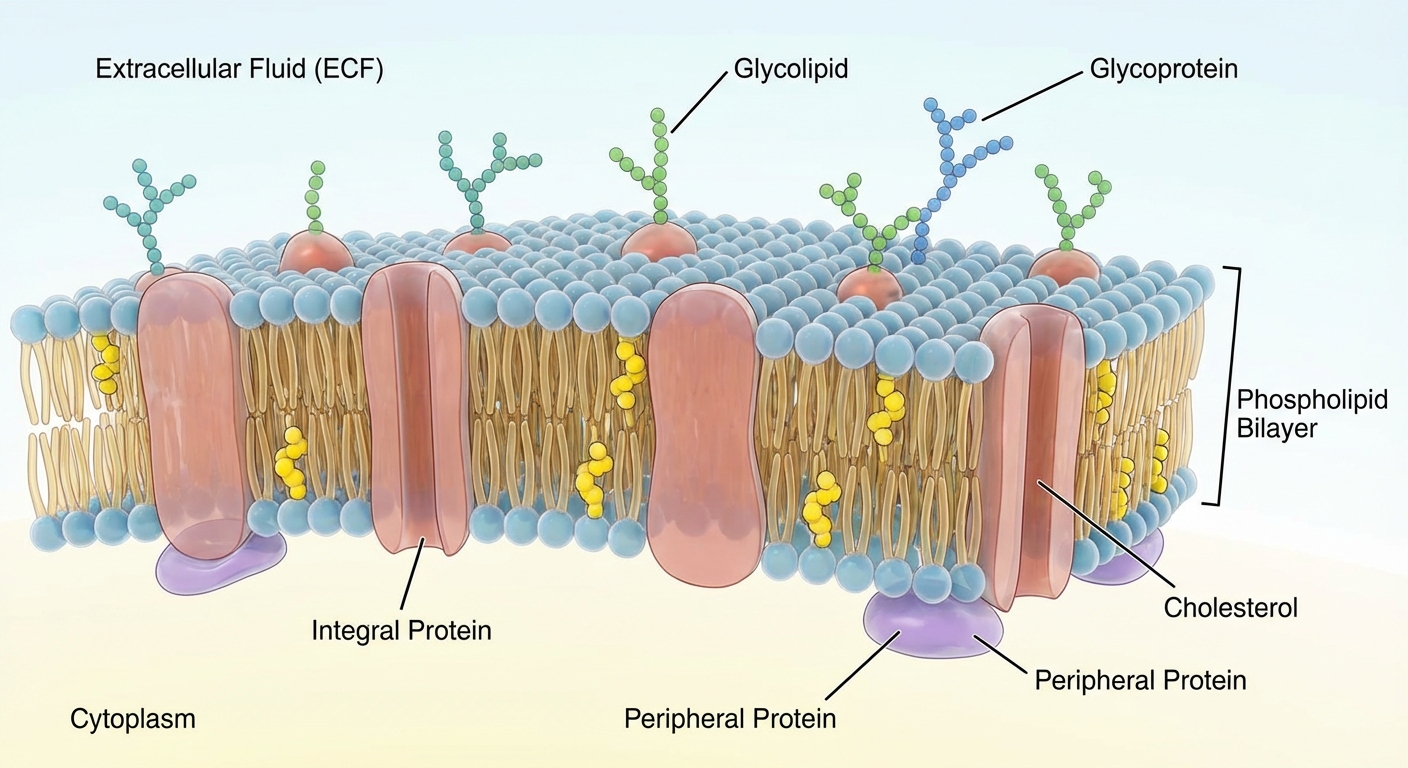
| Protein Type | Location | Characteristics |
|---|---|---|
| Integral Proteins | Penetrate the hydrophobic interior of the lipid bilayer. | The majority are transmembrane proteins, which span the entire membrane. The hydrophobic regions consist of one or more stretches of nonpolar amino acids (often coiled into $\alpha$-helices). |
| Peripheral Proteins | Loosely bound to the surface of the membrane. | Often exposed to parts of integral proteins. Can be attached to the cytoskeleton (inside) or ECM (outside). |
Six Major Functions of Membrane Proteins
- Transport: Moving substances across the membrane.
- Enzymatic Activity: Active site exposed to substances in the adjacent solution.
- Signal Transduction: Binding site (receptor) fits a specific chemical messenger (ligand).
- Cell-Cell Recognition: Identification tags (often glycoproteins).
- Intercellular Joining: Hooking cells together (gap junctions or tight junctions).
- Attachment: Connecting to the cytoskeleton and Extracellular Matrix (ECM) to maintain cell shape.
4. Carbohydrates: Cell Recognition
Membrane carbohydrates are usually short, branched chains of fewer than 15 sugar units. They function primarily as markers that distinguish one cell from another.
- Glycolipids: Carbohydrates covalently bonded to lipids.
- Glycoproteins: Carbohydrates covalently bonded to proteins (more common).
Membrane Permeability
The structure of the membrane results in selective permeability, meaning some substances can cross more easily than others. This regulation is crucial for maintaining homeostasis.
1. The Hydrophobic Barrier
The core of the membrane is hydrophobic. This chemical nature dictates the "rules of entry" for direct diffusion.
Easy Passage (Simple Diffusion)
Small, nonpolar molecules that are hydrophobic can dissolve in the lipid bilayer and cross it easily without the aid of membrane proteins.
- Examples: Hydrocarbons, Carbon Dioxide ($CO2$), Oxygen ($O2$), Nitrogen ($N_2$).
Difficult/Blocked Passage
Polar molecules and ions generally cannot pass through the hydrophobic interior directly.
- Examples: Sugars (glucose), water ($H_2O$), and ions ($Na^+, K^+, Ca^{2+}, Cl^-$).
2. Transport Proteins
To move hydrophilic substances across the membrane, cells use rigid structures called transport proteins that span the membrane.
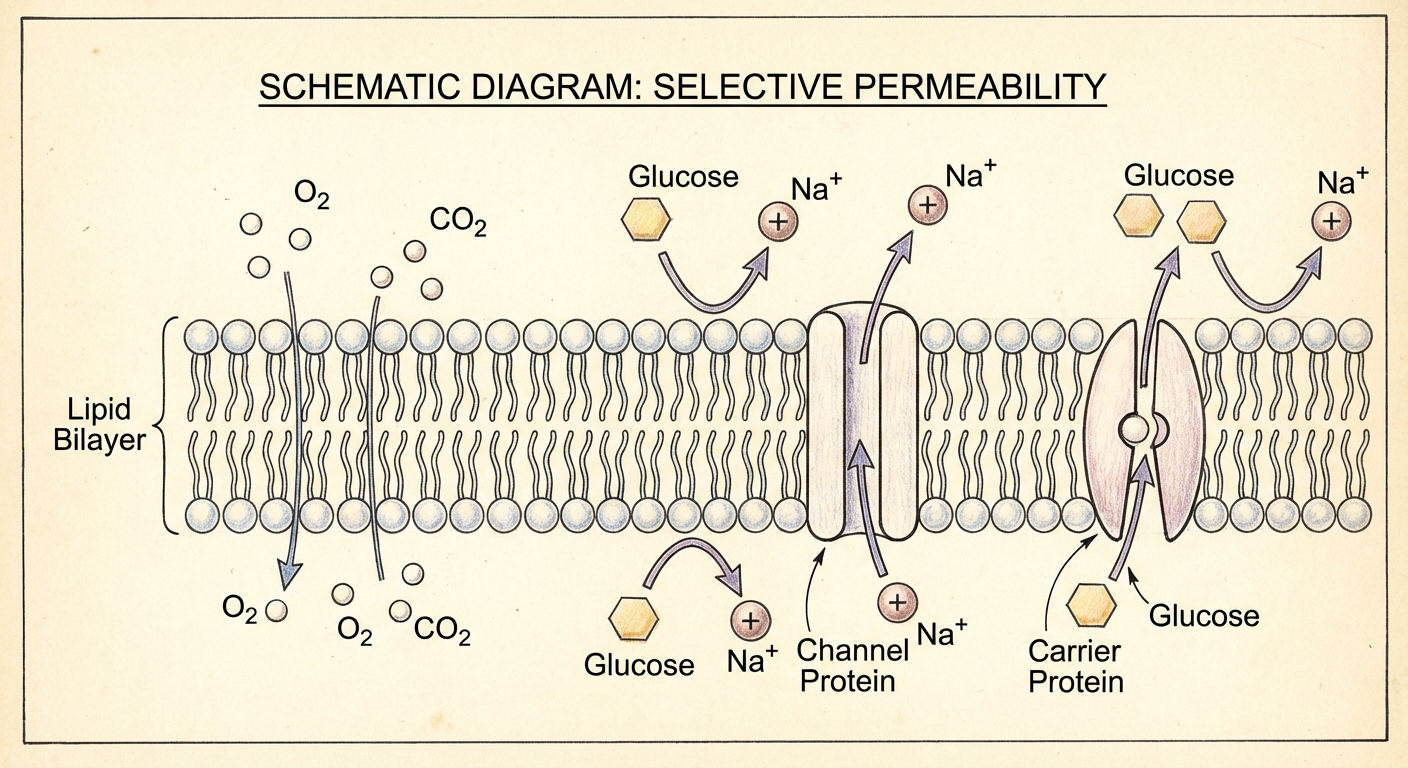
Channel Proteins
These have a hydrophilic channel that certain molecules or ions use as a tunnel.
- Aquaporins: Specialized channel proteins that facilitate the massive passage of water molecules (up to 3 billion molecules per second).
- Ion Channels: Specific for certain ions; many are "gated" and open/close in response to a stimulus.
Carrier Proteins
These hold onto their passengers and change shape in a way that shuttles them across the membrane. This process is highly specific (like a lock and key); a carrier protein for glucose will not transport fructose.
3. Cell Walls
While not part of the plasma membrane, the cell wall is an extracellular structure in plants, prokaryotes, and fungi that contributes to permeability and structural integrity.
- Composition by Organism:
- Plants: Cellulose (polysaccharide).
- Fungi: Chitin.
- Bacteria: Peptidoglycan.
- Function: Provides a rigid boundary, prevents excessive uptake of water, and maintains shape. It is much thicker than the plasma membrane and is generally permeable to most small molecules, acting more like a coarse mesh than a selective barrier like the membrane.
Summary & Review
Mnemonic: "Fluid Mosaic"
- Fluid: The pieces (lipids/proteins) move laterally; they are not frozen in place.
- Mosaic: It is made of many different pieces (phospholipids, proteins, cholesterol, carbs) working together.
Common Mistakes & Pitfalls
- Thinking the membrane is solid: Students often conceptualize the membrane as a hard shell (like an eggshell). Remember it is fluid, similar to the consistency of salad oil.
- Confusing "Cell Wall" and "Cell Membrane": All cells have a plasma membrane. Only some (plants, fungi, bacteria) have cell walls. The membrane controls selective transport; the wall provides structural support.
- Water Permeability: Students often think water cannot pass the membrane at all because it is polar. While water diffuses very slowly across the bilayer, it moves rapidly via aquaporins.
- Cholesterol's Function: Don't forget cholesterol's dual role. It stabilizes the membrane at high temps but prevents freezing at low temps. It is NOT an energy source in this context.