Dynamics of Japanese Households: Unit 1 Study Guide
Family Roles and Relationships
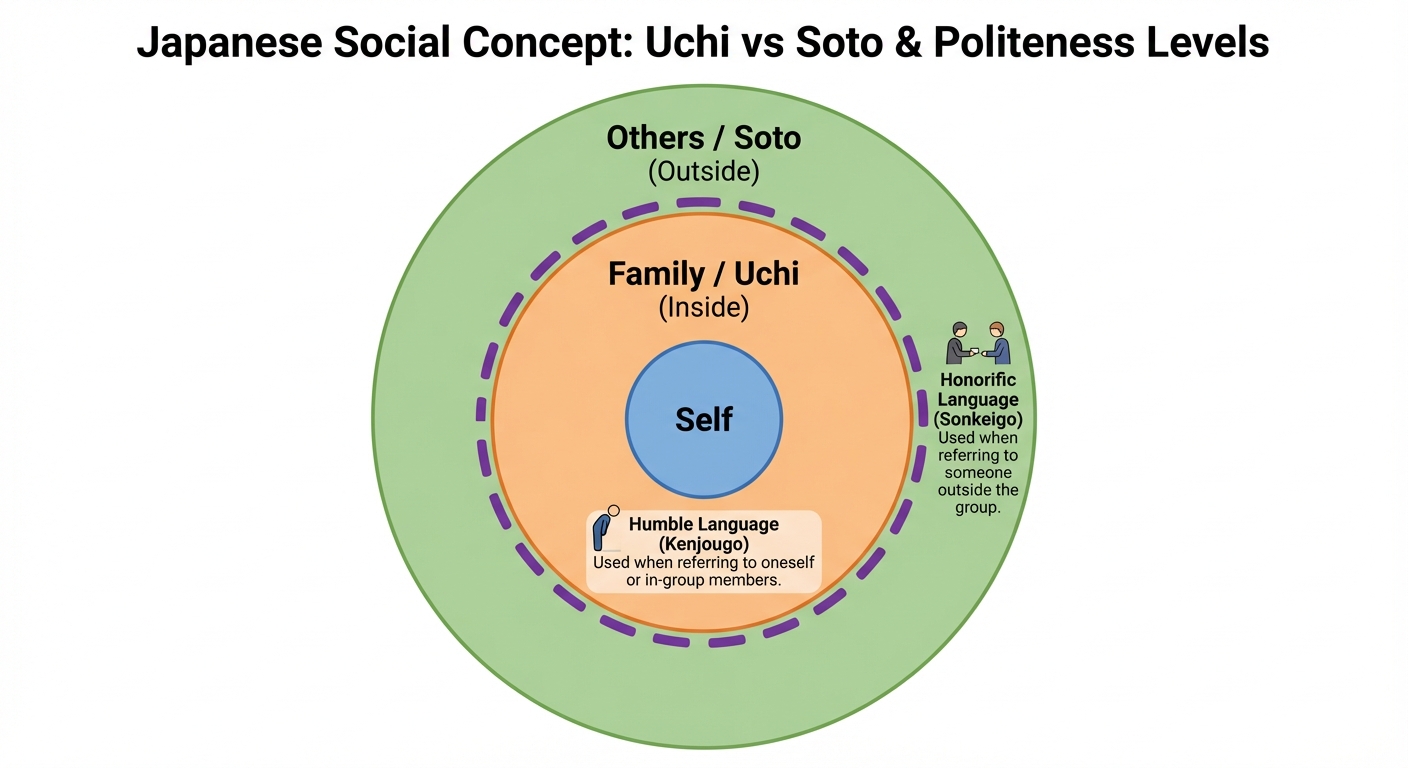
Understanding the Japanese family (Kazoku) is essential not just for vocabulary, but for grasping the fundamental social structure of Japan. The family unit often serves as a microcosm for how Japanese people interact with society at large, particularly through the concepts of Uchi (inside/in-group) and Soto (outside/out-group).
Traditional vs. Modern Structures
Historically, the Japanese family followed the Ie System (household system), a patriarchal structure where the eldest son inherited the household.
- Daikazoku (Large/Extended Family): Historically common, consisting of three generations (grandparents, parents, children) living under one roof. While less common in urban Tokyo, this is still seen in rural areas.
- Kakukazoku (Nuclear Family): The dominant structure in modern Japan, consisting only of parents and children.
- Tanshin-funin (Job Transfer apart from family): A unique business culture phenomenon where a father is transferred to a different city/country for work, while the rest of the family stays behind to avoid disrupting the children's education.
Gender Roles and Parenting
- Sengyō-shufu (Full-time Housewife): Traditionally, the mother managed the household finances (holding the saifu or wallet) and education (kyōiku mama), while the father was the breadwinner.
- Tomobataraki (Dual-income family): In modern Japan, due to economic necessity, both parents working is increasingly common.
- Ikumen: A modern term combining "Ikuji" (child-raising) and "Men." It refers to fathers who are actively involved in child-rearing, significantly shifting away from the traditional absent workaholic father figure.
The Uchi-Soto Dynamic in Language
One of the most tested concepts in AP Japanese is the linguistic shift based on whom you are talking to. You must distinctively use Humble forms for your own family and Honorific forms for others.
| Person | Your Family (Talking to others) - Uchi | Someone Else's Family (Talking to them) - Soto |
|---|---|---|
| Father | Chichi (父) | Otōsan (お父さん) |
| Mother | Haha (母) | Okāsan (お母さん) |
| Older Brother | Ani (兄) | Oniisan (お兄さん) |
| Older Sister | Ane (姉) | Oneesan (お姉さん) |
| Younger Siblings | Otōto/Imōto (弟/妹) | Otōtosan/Imōtosan (弟さん/妹さん) |
| Wife | Tsuma/Kanai (妻/家内) | Okusan (奥さん) |
| Husband | Otto/Shujin (夫/主人) | Goshujin (ご主人) |
Customs, Ceremonies, and Traditions
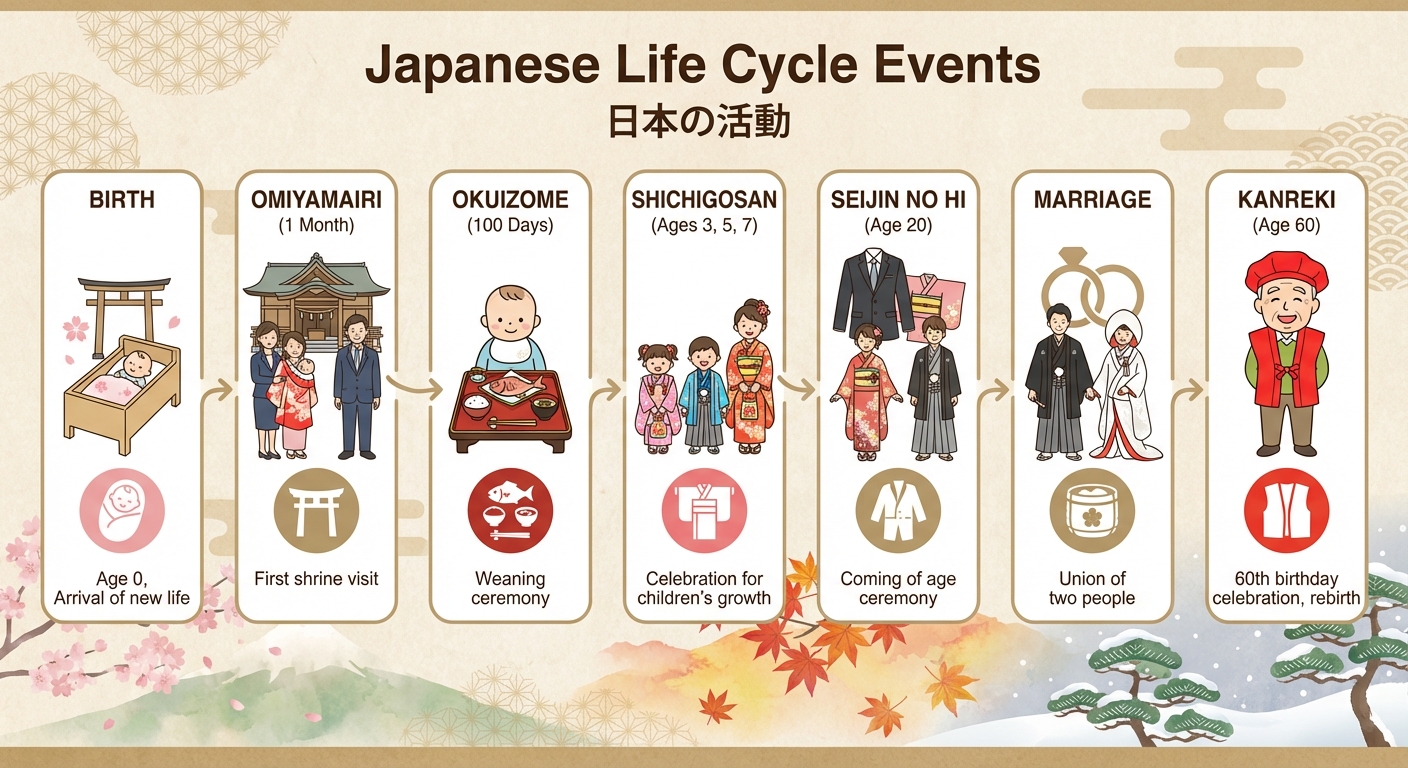
Japanese families are bound together by specific life-cycle events (Kankonsōsai - ceremonial occasions). Knowing these is crucial for the "Cultural Perspective" part of the exam.
Vital Life Events
- Omiyamairi (Shrine Visitation): Approx. one month after birth, babies are taken to a Shinto shrine to pray for healthy growth. This introduces the child to the community's guardian deity.
- Okuizome: Around 100 days after birth, a ritual "first meal" is simulated to wish that the child will never go hungry.
- Shichigosan (7-5-3 Festival): Held on November 15th. Girls aged 3 and 7, and boys aged 3 and 5, dress in Kimono and visit shrines. Parents buy Chitose-ame (thousand-year candy) symbolizing longevity.
- Seijin no Hi (Coming of Age Day): Second Monday of January. Those turning 20 (the legal adult age, though voting is now 18) wear formal dress (often Furisode kimonos for women, suits or Hakama for men) and attend municipal ceremonies.
Seasonal Family Gatherings
- O-Shōgatsu (New Year): The most important family event. Relatives gather to eat Osechi-ryōri (traditional preserved foods with symbolic meanings). Children receive Otoshidama (money in envelopes) from older relatives.
- O-Bon (Festival of the Dead): In mid-August, families return to their hometowns (Kisei) to visit ancestors' graves (Ohaka-mairi). It is believed ancestors' spirits return to the household altar (Butsudan).
Generational Differences and Perspectives
Modern Japan is facing a demographic crisis that heavily influences family dynamics and is a frequent topic in AP reading comprehension passages.
Shōshikōreika (Low Birth Rate and Aging Population)
This is a critical term to memorize.
- Demographic Shift: People are living longer (Chōju), but fewer babies are being born. This inverts the population pyramid.
- Impact on Family:
- Caregiving (Kaigo): Traditionally, the eldest son's wife cared for aging in-laws. Now, with more women working, families rely on nursing homes or professional home care, creating tension between traditional values (Oyakōkō - filial piety) and modern reality.
- Parasite Singles: A term for adult children who live with their parents well into their 20s and 30s to enjoy a comfortable standard of living while delaying marriage.
Changing Views on Marriage
- Banka (Late Marriage): The average age of marriage has risen significantly.
- Omiai (Arranged Marriage) vs. Ren-ai (Love Match): While Omiai still exists (often via matchmaking apps or services essentially acting as the "go-between"), the vast majority of marriages today are Ren-ai.
Cultural Comparison Strategy
When writing or speaking about families for the AP exam, consider contrasting Japan with your own culture using these axes:
- Independence vs. Interdependence: American families often value independence at age 18. Japanese families value Amae (dependency/reliance on the benevolence of others) and often support children until marriage.
- Elder Care: Sending parents to nursing homes is common in the West, but carries a stigma of "abandonment" in traditional Japanese views, though this is changing due to necessity.
- Dining: The concept of the whole family eating seated on the floor around a Kotatsu (heated table) versus individual dining times.
Common Mistakes & Pitfalls
- The "San" Error: Never attach "-san" to your own family members when talking to an outsider. (e.g., Saying "My Okaasan is kind" is wrong; say "My Haha is kind.")
- Stereotyping: Do not assume all Japanese women are housewives. Avoid absolute statements like "Japanese women do not work." Instead, use phrases like "In the past…" (Mukashi wa) vs. "Recently…" (Saikin wa).
- Siblings Vocab: Students often forget that "Kyōdai" (siblings) usually refers to brothers or mixed siblings. If asking specifically about sisters, use "Shimai."
Vocabulary Checklist
- 世帯 (Setai): Household
- 親孝行 (Oyakōkō): Filial piety/devotion to parents
- 一人暮らし (Hitorigurashi): Living alone
- 共働き (Tomobataraki): Dual income
- 孫 (Mago): Grandchild