Mechanics: Dynamics of Work and Energy
Conservation Principles: Work, Energy, and Power
3.1 Work and the Work-Energy Theorem
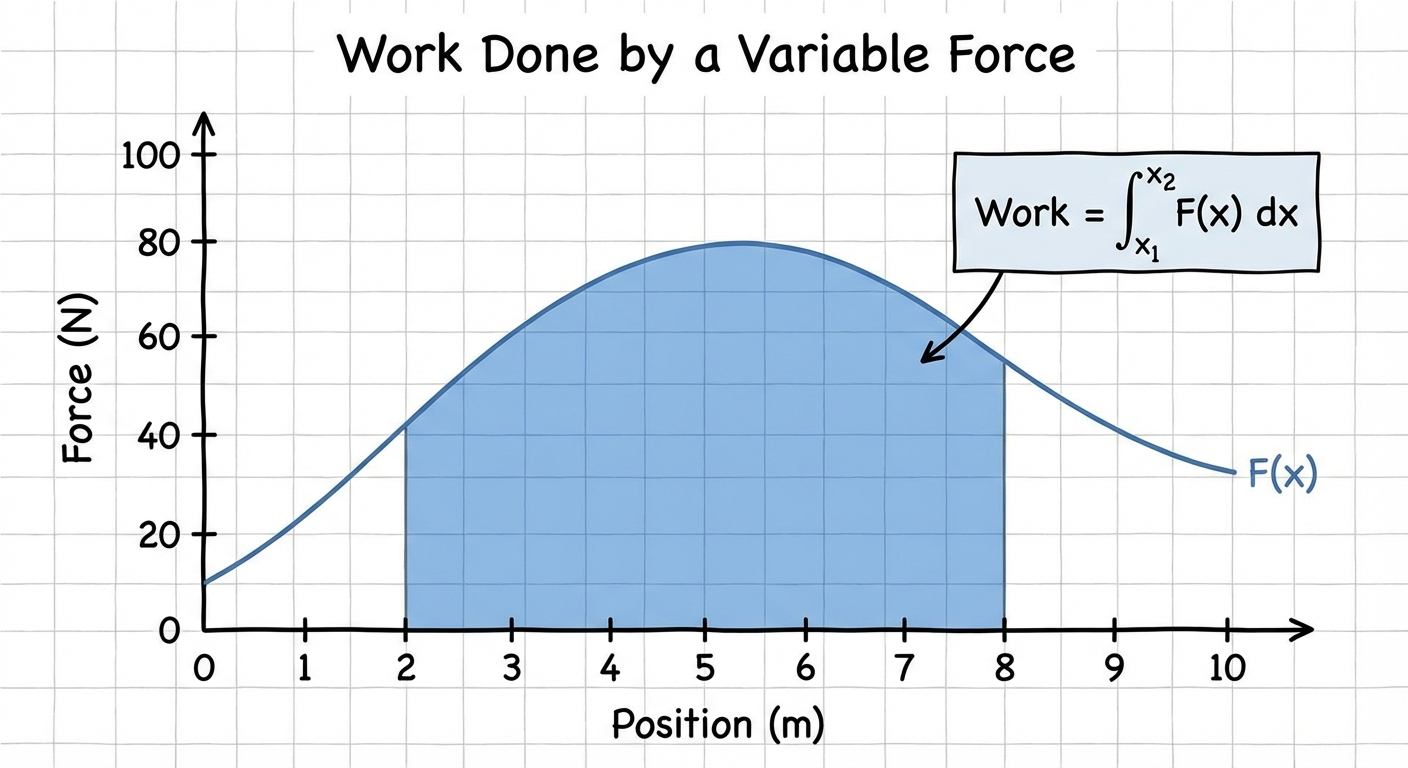
Defining Work with Calculus
In physics, Work ($W$) is the measure of energy transfer that occurs when an object is moved over a distance by an external force at least partially in the direction of the displacement. Unlike everyday language, work is a strict scalar quantity—it has magnitude but no direction.
For AP Physics C, we move beyond simple algebra. If a force $\vec{F}$ varies as a function of position, or if the path is curved, work is defined as the line integral of the force along the path $C$:
Where:
- $\vec{F}$ is the force vector.
- $d\vec{r}$ is the infinitesimal displacement vector.
- The dot product ($\cdot$) indicates that only the component of force parallel to displacement contributes to work.
Special Case: Constant Force
If the force is constant in both magnitude and direction, the integral simplifies to the dot product of the force and displacement vectors:
- $\theta$: The angle between the force vector and the displacement vector.
- Unit: Joule ($J$) or Newton-meter ($N\cdot m$).
- Sign Conventions:
- Positive Work ($W > 0$): Force acts in the direction of motion ($0^\circ \le \theta < 90^\circ$). The object gains energy.
- Negative Work ($W < 0$): Force acts opposing motion ($90^\circ < \theta \le 180^\circ$). The object loses energy (e.g., friction).
- Zero Work ($W = 0$): Force is perpendicular to motion ($\theta = 90^\circ$) or displacement is zero. Centripetal force does zero work.
Sample Problem: Constant Force
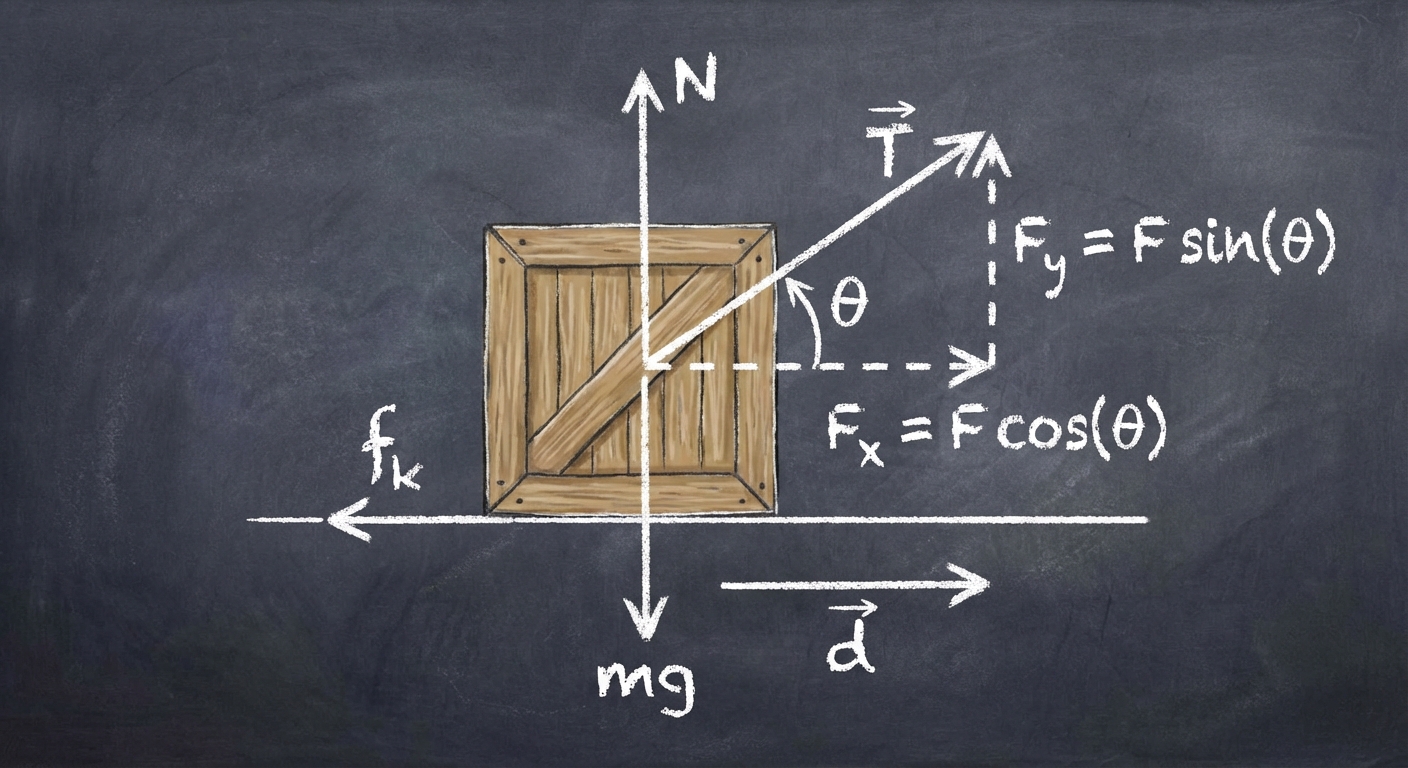
Scenario: A 15 kg crate is moved along a horizontal floor by a worker pulling a rope. The rope makes a $30^\circ$ angle with the horizontal. The tension in the rope is 200 N, and the crate slides 10 m. Friction is negligible. How much work is done by the rope?
Solution:
- Identify the knowns: $F_T = 200\,N$, $d = 10\,m$, $\theta = 30^\circ$.
- Apply the dot product definition. Only the horizontal component of the tension ($F_T \cos \theta$) moves the crate.
- Calculate:
Kinetic Energy and Variable Forces
Kinetic Energy (KE) is the energy of motion. For a point mass, it is defined as:
The Work-Energy Theorem
The net work done on an object equals its change in kinetic energy. This theorem is derived directly from Newton's Second Law ($F_{net}=ma$) using the chain rule for acceleration ($a = v \frac{dv}{dx}$).
Key Consequence: If you know the work done by the net force, you can find the final speed without knowing time or acceleration details.
Sample Problem: Variable Force (Spring)
How much work is required to compress a spring with spring constant $k = 500\,N/m$ from its equilibrium position ($x=0$) to a compression of $x=0.2\,m$?
Solution:
- The force required to compress a spring opposes the restoring force, so $F_{applied} = kx$.
- Since $F$ varies with $x$, we integrate:
3.2 Conservative Forces and Potential Energy
Conservative vs. Non-Conservative Forces
Not all forces store energy. We distinguish between:
- Conservative Forces: Work done is independent of the path taken; it depends only on initial and final positions. Work done on a closed loop is zero.
- Examples: Gravity, Spring force ($F_s = -kx$).
- These forces are associated with Potential Energy ($U$).
- Non-Conservative Forces: Work depends on the path. Energy is usually dissipated as heat or sound.
- Examples: Friction, Air resistance, Applied push/pull.
Potential Energy ($U$)
Potential energy is energy stored due to an object's position within a system. We define the change in potential energy as the negative of the work done by a conservative force:
Common Types of Potential Energy
| Type | Force Formula | Potential Energy Formula | Notes |
|---|---|---|---|
| Gravitational (Earth surface) | $\vec{F}_g = m\vec{g}$ | $U_g = mgh$ | Assumes constant $g$. $h=0$ is arbitrary. |
| Elastic (Spring) | $\vec{F}_s = -k\vec{x}$ | $U_s = \frac{1}{2}kx^2$ | $x$ is displacement from equilibrium. |
| Universal Gravitation | $\vec{F}_G = -\frac{GMm}{r^2}\hat{r}$ | $U_G = -\frac{GMm}{r}$ | Used for large distances (satellites). |
The Gradient: Finding Force from Potential Energy
This is a critical Calculus concept for AP Physics C. Since $\Delta U = - \int F \cdot dx$, we can reverse this using a derivative. In one dimension:
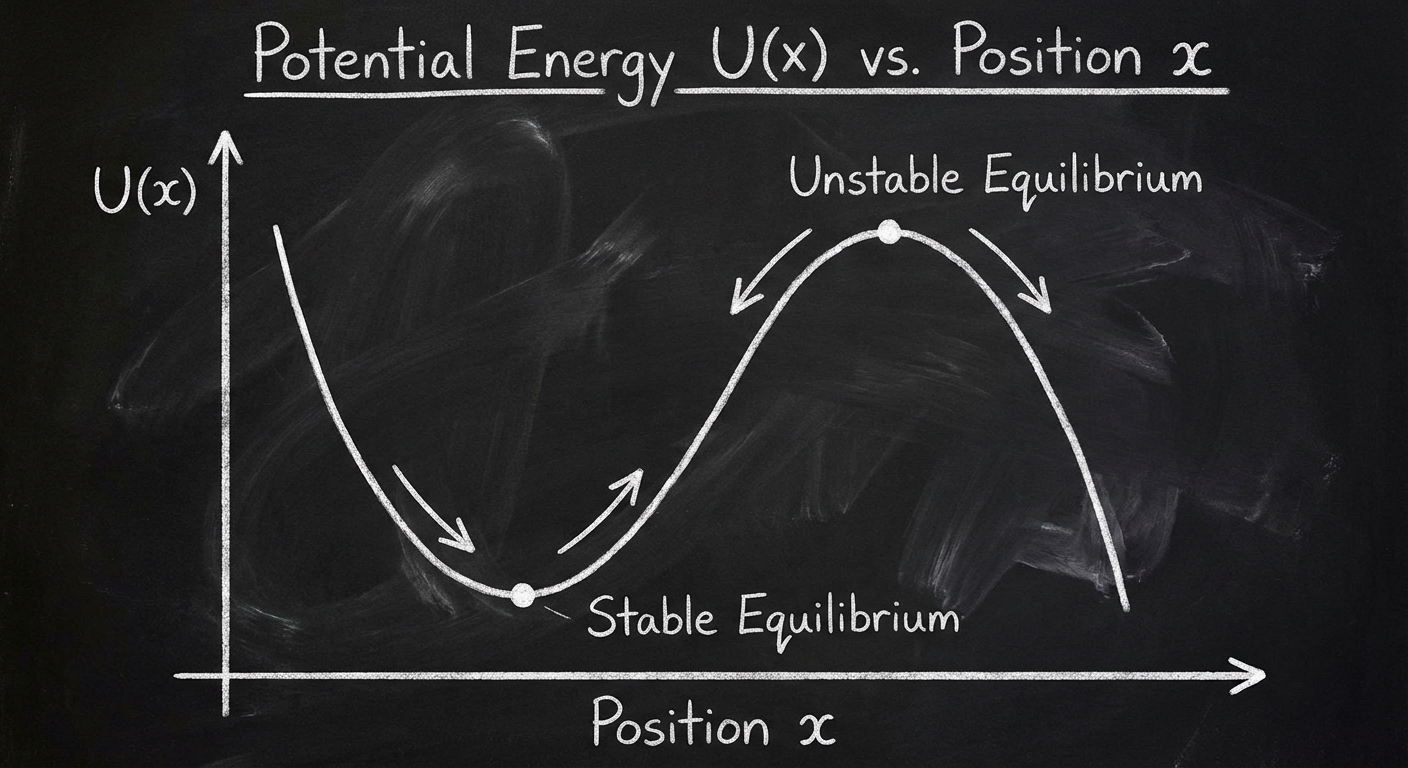
Visually, on a graph of Potential Energy $U(x)$ vs. Position $x$:
- The Force is the negative of the slope.
- Equilibrium Points: Where slope $= 0$ (Force $= 0$).
- Stable Equilibrium: Logic dictates the particle enters a "valley" (rel. min). Displacement creates a restoring force.
- Unstable Equilibrium: The particle is on a "hill" (rel. max). Displacement creates a force pushing it further away.
Sample Problem: Analysis of U(x)
A particle moves along the x-axis with potential energy $U(x) = 4x^2 - x^3$ (J). Find the equilibrium points and categorize them.
Solution:
- Find Force: $F(x) = -\frac{dU}{dx} = -(8x - 3x^2) = 3x^2 - 8x$.
- Find Equilibrium: Set $F(x) = 0$.
- Determine Stability (Second Derivative Test or slope inspection):
- At $x=0$, graph is near minimum? $U(0)=0$. Small $+x$ gives positive $U$. Small $-x$ gives positive $U$. It is a local minimum $\rightarrow$ Stable.
- Alternatively, check concavity: $\frac{d^2U}{dx^2} = 8 - 6x$. At $x=0$, pos (concave up). Stable.
3.3 Conservation of Energy
Conservation of Mechanical Energy
In a system where only conservative forces do work (no friction, no air resistance, no motor adding energy), the total Mechanical Energy ($E$) remains constant.
Stuntwoman Example:
A 60 kg stuntwoman jumps from a 40 m cliff ($v_i = 0$) onto a cushion. What is her landing speed?
- System: Stuntwoman + Earth.
- Step 1: Initial State (Top). $Ki = 0$, $Ui = mgh = (60)(9.8)(40) = 23,520\,J$.
- Step 2: Final State (Bottom). $h=0 \Rightarrow Uf = 0$. $Kf = \frac{1}{2}mv^2$.
- Step 3: Conserve. $23,520 = \frac{1}{2}(60)v^2$.
- Step 4: Solve. $v = \sqrt{2(23520)/60} \approx 28\,m/s$.
Conservation with Non-Conservative Forces
If non-conservative forces (like friction) act on the system, mechanical energy is not conserved. The change in total mechanical energy equals the work done by these non-conservative forces:
- If friction is present, $W_{friction}$ is negative, representing energy lost to thermal energy.
3.4 Power
Time is irrelevant for Work vs. Energy calculations, but in engineering, how fast work is done matters. Power is the rate of energy transfer.
Average and Instantaneous Power
- Average Power: $P_{avg} = \frac{\Delta W}{\Delta t}$
- Instantaneous Power: The derivative of work with respect to time.
Power in terms of Velocity
Using the chain rule, since $dW = F \cdot dx$:
This form is incredibly useful for vehicles (rockets, cars) moving at constant velocity against resistance.
Sample Problem: Rocket Power
A rocket moves at a constant speed of $8.0\,m/s$ vertically against gravity. Mass $= 1000\,kg$. What is the engine's power?
Solution:
- To move at constant velocity, $a=0$, so Net Force $= 0$. The Engine Force must balance Gravity ($mg$).
- Power output:
Common Mistakes & Pitfalls
Confusing Signs in Work:
- Student error: Always assuming $W = Fd$.
- Correction: Check the angle. If force opposes motion (friction), Work is negative. If force is perpendicular, Work is zero.
Neglecting the System Boundary:
- Student error: Double counting gravity. Calculating both Work done by gravity and change in Gravitational Potential Energy in the same equation.
- Correction: Either treat gravity as an external force doing Work ($W{ext} = \Delta K$) OR treat the Earth as part of the system and use Potential Energy ($Ki + Ui = Kf + U_f$). Never do both.
Mixing up Potential Energy references:
- Student error: Changing where $h=0$ is defined midway through a problem.
- Correction: Pick a reference line (usually the lowest point in the problem) and stick to it.
Integration errors:
- Student error: Moving a variable force outside the integral sign.
- Correction: If $F$ depends on position ($kx$ or $GmM/r^2$), you must integrate. You cannot use simple algebra.