Unit 1: Fundamentals of Time and Expression
Rhythm and Note Duration
Music exists in time. While pitch determines what note is played, rhythm determines when and for how long. In AP Music Theory, precision in calculating duration and understanding notational hierarchy is critical for both sight-singing and harmonic analysis.
The Anatomy of a Note
To discuss rhythm accurately, you must identify the physical components of musical notation:
- Notehead: The oval part of the note. It can be filled (black) or open (white).
- Stem: The vertical line attached to the notehead. Stem direction generally follows the "middle line rule" (notes below the middle line have stems up; notes on or above have stems down).
- Flag: The curved stroke attached to the right side of the stem. Each flag halves the value of the note.
- Beam: A thick horizontal line connecting two or more stemmed notes. Beams replace flags and are used to group notes visually according to the beat.
Hierarchy of Values
Rhythmic notation is based on a binary system of division. Starting from the whole note, each subsequent note value is exactly half the duration of the previous one.
| Note Name | Relative Duration | Symbol Features | Rest Symbol |
|---|---|---|---|
| Whole Note | 1 | Open head, no stem | Box hanging below 4th line |
| Half Note | 1/2 | Open head, stem | Box sitting on 3rd line |
| Quarter Note | 1/4 | Filled head, stem | Squiggly vertical line |
| Eighth Note | 1/8 | Filled head, stem, 1 flag/beam | Stem with 1 flag |
| Sixteenth Note | 1/16 | Filled head, stem, 2 flags/beams | Stem with 2 flags |
Augmenting Rhythm: Dots and Ties
Composers use dots and ties to create durations that do not fit the standard binary powers of two (like a duration of 3 beats).
1. The Augmentation Dot
A dot placed to the right of a notehead increases the note's duration by half its original value.
- Example: A dotted half note ($d.$) = Half note ($d$) + Quarter note ($d$) = 3 Quarter notes.
- Double Dot: A second dot adds half the value of the first dot. A double-dotted half note = Half + Quarter + Eighth.
2. The Tie
A curved line connecting two notes of the same pitch. The durations are added together, and the second note is not re-articulated.
Note: Do not confuse a tie with a slur. A tie connects identical pitches (rhythmic addition); a slur connects different pitches (articulation/phrasing).
Meter
Meter is the organizational pattern of strong and weak beats. It provides the "grid" upon which rhythm is placed. In AP Music Theory, you must analyze meter based on how the beat is divided.
Time Signatures
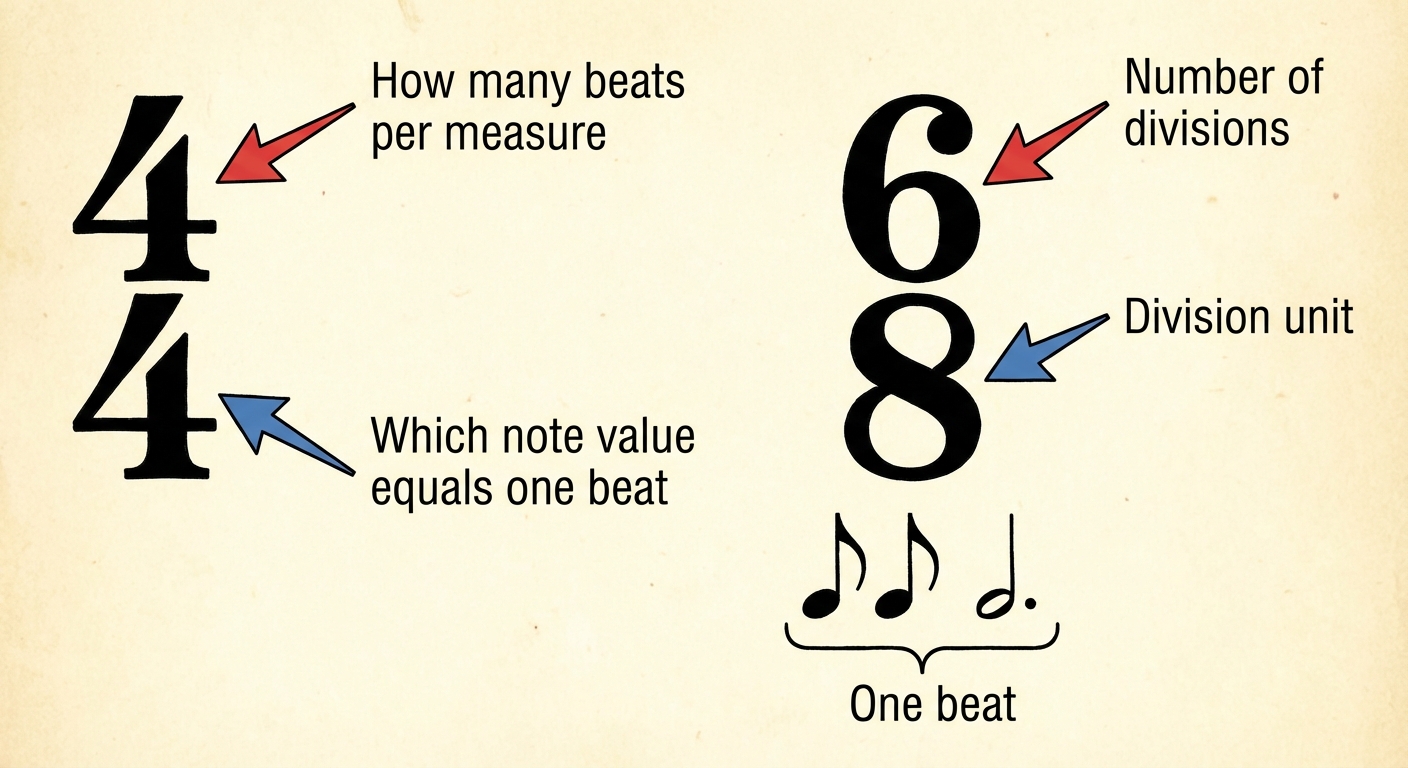
The time signature appears at the start of a piece (and wherever the meter changes). It consists of two numbers stacked vertically.
Meter Classification
Meters are classified by two criteria: Beat Division (Simple vs. Compound) and Number of Beats (Duple, Triple, Quadruple).
1. Simple Meter
In Simple Meter, the beat is divisible by two.
- Top Number: Represents the number of beats per measure (2, 3, or 4).
- Bottom Number: Represents the note value that gets the beat (usually 4 for quarter note, 2 for half note).
- The Beat: A non-dotted note (e.g., a quarter note).
| Classification | Time Signatures | Beats per measure | Pulse Pattern |
|---|---|---|---|
| Simple Duple | 2/4, 2/2 | 2 | Strong - weak |
| Simple Triple | 3/4, 3/8, 3/2 | 3 | Strong - weak - weak |
| Simple Quadruple | 4/4 (C) | 4 | Strong - weak - Medium - weak |
Memory Aid: Common Time (C) is 4/4. Cut Time (Alla Breve, $\cent$) is 2/2.
2. Compound Meter
In Compound Meter, the beat is divisible by three. This is the source of significant confusion for valid reasons: standard notation does not have a single number to represent a "dotted" note.
- Top Number: Usually 6, 9, or 12. This number represents the division of the beat, not the beat itself.
- Bottom Number: Usually 8. Represents the division value.
- The Beat: A dotted note.
To find the number of beats in compound meter, divide the top number by 3.
| Classification | Time Signatures | Beats per measure | The Beat Unit |
|---|---|---|---|
| Compound Duple | 6/8 | 2 | Dotted Quarter |
| Compound Triple | 9/8 | 3 | Dotted Quarter |
| Compound Quadruple | 12/8 | 4 | Dotted Quarter |
Key Difference Example:
- 3/4: Three beats. Beat is a quarter note. Count: ONE - and - TWO - and - THREE - and.
- 6/8: Two beats. Beat is a dotted quarter note. Count: ONE - la - li - TWO - la - li.
Rhythmic Grouping and Beaming
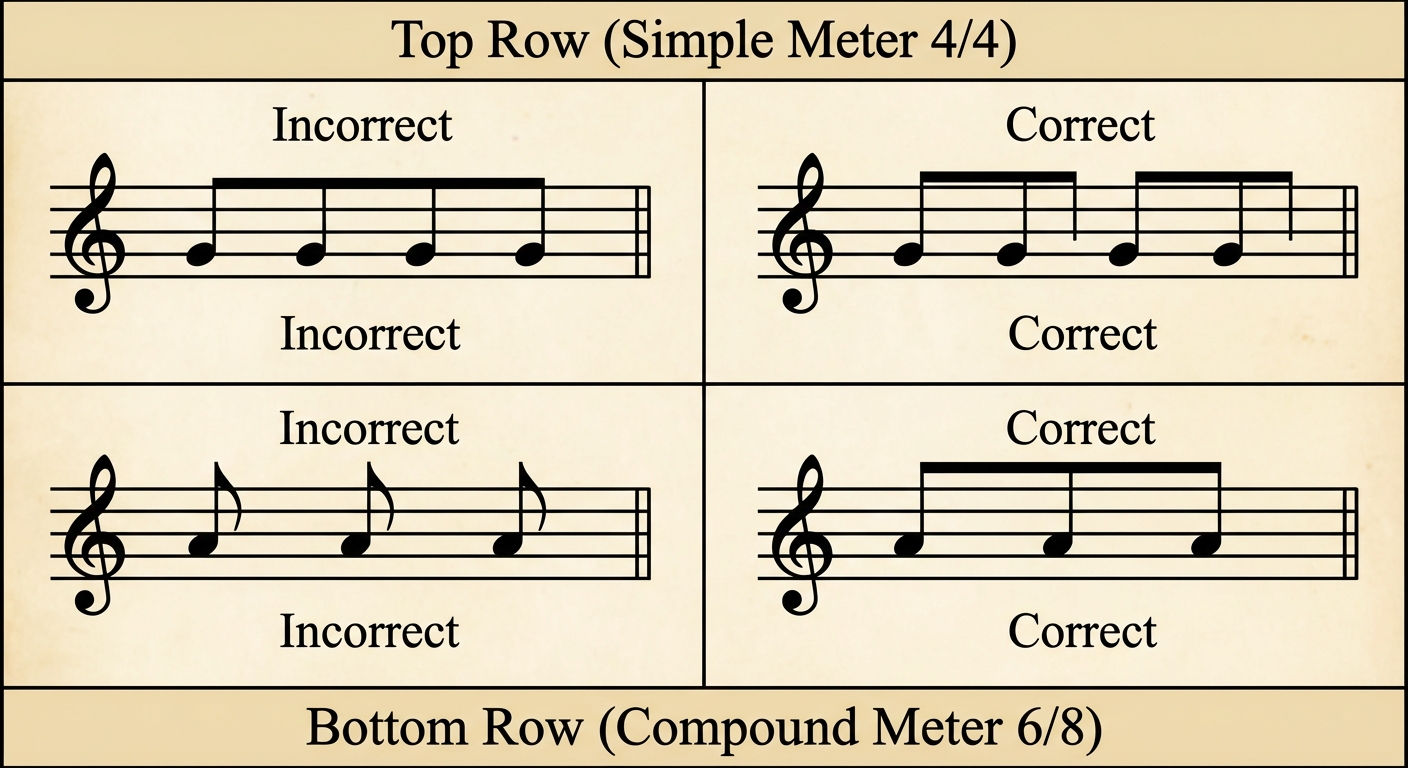
On the AP exam, you may be asked to correct rhythmic notation. The simplistic rule is: Show the Beat.
- Do not beam across beat boundaries: In 4/4, you usually shouldn't beam beat 2 into beat 3 (crossing the imaginary "middle of the bar").
- Visual clarity: In simple meter, beam in groups of 2 or 4 eighth notes. In compound meter (like 6/8), beam in groups of 3 eighth notes to show the dotted-quarter beat.
Tempo, Dynamics, and Expressive Elements
The "Expression" component involves the terminology that tells a musician how to play, not just what to play. You must memorize standard Italian terms.
Tempo (Speed)
Tempo markings are generally synonymous with Italian descriptors of mood or movement.
Slow Tempos
- Grave: Very slow, solemn
- Largo: Broad, very slow
- Adagio: Slow, at ease
Medium Tempos
- Andante: Walking pace
- Moderato: Moderately
- Allegretto: Moderately fast, light
Fast Tempos
- Allegro: Fast, cheerful
- Vivace: Lively, very fast
- Presto: Very fast
Changing Tempo
- Ritardando (rit.): Gradually slower
- Accelerando (accel.): Gradually faster
- A tempo: Return to the original speed
- Rubato: "Robbed time"; rhythmic flexibility for expressive effect
Dynamics (Volume)
Dynamics are based on variations of piano (soft) and forte (loud).
| Symbol | Italian Term | Meaning |
|---|---|---|
| pp | Pianissimo | Very soft |
| p | Piano | Soft |
| mp | Mezzo piano | Moderately soft |
| mf | Mezzo forte | Moderately loud |
| f | Forte | Loud |
| ff | Fortissimo | Very loud |
Dynamic Changes
- Crescendo (
- Decrescendo / Diminuendo (>): Gradually getting softer
- Subito: Suddenly (e.g., subito piano means suddenly quiet)
Articulation
Articulation indicates how a note should start, sustain, and end.
- Legato: Smooth and connected (indicated by a slur).
- Staccato (dot above/below note): Short, detached, crisp. technically halves the duration of sound, replacing the rest with silence.
- Tenuto (line above/below note): Hold for full value; slightly emphasized.
- Accent (>): Emphasize the note; play louder.
- Marcato (^): Strong accent; play heavily.
- Fermata (bird's eye symbol): Hold the note longer than its written value (watch the conductor).
Common Mistakes & Pitfalls
Confusing 6/8 and 3/4:
- Mathematically, they appear to have the same amount of time ($6 \times 1/8$ vs $3 \times 1/4$).
- The Mistake: Listening to a piece in 6/8 and identifying it as 3/4.
- ** The Fix**: Listen for the division. Is the pulse dividing into *two* (ONE-and-two-and-three-and $\to$ 3/4) or three (ONE-la-li-TWO-la-li $\to$ 6/8)?
The "Beam Over the Middle" Error:
- In 4/4 time, students often beam beats 2 and 3 together.
- Rule: Never obscure the halfway point of a 4/4 measure with a beam. Use a tie instead.
Misinterpreting Cut Time ($\cent$):
- Students often treat Cut Time as 4/4.
- Remember: Cut time is 2/2. There are only two beats per measure, and the half note gets the beat. It implies a faster feel.
Mixing up Tie vs. Slur:
- If the notes are the same pitch, it is rhythmic (Tie). If they are different pitches, it is articulation (Slur).