Unit 2: Fundamentals of Minor Tonality and Melodic Structure
Here is a comprehensive guide to Minor Scales, Key Signatures, and Melody configuration for AP Music Theory.
The Minor Scale Ecosystem
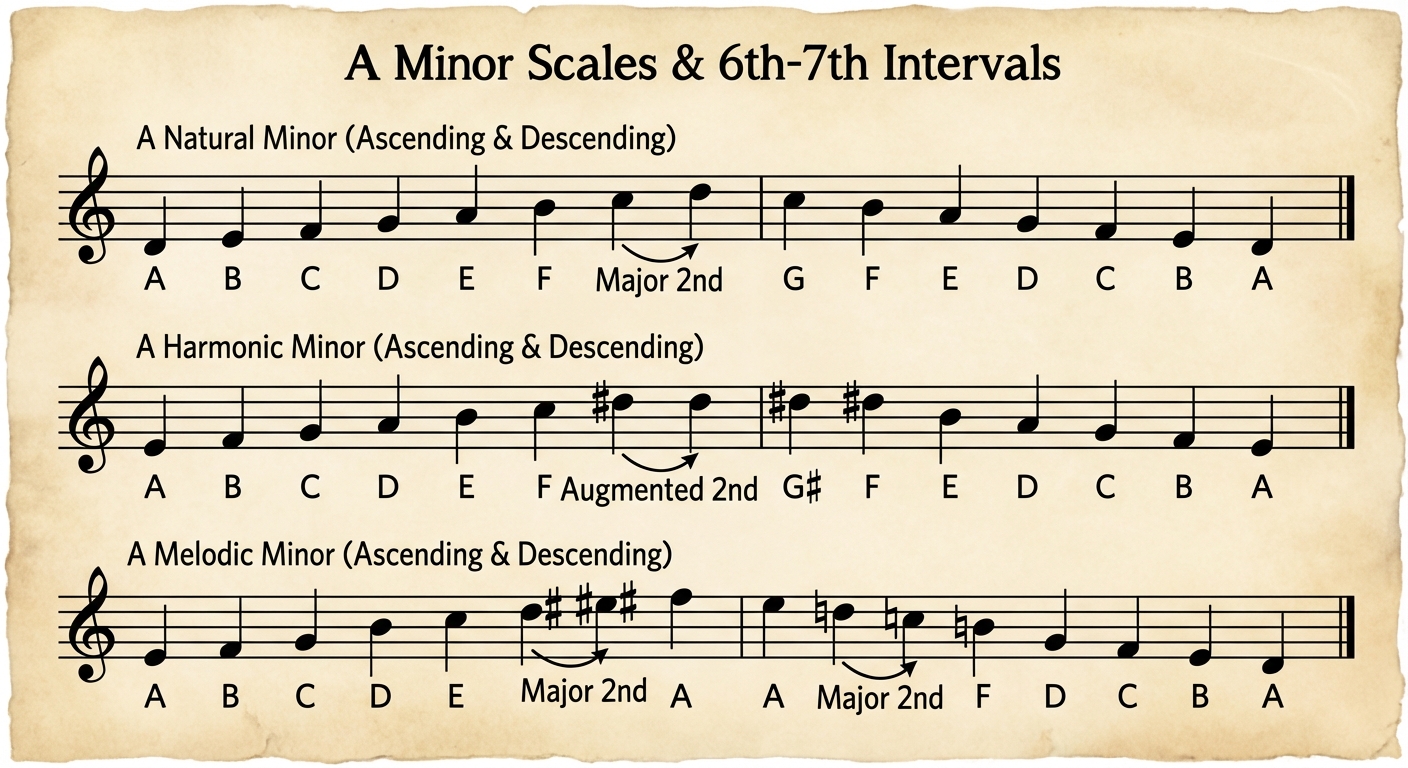
In tonal music, minor keys provide a distinct harmonic and melodic color characterized primarily by the lowered third scale degree ($ lat\hat{3}$). Unlike the Major scale, which has one standard form, the minor scale appears in three distinct variations. Understanding the relationship between these three forms is critical for both analysis and part-writing.
1. Natural Minor (Aeolian Mode)
The Natural Minor scale is the foundational form found in the key signature. It contains no altered notes outside of what is in the key signature.
- Formula: $W - H - W - W - H - W - W$
- Scale Degrees: $1, 2, \flat3, 4, 5, \flat6, \flat7, 1$
- Solfege: $Do, Re, Me, Fa, Sol, Le, Te, Do$
2. Harmonic Minor
The Harmonic Minor scale is the most frequent form used in chord progressions (harmony). In the Natural Minor scale, the interval between the 7th scale degree and the tonic is a Whole Step, creating a "Subtonic" rather than a "Leading Tone."
To create a strong pull toward the tonic (vital for the V-i cadence), the 7th scale degree is raised by a half step.
- Alteration: Raised $\hat{7}$
- Scale Degrees: $1, 2, \flat3, 4, 5, \flat6, \natural7, 1$
- Distinctive Interval: This creates an Augmented 2nd between $\flat\hat{6}$ and $\natural\hat{7}$. While harmonically useful, this interval is awkward to sing melodically.
3. Melodic Minor
The Melodic Minor scale evolved to fix the "awkward" gap (the augmented 2nd) found in the Harmonic Minor scale. It smooths out the melodic line.
- Ascending: Both the 6th and 7th scale degrees are raised. This mimics the Major scale's top tetrachord ($6-7-8$).
- Degrees: $1, 2, \flat3, 4, 5, \natural6, \natural7, 1$
- Descending: The scale reverts to the Natural Minor form (lowered 7 and lowered 6).
- Degrees: $1, \flat7, \flat6, 5, 4, \flat3, 2, 1$
Note: In AP Music Theory analysis, if you see an ascending passage with a raised 6 and 7, identify it as Melodic Minor. If you see a $V$ chord utilizing a raised leading tone, it implies Harmonic Minor usage.
Relative vs. Parallel Keys
Confusion between these two terms is a common source of error.
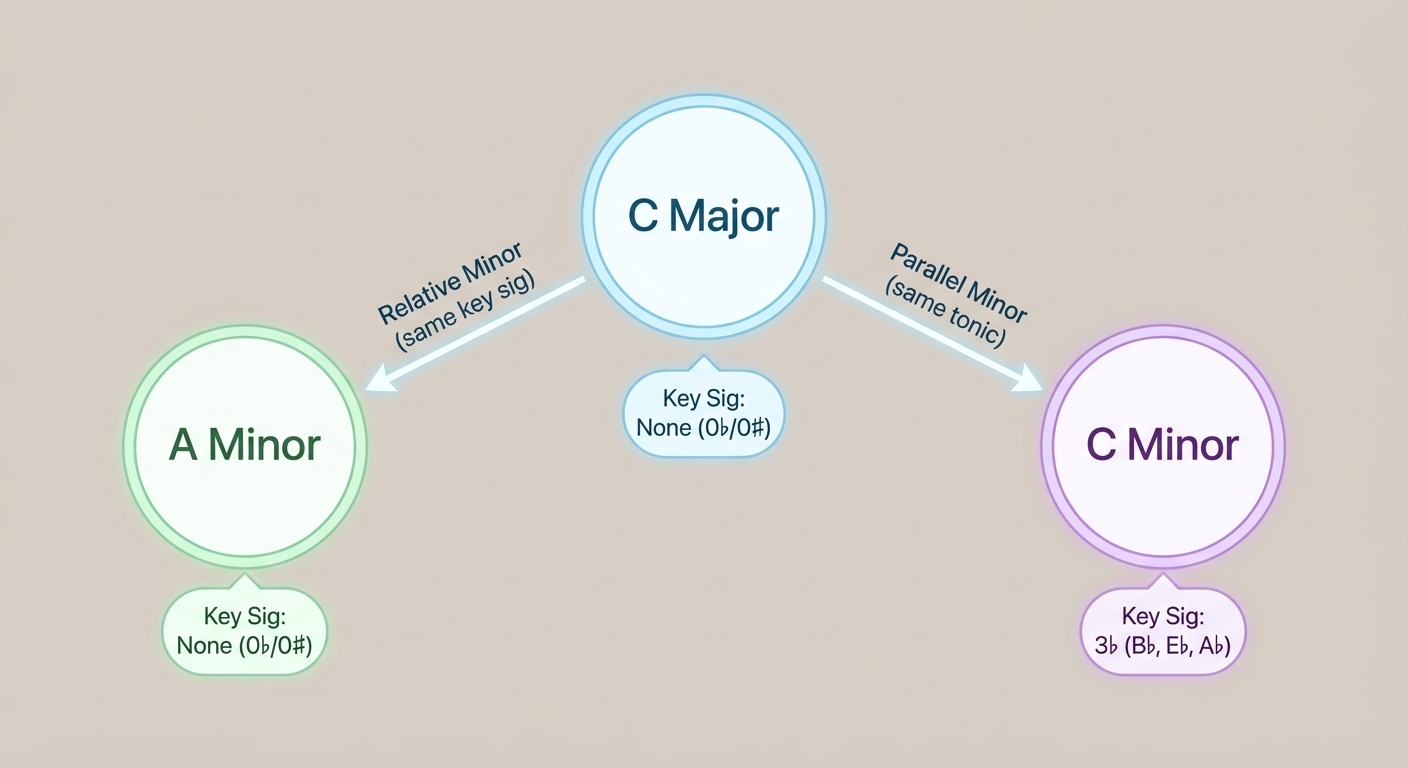
- Relative Minor: Shares the same key signature as a Major key. The relative minor tonic is a minor 3rd down (or a Major 6th up) from the Major tonic.
- Example: C Major and A Minor (0 sharps/flats).
- Parallel Minor: Shares the same tonic (starting note) as the Major key but has a different key signature.
- Example: C Major (0 sharps/flats) and C Minor (3 flats).
Minor Key Signatures
Key signatures for minor keys strictly reflect the Natural Minor scale. You will never see the raised accidental of a Harmonic or Melodic minor scale in the key signature itself; those are always written as accidentals next to the notes in the score.
Determining the Key Signature
To find the key signature for a minor key:
- Identify the Relative Major: Go up a minor 3rd from the minor tonic. (e.g., for F minor, go up a minor 3rd to A$\flat$).
- Use the Circle of Fifths: The key signature of the relative Major is the key signature of the minor key.
Summary Table
| Minor Key | Relative Major | Signature |
|---|---|---|
| A Minor | C Major | 0 |
| E Minor | G Major | 1 Sharp ($F\sharp$) |
| D Minor | F Major | 1 Flat ($B\flat$) |
| C Minor | E$\flat$ Major | 3 Flats ($B\flat, E\flat, A\flat$) |
| F$\sharp$ Minor | A Major | 3 Sharps ($F\sharp, C\sharp, G\sharp$) |
Melody and Melodic Motion
Melody is the linear presentation of pitch. In AP Music Theory, you must analyze melodies based on their motion, contour, and use of scale degrees.
Types of Melodic Motion
- Conjunct Motion: Movement by step (intervals of a 2nd). This accounts for the majority of well-written melodies as it is smooth and singable.
- Example: C $\to$ D $\to$ E.
- Disjunct Motion: Movement by skip (intervals of a 3rd) or leap (intervals of a 4th or larger).
- Rule: Large leaps (disjunct motion) are usually followed by stepwise motion in the opposite direction to balance the melodic line.
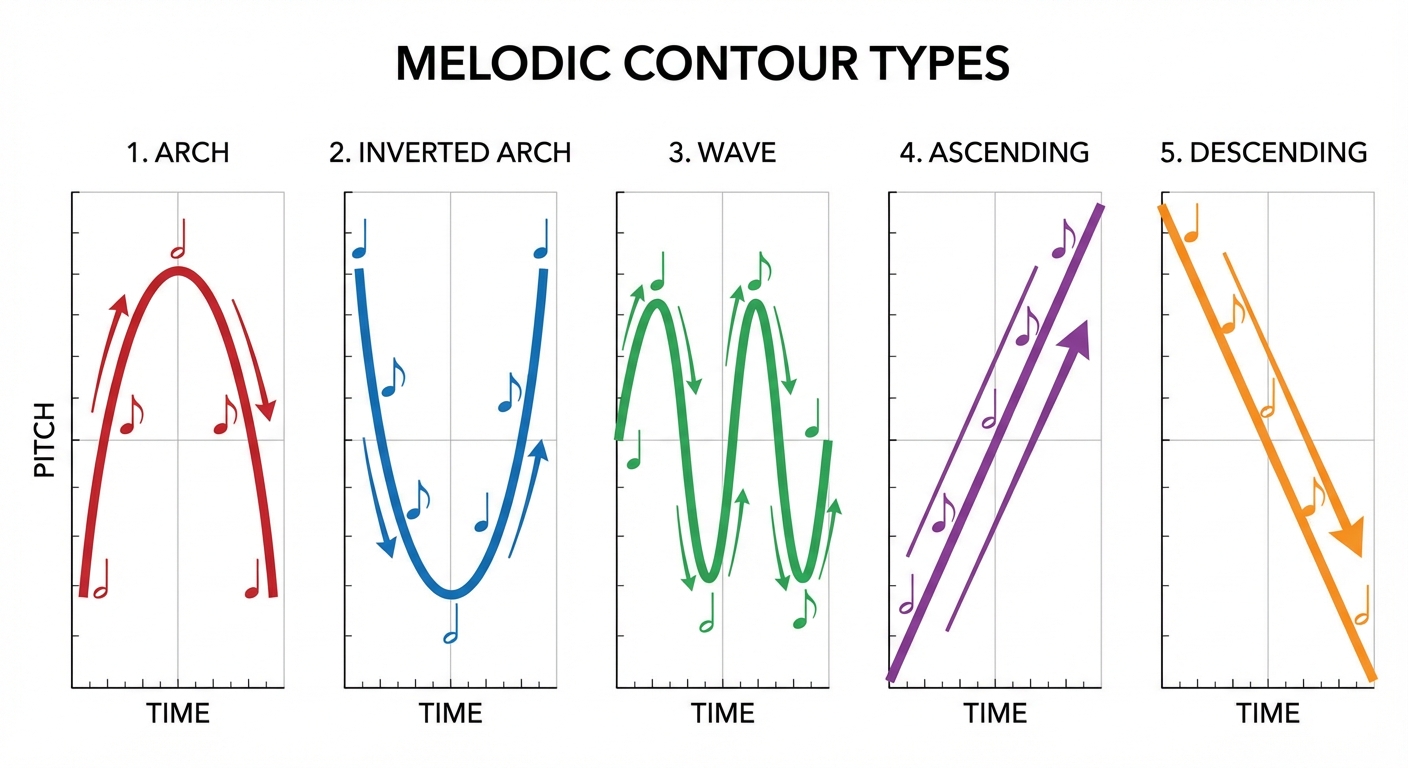
Terms for Melodic Contour
- Ascending: Moving upwards in pitch.
- Descending: Moving downwards in pitch.
- Arch: Ascending to a high point (climax) and then descending.
- Inverted Arch: Descending to a low point and then ascending.
- Static/Oblique: Repeating the same pitch.
Scale Degree Names and Tendency Tones
Every note in the scale has a name indicating its function. In minor keys, two degrees have variable names based on the scale form.
| Degree | Name | Function/Tendency |
|---|---|---|
| $\hat{1}$ | Tonic | Stable home base. |
| $\hat{2}$ | Supertonic | Predominant function. |
| $\hat{3}$ | Mediant | Defines the modality (minor third above tonic). |
| $\hat{4}$ | Subdominant | Predominant function. |
| $\hat{5}$ | Dominant | Harmonic anchor. |
| $\hat{6}$ ($\flat6$) | Submediant | Strong tendency to resolve down to $\hat{5}$. |
| $\hat{7}$ ($\flat7$) | Subtonic | Found in Natural Minor. A whole step below tonic. Used in sequences or modulation. |
| $\hat{7}$ ($\natural7$) | Leading Tone | Found in Harmonic/Melodic Minor. A half step below tonic. strongly resolves up to $\hat{1}$. |
The Importance of Tendency Tones
Melodies are driven by unstable notes seeking stable ones.
- Leading Tone ($\natural\hat{7}$): Must resolve up to Tonic ($\hat{1}$).
- Submediant ($\flat\hat{6}$): Typically resolves down to Dominant ($\hat{5}$), especially when the leading tone is present, to avoid the augmented 2nd interval.
Common Mistakes & Pitfalls
1. Misinterpreting Key Signatures
- Mistake: Seeing 3 flats and thinking it is E$\flat$ Major without checking the start/end notes or the leading tone.
- Correction: Always check if the melody centers around the relative minor tonic (C) and look for the raised leading tone ($B\natural$) which signals C Minor.
2. The "Descending Melodic Minor" Trap
- Mistake: Writing a descending scale and keeping the 6th and 7th raised (like a Major scale).
- Correction: Remember that Melodic Minor is only specific in its ascending form. Descending, it behaves exactly like Natural Minor (lowered 7 and 6).
3. Subtonic vs. Leading Tone
- Mistake: Calling the 7th scale degree a "Leading Tone" when the interval to the tonic is a whole step.
- Correction: If the distance to the tonic is a whole step (Natural Minor), it is a Subtonic. It is only a Leading Tone if it is a half step below the tonic (Harmonic/Melodic Minor).
4. Writing Accidentals in the Key Signature
- Mistake: Trying to write the sharp for the harmonic minor's leading tone inside the box at the start of the staff.
- Correction: Key signatures only represent the diatonic (natural) notes. Harmonic alterations are always clearly marked accidentals within the bars of music.