Analytical Applications of Differentiation: Existence Theorems and Optimal Values
The Mean Value Theorem (MVT)
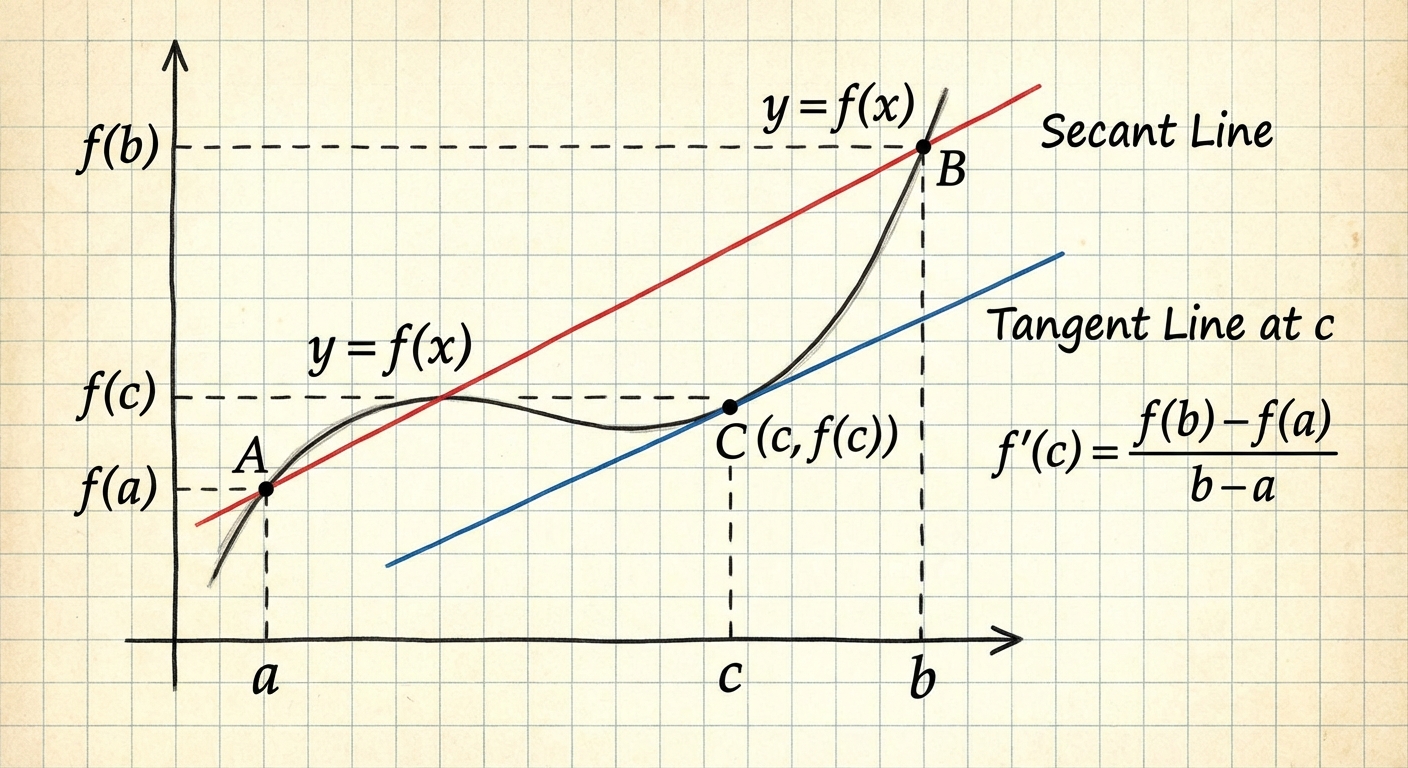
The Mean Value Theorem is one of the most critical "existence theorems" in AP Calculus. It connects the average rate of change over an interval to the instantaneous rate of change at a specific point within that interval.
Conditions for MVT
For the Mean Value Theorem to apply to a function $f(x)$ on an interval $[a, b]$, two specific conditions must be met:
- $f(x)$ must be continuous on the closed interval $[a, b]$.
- $f(x)$ must be differentiable on the open interval $(a, b)$.
The Theorem Stated
If the conditions above are met, then there exists at least one number $c$ in $(a, b)$ such that:
In plain English: At some point $c$ between $a$ and $b$, the instantaneous slope (derivative) equals the average slope (secant line slope) over the interval.
Special Case: Rolle's Theorem
Rolle's Theorem is a specific instance of the MVT. If the conditions for MVT are met, AND $f(a) = f(b)$, then there must be at least one value $c$ in $(a, b)$ such that:
Meaning: If the function starts and ends at the same height, it must turn around (have a horizontal tangent) somewhere in between.
Example: Applying MVT
Problem: Function $f(x) = x^3 - x$ on the interval $[0, 2]$. Find the value(s) of $c$ guaranteed by MVT.
Solution:
- Check Conditions: $f(x)$ is a polynomial, so it is continuous and differentiable everywhere.
- Find Average Rate of Change (ARC):
- Set Derivative equal to ARC:
- Solve for $c$:
- Check Interval: Only $c = \frac{2}{\sqrt{3}}$ is inside $(0, 2)$.
The Extreme Value Theorem (EVT)
The Extreme Value Theorem guarantees the existence of maximum and minimum values, but it does not tell you how to find them—it simply assures you they exist.
The Theorem Stated
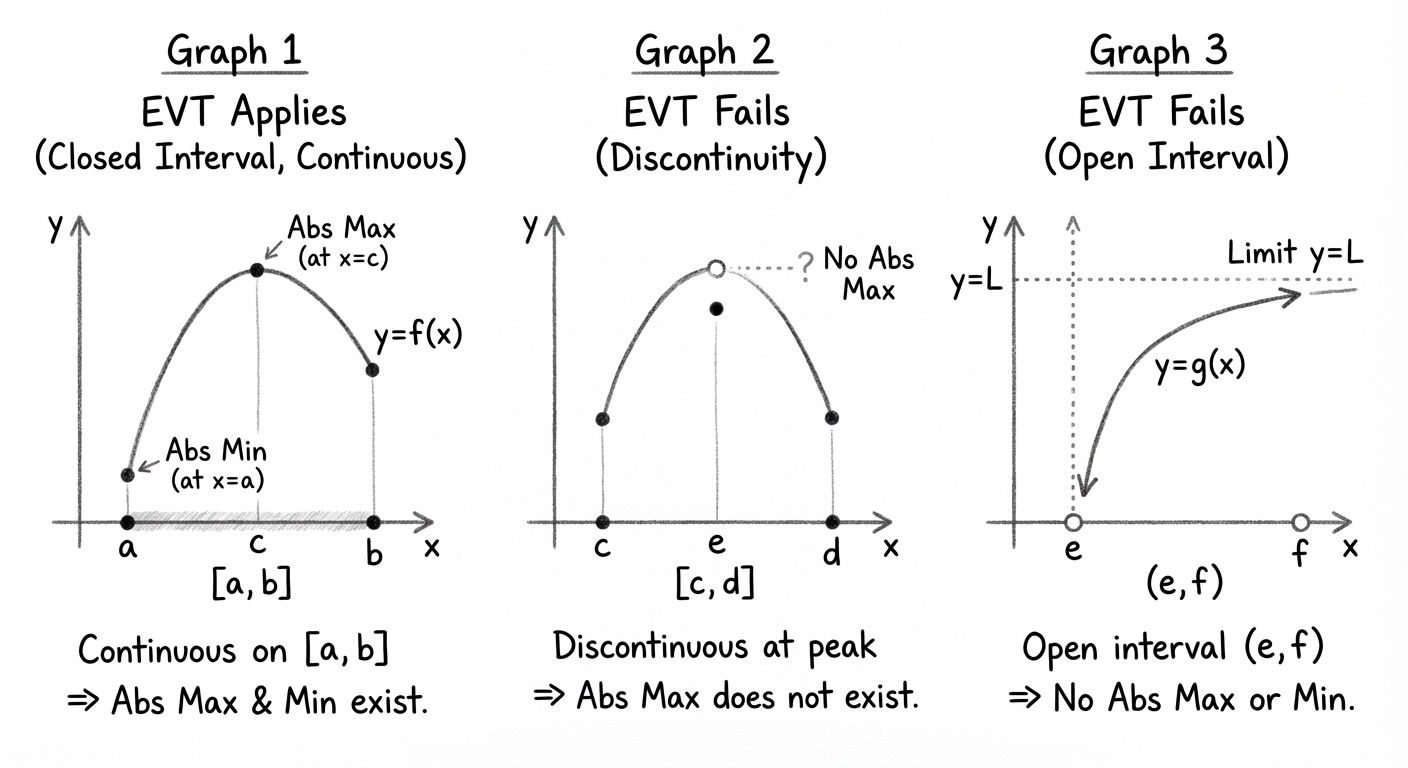
If $f(x)$ is continuous on a closed interval $[a, b]$, then $f(x)$ attains both an absolute maximum value and an absolute minimum value on that interval.
Key Nuances
- Continuity is mandatory: If there is a hole or asymptote, a max or min might not exist.
- Closed Interval is mandatory: On an open interval like $(0, 1)$, a function like $y=x$ has no absolute max (gets infinitely close to 1) and no absolute min (gets infinitely close to 0).
Finding Absolute and Relative Extrema
To find extrema mathematically, we must examine specific points of interest on the graph.
Types of Extrema
- Absolute (Global) Extrema: The highest or lowest $y$-value on the entire domain or specified interval.
- Relative (Local) Extrema: A "hill" (local max) or a "valley" (local min). It is the highest or lowest point in its immediate neighborhood.
Critical Points
A Critical Point is a value $x = c$ in the domain of $f$ where:
- $f'(c) = 0$ (Horizontal tangent)
- $f'(c)$ is undefined (Sharp turn/cusp or vertical tangent)
Important: Relative extrema only occur at critical points. However, not every critical point is an extremum (e.g., $f(x)=x^3$ at $x=0$).
Candidates Test for Absolute Extrema
When asked to find the Absolute Extrema on a closed interval $[a, b]$, you must use the Candidates Test (also known as the Closed Interval Method). This is a standard procedure on the AP Exam.
The Strategy
Because of the EVT, the absolute max/min MUST occur at either a critical point or an endpoint.
Step-by-Step Procedure
- Differentiate $f(x)$ to find $f'(x)$.
- Find Critical Points: Solve $f'(x) = 0$ and find where $f'(x)$ is undefined. Keep only those critical points inside the interval $(a, b)$.
- Evaluate: Calculate the function value $f(x)$ (the original function, not the derivative!) at:
- All valid critical points.
- The endpoint $a$.
- The endpoint $b$.
- Compare: The largest $y$-value is the Absolute Maximum; the smallest is the Absolute Minimum.
Worked Example: Candidates Test
Problem: Find the absolute extrema of $f(x) = 2x^3 - 3x^2 - 12x + 1$ on $[-2, 3]$.
1. Differentiate:
2. Find Critical Points:
Set $f'(x) = 0$:
$x = 2$ and $x = -1$.
Both are inside $[-2, 3]$.
3. Evaluate Candidates in a Table:
| Candidate Type | $x$ | $f(x) = 2x^3 - 3x^2 - 12x + 1$ |
|---|---|---|
| Endpoint | $-2$ | $2(-8) - 3(4) - 12(-2) + 1 = -3$ |
| Crit Point | $-1$ | $2(-1) - 3(1) - 12(-1) + 1 = 8$ |
| Crit Point | $2$ | $2(8) - 3(4) - 12(2) + 1 = -19$ |
| Endpoint | $3$ | $2(27) - 3(9) - 12(3) + 1 = -8$ |
4. Conclusion:
- Absolute Maximum: $8$ at $x = -1$
- Absolute Minimum: $-19$ at $x = 2$
Common Mistakes & Pitfalls
Forgetting to Check Endpoints (EVT):
- The Trap: Students find the critical points, identify the relative max/min, and assume one of them is the absolute max/min.
- The Fix: Always construct the table including $a$ and $b$ when the interval is closed.
MVT Conditions:
- The Trap: Applying MVT to a function that has a cusp (like $|x|$) or asymptote within the interval.
- The Fix: Explicitly write "Since $f$ is continuous on $[a,b]$ and differentiable on $(a,b)$…" to justify your use of the theorem.
Mixing up Value vs. Location:
- The Trap: Being asked for the "absolute maximum value" and providing the $x$-coordinate.
- The Fix: The "value" is $y$. The "location" is $x$. If asked for the maximum, give the $y$-value.
Ignoring Undefined Derivatives:
- The Trap: Only solving $f'(x)=0$ and forgetting points where the derivative doesn't exist (like the tip of a 'V' shape). These are also critical points and can be extrema.